‘We’re Not A Plant-Based Company:’ Meati CEO Talks Breakfast, Distribution and Being Practical About Alt-Proteins


Meati has been on a winding, hazardous decade-long road to defining its place in the market. (Remember, at one point the company was known as Emergy Foods). But in moving beyond its original “mushroom root” positioning, the brand may have finally found itself.
After a year on the job, CEO Phil Graves, who arrived at Meati after the business conducted multiple rounds of layoffs and later brought in a handful of new hires, now believes the food tech outfit is primed to usher in a new phase of growth with its hero mycelium ingredient as the face of the brand.
“People have eaten mycelium for thousands of years without realizing it,” Graves emphasized. “It’s part of manufacturing, baking, blue cheese, tempeh. We just have to showcase that this isn’t a traditional ‘plant-based alternative’ – it’s something that’s entirely new. It’s revolutionary, and it’s been under our feet the whole time.”
Beefing Up In Breakfast
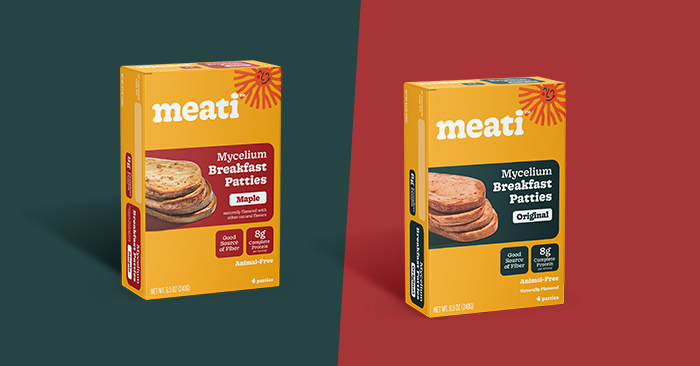
The company is extending into a new day-part as it works to fill whitespace left by the first wave of plant-based meat products sold at grocery stores. On Thursday, Meati debuted Breakfast Patties in Original and Maple varieties at Sprouts Farmers Market locations nationwide, where they will retail for $9.99 per 4-count box; additional retail partnerships are expected in May.
The product contains 8 grams of protein, 4 grams of fiber and no saturated fat or cholesterol per serving. It is made of 98% mycelium and is free of the top nine allergens. But in Graves’ view, the biggest point of differentiation comes from its ingredient list, where it boasts 64% fewer inputs than conventional products from top players like Jimmy Dean and nearly 20 fewer ingredients than plant-based versions from category leaders like Impossible Foods and Beyond Meat.
“I ate a fair amount of [Jimmy Dean sausages] growing up in Texas, and I still have fond memories of doing so,” Graves said. “But if you look at how we stack up… it’s absolutely crushing Impossible [Foods], Beyond [Meat] and Jimmy Dean… For example, in our maple [SKU] – the syrups from Vermont. It’s not from a flavor lab in New Jersey. We want to have things be real and simple and complement our mycelium.”
Mycelium In The Market
In addition to its portfolio growth, the company has also added about 500 doors between Harris Teeter stores across North Carolina and Raley’s locations in California and Nevada this month. According to Graves, Meati has grown its distribution footprint 130% between 2023 and 2024, and reached over 100 retail banners nationwide since entering retail in 2023. Its products span regional and independent retailers up through national players like Whole Foods, Kroger and Target.
“There’s no major market in the country that we’re not in, and we’re in a lot of the minor markets as well,” Graves said.
The company, which last raised $100 million to grow its conventional retail footprint via Kroger, has brought in nearly $365 million in funding in its decade in operation. That debt is miniscule compared to the over $2 billion raised by Impossible Foods and $1 billion in debt currently on publicly-traded Beyond Meat’s books.
The company is set to achieve a positive gross margin by the end of the year and has doubled revenue between 2023 and 2024, according to Graves. As it looks to continue growing its retail footprint, Graves said Meati will focus on honing the brand, driving trial and educating consumers about mycelium; for the latter effort, it is primarily relying on its back-of-box copy to do the heavy lifting.
Strategic new hires are also key to that growth equation. In the past year Meati has enhanced its executive team with the addition of former a2 Milk, Clover Sonoma and PepsiCo executive John Bortells as chief commercial officer. The company has also added former a2 Milk Company head of sales Luis Connor as its VP of sales, former Lillie’s Q foodservice director Chris Tom as its director of foodservice and marketing executive Dawn Jacobs as VP of marketing.
At this point, foodservice only accounts for a small fraction of Meati’s revenue, but with Tom on board, Graves said the company is beginning to prioritize growth in the channel, pointing to its role in driving consumer awareness and trial. He said Meati currently has “multiple irons in the fire” with accounts that align with its mission.
Being Practical About Plants
Graves acknowledged that while “plant-based 1.0” may have opened up the conversation around the relationship between the environment and our food supply, the “ultraprocessed frankenfood” products that came out of it, and the associated “bold claims” about upending the food system, were premature and misguided.
“Plant based 1.0 is failing for good reason,” Graves said. “A lot of it is that divisive mindset. People have been eating animals for thousands of years. No shade on people who choose not to – my daughter’s a vegetarian – but you can’t change culture, and food is culture, at least not in four or five years.”
Instead, he sees a future where animal products and alternative protein innovations work in unison together. Hailing from meat company Wild Idea Buffalo Company, and Patagonia before that, where he helped build its regenerative-focused food business, Graves highlighted his belief that regenerative organic animal protein will be a key part to achieving the climate related mission of the broader alternative protein industry.
“We need to raise the bar with traditional proteins,” Graves said. “We need to put our shoulder into it and push feedlots out of existence. In 20 years, if those are gone, we should all celebrate and then, along in doing so, we need to underscore that we’re not a plant-based company, because there was a boom and bust in plant-based.”
According to Graves, mycelium is actually closer genetically to an animal than a plant, citing this as a motivating force behind the choice of the brand’s name. Meati is working to differentiate itself from plant-based companies, but also to move away from its original position as a mushroom root product.
In July, consumers took aim at the claim, alleging the product was falsely advertised as being derived from mushrooms in a class action lawsuit; Meati’s mycelium strain of choice, Neurospora Crassa, is a type of mold that commonly grows carbohydrate-rich foods like bread.
Graves said the product’s positioning had been the subject of an ongoing, and at times “spirited” discussion within the company’s boardroom since he took the helm in February. As the company looks toward future growth, he emphasized that a focus on consumer education around mycelium will be a top priority.
“We need to educate and to showcase that we’re not Impossible 2.0 or Beyond 3.0, we’re not just another run-of-the-mill pea protein company… Those are failing consumers’ expectations for human and environmental health, and the sustainability scorecard doesn’t even measure up.”