Building brand awareness while working to grow a startup is a delicate balancing act, especially in CPG where barriers to entry – such as opening a Shopify site – are fairly low, but operational costs add up fast. That dynamic has pushed many early-stage brands to look beyond their own audience, seeking out collaborations with other companies as well as content creators to accelerate awareness in a way as they work to build beyond their own niches.
We recently sat down with Kendall Dickieson, a social marketing strategist who supported brands such as Graza, Laoban, Olipop and more through their early stages via her firm Flexible Creative. Dickieson broke down the key elements that contribute to an effective collaboration, where to start and what it takes to make each post and product a success.
Balance When Building Social-First
When it comes to collaborations there’s plenty of different levers to pull: from social content partnerships with influencers, pop-up events, co-branded product launches and more.
Knowing when, how and where to direct that energy can be complex. According to Dickieson, if you don’t know where to start, turn to social media first. Whether that is simply regular posts on your brand pages, or actively building an army of microinfluencers and authentic fans, online engagement is the first step to give a brand a solid foundation for effective, intentional collaboration.
Targeted sampling with curated groups of brand-aligned influencers can also accelerate the expansion of that initial community. Dickieson emphasized that consistency is key – during the early days of Graza, sample drops and outreach were executed on a regular basis – and brand operators should fight the urge to try to control the narrative for these groups. In other words, don’t include talking points alongside your snack packs; rather let the product speak for itself and use the feedback to continue testing and iterating.
According to Dickieson, any brand building with a social and collaborative focus should also ensure it has the capacity to sell online. Particularly in the early stages – when it may build up a broad audience via social media, but doesn’t yet have the capabilities for national retail distribution – making sure fans can experience the product is essential.
Tips From Good Culture To Graza
These tactics aren’t just for brands at launch. Influencer collaborations can be impactful at any stage and bring added value when campaigns are timed to align with a new product rollout or retail launch. Though Dickieson emphasized it is nearly impossible to measure the direct impact on sales of any content collaboration, preparing and aligning activations ahead of an expansion can bring an added ROI.
“It’s always going to be a brand awareness focus, but if you can track the dollars on [a content collaboration], then that’s a bonus. Most people just don’t want to hear that answer,” she said.
Dickieson said her early approach to building up interest for the concept of olive oil in a squeeze bottle via Graza leaned heavily into accounts that typically would not use olive oil in the first place – like restaurants serving Mexican and Asian cuisines – “How can we convert those people?” Dickieson said. That wide-ranging base has allowed the brand to effectively reach into new areas and accumulate a more expansive audience via co-branded drops with companies like Ithaca Hummus and Firehook Crackers, among others.
Depending on what the product is, content partnerships such as recipe collaborations can be extremely effective. Just look at the growth of Good Culture, which, after seeding and leaning into a handful of cottage cheese-based recipes in partnership with food influencers, experienced 80% dollar sales growth in 2024, propelling it to be the fastest growing cottage cheese brand across all tracked channels. While it outpaced the category’s growth sixfold, it also helped buoy the once-stale set, leading to a 19% year-over-year category sales boost by June 2024, per SPINS.
Once people are talking about a brand, then it could be time to start thinking about reaching beyond your base to grow awareness, Dickieson said. However, she cautioned against diving into product collaborations too soon, and emphasized the importance of testing and teasing concepts or a community crossover on social media before committing to a production run.
“I feel like most [brands] jump on [product collaborations] too fast,” she said. “I would say once you’re around for a year or so [it’s time], with the consideration that people ideally know [your brand] and are talking about it.”
Flavors In Focus
Global flavors are all the rage, and some of the brands that have had the most success commercializing their concepts have stuck close to their core while collaborating with others to build beyond their base. Sound familiar? Think about the growth of brands such as Fly By Jing, Van Leeuwen, Graza and Tajin in recent years.
“Everyone wants community crossover and they know it’s harder to get if you’re doing it on your own,” Dickieson said. “If you don’t have the budget to pay influencers, to do recipes or whatever [the content may be], then it’s way cheaper to go brand-to-brand because that [other] brand might have someone in house who can film something, etc., and then you save money.”
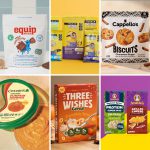
The brands named above have done just that. Both Graza and Fly By Jing have used their hero ingredients to bring new flavor profiles to artisan cracker brand Firehook, owned by PE firm Forward Consumer Partners. They’ve also leaned on startup hummus makers, including Graza’s aforementioned Ithaca collaboration and Fly By Jing’s co-branded SKU with Little Sesame.
Fly By Jing has notably gone deeper on this approach, infusing its infamous Sichuan Chili Crisp flavor into products across the grocery store including Fishwife’s tinned Smoked Salmon, Daily Crunch’s Sprouted Cashews and Lundberg Family Farms’ ready-to-heat rice packs.
These co-branded products gave Fly By Jing the opportunity to capture consumers outside of the condiment set and offer a lower-stakes path to entry. Rather than purchase a $10 jar of chili crisp, a shopper can sample the spice in a favorite snack or meal.
Per a recent Mintel report, co-branding can be an effective purchase driver, particularly in the ice cream and snack aisles. The number of U.S. adults that would be interested in buying more frozen treats if they are co-branded increased from 32% in 2022 to 34% in 2023; 35% said they are more likely to try a snack featuring flavors from other foods.
Building Beyond F&B
While co-branded products can be impactful to drive trial, they can also be a lever to simply merge the fanbases of two like-minded, early-stage brands.
Graza and A2 ice cream maker Alec’s pooled resources and ingredients to embrace the Dubai chocolate trend with the launch of a pistachio and olive oil ice cream at the start of the summer season.
According to Dickieson, an olive oil and ice cream collab has long been in the works for Graza, which began testing and tracking consumer interest toward the combination on Graza’s social media pages more than a year ago. She emphasized that subtle social media tactics like posting a recipe via pictures or reels can ensure that investing in a full production run for a co-branded product is actually worth the time, effort and capital.
“It’s more like vibe checking,” Dickieson said. “If there’s no data to prove it, or you don’t have an active audience within that segment – I wouldn’t invest in it. Most [brands] fail to test the other waters of what [a collaboration] could be before it’s a product.”
For Graza, the broad-reaching use occasions for olive oil soon have become its key to co-branding. Dickieson emphasized that a company needs to have solid brand equity within its own space to make collaborations work elsewhere and explained that because of the versatility of Graza’s product, and its cult-like audience, that equity began organically pulling the brand into new sectors including the beauty space, home essentials, pet and other niches of CPG.
Earlier this summer, Magnolia Bakery took its iconic banana pudding product into a non-edible category through a co-branded lip balm with Glossier, the startup beauty brand that has a cult-like following itself.
While Dickieson laughed when asked about tracking the ROI of any collaboration, it seems the common denominator, and return, is that these brands are able to accelerate their own growth by building an audience outside of their standard circles.