A Bite With… Fishwife Head of Sales Pierre Jamet

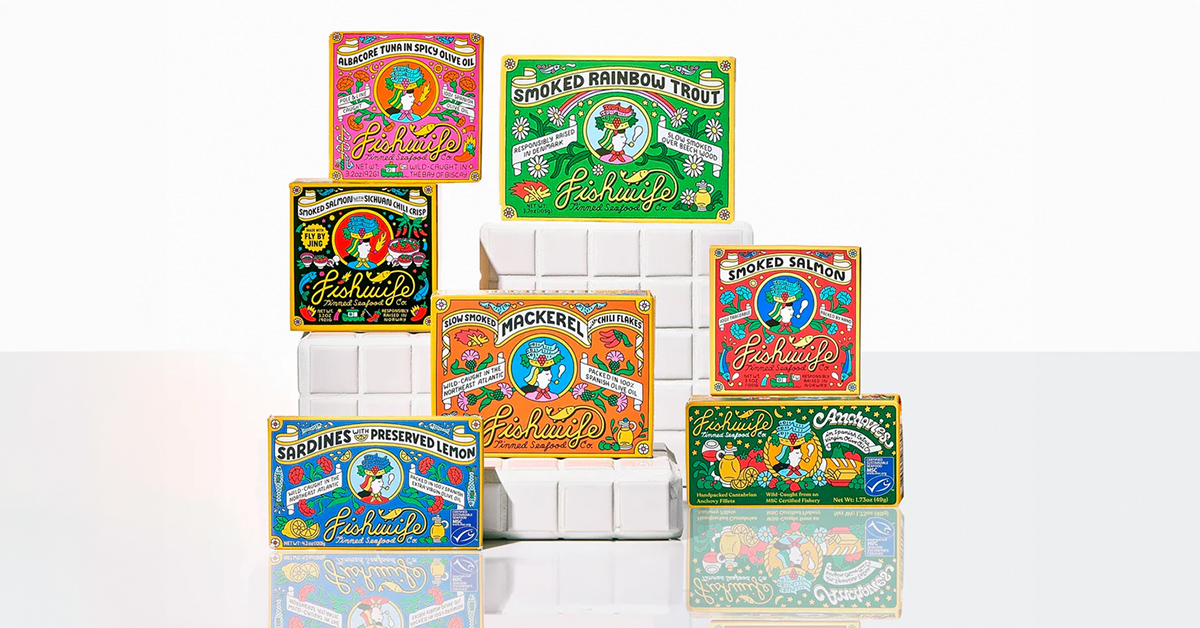
It’s no easy task fishing for consumers in a stagnant category. Tinned seafood brand Fishwife added to that challenge by positioning itself as an ultra-premium product amid a sea of conventional legacy brands.
Launched in December 2020, Fishwife brought a fresh face to the category complete with colorful packaging and a robust social strategy. The brand has found success collaborating with brands like Fly By Jing, Tabasco, Jacobsen Sea Salt and Tsar Nicoulai on innovative products and, in the process, leveraged its influencer portfolio to drive enthusiasm within the category.
Beginning as a consultant for Fishwife in 2022, Pierre Jamet took on the head of sales role in late 2023. Before joining the team full-time, Jamet led sales at Petit Pot and was the director of growth and category management at Coolhaus.
Jamet has helped shape Fishwife’s sales strategy during a big year for the brand. In 2024, Fishwife (along with winning a Nosh Best Of award) made it to over 4,500 retail doors, appeared on “Shark Tank,” hosted a viral pop-up in New York and prepared to launch a cookbook that is set to release in February.
Jamet talked with Nosh about how he has helped the brand keep its early momentum, why saying “no” to some retailers is necessary and the role collaborations play in keeping consumers coming back.
What has been one of the key guiding principles to building a successful sales strategy around a tinned fish brand?
The category of canned seafood was very “brand-less” until Fishwife came to the scene in late 2020. I think COVID was somewhat of a blessing for Fishwife because B2C (or direct-to-consumer) was the only way to launch then and there was a desire to buy online. We focused on B2C in the first few years, and we created an amazing community of super-fans, influencers and celebrities. Before hitting retail shelves, we were able to create a lot of demand, which eventually drove people to stores.
It can be easy to get lost on the shelf in a center-store category like canned seafood. How have you approached building brand awareness on-shelf?
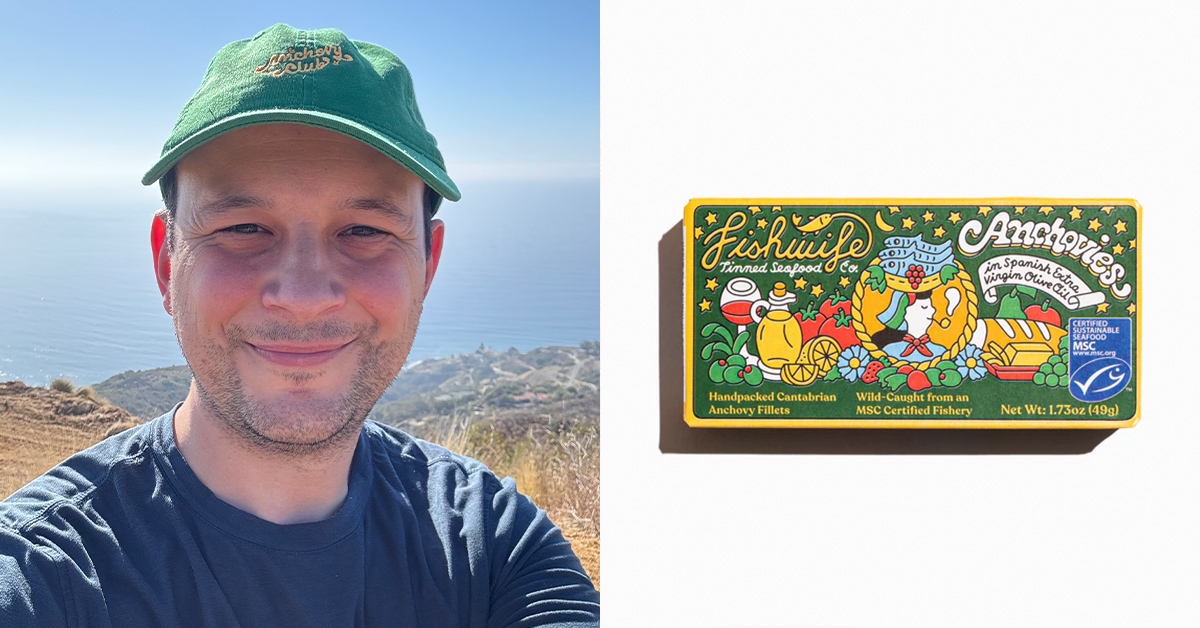
All of the credit goes to our founder and CEO Becca Millstein for having the vision and finding an incredible designer, Danny Miller. [Becca] pictured a brand that would work online and in brick-and-mortar retail through illustrations, colors and fonts that told a story of a premium taste and product. If we did not have amazing packaging, we would not be successful in retail.
The canned seafood category is often merchandised by species and it is usually only a 4-foot set. The consequence for a brand like Fishwife — which usually only has one or two items per species — is often a diaspora of tins that can be hard to find. Even though we always push for it, brand blocking is rare so at the very least we try to build adjacencies among species to create “mini” brand blocks like we have in Whole Foods.
Has your approach to building a distribution network at Fishwife differed from your time at Coolhaus and Petit Pot? Any similarities?
Both Coolhaus and Petit Pot had solid bases before I joined those respective companies, but neither of them had strong online B2C sales and direct B2B sales like Fishwife; which is totally normal for frozen and refrigerated brands, respectively.
At Coolhaus, there was a focus on brand building and partnerships primarily via the ice cream trucks and its brick-and-mortar shop in Culver City. Those were our innovation centers and marketing powerhouses. The brand led with design and creativity, national appearances on Food Network, celebrity endorsements and the early days of influencer culture.
Like at Petit Pot, I am focused at Fishwife on establishing proof of concepts across channels and key retailers from Whole Foods in the natural channel to Wegmans, Kroger or Target [in conventional and mass]. It’s a work in progress!
How do you decide to move into a new market or region? How do you decide if a retailer will be a good fit for the brand?
I take a lot from my previous experiences with Coolhaus and Petit Pot. I weigh questions like: Which premium brands and super-premium brands are carried in the set and adjacent sets? What items are guests shopping for and putting in their carts? I call this the “bench test.” Do I foresee them purchasing Fishwife or not? What are the costs associated with distribution and promotion? Can we afford it?
I believe that timing is everything in CPG. I have only gotten two “nos” in my time with Fishwife, but I have said “no” many times to retailers where it felt too early. Retailers are always looking for innovation and disruptive brands, but after six months, if our velocity is not there, we will be discontinued. They will not remember that we checked a lot of boxes like being woman-owned, having cool packaging, or incremental products and flavors.
Fishwife is also sold in many experiential accounts like specialty “shoppy shops,” cafes, bakeries or gift shops. All of these accounts are particularly influential and cater to a very curious, less price-sensitive audience.
How do you consult retailers on pricing in a way that maintains Fishwife’s premium positioning while making it approachable to a consumer base who might not be familiar with the brand?
Before joining Fishwife, I thought this would be the main pushback, but honestly that has not been the case. [Buyers] understand that we are building a brand at a super-premium price point. It’s similar to how Wild Planet established a premium price point amid a sea of private label, Starkist, Chicken of the Sea and Bumble Bee canned seafood. [Wild Planet] paved the way for a brand like Fishwife to have the pricing that we have.
We always strive to be a great partner, but we do negotiate placement fees to help with velocity. Discounted promotions work, but, beyond that, we want to drive trial and education via off-shelf promotions to get in front of the shoppers. We have built an incredible sampling program of 15 brand ambassadors throughout the country, and we execute in-store demos with great results. We also leverage our fanbase and subscribers via social media and newsletters.
Explain how the sales and marketing teams work together on projects like the pop-up to build value and brand awareness.
The team all bought into the idea of creating a pop-up at the beginning of the year, and we were thrilled to have the opportunity to see it come to life. When we got all of these rare opportunities — a national TV spot, a significant, multichannel partnership with a brand sponsor, and an exciting educational tool in the form of a cookbook, we asked ourselves – how do we maximize these to their fullest extent to explode brand impressions?
With the support from Klaviyo, we were able to push ourselves and make the pop-up as big, beautiful and impactful as possible. The brand and influencer collaborations were created to make a special time each day to visit the pop-up and added to more traffic.
The success of the Fly By Jing collaboration showed that innovation is an important driver for success. How do you decide whom to collaborate or co-brand with and how do you decide which SKUs to bring into stores?
Our director of operations Jack [Henry Delano] has built a very thorough process when it comes to innovation. We have strict guidelines on sustainability, taste, unit economics and incrementality. We iterate from there and do not launch if we don’t feel absolutely comfortable that the item will succeed with limited resources.
We share our innovation pipeline with retailers, in particular Whole Foods, and keep them aware of our progress. That way, we have great launch partners that are already invested. It is also an opportunity to make sure that they see a need for these new items.
The collaboration with Fly By Jing is very special. It came about because Becca and Jing [Gao] were friends and shared an office space in the very early days of Fishwife. One day, they experimented with adding the Fly By Jing Sichuan Chili Crisp to our Smoked Salmon. In March, we will celebrate the fourth anniversary of this item. It is our number-one seller nationally across channels. We are very selective of our brand collaborations, and we really want to make sure they are intentional and serve a purpose. Growing awareness and penetrating new households are paramount.