Lexington Bakes Raises $1M To Scale ‘Like A Media Company’

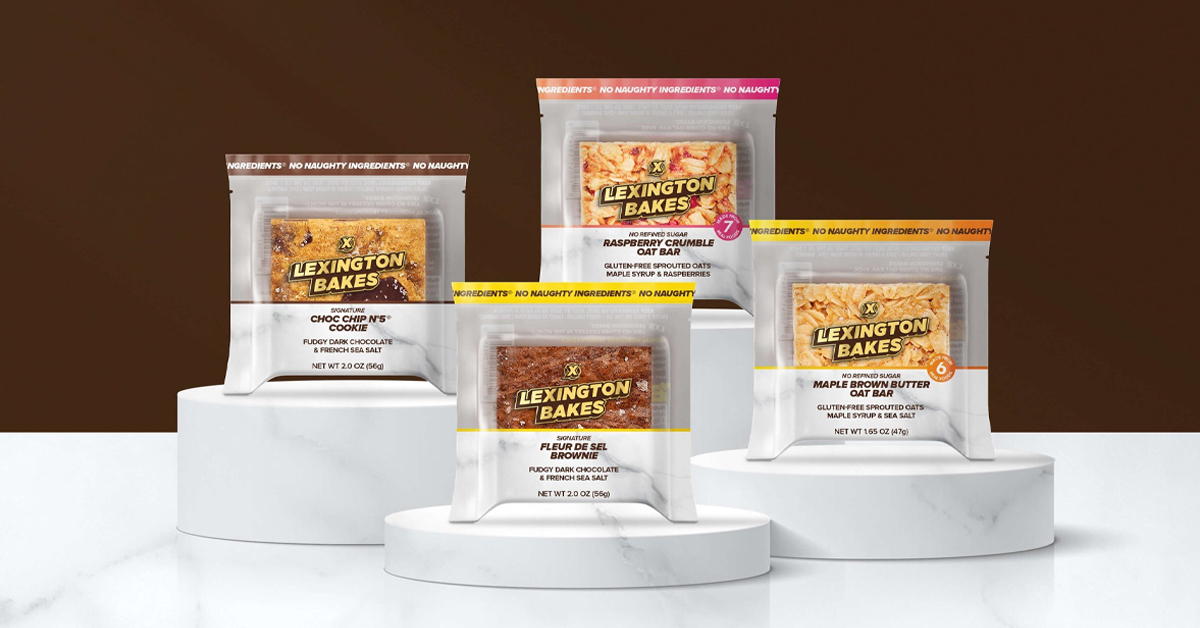
California-based Lexington Bakes has raised $1 million in a funding round led by VC firm Rainfall Ventures. The new cash will support the business as it scales up with a new co-packing partner, pipeline of retail launches and growing team that has been strategically built via agencies, contractors and fractional help.
“What I’m most excited about is being able to say yes to more opportunities,” founder, CEO and chef Lex Evan told Nosh. “What I’m most stressed about is saying yes to more opportunities, but that’s the trajectory.”
Aligning with Rainfall has provided the brand with strategic support as well, Evan said. He said that one of his investors has become “acting CMO” and meets with him on a monthly basis to pressure test ideas and marketing approaches as he works to build Lexington Bakes as a content or media company that “just happens to have products… I feel like that’s the future of any brand – so much of marketing has become social media.”
The luxury baked goods brand marks Rainfall’s second packaged food investment, Evan said; the firm previously allocated cash to fellow Los Angeles-based brand The Real Cereal Company, however, it has also made a handful of investments in food tech companies including alt-protein business Simulate, parent company of NUGGS.
“Tom [Binder], who’s the founder of Real Cereal, introduced me to Ron [Rofe], the [general partner] of Rainfall, when I announced I was fundraising a couple of months ago,” Evan explained. “They happen to be [based] in West Hollywood, which is where I live. So we got coffee a couple times and talked about the vision for the brand. Ultimately, he [said], ‘we love the brand, but we’re investing in you.”
Studying, Strategizing and Social Media Success
Evan worked as a brand designer and strategist at Johnson & Johnson in the 10 years prior to jumping full-time into the bakery business. He emphasized that he has “studied people for 20 years,” and those learnings stuck out to Rofe as he assessed Evan’s approach to building his business, including his strategy toward hiring.
“A million dollars seems like a lot, but in the world of CPG, it’s not,” Evan said. “[Rainfall said] ‘We know that you can do so much more with that than a lot of other founders because you don’t have to go out and hire someone for every function.’”
Now with a check in hand, Evan has onboarded a part-time designer to help handle some of his own workload, in addition to two agencies – one to manage email marketing and 203 Media, a guerilla-style marketing agency that will produce on-the-street interviews for the brand’s social media pages. Lexington Bakes’ first hire, however, was a community marketing manager.
“We are building a community to market this brand, and that’s what it is,” he said about his thinking behind the role. “It’s not just influencers. It’s not just creators. We can invite our fans to be a part of this, too. [The community marketing manager] is someone to manage all of those marketing efforts under one umbrella.”
But one key function will remain in house: social media. Evan said he “hired and fired an agency within a week” after having extensive conversations about his idea and vision for content, but was quickly delivered lackluster results.
“I’ve realized that I need to just own that myself and hire people to execute my ideas,” he said. “I have endless lists of skits and series ideas to do, which leads me to the YouTube show that I’m starting to develop…. ultimately I want that YouTube show to go to Netflix in a couple years…. no one else is thinking about the brand funnel to Netflix, [but] I’m building that pipeline.”
Evan said in the meantime, social media marketing efforts are primarily rooted in engaging between 25 to 50 influencers or creators around a specific goal each month. For Pride month in June, it gifted its Cocoa Crunch Bar collaboration with So Gay to 50 influencers and collectively reached a potential audience of 50 million people, he said; “It was a really powerful group.”
As the brand gears up for a rollout to Chicago-area Mariano’s stores this month, Evan has another activation with local creators already underway, aimed at creating content that will build awareness for the brand as it rolls out in the region.
Those efforts will put Lexington Bakes in a strong position as it continues to test, learn and expand its reach. The brand is currently sold in 100 stores but has its eye on reaching 1,000 doors over the next 12 months, including a confirmed roll out to Central Market stores in the coming weeks. Retail growth will be supported by a distribution deal with KeHE, and the company is now active in two of its distribution centers in addition to working with two regional distributors in California.
Manufacturing Market Momentum
In order to meet the demand of those retail partnerships, Lexington Bakes has onboarded with its first co-packing partner and is expecting to complete a final scale trial run for its brownie and cookie products in the coming weeks. By September, Evan expects the manufacturer will be producing about half of the company’s SKUs.
For Evan, who has primarily self-manufactured his products since launching the brand over three years ago, the manufacturing shift gave the business a significant boost as it scales up to meet current market demands. Evan said he is considering also hiring a part-time individual to manage operations at the co-manufacturing plant once the partnership is completely up and running.
In the meantime, however, he is still workshopping how to produce the brand’s highest-volume, “hero” platform: its recently launched Chilled Oat Bars. The product’s browned butter ingredient presents a safety issue for most large-scale production facilities, he said, leading him to consider a variety of possible solutions, including tweaking the ingredients.
“[We’re] working on more flavors and expanding that,” he said. “We officially have an indulgent platform and a nutritious [platform]. Eventually we’ll have granola bars, or oat and seed bars, which will bump up the protein – the oat bars are doing phenomenally in retail.”
The 2-SKU line held the No. 1 and No. 2 best-selling fresh snack products on Good Eggs for two months, he said, beating out competitors such as Yes Bar, Mid-Day Squares and Go Macro. Evan credits those “insane velocities” to a “really strong launch promo” and emphasized that over the next eight months he is focused on running “micro tests” to continue evaluating pricing and discounting strategies in order to replicate those results with every retail roll out.
“I’ve learned so much in the last couple of years that when I launched the oat bars, I just knew how to tweak the formulas to be more aligned with what consumers are looking for,” Evan said. “I knew more about the pricing strategy – it’s almost like I was able to relaunch the business with so much more learning, but now I can tweak that learning and apply it to the brownies and the cookies for the future.”