Can Paper Replace Plastic? KIND Pushes for Industry-wide Shift With Paper Wrapper Pilot

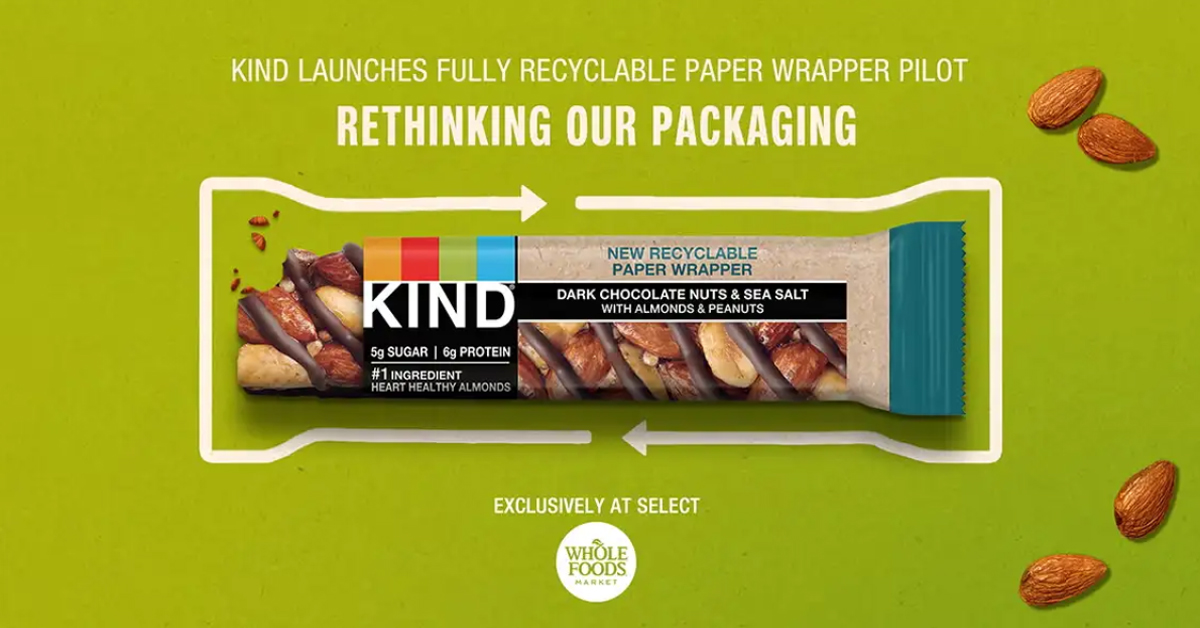
KIND Snacks is hoping to jumpstart the scale-up efforts of sustainable packaging materials and show a potential for these materials to succeed in the mainstream marketplace by qualifying performance, consumer perceptions and post-use purchase intent through a new pilot launch.
Since May, the Mars-owned snack maker has been testing a limited-edition version of its popular Dark Chocolate Nuts & Sea Salt bars that is packed in a curbside recyclable paper wrapper and available at select Whole Foods locations. Amid that ongoing test, expected to conclude in the fourth quarter, we spoke with the brand’s VP of Packaging R&D, Kerri Clark, and Sustainability Communications Manager, Lindsay Philpott about what KIND has learned so far.
“[Sustainable packaging] is a big, complex topic, and it all can feel very overwhelming on where to start,” said Clark. “For us, it really was about making a start and not waiting until all of the questions were answered. There is unfortunately, in sustainability, not one right answer, or one size fits all, or even a preferred silver bullet that’s going to solve all the problems.”
Pros Of Paper
While there may not be one right answer, KIND recognized that the circularity, availability and performance of protective barriers for flexible paper wrappers has significantly improved over a short amount of time.
During its tests, it has also discovered the packaging type benefits recyclers’ paper bales, which are improved with a greater diversity of material thickness and fibers lengths, and gleaned “better than expected” results from a smaller scale test among online consumers.
In 2023, KIND tested the flexible paper wrappers in a launch on its direct-to-consumer platform and received the consumer validation to keep evolving the project. That phase of the pilot primarily focused on the product’s durability, Clark explained, noting that the majority of the product’s consumption typically happens on-the-go.
“If I’m throwing this in my backpack or trying to take it with me on my hike – is it going to hold up?” Clark’s team wondered. “That first test is where we had the most pleasant surprise as far as the response to the durability piece… the post-use purchase intent was as high as pre-use, which was a bit of an unexpected outcome in a positive way,” she said.
According to a McKinsey study, conducted alongside NielsenIQ, products making environmental, social, and governance (ESG) related claims experienced higher growth rates during a five-year period than those that did not (+28% versus +20%).
While that margin is fairly narrow, Clark noted that KIND “overindexes” with Gen Z and Millennial consumers – two demographics most likely to report sustainability claims as a key purchasing driver – making its brand an important early mover in the space.
Decoding Durability
Consumer respondents from the DTC test also reported unexpected benefits such as the paper packaging being easier to open than plastic and perceiving the paper-wrapped bar as “more fresh,” Clark said. KIND’s current test is now narrowing in on how the alternative substrate impacts shelf life; the natural, whole food-focused product runs the risk of its nut base oxidizing and the chocolate base being impacted by moisture sensitivity, Clark explained.
The current pilot products were coded with a shorter expiration range (eight to nine months) than typical KIND products (12 to 15 months), Clark said, since they were distributed during the summer months, and in some cases in the South, where heat and humidity can have a significant impact on product integrity as it makes it way to shelf.
However, KIND is running concurrent shelf life testing and hopes that if it pursues a larger-scale rollout of paper wrappers, that the products will carry a standard shelf life. Clark said the barrier and performance qualities of paper are beginning to match those of plastic films, noting that the company is “very encouraged” by how fast the market is developing.
“We have to keep multiple irons in the fire because we don’t know exactly where this whole thing is headed,” Clark said. “We’ve got infrastructure developing in parallel to materials developing in parallel to consumer behavior and education evolving. Until that all lands someplace, we don’t know what the best right answer is, and there’s probably not one best right answer at the end of all of this anyway.”
Managing Consumer Perceptions
A handful of unknowns still remain, particularly around how consumers interact with the product at the shelf. Known for its clear, high-clarity, transparent wrappers, the Whole Foods pilot has been designed to solicit feedback on whether food photography printed on the eco-friendly wrappers, in partnership with Printpack, will suffice and continue to “inspire a purchase.”
“We were one of the first food products out there in clear, high clarity [plastic] with a really good, clear window where you could see the product,” Clark said. “For me, [KIND is about] ingredients you can see and pronounce, but I don’t know that it has to be so literal [anymore].”
The company is also making calculated bets when it comes to the cost of a full-scale transition; KIND aims for all of its products to be packaged in fully curbside recyclable packaging by 2030. Philpott said the company is seeing early signs that the price for paper will eventually decrease and is hopeful it will reach parity, or at least a little bit above parity, with the price of plastic.
“We have to be cautious of the cost pressures on all of our businesses right now and how transitioning packaging can impact the cost of our products,” Philpott said. “KIND made a really conscious choice during these pilots to not pass that cost on to our consumer… in order to be able to pilot and test these and figure out the consumer insights and some of the sales velocity tests that we would need to move this forward.”
But in order to succeed, it needs others to copy, or at least consider, its approach. The brand is making a conscious effort to share all of its learnings related to paper-wrappers, with Philpott explaining that in this space, “a rising ride lifts truly all boats.” In order for these new materials to scale and become both readily available and affordable for all, KIND needs other businesses to buy-in.
“Even as big companies, it’s not enough scale on our own. We need a few big players to go for it to truly move the needle,” Philpott said. “We’re hoping that being very open in what we’re doing and how we’re doing it and what we’re learning – that that will bring others along.”
Explore the Nombase CPG Database
Head to Nombase to learn more about the tagged companies and their offerings.

![[Exclusive]: Leaven Foods Rises with TIME Best Inventions Honor as It Seeks to Scale Sourdough](https://d2azl42aua8mom.cloudfront.net/wp-content/uploads/2026/10/14180815/Leaven-970-150x150.png)