Tia Lupita Acquisition Will Bring It ‘To The Motherland’

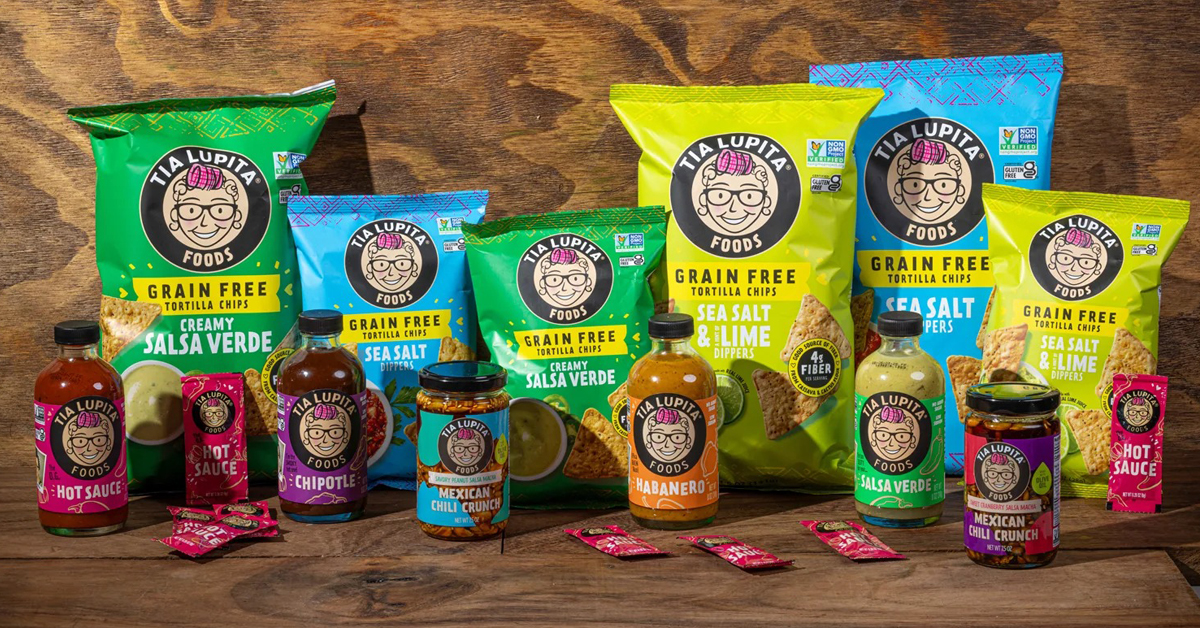
Global flavors are gaining additional mainstream momentum as evidenced by this week’s acquisition of Tia Lupita, which was scooped up by the billion-dollar Hispanic food company Vilore Foods. Nosh spoke with Tia Lupita founder Hector Saldivar, who emphasized the potential market opportunity the legacy player sees in the better-for-you Hispanic food market and the validation and efficiencies this deal will provide for the startup brand.
“I feel like the weight of a thousand elephants has been lifted off my back. It’s quite a relief, and we’re very happy. We’re very proud,” Saldivar said. Now with the backing of Vilore’s extensive resources, he believes Tia Lupita will have the opportunity to usher in a new era of Mexican packaged food offerings while maintaining and “leaning even harder” into its principles around gluten-free and clean, high-quality ingredients.
The conversation with Vilore initially began because Tia Lupita was seeking a “truly strategic [investment] partner,” Saldivar said, noting that while it was looking to raise capital, it was primarily looking for a partner that could offer resources and efficiency to help provide logistical and manufacturing support.
After reconnecting with Edgar Vargas, Vilore’s venture lead, at Newtopia Now in August 2024, conversations about a possibly larger partnership began to take shape. Saldivar first met Vargas years ago when he worked for 7-Eleven’s venture group and its Brands With Heart program: “a key learning lesson is you never know. That’s why you network, that’s why you keep following up with all the old friends and colleagues,” Saldivar emphasized.
Currently Tia Lupita produces all of its products via a network of co-manufacturers strategically located across the U.S. and in Mexico. Those relationships will remain intact, Saldivar said, but moving forward, Tia Lupita will have access to Vilore’s vast manufacturing, logistics, administrative and distribution expertise as it continues to scale. It will remain a standalone entity within Vilore’s business, and Saldivar to continue to lead the brand.
“We’re still a young brand, and the founder story is still very connected to this,” Saldivar said. “I think it’s very necessary, and it was one of the ‘friendly musts’ at the negotiating table – ‘you have got to come with us.’ It was the same with the team; we’re a small team of three to four people, and we were able to make sure that everybody agreed to this, to come over and be part of this transition.”
Ingredient buying power will also be a massive unlock from the transaction for Tia Lupita, particularly for “competitive commodities” like peppers, which Saldivar expects will allow the brand to secure better prices and allocations on a lot of key inputs. That could also lead to an expanded portfolio built from a range of traditional Mexican ingredients such as different varieties of beans, peppers and even Huitlacoche, a fungus that grows on corn that Saldivar said is considered Mexico’s version of truffles.
Saldivar believes this new backing will accelerate Tia Lupita’s ability to bring new innovations to market, but it will also have a significant impact on the brand’s ability to grow beyond its roots in a “complementary” manner. Vilore is looking to tap into the brand’s connections in the natural channel, he said, while for Tia Lupita, the legacy company’s longstanding relationships in the conventional segment as well as among Hispanic grocers present a significant opportunity to grow the business among new audiences.
“We’ve come up with a transition structure and transition process, but there’s also things that we want to get ahead and that we might have to skip a few steps in the process or in the schedule – it’s an art and science,” Saldivar said. “There’s gonna be some steps to follow, but we’re also going to have to take some bold strokes and brush things, especially in the sales time [when] there’s opportunities.”
Since the announcement, Saldivar said the brand has received inbound requests for distribution in Saudi Arabia and Australia and it is already looking to enter the Canadian market alongside Vilore, which is working to expand its northern reach. But Saldivar is most excited about the opportunity to bring the brand back to its roots.
“They are a billion-dollar brand. These are brands I grew up eating in Mexico. When I went to school, my mom would put me a Jumex can in my lunchbox,” Saldivar said. “La Costena is 100 years old, Jumex is 70 years old, and so they have all this distribution in Mexico, but finally there’s this opportunity to introduce Tia Lupita to the motherland – to the land where my mother lives. That’s going to be amazing. I think there is an opportunity in the Mexican market to bring this refresh of innovation and better position.”
Amid all of that excitement around opportunity and growth potential, Saldivar emphasized the importance of also ensuring that both companies “share the same vision” and complement one another. He cautioned founders considering a deal where their business is just “covering a hole because the bigger boat is sinking.”
“Don’t pretend everything is perfect because that would be the first red flag,” Saldivar said. “Nothing is ever perfect and awesome, so me being very transparent with the Vilore team from the get-go set up an amazing stepping stone for our relationship. [I said] ‘this is where we’re struggling, this is where we need help, things are not great here, things are better here, things are really good here.’ But overall [being an] open book, and being transparent and honest [has paid off.”
Saldivar highlighted a recent example where, just days after the deal was finalized, Tia Lupita was hit with a settlement fee in a Prop 65 case in California over its use of cassava flour. He said that while he was initially worried about discussing the issue with the brand’s new parent, he was pleasantly surprised to learn Vilore’s legal team was already aware of the fee and was working on taking care of it.
“This process has taken a year, it’s slow, and sometimes that is frustrating, but also we’re getting to know each other more,” he added. “We’re getting to know how each other handles conversations and business thoughts and strategy and this and that. For us, all this time we’ve been falling more and more in love [and realizing] I want to be part of this family.”
Explore the Nombase CPG Database
Head to Nombase to learn more about the tagged companies and their offerings.