Q Drinks Founders Get Aggressive with AGRO Plant-Based Jerky

Having transitioned away from day-to-day operations at their first brand, Q Drinks, entrepreneurs Jordan Silbert and Ben Kaplan are going AGRO for their next big project.
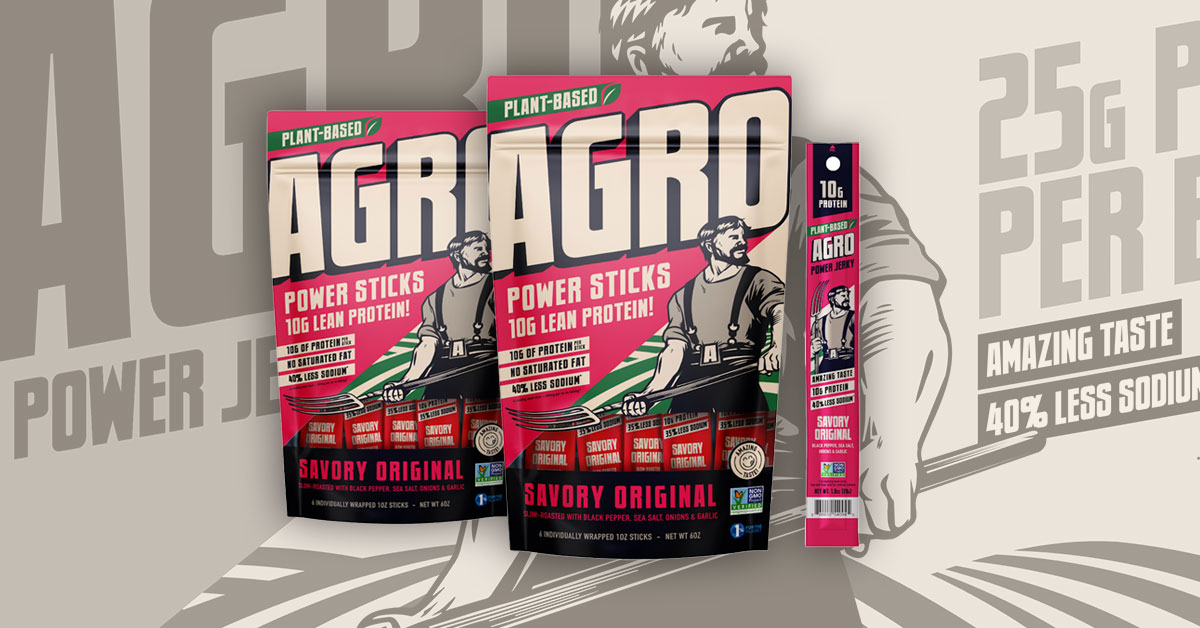
Founded in 2023, AGRO makes a line of plant-based jerky that comes in resealable bags and includes functional options alongside indulgent snacks, such as a caffeinated Energy Bolt flavor.
This year, the brand introduced a line of individually wrapped sticks, available in Savory Original, Spicy Chipotle, Grilled Teriyaki and Texas BBQ flavors. Each bag contains seven 1 oz. sticks and are sold on Amazon for $14.99 per unit.
“Our vision is to try to take what we’ve learned [at Q] and do this in a very lean, efficient way,” Kaplan told Nosh last week.
The company is primarily self-funded with some individual angels recently invested, and the company hopes to be able to disrupt the plant-based sector with an approach to product that more closely follows the successes of meat-based jerky products.
The sticks are now providing AGRO with a stronger lead to expand into retail nationwide, adding Albertsons/Safeway stores and Lassens as well as targeting the airport and travel space (around 50 or 60 locations, with plans to double that in the next month), corporate cafeterias and other foodservice accounts via a distribution agreement with Canteen.
The latter has provided AGRO with rotations at cafeterias for Google, Raytheon and other large companies, Silbert said.
In Albertsons, the brand has won placement in the retailer’s protein snacking set, as well as select checkout areas in premium locations, Kaplan said.
While natural and conventional grocery are certainly part of the vision for AGRO, the diversified channel strategy early on is largely about having “test cases” for the company to later focus on its best performing channels and locations.
“We want to have case studies of proof of concept in a number of different verticals, and maybe there’ll be verticals where it doesn’t work,” Kaplan said. “But we want to be in tech cafeterias and big business cafeterias. We want to be, obviously, in airports. We want Amazon. We want conventional grocery. We want some natural grocery.”
While the plant-based jerky set is not wanting for options, Kaplan said that AGRO’s key differentiators are delivering on higher protein and a lower price point at parity with meat-based jerky. With the current trends for high protein consumption and better-for-you alternatives, the idea is for AGRO to be the proper on-trend brand in a category that has too often foregone the key characteristics of a traditional meat stick.
“What we’ve seen in our category is a bunch of mushroom jerky, sweet potato snacks, things like that,” Kaplan said. “They might taste good, but they don’t have protein, and the consumer is not interested.”
In addition, AGRO’s sticks have 40% less sodium than their meat-based counterparts. According to Kaplan, focus group research showed that there was a “nexus of high protein” and low sodium that was missing from the market, and “the combination of those attributes was exceptionally compelling for consumers.”
“The number I have is something like in 36% of all snacking occasions someone wants protein, they call it ‘healthy fuel,’ but it’s only fulfilled in 19% of purchases,” Silbert said. “So people go looking for something with some protein power, but end up with Fritos or Pringles, and that is because, largely, the product isn’t there for them, or it’s way overpriced.”
Kaplan suggested that the branding also helps push it away from other plant-based jerky and aligns it closer to the meat space, featuring a burly farmer mascot on the packaging as opposed to the holistic theming that dominates much of the category.
“This isn’t like ‘Mother Earth’s Organic Pantry’; this is AGRO,” Kaplan said. “It’s about you, the consumer. It’s about performance. And in that way it is, it is quite differentiated.”