Loopini: Italian Entrepreneur Cooks Up Protein Pizza On A Spreadsheet

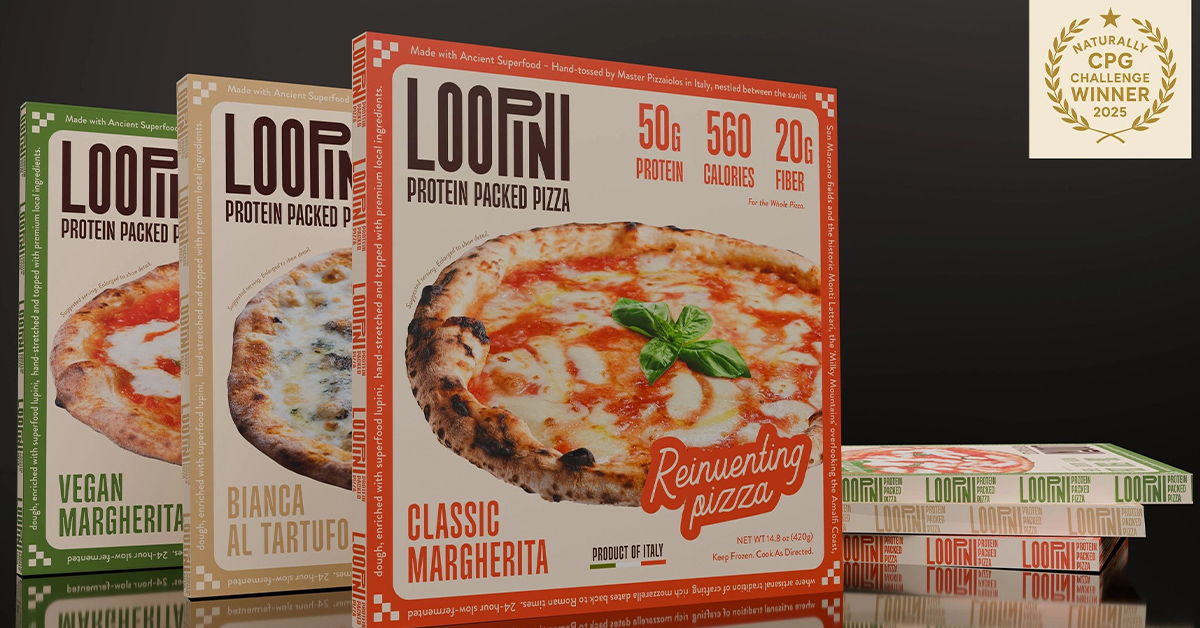
The clean label protein craze has made its way into the frozen pizza segment, and it’s about to be available in mass.
Frozen protein pizza maker Loopini is gearing up to roll out to its first chain retailer after a year of building the business online and within New York City independent retailers. The distribution gains come on the cusp of a new capital infusion for the bootstrapped brand with founder and CEO Damiano Messineo claiming it will close a $1 million round in the next few weeks.
In November, the lupini bean-based pizza maker will roll out all of its 3 SKUs to Wegmans stores, which will be followed by a launch at Whole Foods in January. In order to support the launch, the team developed a plan to circumvent Wegmans’ policy against in-store sampling after noticing that the retailer’s stores in New York’s Buffalo and Rochester region are located in clusters, with 10 to 15 stores within fairly close proximity to one another.
“Those are cities of 200,000 inhabitants so what we are thinking, and what we’re doing, is to go there with a Loopini truck and just give out pizza for free, do the demos outside, and try to do brand activation this way,” Messineo explained.
The brand will also lean into microinfluencer partnerships to support the rollouts, he said. For now, Loopini will target partnerships in the natural channel as Messineo does not believe it will be able to get the product’s price (SRP: $14.99) down to a point it would be successful in large conventional chains.
Pumping Protein Into Pizza
The high-protein pizzas, available in Classic Margherita, Bianca al Tartufo and Vegan Margherita, contain between 38 to 54 grams of protein, 560 to 590 calories and 18 to 26 grams of fiber, depending on the variety.
“Pizza is the most loved food in the world, and we try to run away from it,” Messineo told Nosh. “[I thought] what if we make it the opposite – instead of eating a chicken salad, you can eat a pizza and get your protein, get your fiber, lower calories. That was the idea behind it and we started in the opposite way, first creating the nutritional label with nutritionists to make [a complete] meal and then we worked backwards to create a recipe.”
Messineo began charting the nutritional content of various flours – everything from fava bean to Okara – in an Excel spreadsheet: “When it made sense on the nutritional results, then I went to the kitchen and tried [to make] the pizza. Most of the time it tasted like shit,” he joked.
Finally, he learned about lupini beans and while the first recipe iteration was just “okay” the more he learned about the crop’s benefits – from nutritional to the environmental and economic gains for farmers – he said he didn’t understand “why we don’t use lupini beans in everything.”
“It costs more than wheat so we sustain smaller farmers, they use less water, they improve the fertility of the soil, and [the farmer] earns more money. Lupini beans have a low glycemic index, and they have phytosterols, which actively lower cholesterol,” Messineo emphasized. “The Romans, Mayans, Egyptians – the best civilizations in the world [ate lupini beans] – and that’s when I realized that’s why we’re so fucked up today because we don’t consume lupini.”
Building The Bean-based Business
The brand is also supported by co-founder and COO Alessandro Pignataro as well as a slate of advisors including Amy Ho, PepsiCo Labs’ senior manager tech partnerships and venturing; Dr. Praeger’s CEO Andy Reichgut and many others.
While Loopini is Messineo’s first food business, the Sicilian native said he has been an entrepreneur since the age of 16, beginning with an event company, later founding a Soccer Academy in Rome and during college at New York University (NYU), taking a leave of absence to buy and flip a hydropower plant in Nepal.
“I’ve been an entrepreneur for events that I like, and sports, and renewable energy, but my true passion was food,” he emphasized. “Most of the time, traveling from Italy to New York, I don’t bring clothes. I just bring cheese and salami and olive oil, especially olive oil.”
Messineo’s passion for Italian ingredients is also reflected in the brand’s supply chain. The tomatoes used for its sauce are sourced from the San Marzano region, and its cheese is sourced from the Monti Lattari region, which is known as The Milky Mountains. All of the pizzas are produced at a facility in Italy as well, and Loopini’s next project is to spearhead the cultivation of its own lupini bean crop in Sicily.
“That is the only ingredient that we are trying to produce ourselves. Because it’s a reduced water footprint, and I’m Sicilian, and last year in Sicily it didn’t rain for seven months, I [thought] it’s perfect to plant there,” he said.
Messiano estimates Loopini will be able to grow enough beans to self-sustain its production by 2027. While farming is typically a high-risk investment, Messineo said growing its own lupini will actually derisk the business’ supply chain. The brand is currently sourcing lupini flour from Poland, but geopolitical tensions threaten the sustainability of that source.
“Our supplier called and was like, just for your information, we have supersonic Russian missiles a hundred kilometers from our production facility – [you] should start looking for someone else.”
Explore the Nombase CPG Database
Head to Nombase to learn more about the tagged companies and their offerings.