Even As Alt-Meat Craters, Investors Stay With Better Meat Co.

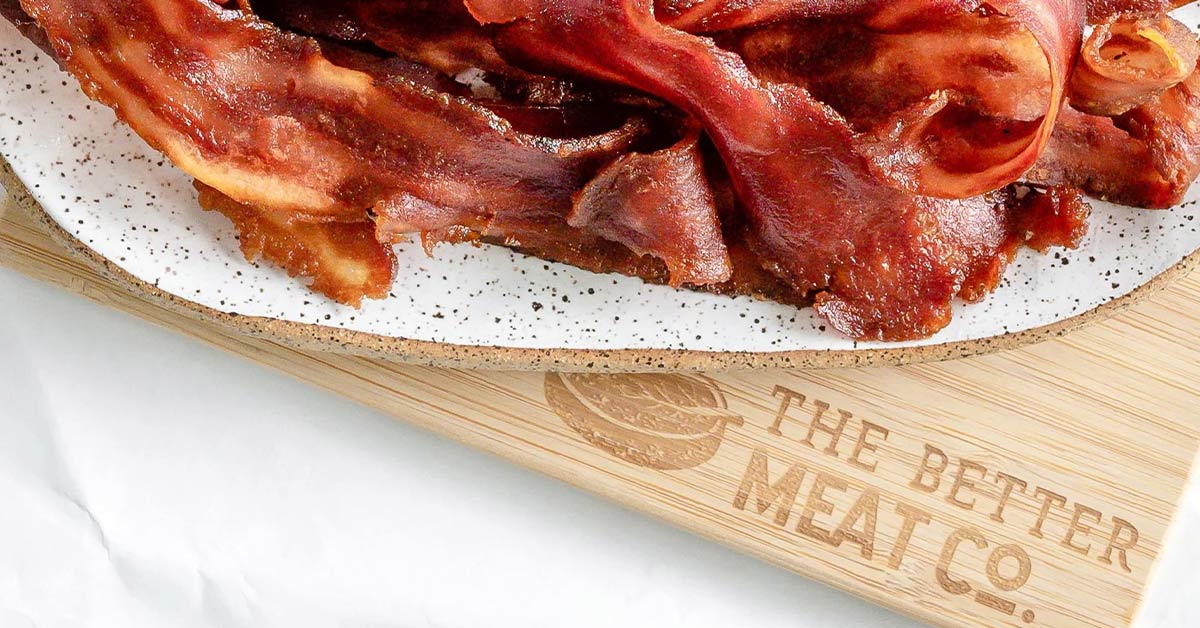
Amid the “wintry VC landscape,” mycoprotein producer The Better Meat Company (BMC) just announced it had reeled in $31 million in Series A funding that founder and CEO Paul Shapiro believes will propel the business into profitable revenue growth.
That’s led to a surprisingly sunny outlook for Shapiro, who has seen many competing alt-meat high-fliers recently come to ground, most prominently Beyond and Meati.
But a different approach – selling the company’s fungus-derived meat alternatives as ingredients to other companies, and a successful 50/50 meat/alt-meat blend it launched with Purdue, has the company and its founder feeling rare optimism, with an acknowledgement that the journey remains long.
“Business plans sometimes don’t survive first contact with reality, but that’s what we are forecasting, and I think that if things go well, we can make it work,” Shapiro told Nosh, adding that he hopes this round will mark the last time the Sacramento-based startup has to raise VC funding.
BMC forecasts that it will be able to sell its patented Rhiza mycoprotein ingredient at prices lower than U.S. commodity beef by 2026. That alone would be a tremendous feat, considering U.S. beef is heavily subsidized in order to maintain low prices; a recent estimate from the Environmental Working Group places annual U.S. livestock subsidies (beef and dairy) at $72 billion. Meanwhile, BMC, which has raised $43 million to-date, did receive a $1.48 million grant from the U.S. Department of Defense in 2024 – but that’s a long way from a government-funded feedlot.
Shapiro emphasized that most of BMC’s competitors have raised much larger rounds while still working to invent their technology; in contrast, BMC’s technology is already established, it has regulatory approvals and patents in place, and its headcount and burn rate has remained below that of an average biotech startup.
“We’ve been laser focused on not just the invention of a new technology, but of scaling it to the point where we can have some accurate forecasts of what we know it’ll cost at certain production parameters,” Shapiro said. “The goal that we have is making a real dent in the total number of animals that are used for food, and so in order to do that, you have to compete on cost.”
Lean Alt-Meat
In order to be cost-competitive BMC spent years “wringing a lot of the COGS out of the process,” with a focus on optimizing its feedstock and energy use, among other aspects of production, Shapiro said. The company currently has 15 full-time employees, and has employed 54 individuals total during its seven years in operation.
Looking ahead, BMC has two goals: tech transfer to scale up production, and finding more customers. Shapiro said he recently presented those goals as a mandate to the team, asking that if they see any colleague working on something that does not pertain to one of those two goals “please stop them… stop them now.”
Bigger revenue will come with commercialized products. BMC has already executed joint development partnerships with some of the country’s largest meat producers, Shapiro said. Under a monthly retainer, those companies received access to mycelium from the company’s demonstration plant in order to build and test products.
About six of those partners went on to sign letters of intent which could lead to them buying about $13 million worth of mycoprotein from BMC on an annual basis. Although those LOIs don’t necessarily mean guaranteed sales, he said, “it’s at least [enough] traction sufficient to show that companies really like and want the product.”
But he recognizes that “[our] investors are making all of this possible [by] betting on us and betting that they’re going to get a return,” Shapiro said.

Now that the company has finished a Series A, Shapiro said, its loyal, returning investor base is validation for the company’s long term potential, noting that if early-stage VC is often about making bets on “the jockey, not the horse,” BMC has made it far enough around the track that its investors are now placing bets on both the steed and on Shapiro.
But that steed has to run on the sale of new ingredients.
“I often think of our work as Sisyphean – we’re just pushing the boulder up the hill and in this case, I’m grateful to have pushed the boulder to a point on the hill where it’s now on a ledge, and we can rest for a moment, but there’s no stopping,” Shapiro said. “We need to keep pushing it – there’s a lot more hill left to go…[capital] doesn’t actually push the boulder up the hill.”
It helps that BMC now has market data as its “resting ledge.” The company’s partnership with Purdue resulted in a 50% plant-based, 50% chicken-based nugget line that was brought to market in 2019. Shapiro claims it is the “most successful product” in the balanced protein space and continues to “sell well,” even as the broader plant-based set has faltered.
“You can still do hybrids without shouting it from the rooftop that it’s a hybrid,” he said. “There are some people who just look at the nutrition facts panel, and want fewer calories [and] less saturated fat – hybrids accomplish that.”
Rhiza Rising
Those successful nuggets aren’t made with Rhiza, however, and there’s a lot riding on that product’s increased availability, and marketability.
While hybrid meat products are the focus of BMC’s current business development efforts, Shapiro said Rhiza is also gaining traction outside of the traditional protein space: it can be ground into a flour, which is being tested in a range of baked goods from pizza crusts to tortillas.
With high protein, high fiber and clean label attributes at the core of BMC’s offerings, Shapiro is optimistic about the market share the company can capture. But he said he is also remaining realistic about the uncertainty that remains ahead, for both corporations and consumers.
“For a long time I beat my head against the wall with the conviction that the wall would break before my head, and eventually the wall broke,” Shapiro stated. “My head had some scars on it, but it still was thinking. There will be another wall in the future, though, and whether that wall is sturdier or not, I don’t know. Hopefully there will be a better macroeconomic climate for us than what we face right now – it’s hard to imagine it being worse – but you just never know.”
Explore the Nombase CPG Database
Head to Nombase to learn more about the tagged companies and their offerings.