With No-Stir Package, Can Brand Win Natural Peanut Butter Race?

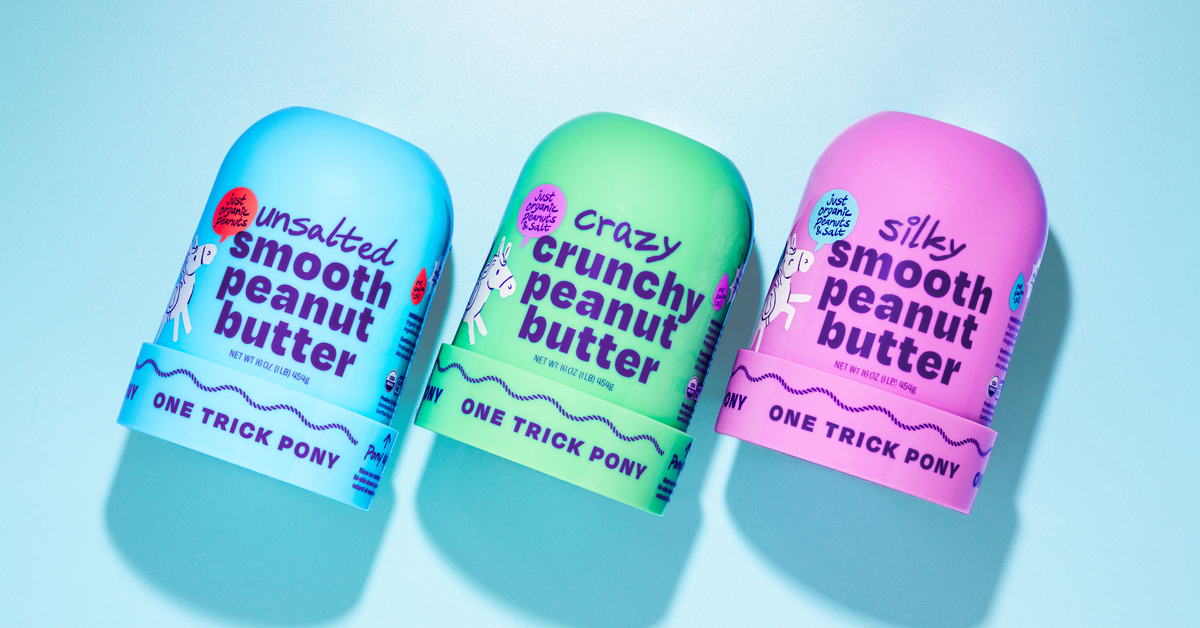
By literally turning the problem on its head, One Trick Pony founder Lucy Dana thinks she’s solved the oil crisis. No, not that one.
The Washington, D.C.-based brand is rolling out new packaging designed to prevent the messy oil separation that often occurs in spreads that are free of stabilizers and additives. One Trick Pony uses only Argentinian peanuts and Patagonian sea salt in its formulations.
“When we first launched, we had no plans to redesign our jar. Jars have been around for many years – like, why even touch that?” Dana told Nosh. “And every tasting I went to or demo where I would interface with our customers, I would hear one of two things. Either, ‘I don’t like natural peanut butter because I don’t like the oil separation,’ or ‘I like natural peanut butter, but the stirring of the natural oil is a disaster, and I hate that part.’”
Drawing inspiration from cosmetics packaging, the custom jars are designed to be stored upside down, helping to prevent separation, and feature a thick, leak-proof lid. Three varieties – smooth, crunchy and unsalted – are rolling out exclusively at Whole Foods Market stores this month and heading to other retailers and on the brand’s website in July.
One Trick Pony’s packaging overhaul follows last year’s round of seed funding from Collaborative Fund, an early investor in companies such as Sweetgreen, Blue Bottle Coffee and Olipop.
We sat down with Dana to discuss the new jar design and more. Responses have been lightly edited for length and clarity.
Tell me about your new packaging.
Everywhere I went, I was getting the feedback that the oil was kind of like this block for people. So I started thinking about if we’re not going to add any palm oil or any stabilizer into the actual peanut butter, then what do we have to do? We have to look at the outside of the jar and the packaging.
This was probably two years ago. At this point, we hired a design studio and gave them this open-ended prompt: How would you solve this problem? And they came back with some of the craziest ideas ever. One of them had a whisk attached to the top of the jar. So, every time you opened it, you could do a little stir. We were looking at a triangle jar at one point, so you could have it rest on different sides when you store it in your pantry.
I didn’t think any of these were that feasible, and so we kind of put it on the shelf. And then last year, I spoke with 30-plus of our customers just on Zoom calls. I was asking them, “What do you like? What do you not like?” And one of the questions I would ask them is, “How do you store your peanut butter?” And the vast majority of them were storing it upside down as is to solve the oil question. So we went back to the drawing board, and we were like, “Let’s just go with what people are already doing, which is store it upside down.”
When we ship stuff for ecommerce, it goes through the mail so it gets shaken up and there’s not a ton of oil separation. But as we move more and more into retail, it’s going to be sitting at a distributor’s warehouse, going on the truck sitting, and then sitting on the shelves, so you don’t get that natural shakeup from shipping. The oil separation is going to be more of an issue going forward.
So we then worked with a cosmetic packaging designer who works a lot with celebrity beauty brands, and we pulled some inspiration also from the beauty aisle.
This is a fully custom jar, so we got to look at all of the touch points. One of the things is there’s no internal shoulder on the jar, so your knife can go straight down the side, versus a lot of jars today have that a shoulder and you can’t get out every last glob of it.
We also made the opening super wide. And we made the jars oversized for the amount of net weight peanut butter in it, so you have this bigger opening to stir so stuff isn’t splashing out. And then we made these super thick lids, so if you do store it at home upside down, there’s not a ton of leakage.
Is your packaging more expensive now than it was before?
It definitely is more expensive. We also changed from conventional peanuts to organic peanuts. So a lot of changes around cost, and especially during this whole tariff situation. You know, we have Argentinian peanuts, and these jars are made overseas. So a lot of moving parts with our cost right now. Hopefully long term, some of those unexpected costs go down, but it was very important to me to keep it reasonably priced. We’re $9 on shelves at Whole Foods.
We’re at parity with most of the other organic brands, and we’re hoping to get some cost savings on the shipping side of things. Shipping stuff around the U.S. in glass is super expensive, and we also had a ton of breakage.
How big is your retail business versus your ecommerce business?
It’s 60% retail and 40% ecommerce. We started on ecomm because it’s easy to get off the ground and it’s easy to reach people in Kansas and places where we don’t have a retail connection, but long term, people want to buy groceries in a grocery store. And if you’re out of peanut butter, you’re probably not going to wait to order it on and wait for it to get there. Convenience is king.
Can you tell me a little bit about your decision to go organic?
It was just following what the customer was asking for. On our Instagram ads, a lot of the comments were, “Is this organic?” So we gave them what they wanted.
How are you educating consumers about the new jars?
On the bottom of the jar, it says, “These specially designed jars help reduce natural oil separation. Store this side down for the best peanut butter.” So we are meeting people where they are, and if they just meet us in the wild and they’re curious, they can pick it up and look.
Obviously, we’re going to be making a lot of social media content, describing how we got here. And then just hitting the demo circuit in supermarkets. So we have probably 20 demos already lined up for Whole Foods, and we’ll do it at other retailers as they get the new jars as well.
How are buyers reacting as you’re bringing this new jar to them?
It’s been mostly positive. I think people are just excited to see something new for the category, which is not the most exciting category in the supermarket. I do think some of the older buyers need a little bit more coaxing, and then when people get it in their hands, then most people are like, “Oh, my god, this is so cool.” So we are just trying to send out as many samples and get it in as many hands as possible.
What else is new?
We are making our second-ever flavored peanut butter that should release in the next two weeks. Last fall, we made our first-ever flavor, Maple Crunch, and it sold way better than I thought it would. We were kind of testing the waters because our peanut butter now is just two ingredients, and so if we’re adding sugar to it, is that going to turn off our core customer?
So we’re making Honey Crunch, and it’s a honey vanilla peanut butter base with chocolate, puffed quinoa pieces in it. That will be mostly on ecomm and smaller retailers.
We are also planning a peanut butter and jelly rodeo for the summer, stopping in multiple cities, partnering with our favorite local businesses to make cool peanut butter menu items. We have an ice cream collab, a coffee collab, a burger collab, and people will get free menu items, and then we’ll keep it on the menu for hopefully a few days after the actual collab.
Explore the Nombase CPG Database
Head to Nombase to learn more about the tagged companies and their offerings.