Why A Friendly Bread Is Pivoting To Foodservice

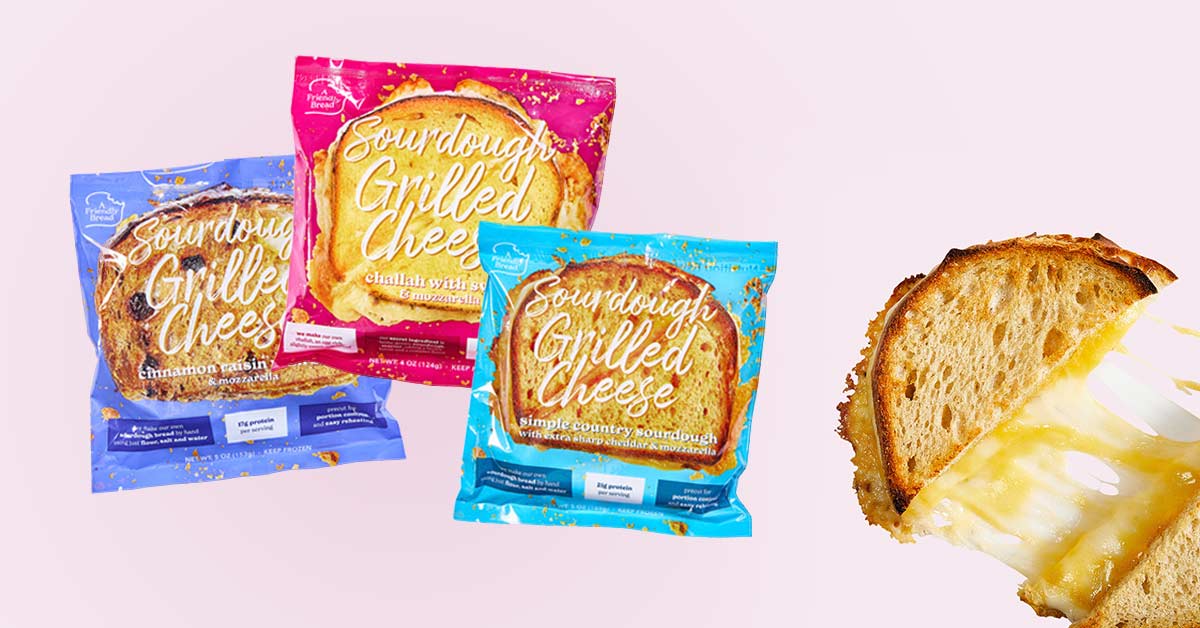
Frozen gourmet grilled cheese maker A Friendly Bread is pivoting away from retail to target growth within a niche region of foodservice nearly a year after diversifying its base business with a cold storage and commercial kitchen facility in its home city of Baltimore.
“I designed the product so that the home user could conveniently heat this up in a toaster oven,” founder and CEO Lane Levine told Nosh. “But there are just so many quick-service applications where they need to save labor, they need to save space and waste from having fancy bread, five different flavors of cheese, the assembling time, etc.”
Regional coffee shops with rapid-heating devices like a TurboChef have become the brand’s highest-volume, most reliable customer, Levine said, noting he organically discovered this opportunity while analyzing the company’s sales reports from UNFI and Rainforest. His team had not targeted these accounts and they were outperforming even its largest retail partners, he said.
When placed on a coffee shop’s hot menu, the product competes with just two or three other items, Levine said. At Canal Coffee, a 10-shop chain across North and South Carolina, he said the brand is moving six units per location per day – a major uptick from its average of two units per store per week in retail. He said that case study informed the company’s new target for distribution: regional, “beloved” 10 to 15 location coffee chains.
“What we’re seeing with coffee shops and coffee chains in particular is there’s this preponderance of so many specialty drinks – energy drinks and fun sparkling drinks – but there’s going to be a limit to that. The only way to continue increasing ticket sizes is with different food offerings. They start with a scone and a cake pop, but now a lot of them are ready to move beyond that.”
A Friendly Bread will continue selling to a handful of existing retail partners, primarily specialty and independent stores, as well as The Fresh Market; however he said the financials and reality of fighting for attention on shelf no longer make sense for the business as it targets higher-value growth opportunities.
“The other thing about that level of volume is that not only is it bigger, but it’s more reliable,” Levine said. “When you go into a grocery store, you still have to fight for your sales. With these coffee chains, you’re going to be one of three things on the menu, or you might be the only new hot lunch item on the menu, whereas you’re competing with 50,000 items in a grocery store.”
The pivot has also helped hone A Friendly Bread’s approach to the college and university space, where Levine sees three different potential opportunities for product placement: grab-and-go mini marts, on-campus coffee chains and within dining halls themselves. At a single coffee shop location on Baltimore’s Goucher College’s campus, the company is selling between 15 to 18 units per day.
However, not all shops have the profile to fit within the business’ new growth model, and Levine faces the hurdle of identifying chains that already have a rapid-heating device to prepare his product and stay open late enough in the day to cater to a lunchtime crowd. He said the opportunity, while only a sliver of the overall coffee shop landscape, is large enough so long as he can get in front of that audience.
“You can’t talk to the home customer about labor saving… that’s talking economics to them [and they don’t care], but you can talk about that to an executive chef of a 43-location coffee chain,” Levine explained. “They know what they are losing when they are trying to assemble something, and they also know what they’re losing when they don’t have the most common, most popular type of sandwich on their menu.”
Levine is currently working through distributors including Sysco, UNFI, Rainforest and a handful of regional and local partners. He believes success in this space has the potential to open up other venues as well – such as movie theaters, amusement parks and bowling alleys – “there’s none that a grilled cheese on the menu doesn’t make sense.”
While the product may make sense on the menu, he has faced pushback on the concept of a ready-to-heat grilled cheese over the years. In a QSR format, where the shop may not have a fully built-out kitchen but still wants to see hot items, this product provides a time-, ingredient- and labor-saving solution. Levine also pointed to Starbucks, which has had a grilled cheese item on its menu for years.
He believes the new approach is a win-win proposition for both A Friendly Bread and its customers. Most coffee chains are able to provide him with a volume prediction, while some are able to guarantee certain volumes, which he noted is a major benefit when it comes to forecasting the emerging brand’s yearly and quarterly growth.
“Since it’s higher volumes, we have been able to start to go down on our prices, but on the other side of that, because it’s a hot item, they can charge more than a grocery store would have, so they can extract some extra margin on the price end and on the cost end from us – we’re kind of realigning and, of course, there’s no chargebacks from distributors.”
Levine said he is already in talks with some larger chains, including one with over 300 locations. As he charts the business’ next phase his eye is on two goals: break into the “ecosystem of coffee shop chain distributors” and raise $750,000 from a mix of angel investors and crowdfunding to support the business through the pivot. That cash will also go towards completing the build-out of its commercial kitchen space.
“There is so much more certainty in this channel once you have the account,” he emphasized. “I’m actually not going to deploy the capital until I have lined up a certain threshold of deals. In a sense, it has the look of a pre-launch raise… I can tell you that if we get these accounts, they will go well, whereas with grocery, I can’t tell you that.”
Explore the Nombase CPG Database
Head to Nombase to learn more about the tagged companies and their offerings.