Olyra Embraces Publix Disco, Recharts Nationally In Natural

Olyra turned its discontinuation from Publix into an insight engine, enabling the brand to rechart growth in the natural channel while better aligning its retail aspirations with consumer awareness and demand, founder and CEO Yannis Varellas told Nosh.
Those efforts have put the Greek-inspired breakfast biscuit brand on a path that brought in just under $7 million in sales in 2024 with expectations to nearly double that revenue over the course of 2025. While Publix represented nearly 30% of the brand’s sales, recent retail gains, including a nationwide launch at Whole Foods, in addition to placement at Wegmans and Sprouts stores, offset the impact of its discontinuation and helped buoy the brand’s 2025 forecast.
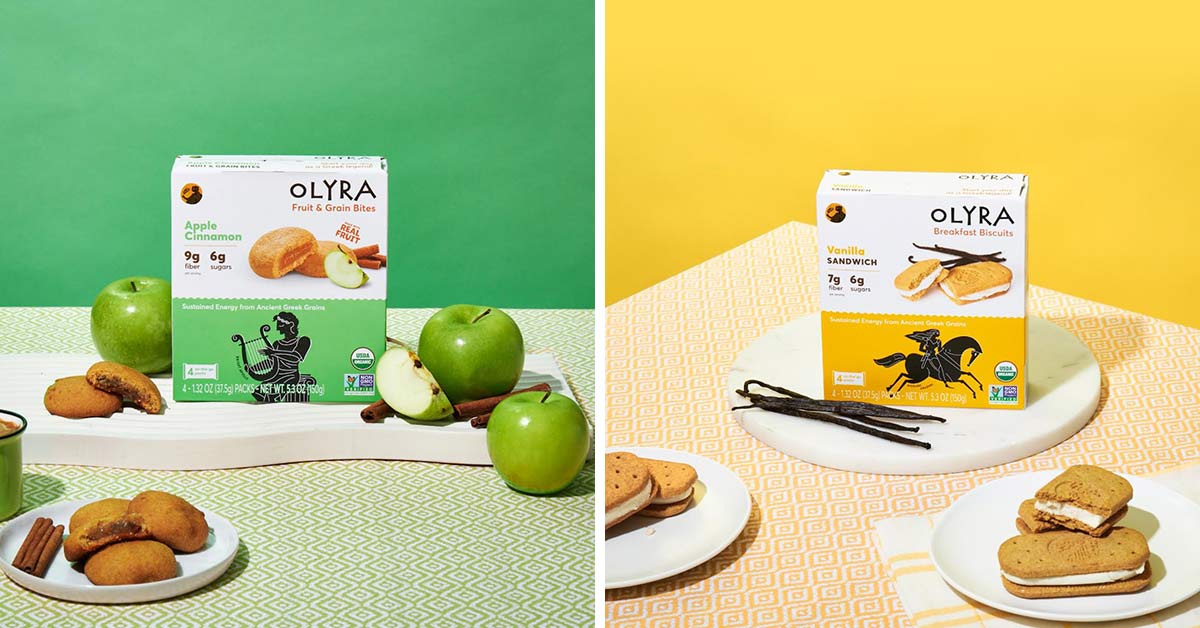
Its products – which include biscuits, filled biscuit sandwiches as well as fruit and grain bites in a variety of flavors – are now available in over 5,000 doors nationwide. Ahead of Expo West this year, the company will also introduce two new SKUs developed alongside Whole Foods, including a Vanilla filled biscuit sandwich as well as an Apple Cinnamon fruit and grain bite.
Olyra’s retail journey has not only helped the brand refine what formats and flavors work best, but also informed how it tunes that assortment to drive trial and consumer awareness. After seven years on the market it has unlocked a formula, which allowed it to reach the velocities needed to trigger a national rollout at Whole Foods, Varellas claims.
“It comes down to simple metrics [like] initial velocity – how the product initially performs on the shelf,” he said. “[That also] shows the purchase intent – how many people originally buy the product from a brand that is not very well known like Olyra. [That] tells you what you’re presenting on the shelf [and] how big the potential is.”

In order to unlock that potential Olyra has iterated each of its product formulations nearly nine times, he said, and is gearing up for a large-scale branding and packaging overhaul later this year. Those efforts have been supported by a $4 million funding round closed in February 2023; the company is also working to close another round in the coming months.
According to Varellas, getting taken off Publix shelves pushed the brand to reassess how it interacts with the consumer and showed the breakfast brand the importance of having the right assortment in order to support brand recognition and eventual success. He sees Whole Foods, Sprouts and Wegmans shoppers as being more interested in discovery and better-for-you innovation.
“As you prove yourself in [these stores], you create more awareness to then, hopefully, succeed in conventional accounts,” said Varellas. “The roadmap hasn’t changed, but the difficulty is you need to survive as a company. The chicken and the egg [retail] game is very hard because you need to have the scale to survive, but, if you’re not sure if you’re performing, it is a boomerang.”
Its Dark Chocolate sandwich and Strawberry, Raspberry and Blueberry fruit and grain bites have emerged as its four strongest-performing SKUs, giving Olyra a solid base of insights to build future retail assortments. That performance also informed the approach it took with its two new innovations launching next month, Varellas emphasized.
“Trade marketing is about trial, but you want to create trial when you know that your product will have repurchase rates,” he said. “You can do thousands of demos, but if the product doesn’t have repurchase intent, it doesn’t make sense.”
That is why online test runs are important for new innovations, Varellas explained, while acknowledging it typically takes about 18 months to understand how a product is performing at retail. But by the end of that 18-month cycle, it may be too late to make improvements and better support the product on shelf.
As Olyra looks ahead to 2025, Varellas said he is focused on continuing to build a business with “a long life cycle.” He sees four components will be key to those efforts including a large, loyal customer base; a business built on organization, culture and processes; healthy financials and being a hub for innovation.
“Innovation and R&D should be prioritized and be focused on the top-selling items first and then [new] innovations,” he said.