Lupini Bean Goes Mainstream As Brami Scales Protein Pasta In Mass, Club

Italian food company Brami believes it is well primed to drive increased consumption of its hero lupini bean ingredient as its protein pasta innovation gains traction “equally across all channels,” including mainstream retailers like Walmart and Costco, founder and CEO Aaron Gatti told Nosh,
Founded in 2015, Brami first launched with a line of snackable, shelf-stable flavored lupini beans. Gatti, a lupini bean fanatic since discovering them in childhood while spending time in Italy, said he was inspired to position the product as a high-protein snack for U.S. consumers after sharing them with his wife, who proclaimed: “They’re like an Italian edamame.”
“I wanted to bottle up that feeling of freedom, of relaxation, of not having to constantly be on this hamster wheel of fad diets, and ‘yes this’ and ‘yes that; and, ‘not this’ and ‘not that’ while also always wondering about the quality of ingredients and what I’m eating,” he explained.
While the snackable beans have gained traction, they still require a bit of consumer education, and the “briny” bitterness can be polarizing, he noted. After introducing a lupini bean-based dried pasta line in 2022, Gatti unlocked the pathway to integrate the legume into American diets. While Brami still sells its line of snackable beans at Whole Foods, Giant, Wegmans and other retailers, the company is focusing distribution and velocity gains on the better-for-you, clean label, high-protein pasta set.
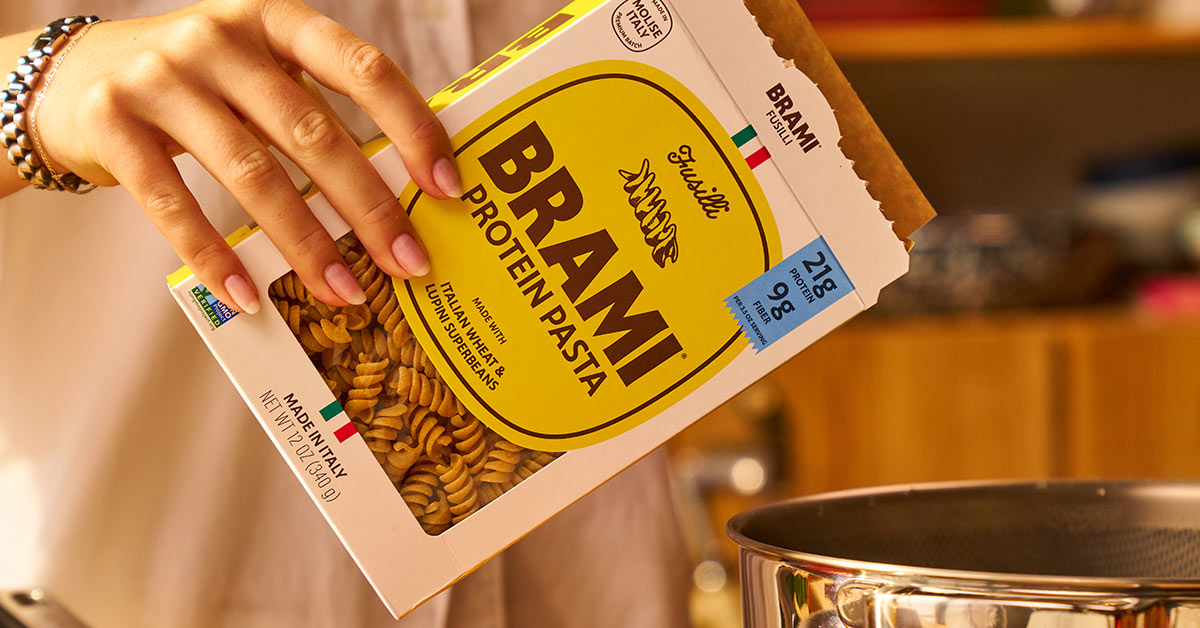
The two-ingredient pastas, made with just lupini bean and semolina durum wheat flour, come in five common shapes and offer 21 grams of protein and 9 grams of fiber per serving. Additional shapes will be rolled out over the next year, Gatti said.
“My grandmother would never think of adding lupini flour to a pasta, but she knows what lupini is – she eats lupini,” Gatti said. “We sometimes think of it as innovating backwards, we look at the past, but we’re still innovating forward. And so [by doing that] the pasta delivers this complete meal in one [product].”
Since the pasta’s launch, the product has gained traction in retail and is now available nationwide across core channels including natural, conventional, mass and club. Just this year, the brand expanded nationally with Whole Foods, Walmart, Target and is now in six regions of Costco. The product has already outpaced its sales goals for its first Costco rotation three-fold, Gatti said.
“I think of lupini like the tortoise in the tortoise and the hare race. It’s going to ultimately win the race, but it just got a slower start,” Gatti said.
“Our biggest friction is that people associate better-for-you pasta with bad texture and grainy, earthy flavor,” he continued. “My big pasta vision and dream is to get Americans to realize that you don’t have to choose between better-for-you on the nutritional side and compromise on taste and texture.”
All of Brami’s products feature ingredients sourced and produced in Italy. The durum wheat used in its pastas is also sourced from within the country, while the lupini bean flour, a specific variety that has been naturally selected for reduced bitterness, is sourced from across Europe.
According to Gatti, Brami is a strategic partner with its co-manufacturers and supplier partners; the business is currently run by 10 full-time stateside team members as well as a handful of fraction consultants. In the next year, he believes Brami’s full-time team will double as it continues to accelerate distribution gains and dives deeper into consumer education on lupini beans.
That education begins with a refreshed packaging design and updated web design. The pasta boxes have been updated with pasta shape illustrations and an aesthetic that Gatti believes will help tell the brands “innovating backward” story with a focus on convey its “a truly heritage, authentic pasta, even though it’s modern and convenient.”
As for the brand’s landing pages, updated in partnership with design firm Day Job, Gatti said he took inspiration from Siete Food’s approach to “reinventing” Mexican foods and traditional geometric patterns. Brami’s new brand aesthetic instead draws from the work of 1970s Italian designer Emilio Pucci, who Gatti said was known for pushing the boundaries of fashion in the “free feeling” ‘60s and ‘70s time period.
“It’s that feeling of the good life that you live in Italy, but in a way that was very authentic to heritage, which to me, is a metaphor for what I want Brami to be,” Gatti said. “The Brami brand today is much more aligned with the original seed of Brami, which came [when I was] a nine-year-old thinking, ‘I have to bottle up this magic that I feel in Italy and bring it back with me to the states.’”
Explore the Nombase CPG Database
Head to Nombase to learn more about the tagged companies and their offerings.