Dress It Up Launches Two SKUs, Backed By New Funding

A slow and steady growth strategy is Dress It Up Dressing’s secret sauce as it works to capture the “sleepy” salad dressing category, said founder and CEO Sophia Maroon.
While the 15-year-old brand has incrementally grown its business over the past five years, expanding into new formats, securing a bit of funding and, most recently, retooling its distribution and business structure to protect margins, Maroon said now felt like the right time to put a touch of fuel on the fire.
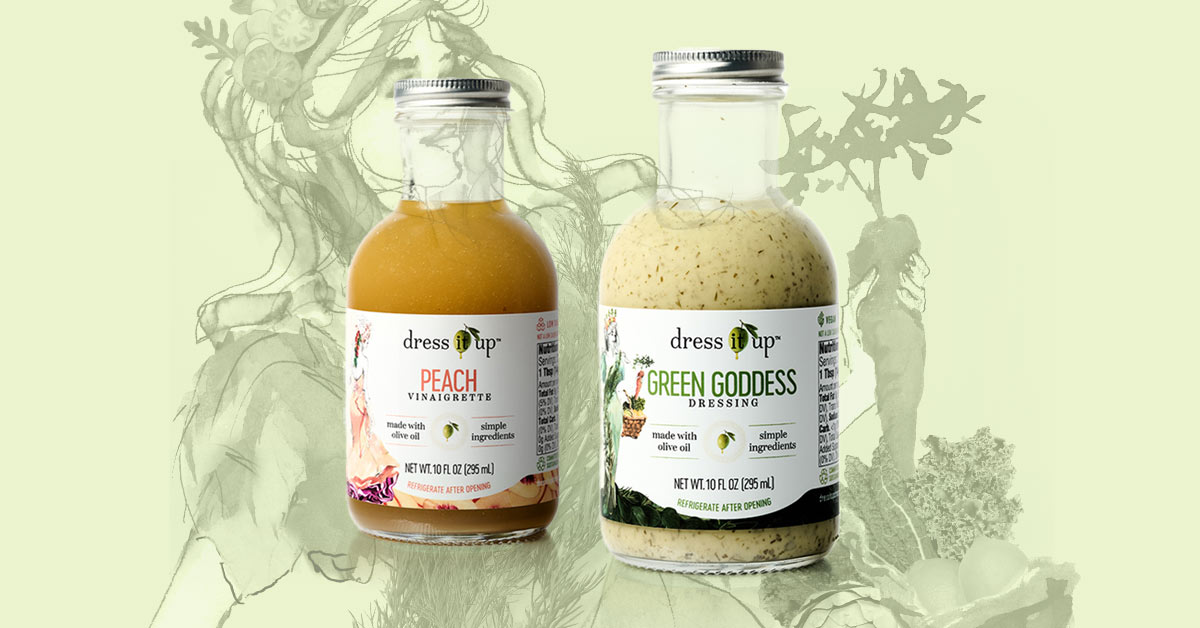
At Natural Products Expo West this week, Dress It Up is debuting its first new products in over seven years: A Green Goddess dressing and Peach Vinaigrette. Although flavor innovation has been a low priority, the business hasn’t been stagnant with Maroon focused on getting “the house in order” and testing new formats – like single-serve packets – for alternative channels.
The Green Goddess marks the brand’s first diversion from a fully-olive oil base, with the addition of aquafaba to create a shelf-stable, yet creamy and plant-based offering, Maroon explained. The brand is now working to secure an upcycled supply of the chickpea byproduct.
Maroon worked to refine the new flavors alongside the brand’s Whole Foods buyer after sending in two initial samples for an off-cycle review. The buyer suggested swapping the original fig dressing sample for a peach flavor, and Maroon thought, if anything, the natural retailer would take on one of the new SKUs. After a few tweaks, both SKUs secured placement nationwide.
“The best thing that [retail partners] can do is give us a reason to innovate and help an emerging brand understand the market in a way that only they can offer,” she said. “It helps strengthen both [sides]. But I still feel like Whole Foods is the only customer that we have those kinds of conversations with.”
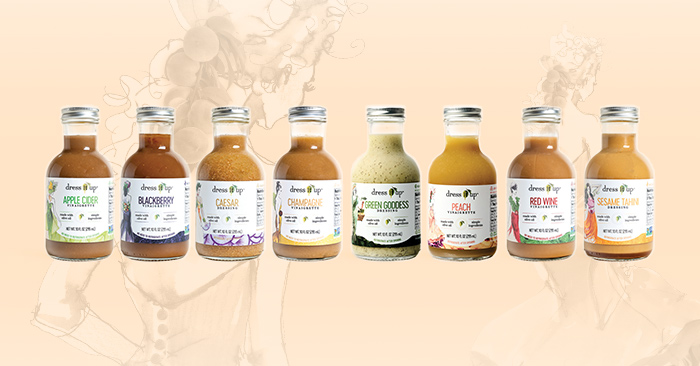
The products will be available on a three-month exclusive at Whole Foods, where Dress It Up now sells a total of eight SKUs nationwide. Rather than “chasing trends” Maroon believes her products – which are gluten-free, sugar-free, vegan, paleo, keto and Whole30 friendly – have been built to withstand the changing winds of consumer demands. But as it has kept up on trends, keeping the business funded has been a more complex challenge.
Finding Funds
The slow and steady approach hasn’t always been an attractive asset to investors, Maroon said. The company, which recently closed a $2 million equity round, spent over a year raising the first tranche of cash; once it had proven itself as a national brand, it quickly closed on the second million ahead of schedule.
“I felt like every investor kept on moving the goal post,” she said. “We were doing well in Whole Foods Mid-Atlantic, and they’re like, ‘Yeah, but you’re not national.’ And then we got national, they’re like, ‘Yeah, but show me a little bit more sales data.’ We were in the top 10 at Whole Foods and then they say ‘Yeah, but the top 10 is not the top five.’ We got in the top five and then finally they said, ‘Okay, now I’m listening.’”
She said there has been a recognizable shift in recent years from the “growth at all costs mentality” to those “just building good solid businesses.” As Dress It Up was executing its first full year as a national brand at Whole Foods, it was also undergoing a strategic sourcing initiative to renegotiate contracts and bring down its supplier costs. She also attributes the brand’s ability to secure capital to this effort.
Dress It Up worked with a representative from its home state in Maryland who took a high-level view of the company’s supply chain and outlined where and how it could simplify and tighten up the business, Maroon explained. The initiative resulted in “dramatic” cost-savings on olive oil, the base to virtually all of its products. It also opened the brand up to an alternative distribution plan that brought down freight costs and solved issues with inconsistent pricing.
Dress it Up previously distributed free on board (FOB) to UNFI and KeHE from its East Coast warehouse. That arrangement generated different freight prices, which were then tacked on to the product’s price tag, depending on the DC it lands in. On the East Coast, a 22-serving, 10 oz. bottle cost about $8.99; by the time that same item reached the West Coast, the price tag was upwards of $11.99.
During its strategic sourcing initiative, Dress It Up was also working toward a foodservice expansion and partnered with DOT Foods. As it was opening up those accounts, it began using DOT to stabilize its retail business as well. DOT now distributes all of Dress It Up’s products to UNFI and KeHE’s DCs, as well as its own partners, for a flat freight fee, which has enabled the brand to now maintain an even $9.99 price point at retail nationwide.
Foodservice As Fuel
2025 will be its year of foodservice, Maroon said, highlighting the lack of a leading clean label, premium, customizable salad dressing option available in the channel. The brand has the ability to package the product in a wide range of formats as well including bag-in-a-box, gallon jugs or even squeeze bottles.
“It’s a chicken and egg situation,” she said. “If we can find a customer, we can put a wide variety of packaging options into production. Packets were an easy one, so that was where we took the plunge, even without the customer.”
Currently, the single-serve products are available at Whole Foods stores and were used onboard Alaska Airlines flights. That format is first priority for production, she said, noting that the brand had to say no to a large order for the packets last year as it was also preparing to go national with Whole Foods due to a lack of funding and resources.
“I used to work in television, and a [common] expression was ‘cheap, fast or good,’ you could have two out of three, but you couldn’t have all three,” she said. “We could have put the packets into production really quickly, but it wasn’t going to be cheap. Now we did it, and it’s cheap and it’s good, but it wasn’t fast.”
Maroon is hoping to re-up packet production, including adding a few additional flavors and expanding with additional formats for foodservice use, depending on the need. With its piggy bank primed and retail relationships ready to keep growing, Dress It Up is eyeing profitability in the near term.
“If we had more money, I would have done everything exactly the same,” she said. “I just would have done it more quickly. That’s really what it buys you – time to grow. But growing quickly also builds a story, that’s a very different story from growing steadily. That [fast growth] story is a story that a lot of the VCs respond to.”
“But salad dressing is not a [more intense] category like beverage,” she continued, noting that if it was, the business would have gone under by now. “That’s also the beauty of being in what has to be one of the sleepiest sections of the store.”
Tagged Brands (1)
Explore the Nombase CPG Database
Head to Nombase to learn more about the tagged companies and their offerings.