As Retailers Roll Back DEI Initiatives, Founders Question The Merit Claim


The CPG food and beverage business is tough, but the odds are stacked even higher against minority and BIPOC-owned businesses, a group that receives a disproportionately small percentage of institutional funding and which has largely lacked market access and support to succeed in retail.
Now, with President Trump pushing to roll back public and private sector diversity, equity and inclusion (DEI) programs supporting underrepresented communities, even more cracks in the limited, existing systems have begun to show.
Over the last 12 months, retailers including Target, Kroger, Amazon and Walmart have rolled back or entirely cut DEI commitments. Those efforts – many of which were implemented just five years ago – are still, on a relative scale, in their early years. They are likely to now all but disappear in order to appease the administration. While Walmart’s Supplier Inclusion program still appears to be standing, Target has ended its Forward Founders and Target Takeoff accelerator programs.
Minority and BIPOC-owned brands have been left with plenty of unanswered questions, as they work to navigate a new, clouded landscape that requires balancing the demands of representing their communities with the task of running a sustainable and commercially viable business.
“When [brands] are disappearing off the shelf – there’s fear,” said Victoria Ho, founding member of :INCLUDED CPG and the creator of Kahlo, an olive oil cooking paste. “We don’t know whether it’s because retailers or decision makers are actively now stifling emerging brands founded by people of color, or if it’s because of the lack of support and again, systemic issues.”
The Industry and Its Issues
Organizations such as :INCLUDED CPG and others, like Project Potluck, emerged in the wake of the 2020 Black Lives Matter protests in order to create networks that would support founders through mentorship, market access initiatives, community and insights. Their work, alongside long running initiatives such as the National Minority Supplier Diversity Program (NMSDP), have had a recognizable impact.
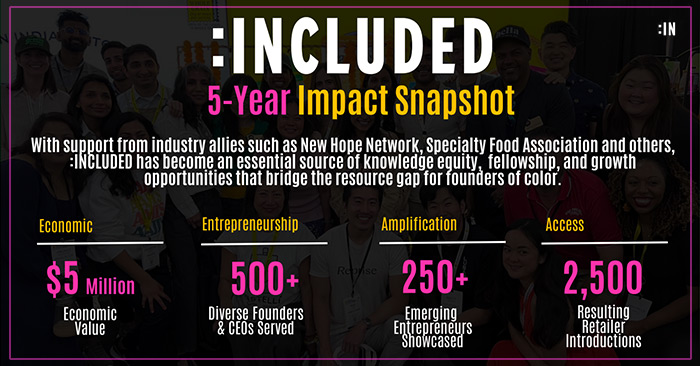
:INCLUDED celebrated five years of impact earlier this year, highlighting that it has created $5 million in “economic value” for its over 500 members and has made over 2,500 retailer introductions. Project Potluck has also grown its network to over 900 members, with nearly 300 individuals mentored through its program. But the work is far from over.
According to NMSDP’s 2023 Economic impact report, black-owned businesses achieved double digit revenue increases and began to “overcome historic disparities” in 2023; it’s important to note this figure includes businesses across all sectors, not just CPG or food and beverage. However, while these businesses may be growing, they still face systemic challenges to ensuring their long term viability.
Black-founded companies received a total of $730 million in funding in 2024, or around 0.4% of all investment dollars allocated, according to a Crunchbase study; in 2023, funding to black founded startups fell 71%, far outpacing the 37% decline in overall funds allocated. While nearly half of all small businesses fail within five years, the rates are even higher among BIPOC businesses: 80% fail within their first 18 months due to a lack of resources and funding.
BIPOC business owners now worry they are going to be left out of retail performance and market access opportunities, yet another integral factor in determining the long term viability of their companies.
If relationships can be foraged or severed for business reasons or political ones, suggested Jomaree Pinkard, founding member of :INCLUDED CPG and co-founder of Hella Cocktail Co., it brings into question whether those determinations were even really “merit-based” to begin with.
“Does that mean that we weren’t the best of the best in the first place?” Pinkard said. “It becomes a bigger question – if you were using a DEI funnel to find commercially relevant brands, that’s fantastic – but are you now saying that we were not commercially viable in the first place?”
The Missing ‘Economic Story’
For Pinkard, the most challenging part of DEI program rollbacks has been the lack of available evidence and sales data to answer that question. He emphasized that consumer insights and retail sales data measuring the net returns of these programs would help underrepresented founders understand the game they are playing and what metrics they are being judged against.
But he is not convinced retailers and distributors designed their respective inclusion programs to track ROI, putting an inherent handicap on the initiative’s long-term viability within a retailer’s operations. While he has not yet been able to get a clear answer, and retailers have already begun to pause their initiatives, he believes if the data exists it “would make a lot of the noise go away on either side.”
Pinkard and Ho each emphasized that without the “economic story,” organizations lack a clear assessment of their challenges. At the retail level, determining barriers to entry is especially complex given the multitude of stakeholders and decision makers involved, including distributors, buyers and brokers.
“The ecosystem has so many open doors,” Ho said. “It’s hard to pin a discontinuation, for example, on just a retailer. There’s been a perception that [black and brown people] get first when DEI initiatives were started, and also the perception now – or the reality – that they go first because it’s the most visible group of marginalized founders.”
At the trade show level, however, both Pinkard and Ho believe that these efforts have produced measurable results, citing a steady increase in participation and membership by underrepresented founders over the past five years. But insight on the long term impact is still scant at best.
Data snapshots are necessary, Ho argues, to create a runway for change and to allow organizations like :INCLUDED to be more strategic than reactionary.
“CPG is a long game industry,” said Ho. “You look over time at the brands that remain alive and well and thriving, gaining doors, gaining distribution – a lot of that is sparked or seeded at these [trade] shows. Even within the microcosm of shows. You get a little time lapse of what can happen when you lead with those successes.’”
The Target on Target
Target came under scrutiny after announcing it would rollback DEI initiatives earlier this year. The mass retailer claimed it designed its Forward Founders and Target Takeoff accelerator programs to “equip historically under-resourced founders to become the next wave of generational wealth building companies,” but quickly paused those efforts as the second Trump Administration moved in.
With Target – a longtime supporter of early stage brands making their first moves into retail – no longer acting on inclusion efforts, Pinkard and Ho said there’s confusion and fear about what happens next. Some consumers have called for boycotts of these retailers altogether, but total spending abstinence puts suppliers in a precarious position as they work to balance representing their communities, running a sustainable business and remaining on-shelf.
On February 28, newly organized movement The People’s Union USA backed the first “Economic Blackout” where it urged consumers to skip big box stores, including Target and Walmart, that had reverted on DEI commitments and purchase from small retailers and producers instead. According to recent data from Numerator, however, the first Economic Blackout did not have a statistically significant impact on retailers’ sales across demographics. When looked at through just the lens of Black shoppers, the data tells a different story.
Amazon, Target and Walmart saw sales dip 24.9% and foot traffic fell 27% among black shoppers; Black households spent less than $1 billion that day, equating to a “statistically significant” decline of nearly $220 million. Notably, Target’s foot traffic consistently declined in the 10 weeks since it cut its DEI initiatives. A second economic blackout has been planned for this weekend.
These efforts are one viable alternative in the interim. Ho believes at this stage, simply keeping the conversation active is essential, noting that programs like :INCLUDED, likely will never be able to claim they have fully achieved their goals, but can maintain forward momentum.
“The end target is amorphous because that’s the way that society is built,” she said. “We may never achieve, let’s say, true justice, because systemic issues run so deep that those roots determine how big the tree grows and how far the branches reach. But committing to solving for that problem through real action… does affect the ecosystem in a way that at least encourages others to buy in.”
Spoken Allyship v. True Action
Other minority-owned CPG entrepreneurs are asking that in the complex world of retail operations, underrepresented founders get the same look behind the curtain as all of the rest. The landscape ahead will be challenging and will require more allyship than ever, Ho emphasized, but over the years she has found a new perspective that has shaped her pursuit of equal opportunities.
“A big learning for me is the nuanced but essential difference between spoken allyship versus true action, and the fact that the thing that we’re trying to solve for doesn’t remain unsolved in the journey of solving for it,” said Ho.
She explained that so far, she has seen retailers, larger brands and other “ecosystem partners” who have been committed to DEI-related principles before 2020 mandates, continue to do so. For some, that has shown up as flexibility on distributor relations, noting she has heard some retailers offering suggestions for emerging brands to work with alternative 3PLs if they are not yet ready to onboard with KeHE or UNFI.
Ho encouraged all brand leaders to lead with empathy and gratitude. Even if those efforts are humble, incremental, behind the scenes or over a long period of time, she believes that still makes them worthwhile pursuits. But in the end, she said the message and goals remain the same.
“If you bring us to the table, we’re going to add a new leaf,” said Ho. “Supporting our community, or any marginalized community, does not take seats away from others. It’s additive, not competitive. When you have a clear understanding of what you’re measuring, I think that overall fear of ‘when we win, others have to lose,’ shows itself to be untrue, especially in the space of food entrepreneurship.”
Explore the Nombase CPG Database
Head to Nombase to learn more about the tagged companies and their offerings.