CPG Week: Trademarks, Trader Joe’s and Anti-Diet Dietitians
Episode 69
In this episode:
In this episode:
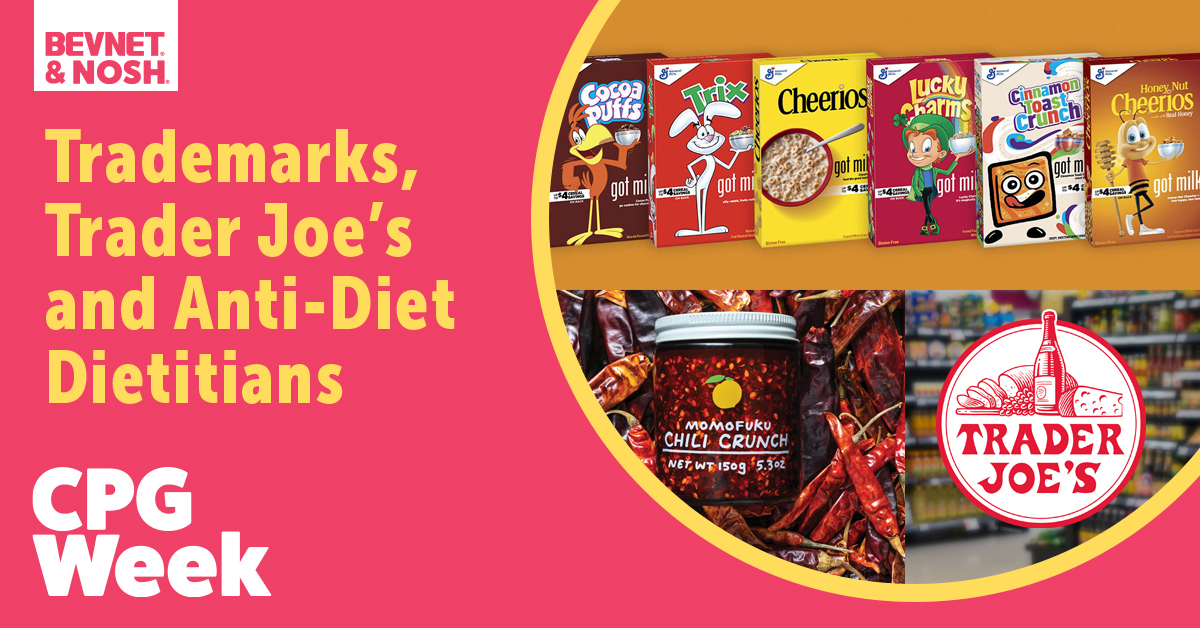
The BevNET and Nosh team discusses three food news stories that have carried industry headlines in the past week. Senior reporter Lukas Southard explains why David Chang-founded Momofuku is getting blowback from other Asian-American brands over a trademark dispute involving chili crunch products. Next, senior reporter Brad Avery discusses an exposé that highlights the questionable innovation stream of Trader Joe’s private label program. Nosh managing editor Monica Watrous finishes the weekly roundup with a conversation around a recent investigative story from The Washington Post that examines how food conglomerates are paying registered dietitian influencers to push anti-diet messaging.
Show Highlights:
0:45 – Hear Brad and BevNET chief marketing officer Mike Schneider’s ode to legumes after accepting Monica’s challenge last week to create an original song about Bush’s Beans.
2:50 – Lukas dives into the chili crisp category and explains how a number of cease-and-desist letters from Momofuku are causing a stir among Asian-American, Pacific Islander CPG brands.
9:20 – All’s fair in love and private label, according to Trader Joe’s. Brad details a recent Taste story that claims the popular grocery retailer might use questionable tactics in its private-label product innovation.
13:45 – Monica discusses a Washington Post investigative piece that sheds light on how major food makers are paying registered dietitian influencers to push anti-diet rhetoric.
About the CPG Week
CPG Week is the podcast that explores the latest happenings in the consumer packaged goods industry. Join our seasoned reporting team as they dish out the week’s stories in quick, easy-to-digest episodes. Catch up on the top headlines of the week, dive into exclusive insights with the BevNET and Nosh teams, and set yourself up to make more informed business decisions. Tune in to stay up-to-date on the latest developments in the dynamic world of packaged food and beverage.
New episodes are released every week. Send us comments and suggestions anytime to podcast@nosh.com.
Show Highlights:
On the CPG Week podcast, the team discuss food news stories involving trademark infringement, Trader Joe’s innovation and anti-diet dietitians this week. Plus, a BevNET original song to baked beans.
Episode Transcript
Note: Transcripts are automatically generated and may contain inaccuracies and spelling errors.
[00:00:05] Monica Watrous: Welcome to the CPG Week podcast by BevNET and Nosh, your source for the latest food and beverage industry news. I'm Monica Watrous, Managing Editor of Nosh, here with my co-hosts, Brad Avery and Lukas Southard. If you're enjoying the show, please subscribe on your listening platform of choice. On the podcast today, we're discussing trademarks, Trader Joe's and anti-diet dietitians. But first, so last week on the podcast, I challenged Brad to enter Bush Beans Musical Fruit Contest with an original ode to beans. And here's a taste of what he and our director and chief marketing officer Mike Schneider whipped up in the Bevinette studio.
[00:00:49] Brad Avery: We're Boulevard of Avery and we're thinking about those beans. I'm always thinking about those beans. They speak to me inside my dreams. They beckon me. They haunt me. They control me. The beans come after me, chase me into a bush. I tried to hide, but they had me microchipped. They forced me to eat them, then I saw the light. Now I can't get enough of those baked beans.
[00:01:32] Lukas Southard: They're nutritious.
[00:01:35] Monica Watrous: We got a sneak peek of this last Friday. And I have to say, I was singing it all weekend to myself as I'm running errands, as I'm cleaning my house. I'm just thinking about those beans. It's really catchy.
[00:01:49] Lukas Southard: You know, I've spent about two months of research working on a feature story that's finally live this week on Nosh.com about how AI is disrupting and transforming the food and beverage industry. You can go there, you can read it now. That feature story is apparently nothing compared to the Bean Song. Everybody loves beans. AI's a little harder to understand, but beans are great. Exactly. Beans, it makes sense. They control you. They speak to you in your dreams. Mike and I wrote that song in like 10 minutes. A real shout out to Mike because it was a real collaborative process. It was both of us coming together to create this.
[00:02:31] Monica Watrous: Well done. I can't wait to see how you do in the contest.
[00:02:35] Lukas Southard: We're going to win.
[00:02:37] Monica Watrous: Today, we're sharing our takes on some food-related features that hit our desks last week from the likes of The Guardian, Taste, and The Washington Post. Let's start with The Guardian's coverage of David Chang's claim to the chili crunch trademark. Lucas, tell us more.
[00:02:52] Martín Caballero: What's in a name, really? For Momofuku, seems like there's a lot. The brand has found itself at odds with the category that its founder, David Chang, has been one of the most recognizable faces of. The Momofuku Empire, which includes its CPG brands under Momofuku Goods, sent out a number of cease and desist letters last month, primarily to Asian American food brands, telling them that they are committing trademark infringement for using the term chili crunch. Now, chili crunch is the name Momofuku and other brands obviously have been using for the chili crisp condiment that's become very popular among American consumers in recent years. Keep in mind, there are a number of cuisines that make a chili crisp condiment. Momofuku's trademark on chili crunch is actually the spelling of Chile used in Spanish. So C-H-I-L-E, not C-H-I-L-I. That's the spelling that's predominantly used among Asian food brands. So the brand is arguing that under common law protections, It encompasses both spellings. And Momofuku has also recently filed another trademark for Chili Crunch with an I late last month. I think it was March 29th. So Momofuku is claiming that it owns the rights to Chili Crunch as a name. But what's interesting is that Momofuku only has the trademark after it was sued by a Denver-based company named Chile Colonial, who had originally obtained the Chile Crunch trademark. took Momofuku to court over the Chili Crunch name, which resulted in Momofuku buying the rights to the name for a reported six-figure sum last year. In March, a number of cease and desist letters went out to Asian American food brands. Malaysian spice and condiment maker Homiya and Chinese street food brand Mila, two of the brands that have received these letters, are contending that the Chili Crunch trademark should have never been granted. Homeia's founder, Michelle Tu, told NASA in an email that, quote, chili crunch has a history that long predates Momofuku's brand, which was first released in 2020, and is culturally common throughout a variety of cuisines from China to Korea to Malaysia. where Michelle Tu's family comes from. The recipe she uses is a five-generation-old recipe that she calls sambal chili crunch. So a spokesperson for Momofuku told ABC News recently, after this issue became pretty big news amongst food publications and general media outlets, their statement said that the company is proud to stand alongside so many AAPI-founded brands, making enormous and long-overdue changes in the space. The statement went on to say, failure to defend our trademark against any size company would leave us without recourse against these larger players who often try to enter categories on the rise. Our goal is and has been to find an amicable resolution not to harm the competition that makes this category so vibrant. So obviously this is a PR statement. It's not really walking back the cease and desist letters too much, and remains a lot to be sorted out in a possibly legal battle. But what I'm interested to hear from you all is, is this a legitimate claim from Momofuku, or does this just feel like a power grab to muscle out competition?
[00:06:34] Lukas Southard: You know, I'm heavily reminded of the Fire Cider lawsuit from 2012. If you'll remember, there was a company that is now out of business called Shire City Herbals that started in Western Massachusetts. And they tried to trademark the term Fire Cider, which is a traditional herbal remedy usually made with vinegar, very spicy. And herbalists, who have been using this term generically for decades or more, and many smaller businesses that have been selling the product in local shops and like, have been using the term. And so it led to a long lawsuit that finally came to a head around 2019. So I see a lot of parallels between that case and this one, where you have, on one hand, a group of entrepreneurs who are saying, this is a generic historical term that has been used in, culture for a long time, and then you have a brand that is on the rise or emerging that is trying to say, no, no, we own it. So I don't know how this will shake out. You know, obviously it's going to come down to is Chili Crunch determined to have the same cultural heritage as, you know, Firesider was determined to by the courts when ultimately the Herbalist won that case.
[00:07:49] Monica Watrous: This chili oil condiment has become so ubiquitous in a number of cuisines and a lot of people jumping to the defense of the brands who received cease and desist letters are drawing comparisons to what if you trademarked ketchup or mustard or another common condiment? It just doesn't seem like it should have been granted in the first place.
[00:08:15] Martín Caballero: This also isn't the first time that Momofuku has tried to Trader Joe of its more popular items. So it's tried on multiple occasions to trademark the name Ssam Sauce, which is one of the kind of signature sauces of the Momofuku restaurants. And every time they dropped it or it was denied.
[00:08:37] Lukas Southard: You know, I think it's a big challenge for this category, though, to have Momofuku effectively fighting against other brands in its category, when together all of these brands have been really working to bring these condiments out of the international aisle and into the broader grocery store. And they've been, so far, pretty successful at it. Now you have bad press against the brand, calling them a, quote, trademark bully in some headlines. So I feel like it's a challenge for everybody when this happens.
[00:09:07] Monica Watrous: Well, this isn't too dissimilar to another story we read this week, this one coming from Taste about a retailer that is allegedly ripping off emerging brands. Tell us more about that, Brad.
[00:09:20] Lukas Southard: Yes, so an article in Taste earlier this month alleged that Trader Joe's participates in a, quote, blatant and aggressive copycat culture. The example at the top of the article involves Brooklyn Deli, an Indian-American condiment company founded by Chitra Agrawal. One of the products at the center of the allegation here is that Brooklyn Deli makes a garlic achar sauce. And now the brand spells achar, A-C-H-A-A-R, which is supposed to be easier for Americans not familiar with the language to pronounce. However, it's typically spelled with just one A at the end of the word. Trader Joe's also spelled it with two A's. That, to taste, and to Agrawal, seemed to be a smoking gun that the retailer had ripped her off. Trader Joe's hasn't admitted to doing this, but other brands have also said they've had similar experiences, where they take a meeting, Trader Joe's expresses interest in having them do private label, and then they don't hear anything, and then see a similar product hit shelves with a Trader Joe's branding in a few months. So Trader Joe's is known for doing private label for almost all the products in the stores. That's part of the appeal of the brand. But it especially wades into tricky territory when you're talking about these emerging ethnic food brands coming from different cultures. And Trader Joe's is seemingly trying to understand these foods and the cultural heritage behind them, but then not working with the founders who they have approached for insight. It's pretty slimy.
[00:10:53] Martín Caballero: The article is pretty in-depth and I agree it doesn't feel right, at least when I read it and I shared it with my wife who's a huge Trader Joe's fan and she was like, Oh, now we can't shop at Trader Joe's anymore. And I think that's maybe a bridge too far, but isn't this kind of what happens with private label? Like when a bigger food company wants to get into a category and they want to formulate a product that they've seen become popular amongst consumers. Isn't this somewhat how it works or is this going too far?
[00:11:29] Lukas Southard: Well, it's funny because speaking of Chili Crisp, Flyby Jing founder Jing Gao is quoted in the article, and she talks about having a meeting with a Trader Joe's rep at Expo West 2022, and they expressed interest in possibly having the brand do private label for them. And she said, why don't you just carry my brand, which ended the conversation immediately.
[00:11:51] Martín Caballero: Which is funny because Trader Joe's does carry a pretty popular item now called Crunchy Chili Onion. which is basically the Chili Crisp.
[00:12:01] Lukas Southard: And you know, Trader Joe's does work with some small brands to do its private labeling, which makes this so much harder because how do you know if you're taking a meeting with Trader Joe's and these allegations have any truth behind them that they're going to actually use your brand or your company to do the private labeling when others have the experience where they absolutely started using them to make a product. So it's a real problem with trust, I think.
[00:12:25] Monica Watrous: We also know Trader Joe's does carry other brands in its stores. Several years ago, it committed to carrying more Black-owned brands on its shelves, and it has followed through. It carries Partake. There's a few others. So why couldn't it just bring Fly-By-Jing onto its shelves?
[00:12:46] Lukas Southard: Perhaps they don't want to have too many outside brands, and they're very select about which ones they allow in. I will also note that this is not the first time a major food industry company has been accused of something like this. There's been a few similar allegations against PepsiCo. In 2021, the adaptogenic beverage brand Droplet, alleged PepsiCo committed, quote, corporate plagiarism with its functional Soul Boost brand, saying that the product was very similar and that PepsiCo was well aware of Droplet. Rise Brewing Company, in its trademark infringement suit against PepsiCo that same year when Pepsi tried to launch Mountain Dew Rise, said that Pepsi was well aware, they talked to them at trade shows, they knew the Rise brand existed. And now this wasn't a coffee, but they were using the word Rise. And they knew that there was a competitor in the beverage space using that trademark.
[00:13:39] Monica Watrous: There's a lot of blurred lines in both of these stories. In this third story that I am going to discuss, it's an investigative piece in the Washington Post that ran last week called, As Obesity Rises, Big Food and Dietitians Push Anti-Diet Advice. And the piece examines the anti-diet movement and how packaged food conglomerates are cashing in by partnering with wellness influencers to promote anti-diet messaging on social media. In one example, General Mills teamed up with a registered dietitian in Kansas City to push its cereals, which include Cheerios, Cocoa Puffs, Cinnamon Toast Crunch, with the hashtag derail the shame. Proponents of the anti-diet approach say it has brought a needed reprieve from toxic diet culture that was so pervasive in the 80s and 90s. But others say it's contributing to rising obesity simply by granting permission to indulge It's actually really complicated. First of all, it's well documented that diets are ineffective. Dieting itself is associated with an increased risk of gaining weight and developing obesity. And research shows anti-obesity bias and fat shaming can actually drive weight gain as well. Demonizing certain foods and food groups is often associated with disordered eating and restrict binge cycles that can cause unhealthy weight fluctuations. Still, is it shady for packaged food manufacturers to co-opt the anti-diet movement to sell more products that contain excessive sugar and fat? Yes. And as a matter of disclosure, several years ago I paid that General Mills-sponsored dietitian to help me overcome binge eating disorder. It didn't work, and in light of this article and all of the other confusing advice about health and nutrition on social media, I actually don't know what to believe anymore.
[00:15:30] Martín Caballero: Well, Monica, first of all, I appreciate you being so candid about your own journey in this really, really difficult space. And, um, it's, it's, it's really nice that you're, you feel comfortable sharing that. Along with that, this, this strikes me as a similar situation to what we see in medicine with doctors accepting money from pharmaceutical companies to push prescription drugs, which just has always rubbed me the wrong way. If the drug is working and the doctors believe this drug is good for the patients that they serve, great. They should prescribe it. They should be trying to get their patients onto these pharmaceuticals. But if there's a financial incentive that's tied to it, it just seems like a conflict of interest that shouldn't be allowed.
[00:16:27] Monica Watrous: Right, it shatters their credibility and it's a scourge on their professional ethics.
[00:16:34] Lukas Southard: To me as well, I think part of the problem is it's about decoupling the idea of being overweight with being healthy. And we tend to associate that just because someone is overweight, it means they're unhealthy. There's ways to do both. Everyone's body is different, and some people may be overweight, but they're overall healthy. Maybe they do eat all the quote-unquote right foods, or they exercise every day, but that is just their limit. That is where their body is, and that is what it is going to be, and having an acceptance and understanding of that is important. I don't think anyone should be shaming anyone else about what they eat. That said, I do think with this food culture issue, what we see here is the co-opting of social justice language and movements by corporations to push their own sales, which is, as we said, I think we can say shady. And I don't like that. I think that there's issues where every individual has to make their own choices about what they eat and understand that Okay, if you have this cake, it's not healthy for you, it could lead to weight gain, but that is what you accept in your choice and your decision. No one else should shame you for that. However, having a paid dietician by a corporation say, go eat that cake that is sold by the corporation, that is a line.
[00:17:55] Monica Watrous: We're journalists and we commit to a code of ethics. We would never write about a food or beverage company because they paid us to. And these content creators with large followings should be held to the same standards.
[00:18:09] Lukas Southard: You know, it goes back to what I was just saying about Trader Joe's. It's about trust. I feel like I've said this a few times in the show now, but it is about trust. And when you erode trust, either between consumers and brands or business to business, it hurts everybody.
[00:18:24] Monica Watrous: Well, this is a pretty heavy episode. We unpacked a lot today. So why don't we go ahead and wrap up. And before we do, here are some other notable bits of news from the week. Ghost and General Mills bring nostalgic focus to protein cereal category. Laird Superfood rides the wave to optimistic future. And NA retailer Boisson files for Chapter 11 bankruptcy and reorganizes to focus on e-commerce and wholesale. For these stories and more, become an insider at BevNET & Nosh. That wraps up this edition of CPG Week by BevNET & Nosh. Thank you to our audio engineer, Joshua Pratt, our director is Mike Schneider, and our designer is Aaron Willette. If you enjoyed the podcast, please subscribe on your listening platform of choice, and we will see you next time.
About CPG Week
CPG Week is the podcast that explores the latest happenings in the consumer packaged goods industry. Join our seasoned reporting team as they dish out the week’s stories in quick, easy-to-digest episodes. Catch up on the top headlines of the week, dive into exclusive insights with the BevNET and Nosh teams, and set yourself up to make more informed business decisions. Tune in to stay up-to-date on the latest developments in the dynamic world of packaged food and beverage.
New episodes are released every week. Send us comments and suggestions anytime to cpgweek@nosh.com.
Stay Informed. Stay Competitive.
Become an Insider to unlock exclusive CPG insights, data, education, and industry exposure for food & beverage leaders.
Industry Analysis
Context behind the headlines
Data & Reports
Category performance & trends
On-Demand Education
Expert-led video courses