CPG Week: Nosh Live Winter Recap
Episode 100
In this episode:
In this episode:
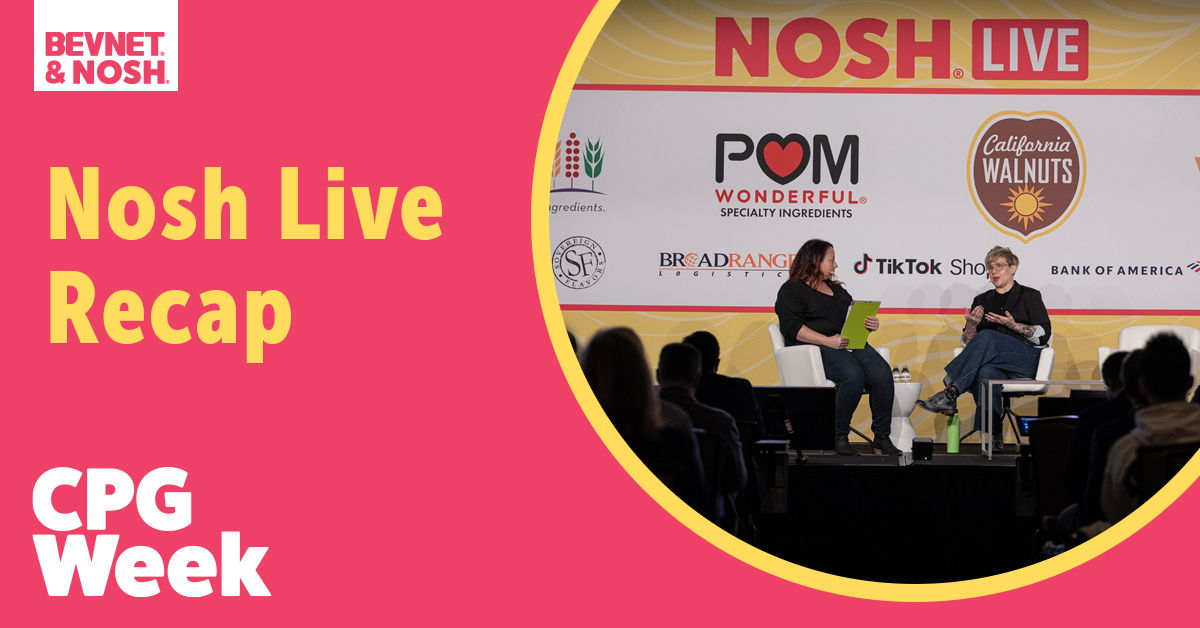
Nosh Live might have wrapped up last Friday in Marina Del Rey, Calif., after multiple days packed with great presentations, lively conversations and amazing networking opportunities. The CPG Week team sat down earlier in the week to chat about all their favorite moments from the two-day event. Nosh managing editor Monica Watrous and senior reporters Brad Avery and Lukas Southard talked about the Pitch Slam, the speakers and the new tattoos some team members got on their day off.
Show Highlights:
0:30 – The podcast kicks off with the hosts’ general impressions of the two-day conference including their love of Lexington Bakes brownies, POM Wonderful’s ingredient innovation and tattoos.
4:30 – The group talks about some of the Pitch Slam presentations. They discuss common themes in the brand pitches and some of the feedback founders received from the judges.
9:45 – The team discusses how there was a common theme running through many panels and on-stage content that spoke to platforming as well as when and how to bring innovation to market in a company’s lifecycle.
17:00 – The podcast finishes up with a quick chat about Lukas’ newfound appreciation for Erewhon’s exorbitantly priced smoothies.
About CPG Week
CPG Week is the podcast that explores the latest happenings in the consumer packaged goods industry. Join our seasoned reporting team as they dish out the week’s stories in quick, easy-to-digest episodes. Catch up on the top headlines of the week, dive into exclusive insights with the BevNET and Nosh teams, and set yourself up to make more informed business decisions. Tune in to stay up-to-date on the latest developments in the dynamic world of packaged food and beverage.
New episodes are released every week. Send us comments and suggestions anytime to cpgweek@nosh.com.
Show Highlights:
On this episode of CPG Week podcast, the team talks about the Pitch Slam, the speakers, the good vibes, new tattoos and expensive smoothies.
Episode Transcript
Note: Transcripts are automatically generated and may contain inaccuracies and spelling errors.
[00:00:05] Monica Watrous: Welcome to the CPG Week podcast by BevNET and Nosh, your source for the latest in food and beverage industry news. I'm Monica Watrous, Managing Editor of Nosh, here with my co-hosts, Brad Avery and Lukas Southard. If you're enjoying the show, please subscribe on your listening platform of choice. On the podcast today, we are talking about all things Nosh Live, which just wrapped a few days ago as of this recording. And how are we feeling about it, guys, now that it's over? Brad?
[00:00:34] Brad Avery: Feeling pretty good. We are, at the moment of recording, about to head into BevNET Live. By the time you hear this, that will be in the past. But right now, we're just thinking about how well Nosh went as well. because it really was a ton of fun. I think some really great on stage moments and especially you and I on this week's community call also talked a little bit about your Jennifer Gardner sit down talk.
[00:00:58] Monica Watrous: Yeah, I definitely had so much fun the whole time we were on stage and networking and judging. I was part of the judging panel for the Pitch Slam. This was the best two days of my life in recent memory. So Lucas, what about you?
[00:01:11] Lukas Southard: Wow, best two days of your life. What a glowing Nosh live response. I had a lot of fun as well. I don't know if I'd say the best two days of my life, but... Okay, I'm feeling a little weird about saying that now.
[00:01:23] Brad Avery: Oh, Lucas. Wow, way to bring the energy down.
[00:01:26] Lukas Southard: No, I said I had a great time. Well, I wouldn't say it was the best day of my life or the best two days, but it was, in my opinion, one of the most successful Nosh lives that I've been a part of. I thought our content on stage was pretty spectacular. I know I learned a ton. I thought there was just like a lot of good energy. It felt like everyone was having a good time. There was a lot of good things to eat, which is kind of important for Nosh Live. And all in all, I think the response that I've heard from everyone was that it was very successful.
[00:01:55] Monica Watrous: So talking about good things to eat, what was the favorite thing that you noshed on?
[00:02:00] Lukas Southard: My favorite thing that I noshed on, well, I mean, I have a soft spot for sweets and Lexington Bakes was there, so I did maybe possibly stash away a couple brownies in my hotel fridge that I've been slowly eating my way through.
[00:02:15] Brad Avery: I do really like those.
[00:02:16] Lukas Southard: They're very, very good. They're very good. I think I only had two of the three flavors that were available because they went quick. I mean, they were gone. I wasn't able to get to them all.
[00:02:24] Brad Avery: Speaking of brownies, I sat in on the palm breakout session where they walked through how they're now using pomegranates as an ingredient to replace certain things like cocoa or even the ability to use it in pizza sauces where you're not going to notice the pomegranate flavor all that much, but it's going to really give you an alternative. So you can make a brownie, which they did, with less cocoa, more pomegranate. And we tried samples, and they had a control that was a full cocoa brownie and a palm version, and almost couldn't tell the difference in a certain way. And in some ways, I would say the palm one, it was a little chewier and nicer in some ways. What really blew my mind was, I think they're calling them bao buns, but they're sort of like a hot pocket, like a sausage pizza. you would not know pomegranate was in there at all.
[00:03:17] Lukas Southard: Shout out to Lex Evans. Maybe you need to be talking to the palm people about getting some of that pomegranate brownie in your formulation.
[00:03:24] Monica Watrous: No notes for Lex Evans. Everything that he makes is amazing. That is really interesting, though. I had no idea that pomegranate was so versatile. Yeah, that's what I learned.
[00:03:32] Lukas Southard: And also, probably less importantly than the ingredients, was Pom also was giving out some really cool pomegranate squish balls. Oh, those are still around. Post-show, we're still seeing them. I grabbed a couple because I know my kids are gonna have a really good time throwing them at each other.
[00:03:47] Monica Watrous: I could've used one of those pomegranate stress balls when I was getting my tattoo yesterday. You guys both got tattoos. We did. Not together, though. No.
[00:03:56] Lukas Southard: Yeah, three tattoos were gotten by the Nosh and BevNET team yesterday on our day off. I know Shana and you, Monica, went together. I went with my brother separately to get a corn dog was tattooed on my arm. What did you get?
[00:04:09] Monica Watrous: I got a queen of diamonds and Shana got a lovely bouquet of wildflowers. And rumor has it there will be BevNET themed temporary tattoos at BevNET Live.
[00:04:19] Lukas Southard: Oh, so does this get me off the hook of having Tattoo CPG Week on my back like we talked about? No, it does not. No, you still have to do that. Absolutely not.
[00:04:26] Monica Watrous: But back to Nosh Live. So we mentioned the Pitch Slam earlier, and that was easily a highlight of the two days for me just getting to deliberate with the fellow judges. We had Arnulfo Ventura, who's like really well known in this industry for a number of reasons, but he's currently with City Capital. We had Lisa Tosin, who is a buyer at Whole Foods. And we also had Luke Abbott from V Driven, which sponsored the event. And the four of us had a very tough job of sampling and judging six amazing brands. The crop of finalists were fantastic. I don't know, did you guys get a chance to try All of the brands were fantastic in terms of the presentations that the founders delivered, but also the products themselves were so tasty and innovative.
[00:05:12] Brad Avery: So when you have a competition that close, what made the difference in choosing the winner? Why did they win? Oh, we flipped a coin. Really?
[00:05:21] Monica Watrous: No. It was so hard that we, you know, joked about it because it was very close. And ultimately, some of the things that we were looking at were how much runway does this Brad Avery? Are they ready for prime time in terms of mass market appeal and the ability to produce at scale? And is the consumer going to understand the product and Some of these products are a little on the cutting edge, like the winner, Mochi Love, which produces a refrigerated take on mochi ice cream. In this case, it's creme clouds. Brad, you were saying when we were talking during the community call recording just now that you were expecting that it was ice cream because of the format that you're familiar with, but were surprised when you grabbed one out of the refrigerator and it was Actually, a softer dessert.
[00:06:10] Brad Avery: Yeah, and it was still really good, but it sort of was not what I expected. And you can hear us talk more about this on this week's Community Call with Melissa Traverse, but I said there that I think the big challenge they will have ahead of them is that American consumers are kind of just learning about mochi, and they're learning about it as an ice cream product. And I'm clearly in that segment because I thought this was going to be a bite-sized mochi ice cream. So when you have consumers already learning something new and coming out with a twist on it already, there's going to be some confusion. And I think that's the big challenge that's going to be ahead of them is educating on that.
[00:06:50] Monica Watrous: And that was another point with one of the finalists, Chutney Punch, which is a fantastic product. It's an Indian-inspired seasoning, and it's packaged in a glass jar. So you use a spoon to sprinkle it out onto whatever application. Sahithia Winrich, who's the founder of Chutney Punch, was talking about it as an alternative to salt and pepper, just a traditional seasoning that you can use on anything. But the packaging is a little tricky for consumers to make that connection. And so one of the pieces of feedback that we had for her is, why don't you consider a jar with a shaker top? So people understand that this is a seasoning that can go on anything that you would put salt, pepper, or garlic powder, that sort of thing.
[00:07:33] Brad Avery: Sometimes it is just like the simple little things like that that really make the difference.
[00:07:38] Lukas Southard: Well, and I think it's a fair point to talk about positioning, especially with some of these new products that kind of go into the ethnic food category. And Ducero is another one that has a great product, really snackable, but you do have to factor in that there's going to be some consumer education that's going to come with it. And not only just consumer education, but also Where are you going to land in the store? You know, what are you going to be positioned with on shelf or in the refrigerator? And these are the important decisions that these brands have to make as they start scaling up and growing outside of the startup phase and into this emerging you know, category.
[00:08:14] Monica Watrous: And that was a big part of our conversations, too, was is the packaging enough that in 1.5 seconds, the shopper will understand what they're looking at? And in several cases, we determined and spoke with the founders afterwards that, hey, maybe consider your hierarchy of call outs on the packaging or where it's merchandised to help the consumer cross that bridge to figure out what it is.
[00:08:38] Brad Avery: I think for me, I always feel like the key to building something successful is not to throw the kitchen sink at a product, but to take one or two things from something that people already know and change just one, two things at the most. And if you look at another one of the Pitch Slam competitors, Newish, that's a matzo ball soup in a cup. And it's basically taking something that is familiar to a a core consumer base of matzo ball soup, a traditional Jewish food, and then taking it in a format that's pretty common nowadays, like the dried ramen cup, and it's just marrying the two. And so it's intuitive, at least for me, like I understand this, I see like, oh, you just add water, soup. But it's something we haven't seen before, which is a matzo ball soup like that.
[00:09:23] Monica Watrous: But at the core, it's something that is very in demand among consumers, which is convenience. And it offers a solution that isn't present in the market. So while it is something that Sarah Nathan, the founder, is going to have to educate consumers on, to your point, it already benefits from being an accessible format.
[00:09:41] Lukas Southard: Brad, it makes me think about something that was said in one of our sessions, the re-founder, I should say, and CEO of Aloha, Brad Sharon, was talking about doing something well. And that doesn't mean you can't go into other categories, because Aloha does have powders and they have protein drinks, but what he focused on when he took over the brand in 2017 was really making that bar that they're known for the best thing and doing it really well and then building from there. And I think that's part of it is just really knowing like what you're doing and building something really great out of that. And then you can build from there and you can bring in new categories or you can bring in new formats and you can really expand from that. But if you do that well, then you have a good base to build from.
[00:10:28] Monica Watrous: And that's also echoed in the conversation that I had on stage with Jesse Merrill, the founder and CEO of Good Culture. He started with a great product, and it's carried into this big wave of Americans seeking more protein-based snacks, and Good Culture is really benefiting from that.
[00:10:48] Lukas Southard: And also creating a dairy platform. I mean, he started with cottage cheese, but now they're moving into sour creams. You can now build out from a brand that has developed a consumer base that has evolved a following and has name recognition to then portfolio expansions that really can make the brand bigger than just cottage cheese or the one category it started in.
[00:11:09] Brad Avery: And I think it's important that they're doing that now because I feel like I see a lot of early stage brands that try to do that out the gate. Like we're going to split our focus into two or even three different categories. And I understand when you establish a brand, you want to be able to have a platform. You want to be able to have something that could be versatile so that you could one day add those additional categories. But so many people try to do it way too early. I think it's interesting to see a brand that sort of waiting for the right time and learning to focus on the core before you can really earn the consumer awareness and the trust and name recognition that will allow you to become the platform brand.
[00:11:51] Monica Watrous: I was actually in the judging room deliberating on the Pitch Slam winner during a panel that was moderated by our colleague Shauna Golden featuring Lauren Castle of Sweet Lauren's and Flyby Jing's Jing Gao talking about platforming.
[00:12:05] Lukas Southard: It was a really interesting conversation. I was in the attendance for that session and I think one of the really important parts of that conversation that both Jing and Lauren agreed on was that The timing has to be right to build a bigger platform than what you started in and to move into other categories. Sometimes it might seem like the right time and you'll try something out, like Jing was talking about, launching dumplings. But what FlybyJing is known for is it's chili crisp and wanting to be kind of more of a sauce. Seasoning brand, but they did these dumplings to see and she said they did really well. They were very successful, but there was some difficulties and challenges to operate in a category that Doesn't have the same distribution isn't in the same part of the store and and she realized you know what maybe for now Dumplings is not where we need to be but instead now they're doing the shelf stable like ramen style noodles with with their sauces and and That really works. And that is more in the wheelhouse of what Flyby Jing has been built on and what it's used to doing and knows how to do well. And so it's building from there. And then maybe eventually she'll get back to dumplings. But for now, that portfolio expansion is what really worked. And same thing for Sweet Orans and moving into other types of refrigerated doughs where it's a cookie dough brand, like they, they want to be in other doughs and it makes complete sense. And that's what the consumers were asking for. And it was the right time for that brand to scale into these other categories.
[00:13:37] Brad Avery: You know, it's funny, I've asked the question to founders and CEOs before about, you know, why did you decide to get into XYZ category now? And the answer has sometimes been, well, the consumer gave us permission, or this is what the consumer asked for. And sometimes that can be kind of an odd answer, especially someone who's not a founder myself, to hear the word permission thrown around like that. But the more you think on it, the more true it does become. It's like, do you have permission from the market for your brand in particular, your company, to get into this category. You are in energy drink, and now you want to do a sleepy time tea. Do you have permission from the consumer? Is that really what your consumers want? Is another big question that you know, you should ask and you know, not just you know, think about it for five minutes, think about it for five months, think about it for five years, even.
[00:14:29] Monica Watrous: And this is something that was discussed during the presentation with the CEO of Rudy's, Jane Miller, and the Chief Innovation Strategy Officer of Rudy's, Justin Gold. They were talking about their experience expanding from a bread company into these value add frozen products, like Texas Toast and Sandoz, which is like a PB&J type play. Oh, I did try those. Those are good. Yeah, they are. But it's, you know, it does take a lot of discipline and thoughtfulness in terms of deciding not only if the timing's right, but what makes sense for this brand. And I think they've identified some real opportunities and white space where their brand proposition can deliver.
[00:15:13] Lukas Southard: What I got from the Rudy's presentation was also just the balance that has arisen from those two working together. Jane and Justin have this rapport that is just so organic and natural, and they riff off each other, but they also kind of temper each other's instincts. You know, one wants to go fast, the other wants to go slow, and suddenly they're going at the right speed. It doesn't always happen for every brand, but when it does happen, using that strength and leaning into that strength can really be what takes a brand to the next level and yields success in the long run.
[00:15:45] Monica Watrous: I would really love to see Jane and Justin in some kind of buddy comedy movie or television show. Their dynamic was so fun to watch on stage. Like a Starsky and Hutch kind of like cop drama maybe or something? Yeah, yeah, or The Odd Couple. I don't know. But no, they were great because they were so full of wisdom. Justin, of course, from building his Nut Butter brand, Justin's, and Jane from leading not only Rudy's twice now, but Lily's Sweets to its exit to Hershey and a number of other leadership roles in CPG. And so for them to come to our event, get on stage and distill their wisdom to our attendees was such a thrill.
[00:16:26] Lukas Southard: Yeah, it was really fun watching them. And I cornered them after their presentation. I was like, kind of just want to hang out at like a dinner and not because I want to be at dinner with you, I just want to witness you two having dinner together and they're really like lovely energy that they have in how they talk to each other and how they kind of play off each other and hopefully are going to build some really, really interesting stuff at Rudy's.
[00:16:48] Monica Watrous: I believe they will and they already have started and I'm really excited to see what's to come from that brand.
[00:16:53] Lukas Southard: Yeah, I tried getting the scoop out of Justin, but he knows better than the teller reporter what he's been cooking up in their innovation labs.
[00:17:01] Monica Watrous: We'll see soon enough, probably at Expo West.
[00:17:03] Lukas Southard: I hope so.
[00:17:04] Monica Watrous: Well, I think that's a good note to end on. Now, before we leave LA, Lucas, how many more Arowan smoothies do you think you're going to get?
[00:17:11] Lukas Southard: For the record, I've only had two, but I did have one. That's like $50. Did you get a raise? Don't tell the bosses, but I think I'm allowed to expense them because it was my breakfast. Maybe I'll have another one. The second one I had, the activated smoothie, was pretty good. I don't know if I would pay $20 for it on a regular basis, but it was great after a long run on the beach. So well done, Erewhon. That's the most I can say. He's been activated. I've been activated. Like a sleeper agent. Erewhon, if you're listening, I will develop a smoothie. I don't know if my branding will go a long way for you, but if you want a Lukas Southard branded smoothie, I will take all calls.
[00:17:50] Monica Watrous: Well, insiders can tune in to the recordings of all of the sessions from Nosh live at Nosh.com. That wraps up this edition of CPG Week by BevNET and Nosh. Thank you for tuning in. We will see you next time.
About CPG Week
CPG Week is the podcast that explores the latest happenings in the consumer packaged goods industry. Join our seasoned reporting team as they dish out the week’s stories in quick, easy-to-digest episodes. Catch up on the top headlines of the week, dive into exclusive insights with the BevNET and Nosh teams, and set yourself up to make more informed business decisions. Tune in to stay up-to-date on the latest developments in the dynamic world of packaged food and beverage.
New episodes are released every week. Send us comments and suggestions anytime to cpgweek@nosh.com.
Stay Informed. Stay Competitive.
Become an Insider to unlock exclusive CPG insights, data, education, and industry exposure for food & beverage leaders.
Industry Analysis
Context behind the headlines
Data & Reports
Category performance & trends
On-Demand Education
Expert-led video courses