Starday Foods’ AI-Approach To Becoming The ‘Next Great Food Conglomerate’

How does a food company disrupt the center-store? Starday Foods is asking the machines.
The New York City-based company is using a proprietary artificial intelligence (AI) platform to find where there is pent-up demand in packaged food and quickly launch new products to meet that need.
“We’re using data science under the hood to predict product market fit,” said co-founder and CEO Chaz Flexman. “We start with the consumer first and try to understand their needs – whether that’s dietary or an ingredient or nutrition – and find where those trends are bubbling from.”
Launched in 2021, the company has accumulated a powerful investment group, which includes entrepreneur Tristan Walker, Instacart CEO Fidji Simo and Instacart founder Max Mullen. Initially incubated within a VC, the company raised $4 million in 2021 in a round led by Equal Ventures and Slow Ventures with additional funding from Haystack, Great Oaks Venture Capital, XFactor Ventures, ABV, Revolution, Vinyl Capital and a group of angel investors.
Starday has created a streamlined process of product development using its AI platform. The software uses different consumer profiles, online conversations and sales data to understand where food trends will develop. The model shortens the production cycle and outpaces what is traditionally brought to market.
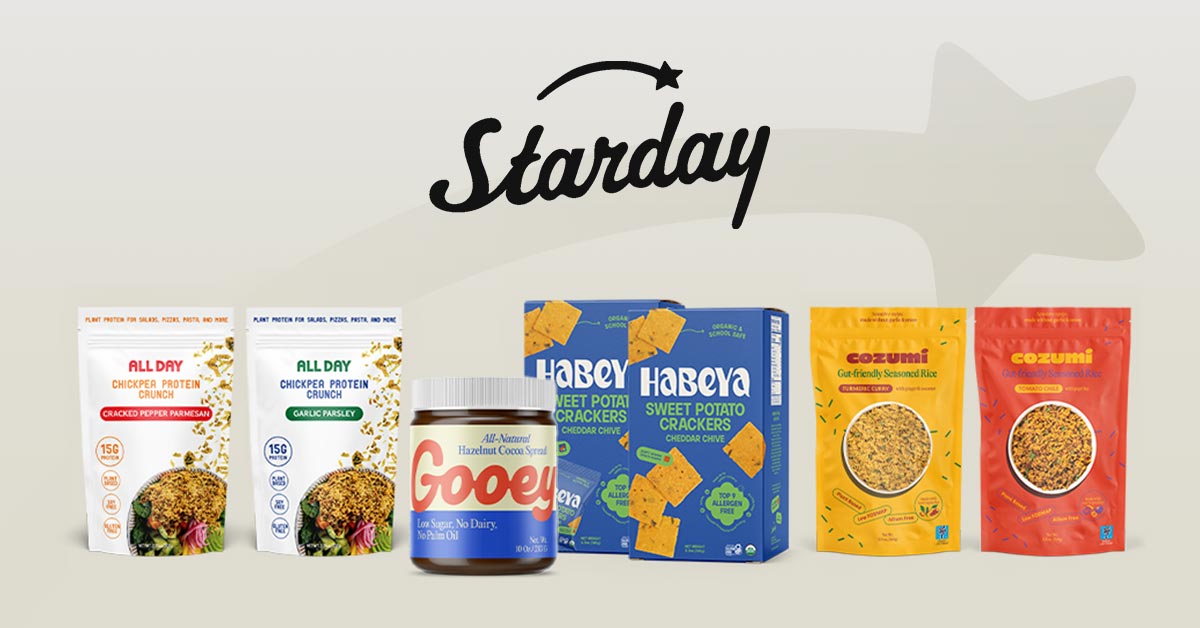
Currently, the company has founded four center-store-positioned brands: hazelnut cocoa spread Gooey, chickpea-based protein seasoning All Day, low-FODMAP seasoned rice blend Cozumi and, its latest product, allergen-free sweet potato crackers Habeya launching this month. The company’s various brands are available at Sprouts, Target, Whole Foods Market, Walmart and The Fresh Market.
The business model uses consumer tracking data paired with online insights scraped from cooking blogs, social media and restaurant websites to anticipate trends. For example, over two years ago, Starday Foods’ platform picked up on an emerging trend towards soy-free and high-protein foods and formulated All Day quickly to meet that need.
“It’s almost like finding those trends before they’re obvious and being able to meet that consumer demand with the right products on shelves,” Flexman said.
Not only is Starday tracking product-market fit and pent-up demand, but also the business uses a separate piece of software that acts as a retail database to track other metrics for launching new products.
“It helps us understand price-pack architecture, price per ounce, or certain claims where there’s white space,” Flexman said. “It creates a framework for the product development and some of those specific specs that we need to make sure we’re in line with and what the market would expect from pricing.”
When it comes to retail execution, Starday uses its proprietary tools to identify the proper influencers and communities that might be most affected by the specific products. Yet, once the products hit shelves, the company relies on typical in-store marketing and consumer education to drive sales, a company representative said.
As with any machine-learning software, Starday’s platform is constantly evolving to understand specific consumer groups. It is now being custom-tailored so that the company can work directly with retail partners and use its data models to find where the retailer could capture more share in certain categories.
Flexman describes the model as being a “category captain for innovation” and building products with retailers that fit a specific need that goes further than just one health claim or category.
“Gut health is a trend, but figuring out what the right SKUs are being put on-shelf is like throwing darts against the dartboard and seeing what sticks,” he said.
By using Starday’s IP software platform, retailers can see not only the right product to launch but one that would resonate with the specific consumer that shops in those retail stores. The model goes further than what can be gleaned from Circana or NielsenIQ datasets to build out a new brand within a tight nine-month timeframe.
One of Starday’s key value propositions is its speed in finding those insights.
“The product development cycle can take so long,” said Starday advisor Orchid Bertelsen. “You need to have a couple of pokers in the fire in order to understand what’s going to take off versus what is not.”
Oftentimes, startup founders launch a brand because they were trying to create a solution for themselves, Bertelsen said. “Sometimes that problem is large enough that their business takes off, but sometimes what they create a solution for is so niche that the company fails.”
Although Starday designed the platform for packaged food and has no intentions to move into other categories, the product development model could have the potential to be used in other industries, Bertelsen said, “because the level of difficulty of food is inherently higher. There is nothing more intimate than food because you are consuming it.
“If you can do it with food and have the information so you’re not wasting time on the restrictions imposed by the category, you can do it anywhere.”