Investment Analysis: As a Dry 2024 Ends, Brands Should Invest in Self-Love


The great winnowing continues. Unilever is looking to spin out its ice cream brands, while Nestlé has announced it’s going to turn its water brand portfolio into a separate company.
Meanwhile, the big brands continue to do-si-do with different product lines – and their accompanying workforces – in an attempt to raise share prices and arbitrage their future. Take Kellanova and its army of snack brands, now getting rolled into Mars. Or Our Home Foods, which picked up Pop Secret and Parm Crisps from Campbell’s and Hain Celestial, respectively. Hain also unloaded Thinsters to J&J Foods.
We know that kind of big-brand portfolio reshuffling isn’t going to all of a sudden clear a pathway to acquisition for tiny brands to get scooped up by huge food concerns – at least not right now (see below for a potential version of that becoming reality). Instead, strategics are looking for those billion-dollar acquisitions that can bring them tangible revenue gains.
To a large extent, the time for being big for bigness’ sake is over, notes Steve Young, Managing Partner of Manna Tree, which backs mid-sized consumer growth brands like Health-Ade and Good Culture.
A lot of the portfolio winnowing and brand-trading taking place is happening as the large consumer strategics are starting to reshape themselves as more streamlined, focused entities, according to Young.
“It’s addition and growth via subtraction,” Young said. “It’s a question of ‘what are we really good at?’”
For a while, the mantra at a Coca-Cola or a General Mills was “Let’s just get bigger,” Young adds. Now, General Mills is focusing on its long-held strengths of processing doughs, flours, cereals, grains, everything from pizza crusts to pet food, and selling off its Yoplait business. The buyer? Lactalis, a dairy company, that is really good at selling yogurt, he adds.
Big Food Seeks Big Revenue
Strategics got a break during the pandemic, it should be noted, when their powerful distribution systems allowed products to get to shelves despite lockdowns and regular interruptions that many smaller brands couldn’t handle. At the same time, however, the bigger products and SKUs got more line time, truck space, and shelf space – almost setting the stage for the back-to-the-core movement Young describes.
So what does M&A look like around entrepreneurial brands right now? Look at two big acquisitions in the past quarter.
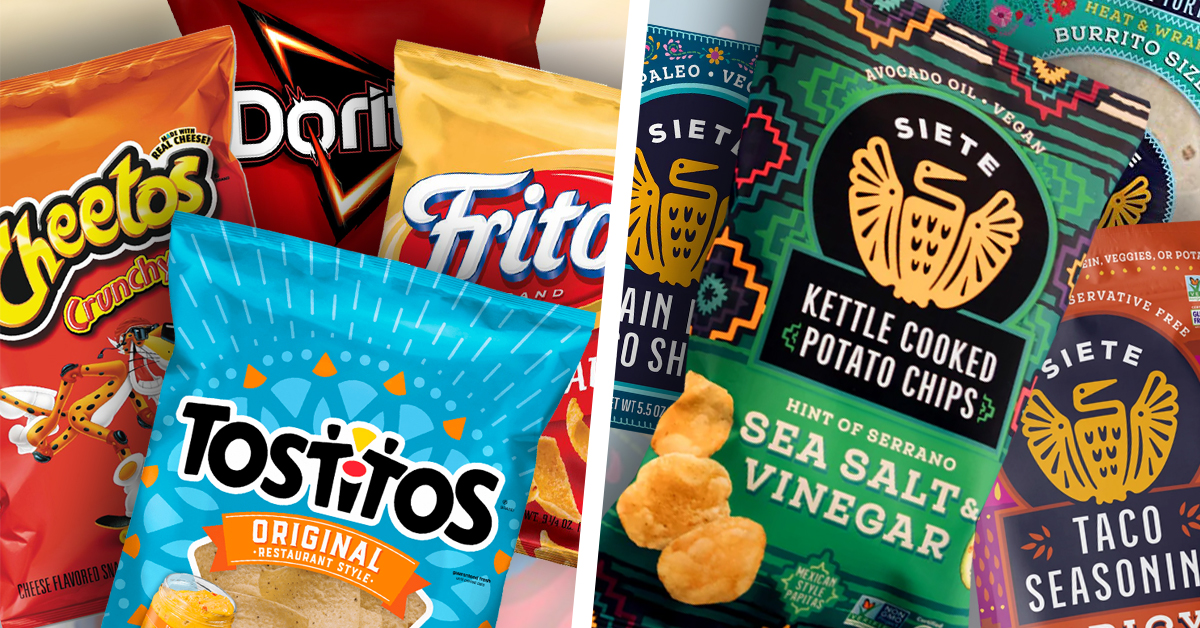
First, PepsiCo spent about $1.2 billion to buy better-for-you Mexican food platform Siete, a brand that layers into its portfolio at a premium to its Frito-Lay category-killer Doritos but still sits firmly in innovation-friendly channels and sets. Siete’s annual revenue was expected to hit about $500 million this year, according to Inc. Magazine. That’s peanuts compared to, say, Fritos, but significant nonetheless – especially if it manages to extend its growth throughout conventional channels or foodservice.
A few weeks later, Keurig Dr Pepper announced it was buying a majority stake in energy and nutrition brand Ghost, a brand that is expecting revenue of about $600 million this year, according to co-founder Dan Lourenco, via robust energy drink sales as well as a growing isotonic portfolio and a foot in the supplement space. That 60% stake cost roughly $1 billion, with another $250 million or so to buy Ghost out of its existing distribution network, with a preset valuation for the other 40% in 2028 when the purchase is complete.
That slots in with KDP’s other recent investments, including C4 maker Nutrabolt, which cost KDP $863 million for about 30%. (KDP did invest in a smaller company, Athletic Brewing, but if nothing else, KDP has proven to be a savvy investor, making money speculating on brands like Body Armor and Vita Coco, both of which it sold at a nice profit).
Both pickups fit acquisition parameters that big company CEOs have set out in earnings calls in the past year or so – M&A isn’t off the table, but it’s got to move the needle.
Meanwhile, those small brand investments that were in vogue between about 2008 and 2018 have faded. Coke’s Venturing and Emerging Brands division has been renamed “New Revenue Streams,” while General Mills’ 301 INC is now Gold Medal Ventures, and what had been a focus on venture investment in startups is now a focus on larger, top-line impact for shareholders via much larger brands. General Mills CEO Jeff Harmening recently announced he had about $2 billion in acquisition cash ready to go – and you can bet it’s not going to be for a kale chip brand this time. Shareholders want to see something like Fairlife, a joint venture Coke pioneered to get into the dairy case, one that is continuing to pay off as the brand’s high-protein smoothies have become a hot item in the age of Ozempic.
Wait, What About VC?
So how does that affect you, the CPG entrepreneur? For the most part, it isn’t going to, at least not for a long time.
One VC investor, Barrel Ventures’ Nate Cooper, has been posting to LinkedIn with stats under the heading “CPG is Hard” – he made the point that there are only about 80 $1 billion revenue brands in retail, and fewer than 500 with scanned revenue above $100 million.
But that’s the area where big companies seem to want to play now, with a few exceptions (Young points to Mondelez’ SnackFutures unit as an active internal VC, for example.) But what’s clear about both deals, and from recent corporate word and deed, is that the revenue level for most strategic investment targets is a far sight higher than the $10 to $20 million revenue that Coke and PepsiCo and General Mills seemed to look at as proof of concept during the big VC innovation era, the one that saw small brands like Zico and Health Warrior and Rhythm Superfoods get investment from strategics, only to ultimately fail to thrive.
So is the era of corporate VC ever coming back? That’s what we referred to earlier, and the answer is… maybe? As the big brands start to clear the decks of non-core products, they might move back toward investing in innovation – only in their core focus areas. That could extend from small investments to bigger M&A: the field of potential strategics might narrow a bit, Young said, but the alignment would be clearer.
One thing that hasn’t come back yet – but which investors swear will eventually return – is institutional-level venture capital.
I recently combed through the deal records on FABID, a consumer-focused investment tracker started by the indefatigable Ryan Williams, and over a roughly 180-day period ending Nov. 24, private equity and VC investments in the entire consumer sector – not just food and beverage, but food tech, supplements, and booze, too – totaled less than $700 million. FABID doesn’t capture all of the action, but it does illustrate a huge downward trend: $2.4 billion over the 365 days leading back to Nov. 24, 2023; $3.6 billion over the 365 before that, $6.3 billion the 365 days before that; the records don’t extend backwards past Jan. 1, 2020, but in a little less than 11 months, FABID tracked $6.1 billion in investment.
The reasons for this are well established: as part of its battle against inflation, the Fed raised interest rates, making it much easier for investors to collect interest, and making capital for brands much harder to come by. Consumer funds themselves have been slower to close. Higher borrowing rates for banks mean fewer loans and costly adjustments to lines of credit that provide working capital. Also, people got sick of investing in plant-based meat and food tech, although, quarter-to-quarter, those are still the biggest investments we see on FABID.
Seeking Self Love
It’s not going to be this way forever; interest rates have already begun to drop, as inflation is slowly coming under control. Premium products continue to grab consumer attention. Brands will break out – some will even raise based on their potential, not their longtime results, and investors will, as they say, “white knuckle it” until a hot brand either transacts or goes down the tubes.
Almost uniformly, investors I spoke with continued to emphasize the key metric of a self-sufficient brand: unit cost efficiency. Sustainable, high margins of at least 40% at wholesale, and a view of profitability that requires hopping a stream rather than fording the river.
If that mantra sounds familiar, it’s not necessarily meant to be a warning. Both well-funded late-round VCs like Young’s Manna Tree and scrappy brand advisors with small funds like Elliot Begoun of TIG make it clear that founders should keep the notion of growth capital from investors and operating capital from your business on separate tracks.
Begoun, as he tends to write in his regular missives to brands, recently put it as bluntly as he could: “Ninety-nine percent of the brands in our industry are not suited for traditional venture capital financing. Yet, repeatedly, founders show up to investor meetings hat in hand with structures and terms that necessitate an exit to monetize the investment. Most get a no, and the few that get a yes find themselves accelerating forward in a way they did not intend.”
Young puts it another way, saying that brands that have good unit economics, that operate profitably “control your own destiny. I’m not in a spot where someone else calls the shots for me.”
In the meantime, when I speak to VC investors, they tell me they’re giving the love and the money to the winners in their portfolio. Everyone loves a winner, while a lot of brands – still – remain desperate for love from investors to survive. But the message is clear: before someone else is going to love you – in a portfolio or on this strange food and beverage brand-based planet – you’re going to have to love yourself.