Plant-Based Meat Startup Tender Food Names Former Oatly Prez as CEO

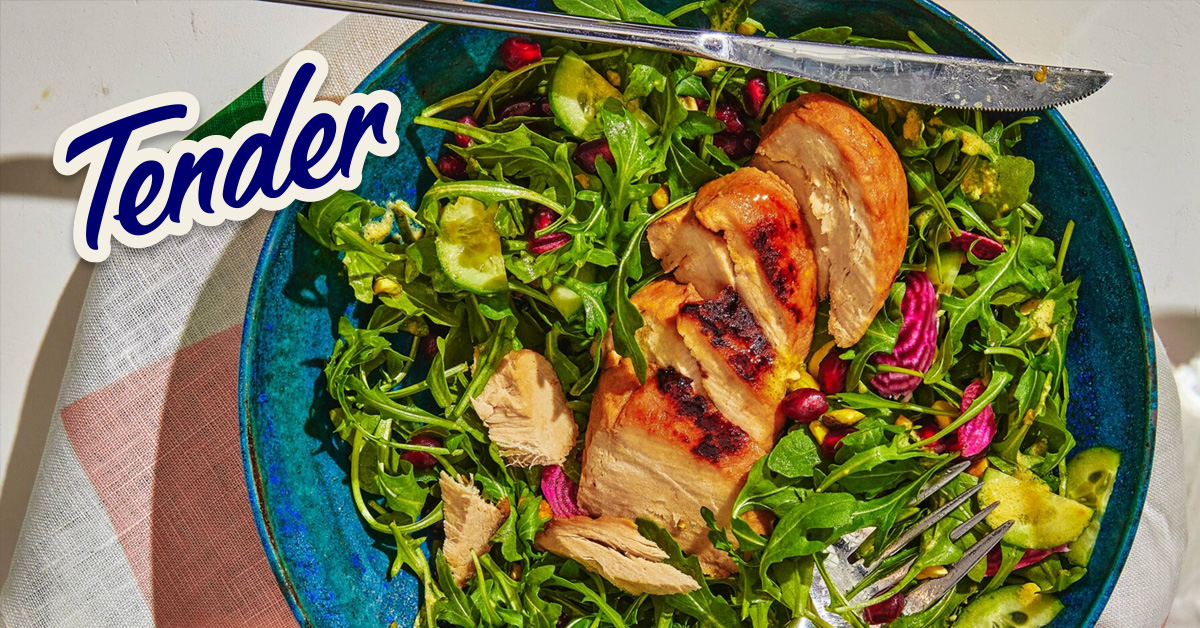
It’s no secret that the plant-based meat category has faced some strong headwinds of late. But Somerville, Mass.-based startup Tender Food believes it has developed a lower-cost, more animal-like product that it says can disrupt the space and help right the ship for meat alternatives – and it’s brought on former Oatly president Mike Messersmith to lead the charge.
Messersmith, who left Oatly in February after seven years leading the oat milk brand’s North America business, joined Tender Food as a board member this spring before being appointed CEO about a month ago, taking over the role from co-founder Christophe Chantre.
“Mike’s appointment as CEO represents a major success marker for Tender…. He has a deep background in scaling purpose-driven companies and building world class organizations,” said board chair Carsten Boers, who is also the managing partner of Rhapsody Venture Partners, in a statement. “Tender has the opportunity to utilize its powerful technology platform to bring a whole category of breakthrough plant-based products to market. Gaining Mike’s experience in leading Tender through what’s ahead will greatly accelerate this next phase of the company.”
Speaking to Nosh this week, Messersmith said he believes that Tender Food has solved for two of the biggest issues that have plagued other modern plant-based meat brands: sensory experience and input cost.
Founded in 2020 by Harvard doctoral students, Tender Food uses proprietary technology that spins plant fibers and protein into meat-like products with textures that it claims more closely resemble their animal-based counterparts than top competitors. The company launched its first products into local Boston area restaurants last year and is now in about 20 locations around the region, with shredded pork, beef and chicken alternatives, as well as a whole-cut chicken breast in its portfolio.
“The barriers that exist that we’ve tried to solve against are that the taste and texture isn’t right on the product,” he said. “Fundamentally, in a lot of cases, I think it’s over-processed and over-engineered food. People reject that – they want simplicity, and that’s across the industry right now.”
Tender’s process also allows it to avoid using thickeners and binders, which Messersmith said gives some meat alternatives a mouthfeel like “Play-Doh,” while sticking to a limited ingredient deck of fava bean protein, peas, barley, rice, seasonings and, fittingly for him, oat fibers: “I can’t get away from oats,” he joked.
According to Messersmith, Tender uses a customized machine that is about “the size of a washing machine and costs less than a new car” to make its products – noting it cost less than $100,000. While the company is not yet seeking to manufacture at a national scale, he contrasted the production method with the far more expensive extrusion processes used elsewhere in the industry (which is used by both Beyond Meat and Impossible Foods), which leads to higher prices in retail and significantly tighter profit margins.
“We’re trying to build something that is like a robust and defensible value-accretive technology platform that then you can build some great consumer brands on top of,” he added.
Tender Food is finalizing a Series A funding round, Messersmith said, and has received investment from Rhapsody Venture Partners, Lowercarbon Capital and Safar Partners.
Tender’s products are currently available in all Clover Food Lab locations as well as local Boston restaurants like Saus and Mamaleh’s, where it’s looking to also build brand awareness by featuring the Tender Food name on menus. Messersmith added that Tender has several culinary-focused team members who can help in discussions with restaurants, people who “talk the talk” and can help customers figure out the best ways to add Tender’s products to their menus.
The company had previously been producing in commercial kitchens, but now works with Rhode Island co-packer Plants to Food, Messersmith said.
However, a retail launch isn’t in the cards yet. Instead, Messersmith said he wants to take a similar approach to how he established Oatly when he first joined the oat milk brand in 2017: Focus on foodservice and establish the brand through word-of-mouth and in-store trial. Although Oatly, he said, was unprepared by the sudden and rapid spike in demand for oat milk, Messersmith feels Tender is well-positioned to grow with a slow and steady approach.
While retail could still be an option in the future, Messersmith said he also views the underlying technology as Tender’s best asset, with joint ventures and multi-brand platform opportunities as possibilities for the business down the line.
“We’re pretty open-minded right now about what the future could look like,” he said.