A Bite With…Little Latke Founder Taylor Blue

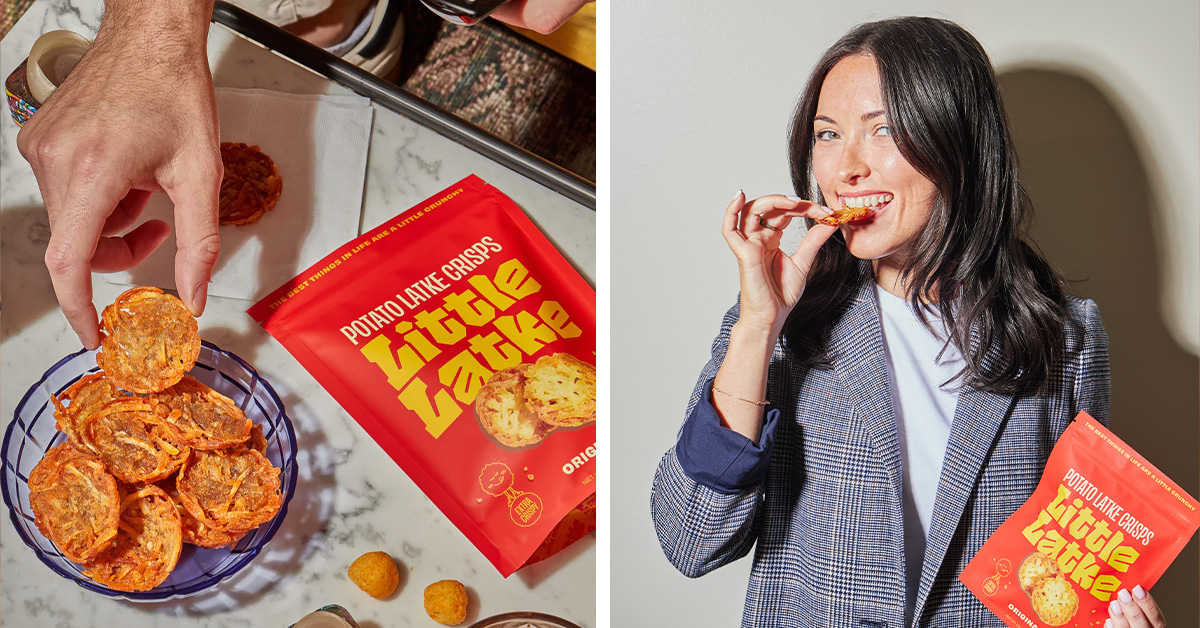
For first-time founder Taylor Blue, bringing Hanukkah’s favorite food into other parts of the year was also a way to bring the potato pancake to a broader audience of consumers: snackers.
Little Latke launched last week turning the shredded, fried spuds into a crispy shelf-stable snack that lives in the pantry. Blue’s vision was to make the cultural staple just as appropriate on a meat and cheese platter or a snack bowl as it is on a Hanukkah dinner table.
Each 2.2 oz. pouch retails for about $8 and is currently available on the company’s website and in select independent grocers in Blue’s home city of Chicago and the Northeast.
Nosh talked to Blue to learn about her years-long journey in becoming a CPG entrepreneur, how trial-and-error is all part of the process, and why there is more than one way to sell, eat or pronounce latkes.
Answers have been lightly edited for context and brevity.
For starters, is it pronounced lat-keys or lat-kas?
The answer is that actually both are correct. A lot of people would argue that “lat-ka” is the proper way, but “lat-key” is correct as well. It’s tricky.
Good to know. What was the impetus for making a shelf-stable latke?
Back in 2020 during the peak of the pandemic, I was home in Dallas longer than usual for the holidays. My mom was sitting in the kitchen telling me how everyone had been begging me for latkes this year but she didn’t have the time. It doesn’t matter how many she cranks out every holiday season, it was never enough. So I looked at her and said: “Mom, time is money and money is time. Why don’t we make it fun and we’ll sell them by the dozen.” Just by word of mouth, within two or three days, we had over 100 dozen orders, which was crazy.
What I realized was that people wanted them for their holiday gatherings, but they also wanted extra to just keep in their freezer for beyond the holidays. So that was when my brain really started twirling and I realized there was something more there.
But at the time you weren’t working in food and you didn’t devote yourself to the project until years later.
That was in 2020. I came back to Chicago and went back to my normal job in intermodal logistics. Over the next four years, I began researching the frozen market because I wanted to bring a handmade potato latke to either ship frozen or be in stores. After researching, I found out that the frozen game is not one that I wanted to be in.
It wasn’t until a year ago that I really started to send out surveys and ask people what their favorite part of a latke was. Answers started flooding in, all saying essentially the same thing. They had to be crispy or with crunchy edges. That wasn’t new information to me, but seeing it made me think there should be a shelf-stable option. It also answered my other question of how to mass-produce latkes without having to be cold-chain distributed. It could be an innovative snack that took the best part of something and turned it into something else.
You don’t have a CPG background, but you did attend culinary school and worked in catering. What has been the biggest challenge of making this idea a reality?
As soon as I had that light bulb idea — which I literally had in the middle of the night — I got to work in my kitchen at home. After a couple of months, I got it to a place that I was really happy with, but I felt like I needed to reach out to recipe developers to help me go that extra mile [of]making it shelf-stable.
Overall, I would say everything’s been a challenge. I’ve never done this. Every single thing I do, whether it has been creating the recipe, making it shelf-stable, getting my kitchen up and running or getting all the proper licenses has all been a huge challenge for me. I’ve really leaned on the CPG community to help guide me through everything.
For now, you are launching mostly direct-to-consumer, but as you line up new retail opportunities, where do you think Little Latke lives best on-shelf?
I tell people we would feel out of place in the chip aisle. We lean more on that premium cracker crisp. I look forward to seeing how people are going to respond to this style of packaging. It is a pinch-to-close, resealable bag. I didn’t want it to be something that you can rip open and then figure out how to store. Some people are going to eat it all in one go or some might want to come back to it later.
I wasn’t anticipating it to be a healthy snack. I didn’t want it to be anything too unhealthy, but I wasn’t planning on being able to market it as healthy. But six months ago, I got the first results from the lab for the nutritional panel and I was astounded. It was 70 calories per serving, which was so low. (Since then) we’ve figured out a way to make that even less, which we’ll put on the next round.
How are you planning to measure success?
To be specific, by February next year, I want to be able to say we’ve sold over 15,000 units (bags) strictly through direct-to-consumer.
For now, my top priority is the packaging. From the style to how much is in each package, I look forward to learning more. Does it need to be more? Does it need to be 15 crisps (currently it’s 12)? Do people like the pouch? Would they rather it come in a box where you often see premium crackers and crisps?
From Manischewitz’s rebrand to your commissary kitchen colleague Sarah Nathan’s Nooish matzah ball soup, Jewish food seems to be positioning toward a new generation of consumers. How have you approached helping build a new category?
The biggest thing I’ve learned is to show everyone what’s happening through social media. The good and the bad. I’m planning to show everything behind the scenes. I’m also starting a series where we’re interviewing people in different situations and asking them things like how they would pronounce latke or how they would top their latke. The whole thing is for everyone to show us how they would be creative and use the product and for us to learn from them.
I was most excited at first to focus on the low-hanging fruit like people in the Jewish community who would love these. But then it became more than that. How do you make this a mainstream thing that isn’t such a holiday-focused item? I’m focusing on going to market as a potato crisp inspired by a traditional latke.
It can be kind of tricky to represent the Jewish community while trying to make it obvious that this is for everybody. As far as our target audience, it’s unique, but I don’t really have one at the moment. It’s for all genders and all ages.