Why Carnéa Thinks Consumers Are Ready For Blended Meat 2.0

Can blended meat fill the white space left behind as plant-based sales continue a downward trajectory?
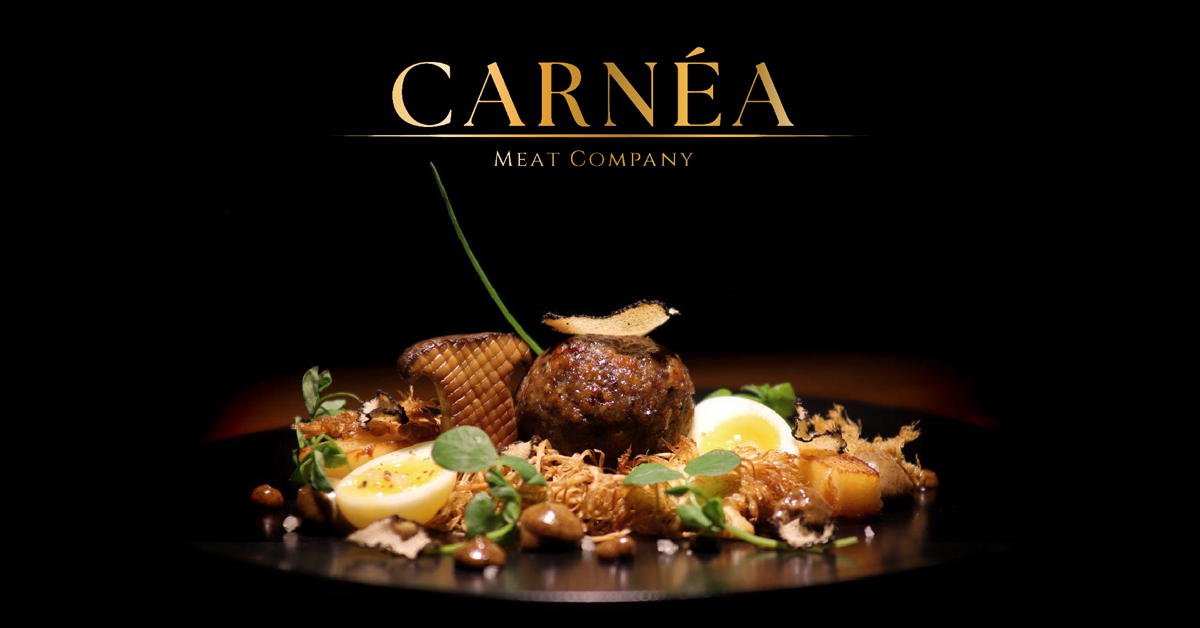
Carnéa Meat Co., a new entrant to the still niche subcategory sometimes referred to as “balanced protein,” is drawing on industry expertise from the cell-cultured, plant-based and fine dining industries to put taste and premium positioning at the center of the plate.
The brand was founded by CEO Parendi Birdie, who helped build brand strategy for cultured meat brands Mission Barns and Eat JUST; CIO Tom Lynch, a two-star Michelin chef and one of Beyond Meat’s first food technologists; and CMO Eric Hedstrand, former Impossible Foods director of product development.
From Beyond To Better Meat
The Texas-based brand will be launching into retail and foodservice locations in the Houston area later this year, starting with two SKUs: Truffle Mushroom Meatball and Roasted Red Pepper Italian Sausage.
Carnéa has intentionally made its product names and descriptions “intuitive” to consumers, Birdie said. “We designed products so we wouldn’t have to use the word ‘blended,’ but creatively used names to communicate that these products have vegetables in them.”
Following its first two products, Carnéa’s innovation pipeline includes a Black Angus Roasted Shallot Burger and a Lemon Chicken Cauliflower Cutlet.
While the brand is not in retail yet, it has been market testing its products at Houston-area farmers’ markets to learn more about how to message with consumers about the category and the most efficient ways to position Carnéa as it moves into distribution.
Birdie has also tapped her network in the tech industry, consulting with a communications expert from Tesla and SpaceX as well as an art director from Apple to determine how Carnéa can “connect with consumers on a deep, emotional level,” she said.
Herein lies one of the main problems that the plant-based and blended meat categories have faced: How to break through with consumers when price, taste and the preconceived notions surrounding meat alternatives affect buying behavior.
Sitting midway between plant-based alternatives and more sustainable animal meat options like pasture-raised or grass-fed beef, blended meat has so far failed to break through in a big way with health-minded and environmentally conscious consumers.
Positioning Around Preferences
U.S. retail dollar sales of blended meat were just $41 million in 2023, according to a Good Food Institute analysis of SPINS data.
One barrier to blended meat adoption is skepticism around taste, according to a report from Food System Innovations (FSI). This expectation stretches into the second most important deciding factor for consumers: household dynamics.
While 83% of FSI survey respondents said that family taste preferences is either “extremely” or “very” important to food purchasing decisions, only 35% would be willing to serve blended meat to their family household and 42% would be unwilling.
“Of those either not willing or unsure, 54% state that their family or household prefers conventional meat, 37% state they are not someone who would eat this, and 36% worry others in their household won’t like the taste of balanced proteins,” the report said.
Thus, blended meat companies are betting on taste but also need to drive trial to prove that the products do not fall short of expectations.
Carnéa’s strategy is to emphasize the “elevated” flavors while also trying to hit a consumer demographic that is aligned with the proposed health benefits, Birdie said.
“We aren’t trying to go for the Jimmy Dean, McDonald’s consumer today. Eventually, that’s the goal, but there’s a really big untouched piece of the market that wants products that are nutrient-enhanced, better-for-you, but still actually relatively affordable.”
Birdie cited the success of mycoprotein producer The Better Meat Co., which landed a $31 million round last month, in its “enhanced meat” positioning. Better Meat Co.’s partnership with Perdue blended its Rhiza mycoprotein with chicken in a kid-positioned nugget. The product spoke to the elevated health benefits parents shop for while capturing a channel conventional consumer with a familiar form-factor at a comparable price point.
By next year, Better Meat Co. reported it expects to sell its patented mycoprotein ingredient at a lower price than most commodity beef.
Whether Better Meat Co. will be the model for how to scale the category is yet to be determined, but its strategy of focusing on taste, price and what value proposition it messages to consumers is notable.
Carnéa is taking a slow and steady approach in its first year. The brand will focus its retail strategy on independent grocers in Texas while also partnering with foodservice locations like restaurants, schools, senior living centers, corporate cafeterias and meal-kit delivery platforms. These will provide valuable data on formulation, product mix and marketing strategy which will guide its larger moves down the road, Birdie said.
“When we do go to the Walmarts of the world, we don’t want to be crossing our fingers and hoping it flies off the shelf,” she said. “We want to know with a lot of confidence through a lot of different channels that this is something that consumers really want.”