‘We’re Watching It All’: A Bite With Kodiak CEO Val Oswalt

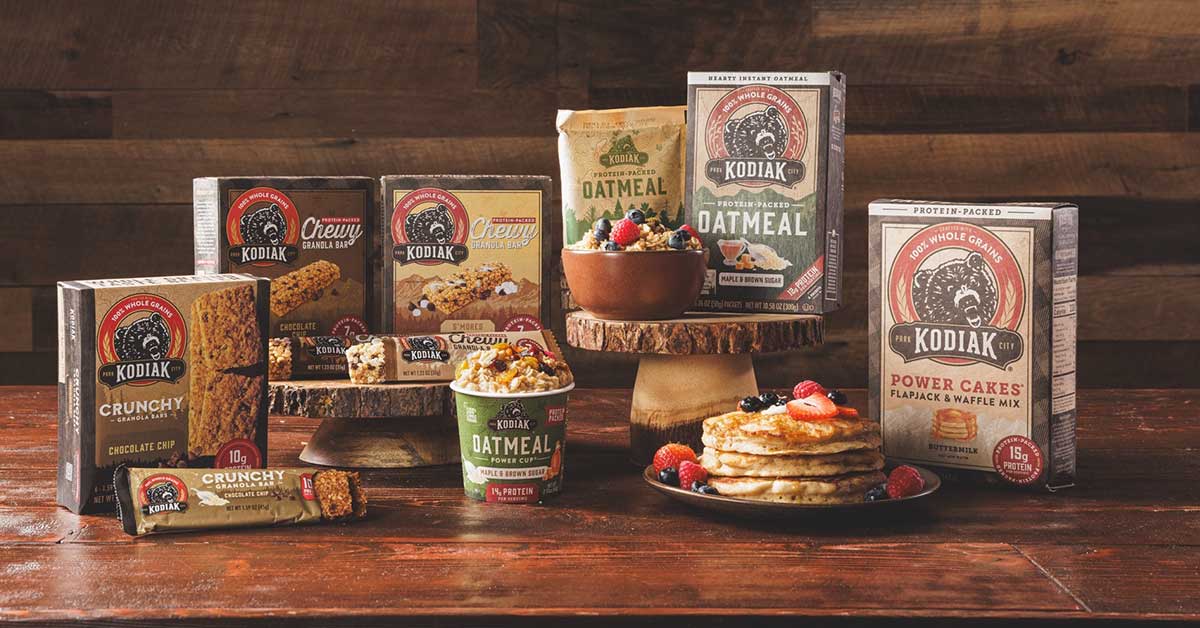
When a founder-led, mission-driven brand moves into new hands, all eyes are on what comes next.
Ever since Kodiak’s acquisition by L Catterton’s in 2021, it has hit the gas on innovation while preserving the brand ethos and mission which CEO Val Oswalt, who joined the company in 2022, believes was key to making Kodiak a more than $500 million brand today. In fact, the team has leaned into its missions and ethos even more, she said, resulting in the highest revenue results in the company’s nearly 35-year-long history.
Oswalt came up in the industry at Big CPGs including Mondelēz and Kraft, later leading PE-backed Century Snacks as CEO before moving into her current post. We recently caught up with Oswalt to learn more about what’s changed and what’s next as well as get her take on how any CPG brand can stay nimble amid shifting consumer and regulatory winds.
How has the business evolved since coming under L Catterton’s wing?
L Catterton has brought a lot of resources. They really care about brand building and so, since the acquisition, we’ve invested a significant amount in marketing – both awareness building marketing as well as conversion.
The other [priority] is our innovation. Like most food companies, we talk to consumers, but we also talk to our athletes. We gather input on opportunities to innovate… across a wide spectrum of sports to get a really diverse perspective of what they’re looking for. We’re in eight categories now. We’re going into two new categories this year. Last year, we launched 19 new products – the biggest innovation year we’ve ever had. We delivered $32 million [in sales] just on innovation alone… we’re [now] over half a billion in retail sales volume (RSV). We’ve been a top 10 growing food brand in America the last two years in a row. Last year, we actually hit the number one pancake brand in America per full-year 2024 RSV.
[For example:] Our Peak Oatmeal was a collaboration with our athletes. They told us they want all the great flavors, all the great taste with 100% whole grains and protein, but also they wanted even more protein, and they wanted less sugar, and they wanted [larger] portions because they need to go for longer. … Its velocities are higher than our regular oatmeal. We intend to continue to innovate in that space and push ourselves into new categories.
How do you measure and ensure that these products are performing at the level you’d hope them to be?
When I got here about [two] years ago, I brought in a new head of R&D. She has an incredible amount of experience in food, and so she was able to help us build an entirely new, really strong R&D team. We’ve invested more in internal sensory, external sensory; we spent a lot of time just iterating constantly.
But what really differentiates Kodiak from the rest is our stuff tastes good – people want to buy it again… We have certain thresholds on our sugar. We always want to be below double digits and no artificials preservatives, no artificial colors, and we want to taste amazing. We really push our team to think boldly, and we always compare ourselves to the top items in the category, and even if they have higher sugar. We still have to taste equal or close to equal and have better nutritionals. That’s how we differentiate; that’s how we bring new consumers to the category.
As we talk to our [retail] customers, too, we show them that we’re incremental to the category, and we’re bringing in, typically younger but definitely less price-sensitive consumers, which everyone is looking for right now.
How much of your innovation efforts focus on new ideas versus existing improvements?
We allocate a certain amount of resources to what we call base renovation because you always have to make sure that your base is strong. I’ve seen brands get into trouble with this, where they’re so focused on that innovation that their core is eroding and not adding that incrementality. We have a process through quality, where we’re seeking feedback through Net Promoter Scores (NPS) and others, but also we do testing against our competitors.
That’s the other piece: We have to make sure if we beat a competitor before and if they’ve improved, we’re on top of that.
We also are pretty aggressive at SKU rationalization. We’re mainly focused on breakfast, but consumers want variety… you can take some SKUs out and work with retailers to be super efficient on the shelf, and that also helps with the innovation, too.
What are you watching or preparing for in terms of both consumer and regulatory scrutiny over the food industry at this current moment in time?
We’re watching it all. I’ve been in the industry a long time and it’s definitely the most uncertainty I think the industry has faced.
Sometimes consumer perception will drive some purchase decisions, despite not being grounded in science. We’re trying to understand the science through R&D… I read a great article recently where a nutritionist said, “You’re going to probably create more inflammation in your body worrying about seed oils than the seed oils themselves.” We have incredible specialists through our R&D group that really understand the details behind that, the Omega-6s and Omega-3s and how we process them.
The other piece that we’re talking about is the transparency in our ingredients. There’s a reason for every ingredient we put into Kodiak [products]. It’s well thought out, it’s well tested, it’s with incredible suppliers. We want to have that transparency with our consumers. Where there are questions, we want to offer that education to them.
That’s another piece too – the ultraprocessed foods. Unless it’s [like] an apple, most likely, at some point, there’s been some processing, and there’s some good reason behind it. My hope is that our regulators can help guide us and provide the right education and the right information that would be helpful to the industry. In the absence of that, consumers are making up their own definitions and listening to folks that aren’t necessarily experts.
You’ve come up through Big CPG. Moving into this role, were there major learnings or unexpected aspects of the job that you didn’t quite anticipate before your first day?
One of the things I’m most proud of is being able to take everything I’ve learned from larger CPG organizations – and the opportunity I had leading a smaller company, Century Snacks, that was private equity [owned] as well as a CEO – and being able to have those learnings coming in. It really set me up to be able to take the best of both worlds.
What I loved about Kodiak when I got here is just the people and the Kodiak culture – we live by the Kodiak Code. Everything we do and how we support the organization is why we’re so successful. I’m so convinced of that.
There’s a few things I would highlight and I wish all companies could do this for [their] people. We’re 100% ownership, so every single employee owns a part of Kodiak. We have something called Bear Bucks, where we give [employees] a certain stipend every year – it’s pretty meaningful, it could be up to like $4,000 – and that is for anything that’s activity-based or recovery-based that ties to our mission of creating Wilder lives, inspiring people to get outdoors.
This morning, I skinned up the mountain and snowboarded down with one of our brand leaders and then when we got up there, we ran into our head of graphic design. We were all literally snowboarding together this morning…We have early out Fridays. We have a very liberal, unlimited [self-governed] PTO. We believe that as we invest in our people, they’re going to give back. In the last two years, we’ve delivered the best business results in the history of the company. You can do both. It’s an “and.”
How has the team strategized around new marketing efforts?
One of the things that is unique about us is we have our own creative team. They live the brand every day. They are the brand. They create our ads and they help us iterate. I think that’s a big part of this. We [also] have some really amazing tools embedded in AI, that help us really learn very quickly and refine our messaging or refine our campaigns to be incredibly effective.
The last two years we’ve invested in [those] tools and they’ve just accelerated. Everyone’s so afraid of AI replacing [people, but] I want employees who [understand] it’s enhancing. They know the tool and they understand they use it to enhance. I encourage our folks to really learn and grow and be open to it, and it’s really accelerated the analytics. We’re able to get the findings faster with a deeper understanding, so we can make decisions quicker, move quicker. I think that speed is incredibly important, especially nowadays, since as we talked about earlier, how much is quickly changing.
Explore the Nombase CPG Database
Head to Nombase to learn more about the tagged companies and their offerings.