That’s it. Is Giving Out 10M Free Samples. What’s The ROI?

Building awareness and protecting profits is a balancing act that many startups fail to manage – whether it’s splurging on flashy trade show booths and marketing campaigns or simply flooding the masses with free samples.
During its 13 years in operation, minimal ingredient fruit bar brand That’s it. learned how integral sampling is for its brand, which president Katie Eshuys emphasized was “a bit ahead of its time with simplicity and transparent ingredients.” The brand, which now sells its hero Fruit bars in over 82,000 doors nationwide, claims that 44% of consumers purchase the items twice or more every year “meaning that when consumers sample, they return.”
In recent years, the company has shifted its strategy in-house, cutting out the middle man and instead taking a “proactive” approach, leading to more “cost effective” and overall higher impact partnerships, Eshuys said. It has also dialed in its sampling strategy at retail, choosing only to sample with specific high-conversion retailers like Target, Costco and Kroger when launching new products.
“We’ve seen a lot of success with sampling, and I think that’s a testament to the product because of how it tastes,” she said. “We know that as soon as someone tries it, we really do get a strong engagement, strong purchase intent, and a lot of conversion as well because they get the opportunity to try it, they love it, and then they’re going to go and buy it.”
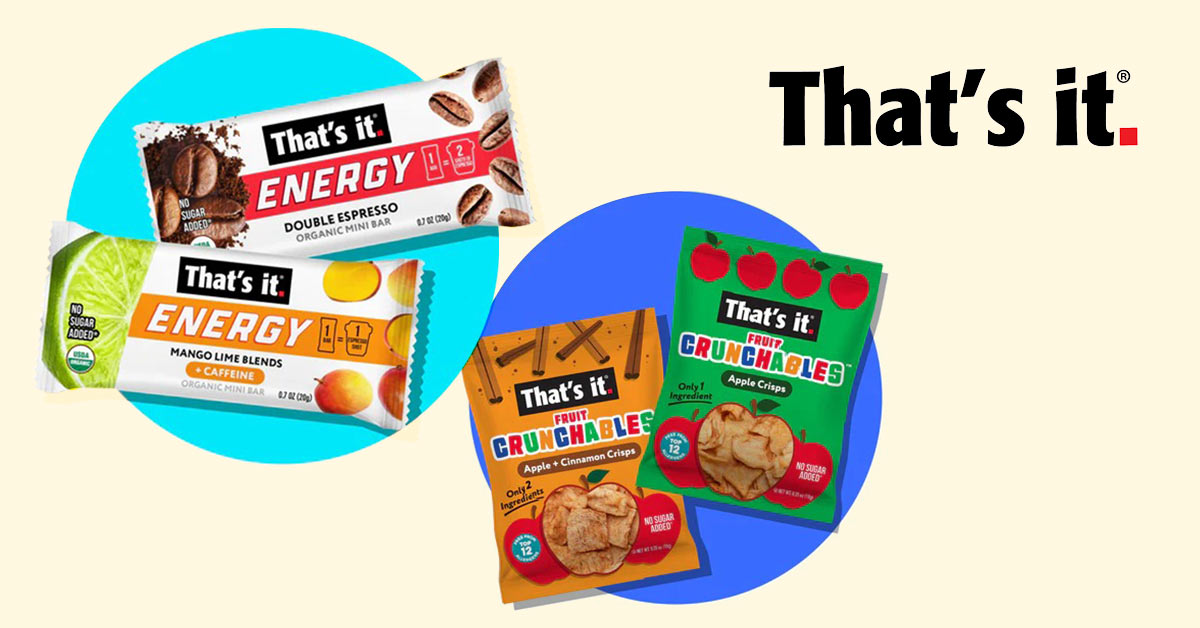
This year, the brand is aiming to give out 10 million free samples to jumpstart awareness among key consumer demographics for its two new innovations: a kid-focused Crunchables snack mix and its clean ingredient Energy Bars. Crunchables rolled out to Walmart, Costco and Sam’s Club stores earlier this year, and Eshuys said it will be going into a new retailer virtually every month for the remainder of 2025.
Crunchables samples will be focused largely on the K-12 market where the two-ingredient offering – available in a combination of dried apple paired with blueberry, strawberry or cinnamon pieces – will be sent to schools, PTA leaders and parents. Eshuys said the brand is able to easily generate feedback from this group, too, noting that samples include a QR code to a survey, which offers the consumer a chance to win free products.
“We’ve partnered with organizations like School Family Media and done sampling at scale among schools with our Crunchables. We’re trying to reach [moms, too] where they’re at so we go to yoga classes and we’re working with companies like Fit For Mom.”
That parental cohort is also a focus for its Energy Bar sampling program. Eshuys emphasized that the Energy Bar is differentiated within its category for its clean ingredient list and the brand is targeting a wider range of consumers with the product, including colleges and the fitness community. That’s it. is the official partner of activewear brand Fabletics’ sponsored run clubs and has a range of similar partnerships that Eshuys said were spearheaded by its internal team.
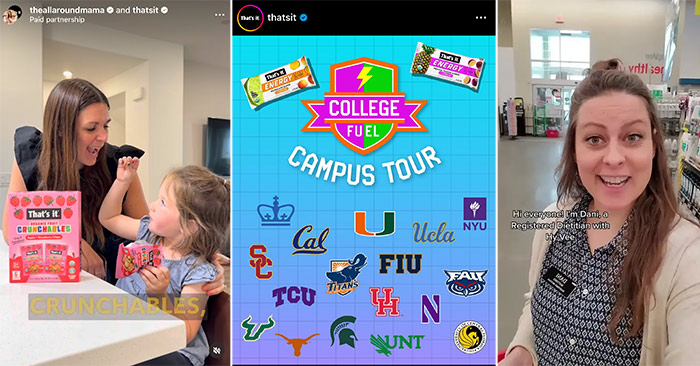
In terms of channels, That’s it. already has nationwide distribution across college and university campuses through its distribution partner for its flagship fruit bars. It is now leaning deeper into those relationships as it builds up momentum for the energy line and works to generate both awareness and feedback on the product.
“We love talking to Gen Zs,” she said. “They are very real, authentic. They give great feedback, sometimes it’s very direct, but it’s great talking to that community. They are also looking for a lot of energy, whether it’s for studying late night or whatever it might be. But we have gone out, scaled at mass to college campuses, and we really focus on particular times of year as well, like back to school, things like that.”
Since the Energy product’s initial launch, That’s it. has upped the caffeine content from 60mg to 100mg, with Eshuys noting that the primary feedback it has encountered when sampling Energy was that consumers wanted more from it. The channel focus for the Energy product also leans into easy trial areas like corporate offices or travel retail where coffee is common, but not always convenient.
“People that need that hit at three o’clock in the afternoon and they don’t want to drink another coffee,” she said. “It’s really hard to get coffee as you’re waiting to board a plane. There’s always massive lines, and it’s messy to bring coffee with you. This is a great way to get that clean caffeine hit as you’re sort of going through an airport or traveling.”
Sending samples, however, is just one segment of the program. Particularly among its college kid cohorts, the company aims to gain user generated content (UGC), preferring to lean into a “micro-influencer network at scale,” rather than larger partnerships that could lack authenticity, Eshuys said.
“At any given time a college will have 100,000 samples out there so the goal will be then, as well as part of the sampling, to generate UGC, and generate social media engagement,” she said. “Typically, if someone’s posting, it means I’ve had a good experience with the product, but that is definitely something that we’ve really kind of leveled up through the help of college [kids] because that generation is posting a lot more.”
The company primarily focuses on TikTok content, using platforms such as Kale, which enables it to set minimums for how much organic UGC it aims to generate over a set period of time. While TikTok’s shopping platform has become integral for snack brands, Eshuys said That’s it. is still setting up its Shop and focused mainly on generating content and awareness on the platform right now.
That’s it.’s secret weapon however may be one of its lowest lifts: the nutrition community. Eshuys said it has found success partnering with registered dietitians and nutritionists because “there is no cost associated with that other than providing product,” and it gains trusted and respected brand supporters.
“They become evangelists for your brand. They go out and they talk to their clients, their community, and really talk it up. It helps us spread the word about food is medicine, so they’re the main audiences that we target [with that].”
Explore the Nombase CPG Database
Head to Nombase to learn more about the tagged companies and their offerings.