Nestle, Conagra Join Dye Phase-Out Amid State Pressure

Nestle and Conagra have joined Kraft Heinz and General Mills in pledging to remove the use of synthetic food dyes, also known as FD&C colors, from their formulations after growing pressure from Make America Healthy Again (MAHA) leader and Health and Human Services (HHS) Secretary Robert F. Kennedy Jr. and accelerated traction on food industry issues in state legislatures around the country.
Nestle will phase out the use of dyes by mid-2026, and Conagra said it will have the job done by the end of 2027. According to Nestle’s announcement, 90% of the company’s portfolio is already free from synthetic food dyes, noting it has been actively removing the use of these inputs in formulations over the past decade.
The tone of the announcement was similar to those from Kraft and General Mills last week as well, with both conglomerates also emphasizing that their product portfolios are already largely free from the eight previously U.S. Food and Drug Administration (FDA) approved inputs.
Speaking to Nosh following the publication of the MAHA Commission’s inaugural report in May, Jeff Grogg, a food formulation expert and managing director of JPG Resources, also emphasized this point, that the vast majority of food is no longer made with these ingredients, noting that in JPG’s 16-year history it has never used this classification of dyes in new formulations, stating that this is the direction the industry was already heading.
But public commitments from Big Food signal there may be growing concern about navigating a potential patchwork of state-by-state labeling and ingredient laws. While removing the use of food dyes has so far been the MAHA platform’s biggest win, the movement’s focus on the food industry is broader, including removing the use of seed oils and reducing the prominence of ultraprocessed food (UPFs).
UPFs were the overwhelming focus of the inaugural report, but with an estimated 70% of the food supply considered to be ultraprocessed, coupled with the fact there is still no federally recognized definition for what constitutes an ultraprocessed food, making good on this promise could be more challenging for both Kennedy and CPG conglomerates.
On Sunday, Texas Governor Greg Abbott signed a bill that would require all food made with 40 artificial colors and additives including bleached flour, Red Dye 40 and Yellow 5 to carry a “high-contrast” warning label in order to be legally sold in the Lone Star state. That bill followed the passage of legislation specifically targeting dyes in West Virginia and Utah earlier this year.
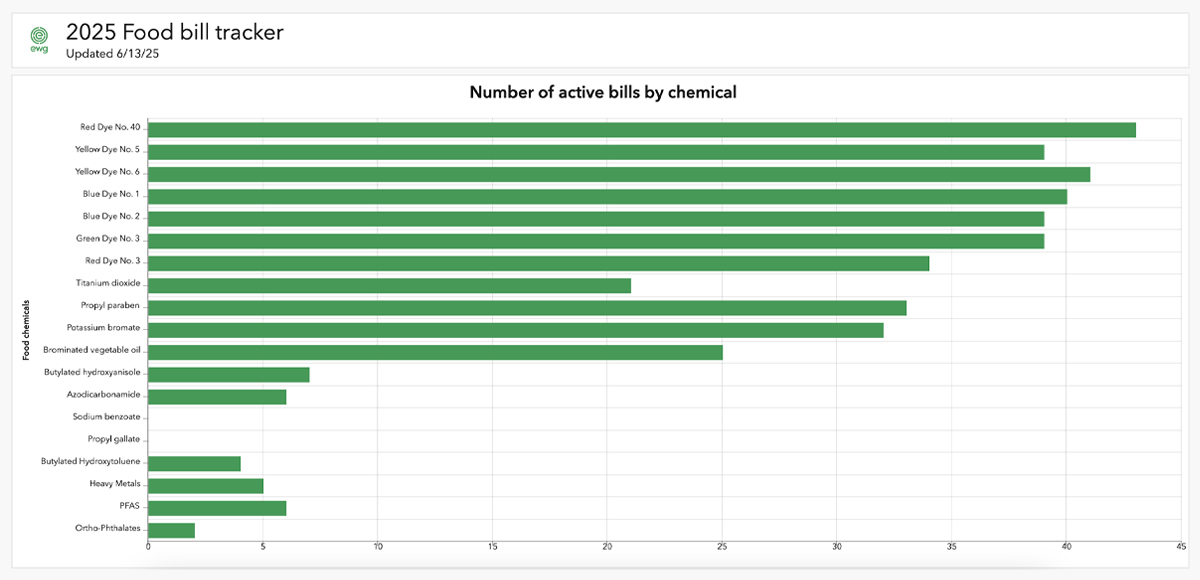
According to the Environmental Working Group, there are 50 active bills in statehouses around the country that target food formulation; 14 have been adopted and 77 have been introduced in total. The vast majority of target synthetic dyes include Red Dye No. 40, Yellow Dye No. 5 and 6, and Blue Dye No. 1 and 2.
Explore the Nombase CPG Database
Head to Nombase to learn more about the tagged companies and their offerings.