Miyoko Schinner Wants Her Name, and the Food System, Back

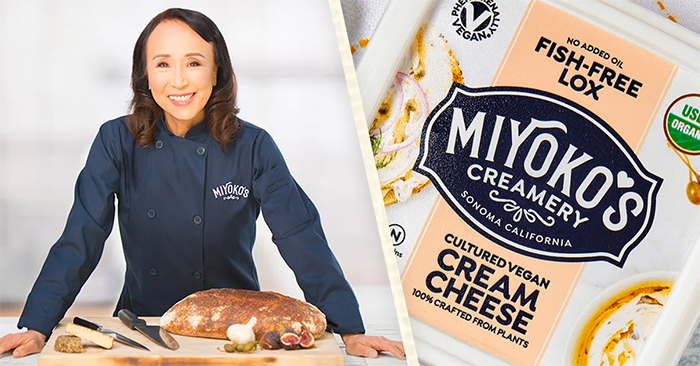
Miyoko Schinner, founder of vegan food business Miyoko’s Creamery, activated a campaign over the past week to buy back her namesake brand three years after she was removed as CEO.
While on Monday night she confirmed she had not received the winning bid, we caught up with Schinner to learn more about her ideas for an “alternative” business model, what she would do differently the second time around and what went wrong in the declining plant-based cheese category.
“I believe in businesses, but I want more businesses,” Schinner told Nosh. “I want more equitable opportunities for more people to participate in. This is the system we have, and we may have to work within it.”
Schinner aimed to raise $500,000 via a GoFundMe crowdfunding campaign and in the span of six days had received over $100,000 in commitments; however, speaking with Nosh on Friday, she knew it would likely not be enough to buy back the brand and had a sense of what the competitive price would be: “I’m probably not going to be close.”
In an Instagram post Monday night, Schinner said she does not know who the winning bidder is, adding “you can have the product – please just give me back my name.”
A Reformulated Business Model
If she had been successful, Schinner had a slate of plans for the new business but first emphasized its supply chain would need to be reestablished as the brand’s flagship facility in Petaluma, Calif., was shuttered and sold for parts in 2023. The product assortment would have been culled, she said, with a focus on high-revenue products, such as its plant-based stick butters, cream cheese and mozzarella.
Although the brand’s style of artisanal vegan cheese wheels originally differentiated its products among a sea of “wall cheese” – the name Schinner has given shreds and sliced cheese formats – those products wouldn’t have been possible without a production facility of its own.
Instead, she was focused on reformulating what remained, with a focus on taste and nutrition, as the recipe and formats have been iterated since she was at the helm. She wanted to keep the team small and marketing spend minimal, noting she preferred traveling around the country and doing “grassroots activism” than shelling out on flashy campaigns.
“I think that will excite more people than ‘we got the hottest new food tech,’ and ‘we isolated this protein, and it’s super cool, and we’re patenting our IP,” Schinner said about her alternative marketing approach. “Who cares about IP? At the end of the day, if you really are truly concerned about creating a better food system, then why are you protecting your IP? Why are you not sharing your IP?”
Fixing The Food System
Schinner has been busy in the past three-and-a-half years since her departure developing both the recipes for her new cookbook, The Vegan Creamery, and studying food history, systems and economics. The latter coalesced into her creating and co-instructing a course on food systems now offered at The University of California, Berkeley.
“The food system is very broken, it does need to be fixed, and it is driven by money – that is the driving force,” Schinner said. “People are all talking about, we’ve got to feed 10 billion people. How are we going to do that? The people that are driving that conversation are private equity and venture capital… Then founders come along thinking, ‘Okay, I’ve got to come up with something that’s going to attract money.’ That is not how we fix the food system.”
During that time she also homed in on what went wrong both within her own company, as well as within the larger category that is posting consecutive quarters of sales declines and has seen many original players close up shop.
The plant-based cheese category was “playing towards total addressable market… [with] wall cheese – slices, shreds and dumbed-down cheeses,” Schinner said. That was its first big issue and emphasized that investors’ appetites steered the space in that direction, she said. If the category is going to succeed it needs to take a strategic approach to winning over early adopters.
“[The majority of] people that are buying in the dairy category – slices and shreds – are the same people that are eating hamburgers – these are late adopters,” Schinner said. “They are not interested in anything vegan or plant-based. And they’re not going to buy it, especially if their doctor says [they] have to reduce saturated fat intake, and they look at the vegan cheese, and it’s basically coconut oil. Why would they buy that? It doesn’t make any sense.”
‘Why Are We All Trying To Make A Killing?’
She believes the venture capital mindset drove the category toward its own demise by pushing brands to focus on the biggest sectors and equating those established markets with growth opportunities.
The plant-based cheese category’s current status is due to lack of nutritional and taste appeal, not lack of need, she emphasized, highlighting that the plant-based liquid milk category, in contrast, has over 50% household penetration and holds roughly 15% of market share of the overall category.
“[Investors] look at [plant-based] categories in the same way they look at any other industry, and they’re not going to win,” she said. “It’s not being driven by people that understand food or understand what it takes to create a new category for early adopters. We should be creating premium whole food, clean label products that early adopters are going to say, ‘You know what? I love dairy, but I would consider this product.’”
For the plant-based alternative market to make it, Schinner believes more small, ethical businesses need to innovate not just for vegans, but also lactose intolerant and mainstream consumers. That type of business model doesn’t necessarily bode well for a “10x exit,” she emphasized, but it does mean that ethical and equitable businesses could thrive.
She returned to the proposition of her new cookbook, highlighting that it contains a lot of open-sourced technology and information to make plant-based cheese. By publishing this information, she hopes to encourage more business and more artisan producers to enter the market.
“The problem is we have a consolidated food system that determines how many winners and losers there are, and it’s mostly losers. It’s who gets the shelf space and who’s got enough runway with [financial] backing [that wins], and that’s really not an equitable system,” she said. “Yes, I wrote the book, and I do get royalties on it, but I also have to make a living. Why are we all trying to make a killing? Let’s be happy with making a living.”
Explore the Nombase CPG Database
Head to Nombase to learn more about the tagged companies and their offerings.