Kids Pouch Brands Adjust To Calif. Packaging Legislation

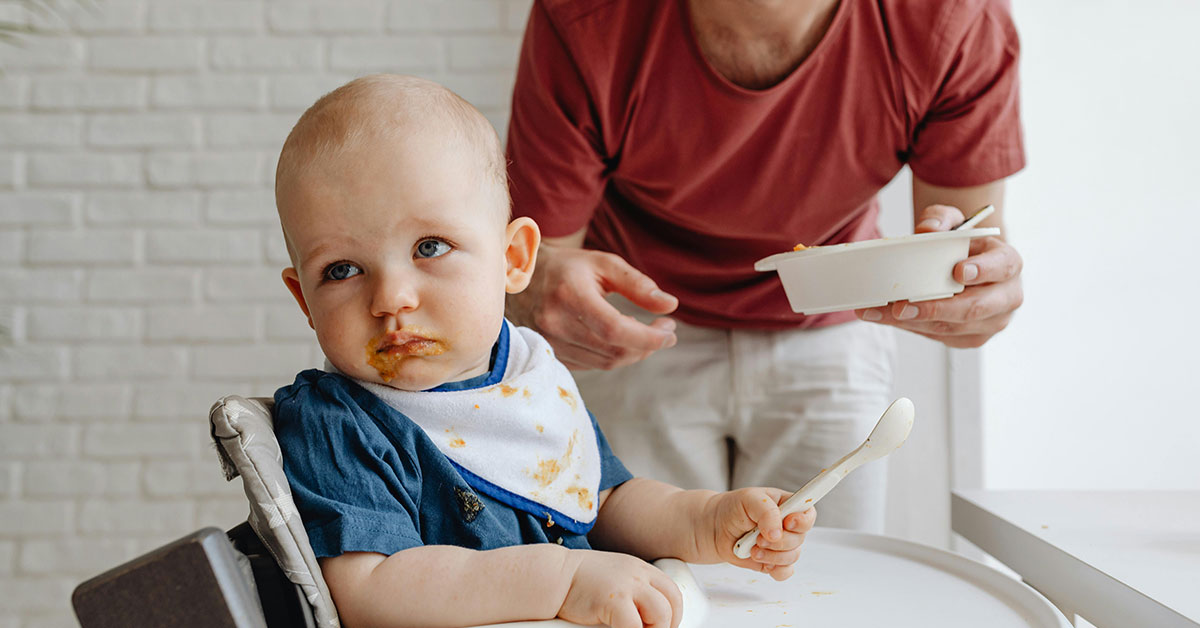
When Serenity Carr launched baby food company Serenity Kids, testing for heavy metals was core to the brand’s ethos. Now, California has made that mission a legal requirement, setting a new standard for heavy metal testing and transparency for baby food.
Under Assembly Bill 899 (AB899), baby and children’s food companies are required to test for heavy metals and disclose the results to consumers. With the exception of infant formula, the law covers any product “packaged in jars, pouches, tubs and boxes represented or purported to be specifically for babies and young children less than two years of age,” including dietary supplements.
Not only has the law changed baby food brand packaging, but it has illustrated how brands can better communicate with consumers while being held accountable for the presence of potentially harmful ingredients in formulations.
AB899 has taken over a year to implement after being officially signed into law by Governor Gavin Newsom in October 2023. As of January 1, all manufacturers must publicly disclose the levels of “toxic elements” arsenic, cadmium, lead and mercury by putting a QR code on packages that directs consumers to a website listing the lab testing results.
The roots of AB899 derive from California’s Proposition 65, or The Safe Drinking Water and Toxic Enforcement Act of 1986. Prop 65 was intended to inform consumers about unsafe levels of toxic elements in drinking water and other consumer products. Though well-intentioned, said regulatory expert and former Food and Drug Administration (FDA) investigator Larisa Pavlick, the long arm of Prop 65 did not fully address how heavy metals and other contaminants get into food products and what levels are acceptable for different consumers.
“Prop 65’s limits for [food] consumption are difficult to accomplish because the quantities of these chemicals are found in many of our products; especially root vegetables, because they will absorb the contaminants in the soil,” Pavlick said.
AB899 goes further than Prop 65 because it targets a “vulnerable population” of young children who are especially susceptible to the harmful impact of heavy metals in popular food products like fruit and vegetable purees, she said.
The law will give an added level of transparency to consumers while also forcing brands to look at supply chains and find ingredients or suppliers that have safer products.
A New Level Of Scutiny
For many kids pouch brands, testing for potentially harmful additives has always been part of the manufacturing process, but AB899 has set an industry standard for testing.
Nonprofit organization the Clean Label Project has been on the forefront of pushing this type of consumer transparency for years and has backed legislation like AB899 across the country.
When Brainiac Foods launched its Little Brainiac during December 2021, the food maker partnered with the Clean Label Project to voluntarily certify that its products were free from industrial and environmental toxins like heavy metals, pesticide residues and plasticizers.
In anticipation of the January deadline, Brainiac Foods began updating its packaging last year to meet full implementation of AB899.
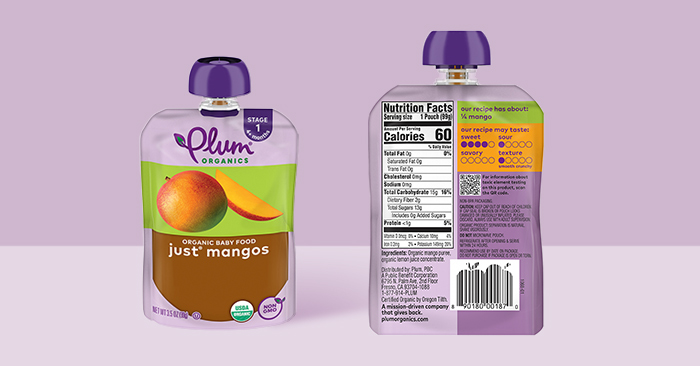
Similarly, Plum Organics reported it was “uniquely prepared” for AB899 compliance after already implementing a QR code on its packages in 2023, said Alicia Vasquez, Plum Organics VP of sales and marketing. “From a production standpoint, we only had to update the language on our pouches to inform parents and caregivers on the purpose of the code.”
The brand has gone an extra step in publishing all its 2024 and 2025 test results providing even more transparency to consumers about levels of toxic elements in its purees.
Cost of Doing Business
For Serenity Kids, the process of implementation did not come without challenges.
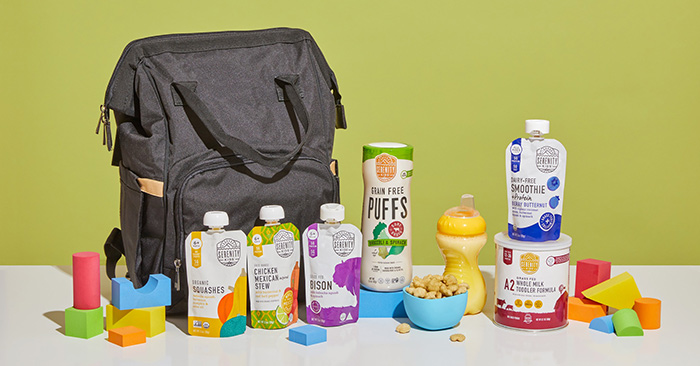
“Logistically, updating packaging to include QR codes added complexity and extended timelines, given the lead times for printing and production,” Carr told Nosh. “We have tightened up contracts with higher-risk ingredient suppliers to require pre-testing for heavy metals, which has raised our prices and restricted supply.”
Despite the extra steps to production and the added costs, adjusting to the requirements of AB899 has allowed the brand to “refine its transparency” and build confidence among a consumer group who scrutinize food labels.
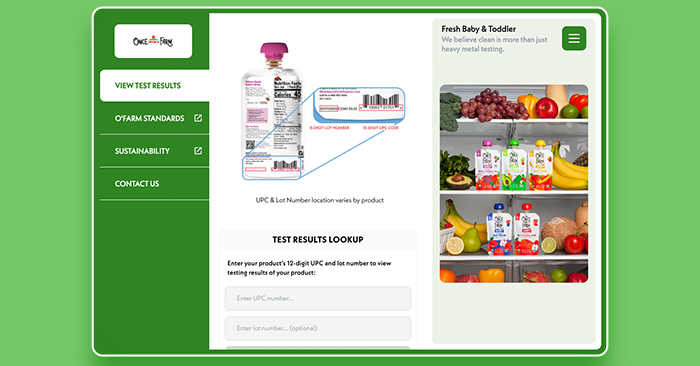
Serenity Kids partnered with BRIJ, a consumer experience app platform, to build a user-friendly website to make test results easy to view from a phone. Once Upon A Farm (OUAF) is also aligned with BRIJ.
“We took this as an opportunity to evolve our testing process,” said OUAF CMO Katie Marston. “It was certainly a significant undertaking to ensure we were compliant, but it’s nothing new to us.”
Considering that OUAF is based in California and the state is one the largest consumer markets in the U.S., the brand decided to implement the packaging changes across all its infant and toddler SKUs distributed across the country. Although a QR code will not be on OUAF’s Kid portfolio products, consumers can input a product’s UPC code directly on the website to receive test results.
A New Normal
California has been aggressive in recent years in tightening regulations around food safety in the state. Under Governor Newsom, the state passed The California Food Safety Act in October 2023, effectively banning common food additives like Red Dye 3, potassium bromate, brominated vegetable oil and propylparaben. In September 2024, oversight was extended to public school food products banning more synthetic dyes. The state has also restricted the sale of soda on public school campuses, barred caffeinated beverages and proposed a sugar limit on non-dairy milk.
At the beginning of the year, Governor Newsom issued an executive order for state agencies to investigate the adverse health effects of ultraprocessed foods and synthetic dyes.
The state’s proactive approach to securing a food system with reduced exposure to potentially harmful additives stands in contrast to the slower moving mechanisms of the FDA.
After significant activist outcry, the FDA followed the lead of California and banned Red Dye 3 from use in food and beverage. Yet, the FDA’s Closer To Zero program has moved slower to deliver guidance on the appropriate levels of heavy metals in foods. So far, lead in baby food has been the only toxic element to have final guidance issued so far. Arsenic, cadmium and mercury are still under review.
What’s been interesting about the implementation of AB899 is that it specified a testing frequency, said FDA regulatory attorney Shelly Garg. “Oftentimes, the FDA leaves it up to the company.”
“These are very specific instructions as to what information needs to be on there and how often,” she said. “It’s very direct. Oftentimes, the FDA leaves it up to the company and doesn’t provide that direct compliance requirement.”
Other states appear to be following suit as well. Maryland has a similar law set to go into effect in January 2026. The Virginia House of Delegates recently introduced a bill that would prohibit the sale of baby food that exceeds the limits established by the FDA.
Whether it’s states pushing the FDA to provide stricter guidelines or vice-versa, “consumers are demanding more transparency, and [AB899] helps reach that objective,” said Garg.
As evidenced by the applesauce recall last year, more FDA safeguards could be put in place to protect vulnerable populations before the system is compromised, she said.
“To wait until the 11th hour and do these massive recalls when there’s extremely high levels of lead is alarming to parents,” she said. “To me, that’s a bigger problem. That’s where we kind of failed the system.”