Is Soy Sauce the Next Olive Oil? Heydoh Launch Signals Premium Shift

Center-store aisles have undergone a clean label revival in recent years. From common pantry staples to international products alike, new brands and upgraded formulations have entered the fray, aiming to appeal to consumers with supply chain transparency, ingredient integrity, clever branding and convenient packaging formats.
Soy sauce is the latest target.
This month, cookbook author and food journalist Clarissa Wei introduced Heydoh, a 2-SKU line of single-origin, artisan soy sauces that bring an authentic, Taiwanese iteration of the popular Asian condiment to the U.S. market. According to Wei, the brand’s goal is to make artisanal soy sauce “so good that you can actually sip it” and “simple enough for anyone to understand.”
“We’re not necessarily reinventing the wheel,” said Wei. “We’re selling a Taiwanese expression, but artisanal, high-quality soy sauces have always existed on the market. I think it’s a story [and] a branding exercise in the U.S. [Currently,] it’s either a very generic soy sauce, which just says, ‘All Purpose’ or you have really high-end brands where [the label] is in an Asian language, Japanese or Chinese, and for the consumer it’s difficult to navigate.”
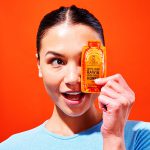
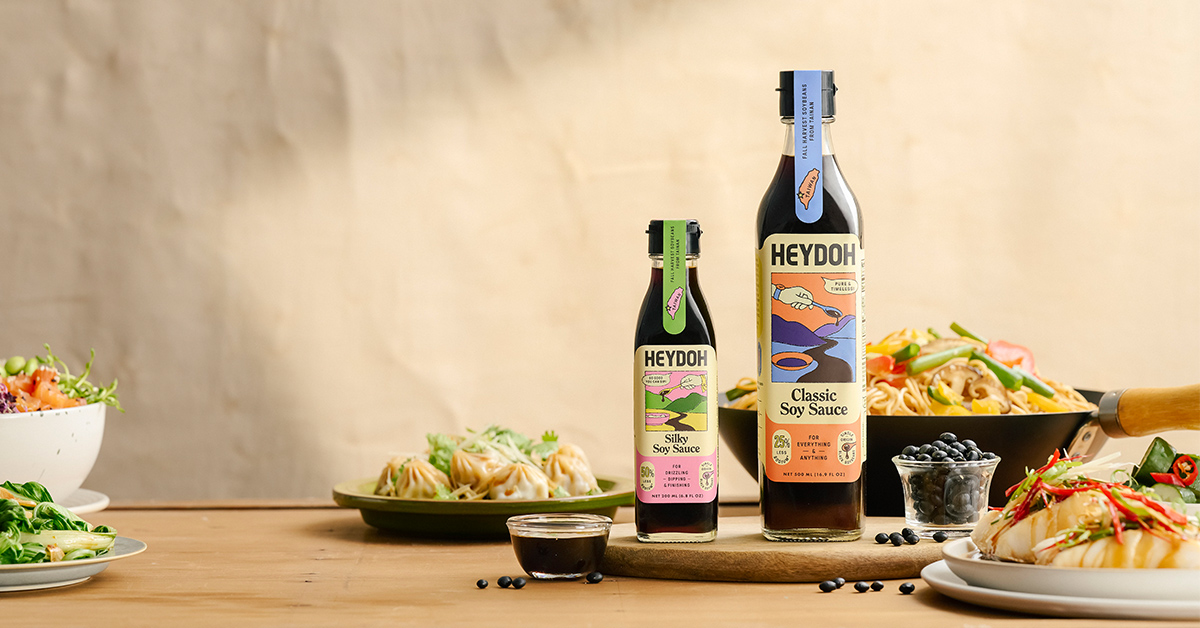
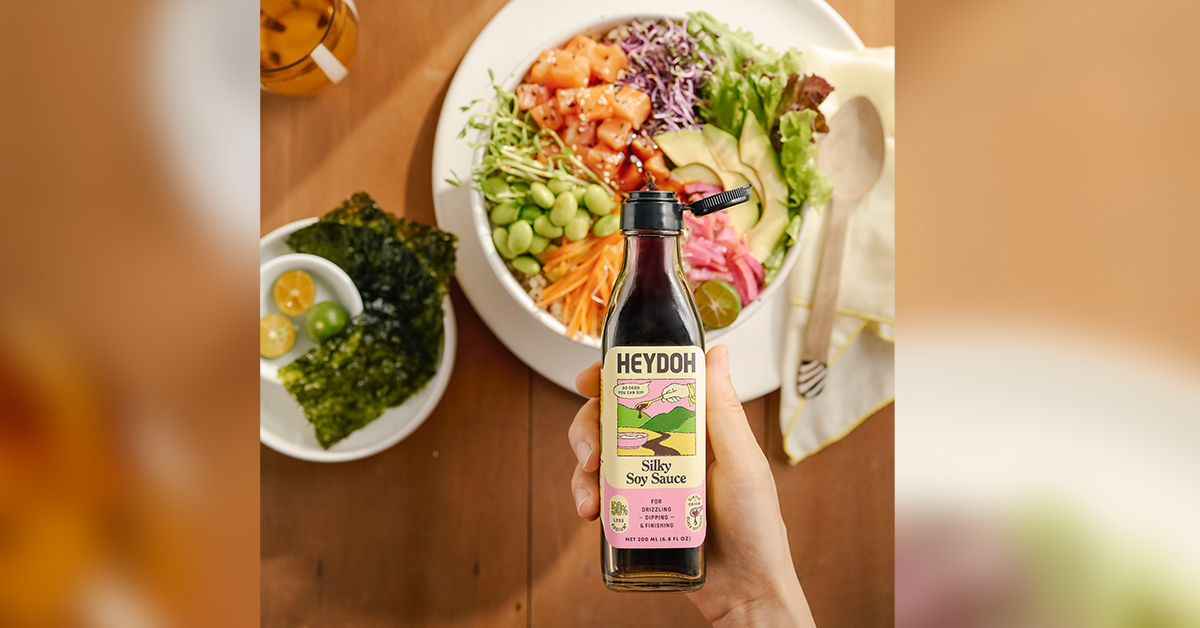
Heydoh’s two varieties aim to streamline that experience: on the front label of its Classic Soy Sauce, the product type is quickly followed by a callout “For Everything & Anything” while its Silky Soy Sauce SKU specifies “For Drizzling, Dipping & Finishing.”
Both labels also call out the use of single-origin black soybeans and the product’s lower sodium content compared to “the big guys” – 25% lower for the classic version (760mg per 1-tbsp serving) and 50% lower for Silky (480mg). The sauces do not contain any added sugar and undergo a long fermentation process, ranging anywhere from four to 12 months, Wei explained.
All-Purpose Premium Packaging
The dual products, priced at $18.99 per 500 mL and $12.99 per 200 mL, respectively, and positioning at launch bear similarities to next-gen, single-origin olive oil brand Graza, which built off a similar approach via Sizzle and Drizzle varieties back in 2022. Heydoh, like Graza, is also working to differentiate itself with a unique bottle type for its category.
Wei chose a unique, rectangular bottle shape with a long neck, which is not customary in the soy sauce market and made working it into production lines a “bit of a hurdle.” Additionally, she was set on using a pop-top cap for the product, another non-customary feature she believes will bring added convenience and differentiate the brand, but was difficult for manufacturers to get behind.
“I like how it feels [and] not screwing the cap back on the bottle – [it improves] the whole experience… As someone who cooks a lot and has developed hundreds of recipes, I was thinking: What is my ideal soy sauce shape, and, for the All Purpose, what’s the [ideal] size too?
“The beautiful part of our team is [that] all three of us are Taiwanese-American, we’re all fluent in Chinese, we didn’t have to go through a middleman, but there was a culture barrier,” Wei added while discussing the challenge of convincing their manufacturer to agree to use their preferred bottle format.
“A lot of my work [as a writer] is amplifying the stories of East Asia and really bridging the gap between East and West – and that goes both ways,” Wei said. “This definitely was a huge learning curve, and something that we will have to continue paving forward as we go through this because even in Taiwan, people are a little bit confused why Americans are even interested in single origins.”
Quantifying High-Quality Sauce
But the interest in the U.S. already appears to be strong. The self-funded company has sold over 1,000 bottles during its first few weeks after soft launching online. Orders will begin to ship once the sauces arrive stateside later this month.
“Just based on the concept alone, we’ve had that many bottles sold, which, it’s hard to compare because other brands don’t publish their numbers, but to me, that sounds pretty good… we do think there is momentum and interest in this concept,” said Wei.
While the company is currently marketing itself around its Taiwan-sourced, single-origin beans, it hopes to eventually elevate the data proving the liquid’s premium nature. According to Wei and co-founder Christine Liu, the metric known as the fermentation index, which quantifies the product’s total nitrogen content, is the only true way to measure the quality of soy sauce. On that scale any sauce scoring 0.4 and up is considered a premium soy sauce; Heydoh’s sauce scores 2.07.
“As we develop the brand we want to not only sell vibes, but to give people a quality product that will make a difference in their kitchen,” Wei said. “Because Christine’s a data scientist she was just like, ‘We need to talk about this; this is solid data and storytelling.’ I was like ‘people aren’t gonna understand this [just yet].’”
The brand is focused on direct-to-consumer to start so it can begin to understand its customer base, but Liu, who is based in New York City, is already in conversations with specialty “shoppy shop” type stores in the area, which it is eyeing for its retail debut. After that the brand will likely turn its attention to the California market.
“We want to put a lot of care into how we’re choosing partners to grow with,” said Liu. “We want to make sure that Heydoh can get into as many people’s mouths as possible in a very accessible way. We want people to be able to go to their retail store [to purchase] – maybe it’s their local, gourmet grocery store, maybe it’s their local add-on-cafe, and then maybe one day, it’ll be their local Wegmans.”
Slow And Steady Sauce Strategy
Forecasting inventory could present a challenge considering the product’s unique input, lengthy fermentation process and overall longer lead times due to transportation by boat from Taiwan to the U.S. Liu said the team is already working to “demystify” and “derisk” parts of its supply chain and is exploring shifting part of the process to the U.S. or working through different ports. The former may prove necessary for the upstart company as Taiwan is currently subject to a 20% tariff rate, per Trump’s latest installment.
“[Taiwan is] a small island, so having these special varieties of black soybeans, not yellow soybeans – they take time,” said Wei. “We don’t want to have too much demand to the point that we’re not able to fulfill it. But if we are able to grow slow and steady, then we can work with the supplier and the partner farms to grow a robust network to supply that. That has always been first and foremost in our mind.”
Demand and new customer acquisitions, at this point, are primarily being generated within Wei’s existing network and fans of her 2023 cookbook Made In Taiwan: Recipes and Stories of the Island Nation. That cohort, as well as Liu’s own personal network, will be the brand’s focus for consumer adoption in the near term.
“We want to have our heads on our shoulders because… we’re funded by our own savings and contributions from our friends and family – we don’t have massive amounts of capital to plow through,” Wei emphasized. “Slow and steady has been our model, which mimics the journey of soy sauce. We are taking a lot of inspiration from how this is made and that it takes time and you want to see it develop before you go too hard and heavy.”
Explore the Nombase CPG Database
Head to Nombase to learn more about the tagged companies and their offerings.