CPG Week: What’s With All The Recent M&A Deals?
Episode 73
In this episode:
In this episode:
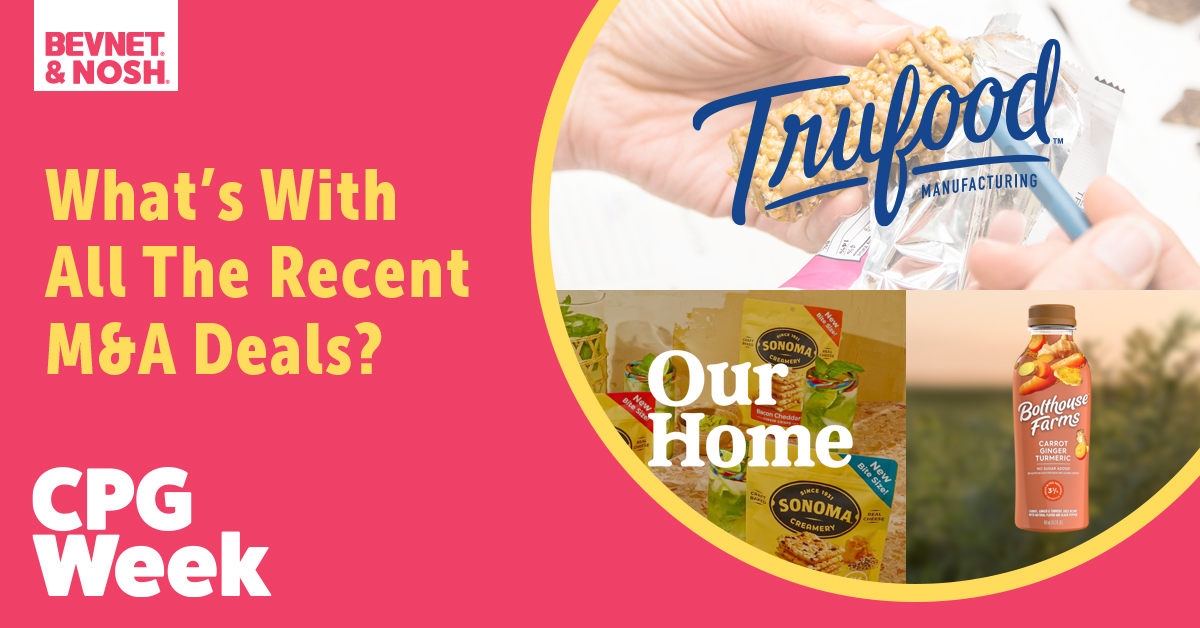
In a first for the CPG Week podcast, the team records all in-person. The group kicks off the roundtable discussing senior reporter Lukas Southard’s reporting on ketone beverages. The Nosh and BevNET team go on to talk about mergers, acquisitions and restructuring by first exploring the news of Bolthouse Farms splitting its agriculture segment from its CPG business.
Nosh managing editor Monica Watrous walks the team through the newest acquisition for snack maker Our Home and why scaling production capacity appears to be the focus for CPG brands presently. Senior reporter Brad Avery talks about the merger between two snack bar makers. The group finishes up the episode talking about the OWYN acquisition and another protein company’s new ownership.
Show Highlights:
0:40 – How do you celebrate the first CPG Week episode recorded in-person? Toast some ketone-enhanced beverages and debate the evolution of this niche category of functional drinks.
3:20 – It might seem obvious to restructure a company’s agriculture business from its CPG juice and salad dressing segments, so why did it take Bolthouse Farms over 10 years to do it? Senior reporter Lukas Southard explains the history and strategy behind the move.
7:30 – Our Home has added even more manufacturing muscle to its network with another new acquisition. What does this say about the better-for-you snack brand’s long-term ambitions?
10:00 – Brad explains the recent merger of two protein bar co-manufacturers and how it relates to The Simply Good Foods new addition to its portfolio. Monica relates it to the acquisition of legacy sausage maker Klement’s by Amylu Foods.
About the CPG Week
CPG Week is the podcast that explores the latest happenings in the consumer packaged goods industry. Join our seasoned reporting team as they dish out the week’s stories in quick, easy-to-digest episodes. Catch up on the top headlines of the week, dive into exclusive insights with the BevNET and Nosh teams, and set yourself up to make more informed business decisions. Tune in to stay up-to-date on the latest developments in the dynamic world of packaged food and beverage.
New episodes are released every week. Send us comments and suggestions anytime to podcast@nosh.com.
Show Highlights:
The CPG Week team talks about mergers, acquisitions and restructuring news this week and why a prioritization of production capacity appears to be the through-line in many of the deals.
Episode Transcript
Note: Transcripts are automatically generated and may contain inaccuracies and spelling errors.
[00:00:05] Monica Watrous: Welcome to the CPG Week podcast by BevNET and Nosh, your source for the latest food and beverage industry news. I'm Monica Watrous, Managing Editor of Nosh, here with my co-hosts, Brad Avery and Lukas Southard. If you're enjoying the show, please subscribe on your listening platform of choice. On the podcast today, we're discussing the latest mergers, acquisitions and portfolio restructuring. But first, for the very first time, the three of us are all here together recording in the studio at BevNET HQ in Newton, Massachusetts. And I think we all rated the cooler beverage samples before we started recording, right? What do you guys have?
[00:00:41] Brad Avery: I grabbed key, so this is a new ketone based energy drink that I talked to recently for a story that should be coming out in the next week or so about ketone beverages and how we're seeing a lot of different brands that are leaning into ketones and, but taking a lot of different approaches to positioning to consumers. So I actually haven't even cracked it. I'm going to crack it open. This is a pineapple passion fruit. I'm excited to try it.
[00:01:09] Lukas Southard: It's interesting because I remember ketones sort of first hearing about them maybe like two years ago and there was a few beverages coming out at the time and they were coming like here are 10 doses in a single bottle and you pour it out with a cap and it was super expensive and now it seems like they're getting more into almost like an energy drink style format for some of these new beverages hitting the market.
[00:01:28] Brad Avery: Yeah, there's a lot of different approaches. So Key is going for a pure kind of energy drink approach. There's a couple other beverages. I think Holy Water. Yeah. I see one of you guys grabbed the Holy Water. It's another ketone beverage that they're doing more of like an alcohol alternative type of approach. So they're pairing with a lot of on-premise outlets. So they're, they're, they have a partnership with Live Nation that they're doing some, some stuff at music concerts. So they're trying to be the alcohol alternative, but. It's hard because there's a steep kind of educational curve that consumers have to get to to understand why they would choose a ketone beverage over another better for you energy drink or a different alcohol alternative.
[00:02:12] Lukas Southard: Right now, it seems very specifically like lifestyle workout, diet focused. If you know what ketones are, then you're seeking it out and you're going to find it. But right now, introducing it to the wider market is a question up in the air.
[00:02:26] Brad Avery: Yeah.
[00:02:26] Lukas Southard: Yeah.
[00:02:27] Monica Watrous: So I'm holding Kinetic, which is another ready-to-drink ketone beverage. And this one's positioned around clarity and focus. It's sparkling with 12 grams of ketones, which I still don't know what that means, but I'm going to read Lucas's story when it goes up on BevNET soon and learn more.
[00:02:45] Brad Avery: If it makes you feel any better, Monica, I'm still learning about what ketones are, because it is confusing. There's different types of compounds that count as ketones. So like I said, the learning curve is steep.
[00:02:58] Lukas Southard: Well, we'll make you come back on like a week or two, and we'll start quizzing you to explain to us.
[00:03:02] Brad Avery: Yeah, please don't.
[00:03:03] Lukas Southard: Yeah, it's going to be like a biology class.
[00:03:07] Brad Avery: I'll put my lab coat on, and I'll get a chalkboard out.
[00:03:10] Lukas Southard: Don't worry. We'll be open note and multiple choice.
[00:03:12] Brad Avery: OK, great. All right, now I feel better. That seems better.
[00:03:15] Monica Watrous: The past couple weeks we've seen several deals going through in food and beverage as far as portfolio reshaping and restructuring goes. Lucas, you reported on Butterfly separating its Bolthouse Farms produce and beverage businesses. Can you tell us more about what happened there?
[00:03:30] Brad Avery: Yeah, so the beginning of the week, Butterfly, which is a private equity firm based in Los Angeles, announced that they were splitting Bolthouse Farms into two separate businesses. Bolthouse Fresh Food would be one of the businesses, and they would handle basically the agricultural side of Bolthouse Farms, which is almost exclusively in growing carrots in Bakersfield area of California. And the other business that they created is called Generous Brands, and that will house the more CPG brands that they, that they have, which is, will still be under Bold House Farms for the juice and the salad dressing, but also the Evolution Fresh juice brand that they bought from Starbucks in 2022.
[00:04:15] Lukas Southard: Now, it always seemed a little strange to me that they had all these different, radically different product formats kind of under the same family, the same company organization. Did that contribute at all to their thinking, maybe we should start separating the carrots from the green juices?
[00:04:30] Brad Avery: Yeah. Yeah. I mean, there's a synergy in terms of supply chain, obviously. A lot of the carrots were being used in the juices, especially in the early days of Bold House Farms. According to Jeff Dunn, who was the previous CEO before it was sold to Campbell's and now is an operating partner with Butterfly and has been running Bold House Farms since Butterfly acquired it in 2019. He was saying this has been a decision that's been years in the making. He was thinking about this in 2012 when Campbell's bought the Bold House Farms brand. And especially once Butterfly reacquired it, he said this was always kind of part of it, was splitting these two up. And what's interesting is, according to him, this has been happening for the last nine months. Like, they've been split. They're just announcing it now. They're, you know, not a publicly traded company, so they don't really need to jumped through hoops that Kellogg's had to when they announced they were going to split up their businesses. And so he said they're basically announcing it to the world now, but leadership's already in place and been in place for a while, and they're pretty confident it's doing well.
[00:05:37] Lukas Southard: Now, Lucas, just to be clear, are these now two separate legal entities, or is it just a further division of these two departments within the same umbrella corporation?
[00:05:49] Brad Avery: No, these are two separate legal entities. They did the deal using debt recapitalization, which basically spread the debt that they took on when they bought the company in 2019. Butterfly is now spreading it across two separate companies that are able to address their need states for capital usage in different ways, one being an agricultural company and one being You know, a juice and salad dressing brand. So there's a lot of different places where they need to operate.
[00:06:21] Lukas Southard: Right. And so if they wanted to seek outside investment for whatever reason, someone might not want to put money into an agricultural company if they're just trying to invest in CPG or vice versa. Just as one option or any number of other ways they might go about either paying off that debt or just going about the business financially.
[00:06:37] Brad Avery: Yeah. And, and they said to me, they're not really looking to divest, but there did seem to be an appetite for maybe some new acquisitions, especially under the new generous brands, uh, CPG oriented business. Um, they said to me that they were definitely looking towards more canned products. So right now they operate in refrigerated juices mostly and salad dressings, like I said, but they were very interested in. kind of alt sodas that we've been seeing. So I don't know what that means, but it was highlighted multiple times that acquisitions are on their radar.
[00:07:12] Lukas Southard: And those guys have some experience at Coca-Cola and some of the other big soda CPG companies.
[00:07:18] Brad Avery: They're not new to this.
[00:07:20] Monica Watrous: Insiders can read more about that restructuring at Nosh.com in a story that you wrote, Lucas, called Bolthouse Restructures Creating New CPG Division Generous Brands. In other acquisition news, our colleague Adrianne DeLuca wrote about Our Home, the snack company acquiring Sonoma Creamery, which makes cheese-based crisps. So Our Home used to be known as powered by real food from the ground up, and some of its brands include Food Should Taste Good, Popchips, You Need This, and it's more recently acquired brands R.W. Garcia and Good Health, which it bought from Utz earlier this year.
[00:08:00] Brad Avery: They really go for the full sentence brand names.
[00:08:04] Monica Watrous: Yeah, well, and You Need This is an all cap, so I feel like it's really... You need this. I think that's great.
[00:08:09] Lukas Southard: I think that's great. Just say like, you need this, buy it right now.
[00:08:12] Brad Avery: To be fair, those are really good. I had some at Expo West and I was like, oh, I actually need this. I need more of this.
[00:08:21] Monica Watrous: It's accuracy in marketing. As part of this deal, our home is gaining a production facility and a warehouse in Sonoma, California. This beefs up the company's current production capacity. They had bought in two new manufacturing facilities from Utz with that R.W. Garcia and Good Health deal in January.
[00:08:42] Brad Avery: It really feels like they're, they're flexing their muscles a little bit in the snacking, uh, better for you snacking category. And part of that is building out scale and capacity in terms of their production, as well as a little diversification in terms of what kind of crunchy, savory snacks they're in or which ones you, you might need. Uh, hint, hint, wink, wink.
[00:09:05] Lukas Southard: I do think it also shows when we talk about the state of M&A today, there's an opportunity that you don't necessarily have to sell to Nestle or Mondelēz. There's some smaller buyers out there looking to acquire and build out their own portfolios. And that's what our home seems to be doing, and they've been doing quite a bit of it.
[00:09:25] Monica Watrous: As Adrian wrote, our home is starting to look like our mansion. And it's interesting because its other brands are bean-based, potato-based, or vegetable-based. And this is quite a departure from those applications and product formats with the crisps. Sonoma makes two brands of crisps, cheese crisps and pizza crisps, in 10 different flavors.
[00:09:49] Lukas Southard: Pizza crisps sound good.
[00:09:51] Brad Avery: Not vegan. I'm more of the cheese crisp kind of guy. I like those whips and yeah, I like a cheesy snack.
[00:09:58] Lukas Southard: Well, there's even more M&A activity in the industry. Last week, there was also a merger of two snack and bar manufacturers, True Food and Bar Bakers. They came together in a deal that included investment from growth equity firm Manitree and an Abu Dhabi based financier, Mubadala Capital. And they're now operating as one entity. The deal closed. Now, True Foods is based in Pittsburgh, whereas Bar Bakers is a West Coast, California facility. Both specialize in nutritional snack bars, and they have some other capabilities as well, cookies and other types of snacks. I was able to talk last week to Steve Young from Manitree and he told me a little bit about their thinking getting into this deal. It's the first time that they've invested that he could remember into a manufacturer. And a lot of that comes from optimism for this nutritional snacking bar category. Now, we do know that the bar category has had a lot of saturation, but he said there's still a lot incoming and there's a lot new brands still entering the market and growth opportunity that they are identifying for this combined entity. You know, another example that he pointed to was the Simply Good Foods company buying Owen, which also happened last week. And Owen makes a variety of protein products, but protein was one of the key words that he came back to. So when we're talking about these nutritional snacks, nutritional bars, it revolves back to the protein trend and the growth of protein that they see the chance to get in on.
[00:11:36] Brad Avery: Yeah. And, and protein is something we've all been talking about. And I know at the beginning of the year, I had a couple of conversations with some industry watchers and stakeholders, and they were all saying the same thing, which is protein isn't going anywhere. High protein snacks, high protein foods in general is, is a trend that all, all companies are leaning into and it's selling. And, and that's, it's not surprising. I mean, I got two young kids. I'm always trying to pump them full of protein as much as I can.
[00:12:02] Lukas Southard: It's almost like you need protein to live or something like that.
[00:12:04] Brad Avery: No, no. Just to go to the gym and work out. You need ketones to live according to the ketone brands.
[00:12:13] Monica Watrous: No, you need this according to our home. All right. All right. Well, in other protein news. Yet another acquisition announced this week. Amalou Foods acquired Clements Sausage Company. Amalou Foods makes chicken burgers, chicken sausage, chicken meatballs. And Clements is a legacy company that produces small batch sausages based on old family recipes. AMLU has already seen 70% year-over-year growth in 2024 and is expecting to enhance its production capacity with this deal and is also eyeing new opportunities across the grocery store with new applications and categories.
[00:12:52] Brad Avery: I will say that's been a running theme throughout a lot of these stories we just discussed.
[00:12:56] Lukas Southard: Getting new production capacity is a big part of what is making some of these deals happen, it sounds like, given how much they've highlighted it.
[00:13:04] Monica Watrous: As well as diversifying the portfolio.
[00:13:06] Brad Avery: Yeah. Well, and, and to come full circle with Bold House, they were talking to me about how they have a very, you know, robust, uh, production facility that has extra space for capacity. And that's why they were looking for more acquisitions. Cause they're like, we think we can, we can scale some of these smaller beverage brands into, you know, uh, the next level of growth through our capabilities that we've already have set up.
[00:13:31] Lukas Southard: Yeah, add on what they already have and then bring it over to your already, you know, we got empty lines here. We gotta beef them up. You know, it sounds like it makes perfect sense why they would be looking. Yeah.
[00:13:43] Monica Watrous: Well, it's exciting to see so much M&A activity at this point in the year. And here are some other notable bits of news from the week. Monster co-CEO Rodney Sachs announces succession plan in Q1 earnings call. Jimbo's pulls best-selling GT's Kombucha after organic ingredient pivot. And Mondelēz grows Q1 revenue and profits despite challenging operating environment. For these stories and more, become an insider on BevNET and Nosh. That wraps up this edition of CPG Week by BevNET and Nosh. Thank you to our audio engineer, Joshua Pratt, our director for this episode is Jacqui Brugliera, and our designer is Aaron Willette. If you enjoyed the podcast, please subscribe on your listening platform of choice, and we will see you next time.
About CPG Week
CPG Week is the podcast that explores the latest happenings in the consumer packaged goods industry. Join our seasoned reporting team as they dish out the week’s stories in quick, easy-to-digest episodes. Catch up on the top headlines of the week, dive into exclusive insights with the BevNET and Nosh teams, and set yourself up to make more informed business decisions. Tune in to stay up-to-date on the latest developments in the dynamic world of packaged food and beverage.
New episodes are released every week. Send us comments and suggestions anytime to cpgweek@nosh.com.
Stay Informed. Stay Competitive.
Become an Insider to unlock exclusive CPG insights, data, education, and industry exposure for food & beverage leaders.
Industry Analysis
Context behind the headlines
Data & Reports
Category performance & trends
On-Demand Education
Expert-led video courses