CPG Week: David’s Fishy New Innovation. Plus, Is Kraft Heinz Breaking Up?
Episode 131
In this episode:
In this episode:
On the CPG Week podcast, Nosh managing editor Monica Watrous and senior reporter Brad Avery discuss an unusual new product launch and continued consolidation among packaged food conglomerates. Then, Brad provides his top takeaways from the Hemp Beverage Expo.
Show Highlights:
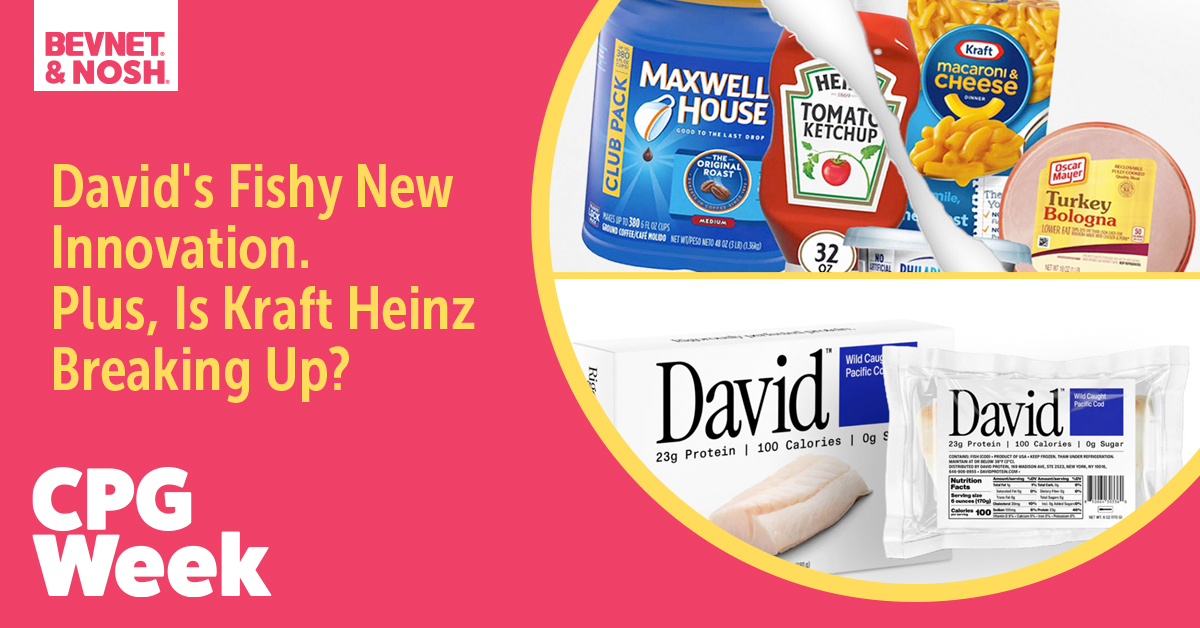
0:15 – Catch of the day? Protein bar brand David started the week with a splash, announcing the launch of frozen, boiled cod. Monica shares the reel deal behind this fishy product extension.
3:25 – Ferrero Group has announced plans to acquire W.K. Kellogg Co. for $3.1 million, adding Frosted Flakes and other legacy brands to a portfolio that also includes Nutella, Butterfinger and Blue Bunny. Brad gives the scoop behind the potential deal.
7:00 – A decade after its merger, Kraft Heinz may be headed for splitsville. Monica unpacks why the beleaguered conglomerate is exploring a spinoff.
9:45 – Brad highlights all the insights he gathered at the Hemp Beverage Expo in Atlanta.
About CPG Week
CPG Week is the podcast that explores the latest happenings in the consumer packaged goods industry. Join our seasoned reporting team as they dish out the week’s stories in quick, easy-to-digest episodes. Catch up on the top headlines of the week, dive into exclusive insights with the BevNET and Nosh teams, and set yourself up to make more informed business decisions. Tune in to stay up-to-date on the latest developments in the dynamic world of packaged food and beverage.
New episodes are released every week. Send us comments and suggestions anytime to cpgweek@nosh.com.
Show Highlights:
On the CPG Week podcast, Nosh managing editor Monica Watrous and senior reporter Brad Avery discuss an unusual new product launch and continued consolidation among packaged food conglomerates. Then, Brad provides his top takeaways from the Hemp Beverage Expo.
Episode Transcript
Note: Transcripts are automatically generated and may contain inaccuracies and spelling errors.
[00:00:06] Monica Watrous: Welcome to the CPG Week podcast by BevNET and Nosh. I'm Monica Watrous, here with my co-host Brad Avery. Now here is the latest in food and beverage industry news. Protein bar brand David started the week with a splash, announcing on Monday the launch of frozen boiled cod. The point of the fishy new product release and an accompanying marketing campaign, complete with billboards around Manhattan, is to underscore the high protein to calorie ratio of the David Protein Bar, while also clapping back at critics of its highly processed ingredient deck. David's Cod is available for purchase on the brand's website and at Happier Grocery, a SoHo grocery store. We spoke with David co-founder Peter Rahal about the Cod, which he acknowledged is a repudiation of some of the chatter that has surrounded his new company's use of artificial inputs. It would also seem to be a not so subtle dig at the backlash and litigation surrounding David's acquisition of Epigee, the supplier of a proprietary fat replacer.
[00:01:07] Brad Avery: Now, I'm going to be honest. I feel like I would have trouble eating a fish if I knew its name was David.
[00:01:15] Monica Watrous: Is the name David a problem or is the fact that your fish is named...
[00:01:19] Brad Avery: It's that the fish has a human name. It feels unfortunate.
[00:01:23] Monica Watrous: Yeah.
[00:01:24] Brad Avery: I do have a real question about the brand though, which is that this appears to be a bit of a joke release or, you know, at least snarkiness to it. I don't know how long term, this line intends to be on the market for because it sounds like it's more of a marketing play to draw attention back to the bar brand. Is that right?
[00:01:47] Monica Watrous: Well, when we asked Peter Grayhall the plans for this brand and whether it could become the primary product, He kind of laughed and said, well, we'll have to see if there's product market fit and we'll do what the consumers say. But you're right. I mean, it's, it's rare that we see a marketing gimmick. That's also a real product in the market. A lot of times we see on April fools, a bunch of fake products and stunt releases. And this is a very real release. I mean, they, you can buy it on the website. I placed an order for Cod on the David website when this was announced. So it accomplishes a couple of things for the company, but I think it's mostly a marketing play. We'll see what happens and what comes out of this, but it is definitely bringing a lot of attention to a brand that already was surrounded by a lot of buzz and even a bit of controversy.
[00:02:41] Brad Avery: Right. I think there's just the question of why COD?
[00:02:45] Monica Watrous: So COD is known as the best source of protein for the amount of calories. It has the highest protein to calorie ratio. And so when you think about bodybuilders, and I know famously Dwayne the Rock Johnson ate a bunch of COD every day as he was getting in shape for something. The reason David is releasing COD as a product is points back to its mission to deliver the highest protein product.
[00:03:13] Brad Avery: Well, I still don't think the cod should have a name. I think that's mean.
[00:03:19] Monica Watrous: Eh, that's fair.
[00:03:21] Brad Avery: Well, after word got out last week, European candy giant, the Ferrero Group, is all set to acquire W.K. Kellogg Company in a $3.1 billion deal. That shakes out to about $23 per share in cash. Ferrero, which makes Nutella and the Butterfinger and Baby Ruth candy brands, will now be adding Frosted Flakes to its portfolio, marking yet another A-list brand portfolio it's picked up in recent years. WK Kellogg, which was spun out of the larger Kellogg business in 2022, consists of core breakfast cereal and granola brands, including Rice Krispies, Raisin Bran, and Fruit Loops. It's a big get for Ferraro. Back in 2018, they struck another $3 billion deal for Nestle's U.S. chocolate and candy business, and they also scooped up the Keebler brand from a formerly United Kellogg company that year. More recently, this past January, they bought the Power Crunch fitness bar brand. Of course, this deal may just be an appetizer for the market ahead of the pending $36 billion main course, as Mars, Inc. prepares to finalize its acquisition of Kelanova, the other old piece of Kellogg's that owns Pop-Tarts, Pringles, Eggo, and Cheez-Its.
[00:04:32] Monica Watrous: Over the past few years, we've watched Ferrero Group getting more and more involved in the U.S. market through acquisition as well as expansion. They brought their Kinder chocolate brand to the U.S. several years ago, and that's a brand that has a huge following in European and other international markets. But in addition to those acquisitions that you mentioned, Ferrero also acquired Wells Enterprises, the maker of Blue Bunny ice cream, as well as Halo Top and a few other frozen dessert brands. So this portfolio diversification strategy is really interesting to me. Now they've got cones and cookies from Kellogg. They have the U.S. chocolate business and non-chocolate business from Nestle. And they have these ice cream brands. And now they're getting into breakfast cereal. I'm not quite sure I see the appeal of what I have considered, and I think many others in the industry have considered, a declining category. Cereal has not been doing great, had a little bit of a bump during the pandemic when more people were eating at home, but certainly hasn't managed to keep that momentum. So I'll be very curious to see how Ferrero manages this business and this category and where it really fits into a portfolio that's largely sweet treats.
[00:05:50] Brad Avery: Declines aside, I feel like the Rice Krispies brand, the Frosted Flakes brand, Fruit Loops, you can do a lot with those. Those are household names. So even if they're down and they're struggling with the sugar issue and just people eating less cereal overall, Those brands are immensely valuable. I can certainly see why they would want to add it to a portfolio that already focuses on suites.
[00:06:17] Monica Watrous: It would be really interesting to see what collaborations and co-branded innovation comes out of this acquisition as well. I know when Ferrero Group bought the Ferrara Candy Company, which is the owner of brands such as Trolley and Brock's and other non-chocolate confectionary brands, we started to see some synergies and some co-branding happening in seasonal confections. And so could we maybe see some chocolate innovation that incorporates frosted flakes or some kind of fruit loop, candy corn. I don't know. The possibilities seem endless to me. While Ferrero and Kellogg appear to be tying the knot, it seems Kraft Heinz is headed for splitsville. The Wall Street Journal reported last week that the packaged food conglomerate, which has been underperforming for years, is mulling a spinoff of a large portion of its grocery business. The new entity could be valued at as much as $20 billion and could include many Kraft products, per people familiar with the matter. The separation could occur in the coming weeks, but the board has not signed off and Kraft Heinz has not discussed other potential options. Now, the creation of Kraft Heinz or the merger of Kraft Foods and the H.J. Heinz Company that was forged in 2015 brought together two businesses with combined revenue of $28 billion and a stable of legacy brands, including Jell-O, Maxwell House, Philadelphia and Oscar Mayer, plus Kraft and Heinz namesake products. Over time, higher costs, waning consumer sentiment and poor operational execution eroded the value of the mega merger significantly, sending its stock down by more than 60 percent, according to the journal. Kraft's news comes amid a larger realignment among leading CPG food and beverage companies that has been heating up in recent weeks.
[00:08:16] Brad Avery: It will be interesting if this does come to pass, whether it follows the same trajectory that Kellogg just followed, where they split apart the business and now all the individual pieces are getting scooped up. by private companies. Yes. And so I wonder if that's part of the trajectory at the moment for a lot of these legacy mega brands, mega conglomerates, or not. And obviously, they could still try to keep this together. But it sounds like this is the path they're heading down, that we're going to see these portfolios divided. Maybe some go private. Who knows? But it's a big question about, what the consolidation of the industry has led to and when you get these giants, how long can they keep those brands, you know, relevant and the entire company stable.
[00:09:08] Monica Watrous: Sure. And the other part of this that we're looking into is how this is going to affect emerging brands. A lot of our listeners of this podcast and readers of our content on BevNET.com and Nosh.com are going to be affected by this reshuffling of portfolios at the highest level. So we are tracking that. We're going to continue to report on that. We already have a piece up. on Nosh.com about what this realignment could mean for smaller emerging brands, and we'll be on top of things as they continue to develop. On a lighter note, Brad, you just returned from the Hemp Beverage Expo last week. What were some of your key takeaways from the event?
[00:09:52] Brad Avery: It was an almost surprisingly ordinary trade show in a way, except that everyone was getting high throughout the day. So the Hemp Beverage Expo 2025 was held last week in Atlanta, and I went down to attend both days of the event. It had panel sessions in the morning, followed by a trade show in the ballroom at the Omni Hotel outside of Centennial Park. This is the second edition of the Hemp Beverage Expo. It was focused specifically on Delta 9 THC products, hemp-derived THC. Not so much CBD. And as the second edition last year, I heard it was held in Minneapolis and about 300 people showed up. This year it was about 1200. So we're talking about 4X growth. And a lot of the brands that I spoke with on the show floor said that they launched in January this year, you know, in this spring. These are young, new brands all getting in on a very fast growing category that everyone is very, very optimistic about.
[00:10:54] Monica Watrous: But it's also a category that's plagued by a lot of murky regulatory issues and other uncertainty, right?
[00:11:01] Brad Avery: Absolutely. And we've been covering this on DevNet for a while now. The regulatory issue with it is massive. The entire category exists because of a loophole in the 2018 Farm Bill that effectively accidentally legalized weed. I mean, that's what it did in layman's terms. It's more complicated than that, but hemp-derived THC is technically legal in every state, and so these products are able to be sold in mainstream markets, and that's why we've seen companies like Total Wine bring them on in the Beer distributors are increasingly interested, and beer distributors were very present at this trade show. Now, ironically, the same day that the first day of the show was held, the Senate moved forward with language for an upcoming spending bill that would close that loophole. It basically says, we're going to reban the hemp THC products, intoxicating hemp, with a deadline of one year. Now that bill still needs to be passed, but it's an existential threat. There's a big sword of Damocles hanging over this category, but no one seemed too concerned about it. And I think there's a big sense that this is getting too big too fast that you can just write it away with a pen stroke. Mainstream companies are very involved. There's a lot of interest. There's a lot of money flowing around through this and these brands are growing and they're growing rapidly. I think that's one of the big takeaways. that a lot of the government people, a lot of the regulatory people feel confident that they can get something passed that will clear things up and allow it to continue to be legal without some of the uncertainty and gray zone that has really hung over this space. But I do have to personally wonder if some people are kind of overlooking that the Senate just said, we want to ban this again. And, you know, that's why one of the key words that came up on the floor is education. And when people talk about education in this industry, you're usually talking about consumers, right? But they said it's not just consumers this time. It's also lawmakers we have to educate. We have to educate regulators. We have to educate the people, the buyers, everyone about what this is, what the legality is and why it needs to remain an open market.
[00:13:24] Monica Watrous: Now, as far as some of the products you saw there, what were general themes or anything that jumped out to you? One of the things I wanted to ask you about was the celebrity involvement with THC brands. I know we were talking about Whoopi Goldberg earlier.
[00:13:37] Brad Avery: Yes, the Whoop Tea brand was there, Whoopi was not. We also saw Rohan Marley, son of Bob, was there with a new drink. He's very involved on the business side of the Marley brands and the family. I didn't see too many people touting celebrities that much actually. More so what I saw was a lot of entrepreneurial brands, a lot of smaller companies that were just getting started, people jumping into this industry for the first time. There were a few bigger companies, some suppliers that were getting in. A lot of breweries that are moving away from craft beer because of the declining sales and now getting into hemp because it's growing, it's booming. As far as product innovation goes, saw a lot of lemonade, tonics, sodas are big formats for this category, seltzers obviously. Some are positioning as an alcohol alternative. Some are saying that the occasions are actually a little different and we need to try to pivot away from just being alcohol alternative. It's interesting. There's a bit of debate about what direction the category should go in or how much room it has to be different things. A few outliers, there was a coffee, a cold brew coffee brand subculture that was there. There was a kombucha based tonic and saw a couple companies using some kind of kombucha elements in their drinks. But largely those are the categories that this space is playing because it's around relaxation and elevation. So you think, oh, lemonade or something you want to kick back and open or non-alcoholic beer with DHC in it that still intoxicates you, just not with alcohol.
[00:15:09] Monica Watrous: Interesting. Now I know whenever I go to Expo West, I have a hard time controlling the number of samples that I grab. How are you able to manage your consumption at a show like this where there are actual samples of intoxicating hemp products?
[00:15:26] Brad Avery: It's a weird question. I think everybody was a little unsure of what the plan is, because, again, I think you hear this type of thing is happening and you're going to expect it to maybe be a bunch of debauchery, but it's not. It's a business event. But it was very chill. I described it as by the end of the day, I think there was more of a lifting lilt that was happening versus the chaos and anxiety of like an Expo West. It was a completely different vibe. But I think everyone was pretty amenable to, you know, you're just going to take a small little sip and, you know, set it aside because it does start adding up. If you're going to be sampling at all, there's really no way around it. Some companies did have uninfused samples, Mostly everyone was getting nice and toasty.
[00:16:16] Monica Watrous: Maybe that's the secret to Expo West. We could all be a little bit more chill if we had a THC pavilion or something.
[00:16:21] Brad Avery: Maybe that's the secret to getting a business deal signed. Get them a little, oh, whoa, what came over me? Whoa, my name's on this check now.
[00:16:29] Monica Watrous: How many deals were inked at this show? I don't know.
[00:16:33] Brad Avery: But I will say I found it to be a pretty productive show. I think everyone was pretty eager and attentive. One area where I thought it was interesting that there weren't that many attendees were retailers, and I asked some people about that, and they said, well, why do they need to attend? All the brands are coming to them right now. You know, that's a bit of what's going on is, you know, they're knocking down the doors, places like Total Wine, to try and get on the shelves. So the distributors are all here looking to, you know, scoop up as many brands as they can, whichever ones look good. And the brands and distributors are just beating down the doors of the retailers to be like, hey, you gotta give this a shot.
[00:17:16] Monica Watrous: Sure. Well, of course, folks can read more about your takeaways and insights from the Hemp Beverage Expo at BevNET.com. And here are some other notable bits of news from the week. The U.S. Food and Drug Administration announced it has approved the use of a new natural food dye, gardenia, to bring blue hues to beverages and candy. On its mission to create healthy minds through healthy habits, Mudwater is turning its attention to protein as it gathers strength in retail with the launch of a ready-to-mix protein shake. And finally, a new challenger to Smucker's Uncrustables has emerged. Jams, a high-protein take on the frozen peanut butter and jelly sandwich, debuted this week exclusively in more than 3,000 Walmart stores nationwide. For these stories and more, become an insider at BevNET & Nosh. And if you're enjoying the show, please subscribe on your listening platform of choice. That wraps up this edition of CPG Week by BevNET & Nosh. Thank you to our audio engineer, Joshua Pratt, our director is Mike Schneider, and our designer is Aaron Willette. If you enjoyed the podcast, please subscribe on your listening platform of choice, and we will see you next time.
About CPG Week
CPG Week is the podcast that explores the latest happenings in the consumer packaged goods industry. Join our seasoned reporting team as they dish out the week’s stories in quick, easy-to-digest episodes. Catch up on the top headlines of the week, dive into exclusive insights with the BevNET and Nosh teams, and set yourself up to make more informed business decisions. Tune in to stay up-to-date on the latest developments in the dynamic world of packaged food and beverage.
New episodes are released every week. Send us comments and suggestions anytime to cpgweek@nosh.com.
Stay Informed. Stay Competitive.
Become an Insider to unlock exclusive CPG insights, data, education, and industry exposure for food & beverage leaders.
Industry Analysis
Context behind the headlines
Data & Reports
Category performance & trends
On-Demand Education
Expert-led video courses