CPG Week: Can Chobani Clean Up Daily Harvest’s Image? Plus, A Peek At Peak Protein
Episode 123
In this episode:
In this episode:
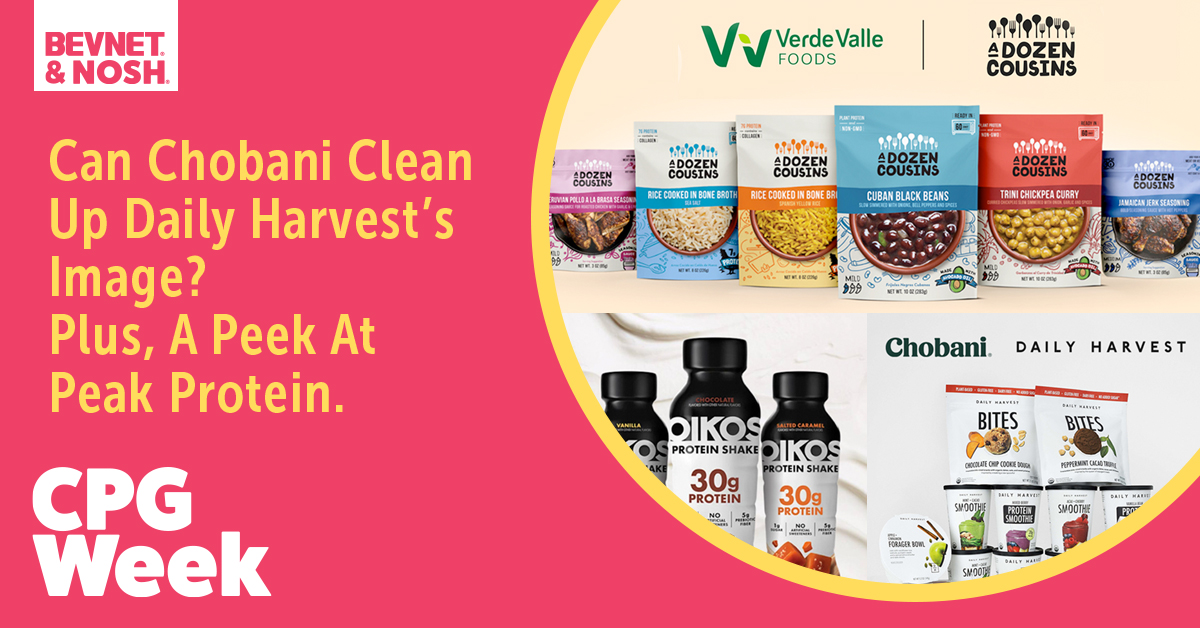
This week, the podcast dives into a couple new acquisition deals, manufacturing and a hefty dosage of protein. Nosh managing editor Monica Watrous and senior reporter Lukas Southard go through the past week’s CPG industry news, covering Chobani’s expansion into frozen foods with its takeover of Daily Harvest, how one bone broth maker is betting on the category’s growth and why protein content continues to rise in the beverage industry.
Show Highlights:
0:15 – The podcast jumps into a pair of recent acquisitions this past week. First, Monica explains the sale of A Dozen Cousins to Verde Valle Foods. Next, Lukas describes what we know so far about Chobani’s newest acquisition, smoothie and plant-based meal maker Daily Harvest.
3:30 – The team digs into the bone broth category, discussing Austin, Texas-based Kettle & Fire’s new manufacturing plant, KettleWorks in Lancaster, Pa.
5:30 – Protein drinks continue their upward momentum. Lukas shares some of the insights from a story tracking how muscle mass-building beverages seem to have no ceiling and now cover multiple segments.
7:30 – On a lighter note, the team goes through the Kingsford and Miller Lite grilling partnership, boomers’ penchant for cannabis, MrBeast is getting meaty with Jack Link’s and yogurt maker Beny’s rebrand to Sourmilk.
About CPG Week
CPG Week is the podcast that explores the latest happenings in the consumer packaged goods industry. Join our seasoned reporting team as they dish out the week’s stories in quick, easy-to-digest episodes. Catch up on the top headlines of the week, dive into exclusive insights with the BevNET and Nosh teams, and set yourself up to make more informed business decisions. Tune in to stay up-to-date on the latest developments in the dynamic world of packaged food and beverage.
New episodes are released every week. Send us comments and suggestions anytime to cpgweek@nosh.com.
Show Highlights:
The CPG Week podcast dives into Chobani’s acquisition of Daily Harvest, Kettle & Fire’s new manufacturing plant and the surge of protein beverages.
Episode Transcript
Note: Transcripts are automatically generated and may contain inaccuracies and spelling errors.
[00:00:05] Monica Watrous: Welcome to the CPG Week podcast by Befnet and Nosh. I'm Monica Watrous, here with my co-host Lukas Southard. Now let's get into the latest in food and beverage industry news. Verde Valley Foods, a rice and bean manufacturer, has acquired a dozen cousins for an undisclosed sum. Founder and CEO Ibrahim Bazir will continue to lead the business as general manager under its new ownership. Los Angeles-based A Dozen Cousins was founded in 2019 and markets a range of pouched beans and rice products that are inspired by Creole, Caribbean, and Latin American cuisines. Third-generation family-owned Verde Valley produces the Isadora brand of ready-to-eat beans and Mexican meals. This transaction gives Verde Valley a foothold across dietary needs and product positionings within the category, while providing much-needed manufacturing capacity and manpower to a dozen cousins. Verde Valley Foods U.S. CEO Herman Brosales told Nosh that he doesn't see the brand's products competing because they target different consumer segments.
[00:01:12] Lukas Southard: In other acquisition news, Chobani has bought plant-based smoothie and meal brand Daily Harvest. While neither the price tag nor the terms of the deal were announced, Daily Harvest was publicly valued at $1.1 billion, after a $77 million Series D. The acquisition by Chobani does stand out, considering its recent moves. Not only did it acquire La Cologne for $900 million less than two years ago, but the yogurt maker recently broke ground on a $500 million expansion to its Idaho dairy facility. It also announced it would begin construction on a $1.2 billion facility in New York. How Daily Harvest will fit into Chobani's manufacturing infrastructure and its retail goals is still a little bit of a mystery, but it will place Chobani into other categories of refrigerated products. Daily Harvest makes smoothies, snack bites, protein powders, and heat-and-eat meals, like breakfast bowls and savory dishes. Though it started and still operates in the meal delivery channel, Daily Harvest has pushed for more presence in retail in the last few years, expanding into Kroger, Target, Wegmans, and Costco, among others.
[00:02:25] Monica Watrous: I think the big elephant in the room here is Daily Harvest is still very much linked to the food safety scare that happened several years ago with the ingredient tarraflour, which was featured in its plant-based meat alternatives. There were a lot of consumers who reported gastrointestinal issues. Some had to have their gallbladders removed, they were hospitalized, and it's still a pretty big blight on the Daily Harvest history. So I'm curious how Chobani will overcome that bit of unsavory past.
[00:03:02] Lukas Southard: Yeah, that remains to be seen, Monica. What will be interesting to watch is how Chobani flexes its pretty massive manufacturing scale into a different section of the store than they're used to operate in. So they'll be expanding from the refrigerated aisle into frozen where Daily Harvest operates. While this might be a hard proposition for Chobani to accomplish to take the ick off of Daily Harvest, Chobani is well positioned and does have the tools in place to breathe new life into Daily Harvest.
[00:03:36] Monica Watrous: From one high-protein category to another, bone broth brand Kettle & Fire opened its first manufacturing facility on the heels of recent financing. The opening of Kettleworks in Lancaster, Pennsylvania enables the Austin, Texas-based company to unlock significant operational efficiencies and maintain its high standards for quality and transparency. Kettle & Fire produces a range of boxed bone broths and soups that are sold in 22,000 stores nationwide and online. At the 167,000 square foot plant, bone broth concentrate will be made using grass-fed and grass-finished, free-range or pasture-raised bones in a slow simmering process that increases the nutrient density of the finished product, according to the company. In February, Kettle & Fire announced a $43 million secondary buyout led by its strategic partner, Coulter Ventures, to fuel its next stage of growth. And according to Spins, the U.S. bone broth market exceeded $300 million in sales in 2024 and is poised to double in the next few years.
[00:04:46] Lukas Southard: It'll be interesting to track this one because as we've reported in the past, moving into self-manufacturing and building out your own space is not easy, but it does offer some extra opportunities for revenue growth, be it in co-packing or private label.
[00:05:04] Monica Watrous: There's been a lot of interest in collagen and natural sources of protein in the past few years. The Maha movement is accelerating this. So there is a lot of expectation that bone broth is going to continue to grow. And Kettle and Fire is really positioning itself as the leader in this space and using their quality markers as a point of differentiation.
[00:05:28] Lukas Southard: So speaking of trends that are doing really well, the abundance of high-protein products does not appear to be going anywhere. And our esteemed BevNET Managing Editor, Martín Caballero, wrote about the continued dominance of protein in the drink space. He cited the latest entrant to the category, Danone's Oikos brand, offering a shelf-stable protein shake with 30 grams in each 12-ounce bottle. But by the numbers, leading brands are driving overall category growth. For example, Bellring brand's Premier Protein grew 22% in Q1 2025, with its shake consumption up 25%. If you factor in Coke's Fairlife brand and Simply Good's one-two punch of Owen and Quest, these are all posting retail sales growth. And when it comes to high-protein beverage set, it also appears that more is better. Quest recently released a product with 45 grams of protein in it. And then you have challenger brands like Slate Milk that have added a 42 gram product to their portfolio. And finally, there's protein sodas. So Energy drink brand Bucked Up has a slew of options. And now sports drink maker Don't Quit has also jumped into the muscle mass momentum with their own protein soda.
[00:06:44] Monica Watrous: I feel like a lot of these brands are just racing to the top. How much protein can we pack into our product? And at what point do consumers stop caring or lose interest? When you see 45 grams on a bottle, does that really make you want to pick it up next to the 36 gram bottle? I just think it's not going to taste very good either.
[00:07:04] Lukas Southard: As we all know, Monica, athletes are encouraged to have one gram of protein per pound every day. So sooner or later, you're going to get like 150 grams of protein in one drink that you can just drink once. And that's all you have to drink for the day. And then you're done.
[00:07:20] Monica Watrous: How many of us are athletes here?
[00:07:21] Lukas Southard: I'm an athlete in my mind.
[00:07:26] Monica Watrous: For the mainstream consumer, this is aggressive. And at some point I just can't imagine it resonating. On a lighter note, Kingsford has teamed up with Miller Light to produce beer coal, which are charcoal briquettes actually made with beer. Who needs logs when you have lager?
[00:07:45] Lukas Southard: Can you puree those and then drink them? Like, how does that work?
[00:07:48] Monica Watrous: I don't think you should be consuming charcoal briquettes, Lucas. But Miller Lite is really leaning into grilling season with some of its promotions and collaborations. The beer brand recently launched a Pringles partnership featuring cookout inspired flavors like beer canned chicken and grilled beer brat.
[00:08:06] Lukas Southard: Those sound good to me. I would eat those over having a Miller Lite, but I'm a bit of a beer snob, so. Yes, you are. Sorry. from beer briquettes to seniors getting stoned, Americans over the age of 55 are the fastest growing cannabis consumer group. Now, according to some data presented by cannabis consulting group higher profits, 75% of growth in cannabis use is among adults aged 55 or older, and nearly one in five boomers say that they use cannabis at least once a week, which is not surprising to me, considering that my parents are some of the biggest consumers of my stash of THC beverages in my basement.
[00:08:49] Monica Watrous: I mean, my dad smoked some weed in Vietnam, like this is par for the course.
[00:08:55] Lukas Southard: That was different weed back then.
[00:08:58] Monica Watrous: The late great Mike Watchers has a stash of weed somewhere in his house. I've been searching for it for the past year.
[00:09:04] Lukas Southard: Well, my parents know where my stash is and they raid my THC drink stash all the time.
[00:09:13] Monica Watrous: Well, if you get the munchies. Sweets and Snacks wrapped last week, where a handful of influencers and social media personalities debuted new ventures into the snacking industry, including Mr. Beast's collaboration with Jack Link's on a line of jerky and meat sticks. And my question is, if they're not calling it Mr. Beef, what are we even doing here? Mr. Beef, anyone?
[00:09:38] Lukas Southard: No notes, no notes.
[00:09:42] Monica Watrous: And speaking of names, yogurt brand Benny has changed its name to Sour Milk. The team believes this name will help the brand stand out on shelves. They're not wrong, but he noted that sour milk doesn't mean spoiled milk and they are drawing parallels to sour cream, which really is just fermented cream in the same way that yogurt is just fermented milk. Makes sense to me.
[00:10:05] Lukas Southard: Yeah, I'm still unsure. Sour milk is really something you want to be putting on your name, but it's memorable. It's true.
[00:10:13] Monica Watrous: I mean, you don't put rotten on candy and not make an impression. Shout out to Michael Fisher, founder of Rotten. And here are some other notable bits of news from the week. VMG Partners closed its sixth fund at its target and hard cap of $1 billion backed by returning and new limited partners. Jones Soda managed to arrest net losses and start generating traction in cannabis drinks in Q1, but lower sales revenue dragged on gross profit as the craft soda company attempts its latest turnaround. And finally, Whipnotic is rolling into Target this month as the mass retailer expands its whipped topping set beyond private label. The startup is slated to join store brand Favorite Day on shelves at 250 locations initially, with plans to triple that footprint by year end. For these stories and more, become an insider at BevNET and Nosh. And if you're enjoying the show, please subscribe on your listing platform of choice. That wraps up this edition of CPG Week by BevNET and Nosh. Thank you to our audio engineer, Joshua Pratt, our director is Mike Schneider, and our designer is Aaron Willette. If you enjoyed the podcast, please subscribe on your listening platform of choice, and we will see you next time.
About CPG Week
CPG Week is the podcast that explores the latest happenings in the consumer packaged goods industry. Join our seasoned reporting team as they dish out the week’s stories in quick, easy-to-digest episodes. Catch up on the top headlines of the week, dive into exclusive insights with the BevNET and Nosh teams, and set yourself up to make more informed business decisions. Tune in to stay up-to-date on the latest developments in the dynamic world of packaged food and beverage.
New episodes are released every week. Send us comments and suggestions anytime to cpgweek@nosh.com.
Stay Informed, Stay Competitive
Unlock the articles, expert interviews, and data reports that power the food and beverage industry. Join our community and stay ahead with exclusive insights from BevNET and Nosh.