CPG Week: Boba Controversy, AI Energy & NACS Takeaways
Episode 94
In this episode:
In this episode:
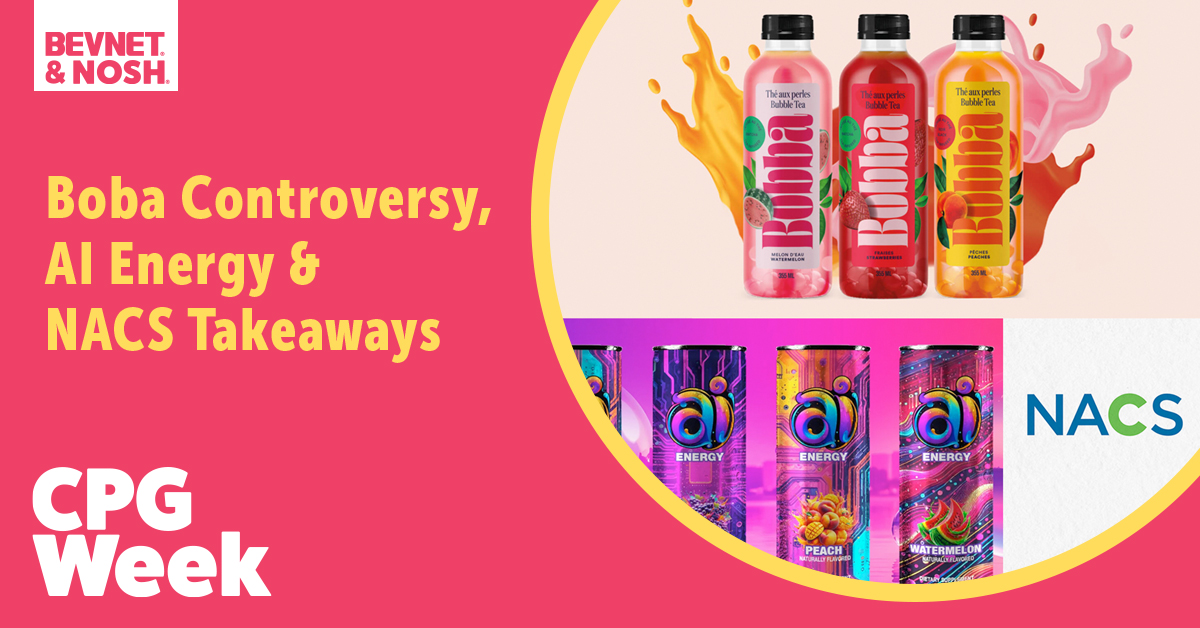
On CPG Week, the podcast team talks about a bubbling controversy in boba, Jack Owoc’s return to energy and an update from the National Association of Convenience Stores’ (NACS) yearly conference.
This week, senior reporters Brad Avery and Lukas Southard were joined by BevNET managing editor Martín Caballero. The group starts the podcast talking about how actor Simu Liu sparked a viral conversation about cultural appropriation centered on bubble tea. The podcasters go on to chat about Jack Owoc’s new caffeinated beverage Ai Energy. Marty goes on to discuss some of the trends he was tracking at this year’s NACS show in Las Vegas.
Show Highlights:
0:30 – Boba takes center stage in a conversation about appropriation versus appreciation. Lukas explains why an episode of Canada’s “Dragon’s Den” television show with Simu Liu sparked the debate. Brad and Marty weigh in on why this is not the first nor the last time the team will discuss the issue.
8:30 – Brad details former Bang Energy founder Jack Owoc’s new AI-powered energy beverage.
11:00 – How is coffee blending into the energy category? Marty shares what he saw in this trend at this year’s NACS show and why it is telling of the ceiling in RTD coffee.
16:30 – Along with energy drinks, Marty also saw a lot happening in carbonated soft drinks at the show. He explains why better-for-you soda is driving innovation in the category.
About the CPG Week
CPG Week is the podcast that explores the latest happenings in the consumer packaged goods industry. Join our seasoned reporting team as they dish out the week’s stories in quick, easy-to-digest episodes. Catch up on the top headlines of the week, dive into exclusive insights with the BevNET and Nosh teams, and set yourself up to make more informed business decisions. Tune in to stay up-to-date on the latest developments in the dynamic world of packaged food and beverage.
New episodes are released every week. Send us comments and suggestions anytime to cpgweek@nosh.com.
Show Highlights:
On CPG Week, the podcast team discusses a bubbling controversy in boba, Jack Owoc’s return to energy, and an update from the National Association of Convenience Stores’ (NACS) yearly conference.
Episode Transcript
Note: Transcripts are automatically generated and may contain inaccuracies and spelling errors.
[00:00:05] Brad Avery: Welcome to the CPG Week podcast by BevNET & Nosh, your source for the latest food and beverage industry news. I'm Brad Avery, Senior Reporter at BevNET & Nosh, filling in as host this week for Monica Watrous, who is on vacation. But joining me as always is Lukas Southard, and we also have joining us BevNET Managing Editor, Martín Caballero. If you're enjoying the show, please subscribe on your listening platform of choice. On the podcast today, we're discussing Jack Owoc'Walk's AI-powered return to energy drinks and a report from the National Association of Association of Convenience show. But first, actress Simu Liu inadvertently sparked some controversy for a bottled bubble tea startup last week after an appearance on Dragon's Den, the Canadian version of Shark Tank. Lucas, you were reading up on what happened here.
[00:00:50] Lukas Southard: So what we have here is kind of a case of appropriation versus appreciation. As you said earlier this month, an episode of Dragon's Den aired with Simu Liu as the guest investor, and it sparked a bit of a viral moment when a Quebec City-based beverage brand called Boba, mind you, they spell it with three Bs instead of two, came on and pitched their canned and bottled Boba beverage. The founders found themselves faced with a disappointed Simulu after pitching their product. He called out the brand on basically cultural appropriation. And he said in the episode, quote, there's an issue of taking something that's very distinctly Asian in its identity and quote, unquote, making it better. After Liu explained why he wouldn't be investing, the brand did get a deal from a fellow Dragon, but that deal was later rescinded when backlash started to develop online over this non-Asian Boba brand appropriating Boba as their platform. In another twist, Leo posted on his TikTok account two days after the episode aired that he had received word that the Boba brand had received death threats and harassment as a result of their brand and their appearance on the show. So since the uproar, the brand has released a statement saying, quote, we will reevaluate our branding and packaging and marketing strategies to ensure that they reflect a respectful and accurate representation of our Taiwanese partnership and Bubble Tea's cultural roots. So the whole issue kind of sparks a whole conversation about brands that are using a very culturally significant ingredient or product that don't actually come from that culture themselves, and whether that's okay to do or it's not okay. And I think there's been a variety of reactions to this from different boba tea brands in CPG.
[00:02:57] Martín Caballero: It kind of feels like we're in an era where we know consumers are hungry for new products and we know that they're interested in global flavors. I think we just had that Whole Foods report kind of highlighting some of the trends that we should expect for this coming year. So it feels like conditions are really kind of like ripe for these kinds of conflicts to kind of rise to the surface where you will have questions about cultural appropriation and sort of what is Okay, for certain brands to do. And I think in this case, there was a lot of particular interest around some of the terminology there, as you mentioned, you know, some of the language I think is important here in terms of claiming sort of this as a quote invention or a disruption, maybe sort of Subtle ways in which ownership can sort of be claimed over some of these things and sort of insinuate that, you know, things need to be improved or changed in order to be, you know, palatable for mainstream consumers. So, I mean, I think it's just something that whether or not you believe this instance was cultural appropriation or not, you know, it's definitely something that brands, entrepreneurs, investors, and then consumers obviously are going to have to be aware of. And obviously there's a lot of influence behind that in terms of evaluating the authenticity of some of these products.
[00:04:13] Brad Avery: You know, an interesting twist that also came out of that incident was another brand seeing a big boost in attention, which is Twirl Milk Tea. And that is a brand that is Asian-American owned and co-founder Olivia Chen posted a TikTok video after the episode aired and the controversy started stirring up. And that wound up going viral and got a lot of attention of Simu Liu as users were trying to sort of say, hey, check out this brand. Instead, you know, Twirl has been around for a few years now. They make an RTD milk tea and they also sell boba separately. They don't do a combined version in a bottle yet, at least. But it's kind of interesting now to see as this issue develops, you know, other brands able to get some, some positive attention out of it as well. And, uh, you know, that's a brand we've been covering since, uh, you know, first time we saw them at a trade show.
[00:05:08] Lukas Southard: As you said, Marty, I think a lot of this did come down to some of the word choices that were used in the pitch on Dragon's Den. They called boba tea as a category sugary and you don't always know what's in it. And that seemed to rub Simulu wrong at the time. But it can be difficult and you have to tread lightly for some of these brands if you are presenting something that might not come from your specific cultural background, but is something very important to a set group of people or an ethnic group.
[00:05:40] Brad Avery: It's worth remembering as well that there's some other brands playing in this category that are doing similar products, these RTD bubble teas, that before the technology didn't really exist until relatively recently to do this type of product at scale with maintaining a consistent quality. And so there's a lot of other brands out there. There's Joiba, there's Dow Herb Beverage, Bub Love, InnoTea does one. And they've been seeing some growth in retail. So this is a format where we've been seeing other brands make similar claims of lower sugar, healthier for you than the on-premise version of the product. But the presentation really seems to be the issue here. And absolutely, there kind of comes across like some tone deafness when it's white people presenting it.
[00:06:28] Martín Caballero: Well, I think, you know, we've definitely seen this great kind of explosion of next generation, I think specifically Asian CPG brands that we've covered a lot on Bevden and Anosh, like Omsom, Flyby Jing, Mila, Sanzo, you know, which Simu is also an investor in a couple of those brands as well. So I think a lot of what is driving some of the entrepreneurs in this space is an ability to sort of reclaim some of the cultural appropriation that's taken place over the past 20, 30 years by large strategics and sort of just the larger food industry and sort of co-opting a lot of these flavors or a lot of these traditions that I think this next generation of brands is sort of putting their own stamp of authenticity on and really sort of reclaiming those in a way that's palatable and appealing. I think Simu really sort of gave a voice to a lot of these entrepreneurs and people in CPG who felt exactly sensitive to those feelings of cultural appropriation and feeling that this food industry wasn't really speaking to them, even though it was reflecting some of the traditions that they're really familiar with. The thing that I think gets a little bit challenging is, is it possible to have a boba tea brand with no Asian entrepreneurs, no Asian advisors or sort of, can you exist outside of that? I mean, that's a question that I think brands, consumers and entrepreneurs are going to have to answer. Well, Simu is going to be particularly disappointed because at NACS, I did see another boba tea and this one is from Jarritos, the Mexican soda brand. So sorry, Simu, but you may have some more competition when it comes into that category, because that's a great example of cultural diffusion, cultural appropriation. Some people will have to decide exactly what that is. So speaking of Knacks, I think we'll get into a little bit of what I saw in Vegas a couple of weeks ago and a bit, but a definite staple of Knacks past is Jack Owoc'Walk, the founder and CEO of Bang. And Brad, I heard he's back with a new venture. Tell us about it.
[00:08:33] Brad Avery: Yeah, absolutely. He is going for the AI route with AI Energy. It's a functional brand that contains a 700 milligram NeuroSync supplements blend, which includes 200 milligrams of synthetic caffeine, very specifically synthetic. L-theanine, and a few other nootropic ingredients to support focus and memory. Now, you'll remember last year, Jack Owoc's previous company, Vital Pharmaceuticals, went bankrupt amid a lawsuit from Monster Energy. Bang was sold off to Monster, and he's still in and out of the courtroom facing some of the lasting aftereffects of that bankruptcy. So it is interesting to see him already coming back with a fresh new brand, particularly one that is tied to this AI theme. As we've seen over the past year, ChatGPT and all these other programs have come up. Jack seems to be saying that he has become an AI expert and wants this energy drink to help the human mind keep up with the machines that are quickly outpacing us.
[00:09:42] Martín Caballero: just chug away and see if you can keep up with the computers. That's basically the message there. But yeah, I mean, definitely interesting to see Jack back in the mix. I think BevNET readers and listeners are well aware of his background, certainly a colorful character. But you know, the other thing is, all jokes aside, it will be interesting to watch him rebuild this brand, because obviously Bang really built its reputation with independent distributors. That was certainly disrupted by Pepsi, and we all know how quickly that fell apart. So really, he's starting over in terms of rebuilding that trust with distributors and finding a way into this extremely crowded channel that has changed and continues to change since Bang's exit. So I think right now he's focusing on gyms and fitness centers. It is a little bit of a different play because it seems like AI is a little bit more focused on that kind of mental stimulation. There's sort of callouts for euphoria and focus. So maybe a little bit less of the kind of fitness weightlifting heavy aspect that was kind of, you know, indicative of bang. So, interesting to see, definitely one we'll be watching, and I think we should have some more information from the man himself, hopefully soon.
[00:10:56] Brad Avery: Well, if you want to read more about that, we did write about it on BevNET. That article is, Awok AI Bang Creator Mounts Comeback with AI Energy. Now, as we've alluded to a few times now, Marty, you just got back from NACS in Las Vegas. Tell us, I mean, what else did you see in energy drinks there? How was the show?
[00:11:14] Martín Caballero: Well, it's always a super busy show. Even over the course of two and a half days, it's tough to really hit up everything. And there's always something surprising there as well. But in terms of energy, you know, what really stood out to me this year was just sort of this continual crossover between energy and coffee. I wrote a little bit about it on the website and on one of my reports there. But it really feels like we're, I mean, we're definitely seeing a lot of crossover between those two. I mean, just off the top of my head. Stoke Cold Brew, which is sort of one of the really high performers in the RTD cold brew space. Their next move is to go into energy coffees or sort of cold brew plus energy in a can aimed at C stores. We've seen a similar approach in the past from the likes of Super Coffee with their extra coffee. Of course, we all know about Monster Java and they're sort of going even heavier with the caffeine and the energy payload when it comes to their And then we've also seen this year at Next there was the showcase for Black Rifle Coffee's new energy drinks, which are going to be going on the trucks starting in January. So it really suggests to me that there's definitely an appeal for obviously more caffeine, more energy. But there's really seems like there's not a lot of other places where these kind of drinks can go. Of course, if you have coffee, you have your black coffee, you have your plant based milk or with dairy, you know, creamers and that kind of thing. But once you sort of push out of those adjacencies. I think that some of these brands are having trouble finding where to go next. So energy may seem like the next safe bet. You know, it's another drink. It's obviously caffeine adjacent. So there's some opportunities there. But will that work? You know, it remains to be seen. I think, you know, Celsius, a lot of discussion around them was about possibly going into snacks and sort of edible categories as well. So maybe something like that a little bit further from beverage might give a little bit of distance and a little bit more way to leverage the brand. Because it's not as simple as it may seem. I think, you know, going back to the example of Starbucks, which once again had another energy RTD product at NACS this year, trying once again to sort of crack that specific category. And even though they're, you know, the biggest name really in coffee, I think the brand doesn't translate immediately and smoothly. And I think there's sort of still some distance between how consumers are interpreting that, but definitely a lot of a lot of crossover or a lot of attempted crossover anyway.
[00:13:49] Brad Avery: Yeah, and it should be noted that this is coming as the coffee category in particular has seen some declines pretty consistently in the scanner data for... Energy as well has declined, yeah. Yeah, energy is slowing down. And so it's interesting, I feel like we're seeing a lot more of the coffee brands going into energy drinks than the other way around. necessarily, a few examples notwithstanding, but Black Rifle, Stoke, which is a brand that is growing quite rapidly still, but we've also seen it in the past, like you mentioned, Super Coffee. This move is coming as these brands need to expand to continue to find new ways to grow, but also as the category itself is looking to reignite.
[00:14:33] Lukas Southard: Is there a sense that there is a enough of a consumer base that would do both? Because I've always understood it and myself being a perfect example, like I'm a coffee drinker, but I don't really drink a whole lot of energy drinks. I get my caffeine and energy from coffee. So it seems strange to play to both markets when I feel like those are kind of separate consumer bases.
[00:14:58] Martín Caballero: I mean, that's a great point. There's definitely I don't think a cannibalization necessarily going on. I think certainly if you look at something like Starbucks, I'm sure they do a lot of business selling hot coffee and coffee in the morning and then in the afternoon that's maybe where their energy drinks, the ones that are on their sort of menu at their cafes. will probably sell better. So I think consumers are interpreting use occasions for coffee and energy drinks somewhat differently. I mean, certainly pre-workout has been a big success for a lot of these energy drinks and really tying into that occasion. Does a brand like Black Rifle, which you know, has certainly a lot of buy-in and a lot of dedicated fans. Um, are those same fans of the coffee products going to decide, Hey, I want to stick with this brand that I'm really into or that I like. And, uh, I'm going to pick up a black rifle energy drink rather than a monster Red Bull or maybe something that was already in my, in my, uh, rotation of things. So I do think they're, they're pretty different. And I think sort of, this is just a little bit of a, uh, next most sensible move perhaps for some of these brands.
[00:16:06] Brad Avery: Right. Is the brand strong enough to not necessarily be synonymous with coffee is the question. And you know with Starbucks we absolutely see a brand synonymous with coffee. They're definitely trying to drive incremental growth and you also see another on premise version of this with Dunkin Donuts recently. You know trying to bring more consumers in who don't drink coffee but might go for an energy drink and then get a bagel or a donut while they're there. Well, also at the show, you mentioned seeing a lot of innovation in the prebiotic soda space and some of these brands now really trying to go for that convenience channel and use occasion. Could you tell us a bit about what you saw on that front?
[00:16:46] Martín Caballero: Yeah, I would say soda in general in terms of just a macro idea of this kind of, you know, the way that most people interpret soda, which is kind of colas and lemon-lime sparkling drinks and the Dr. Pepper sort of adjacent, those kind of things. I think that the desire for those kind of flavors seems to be pretty strong in terms of the prebiotic stuff. We've certainly seen Olipop showcase their new Slim Cans at NACS, which are really obviously designed to drive C-store traffic. We saw a new product from Blue Triton, which was also doing soda flavors. It was called Splash in a 16-ounce can. That's also another zero-sugar sparkling product, but with soda flavors and sort of recognizable, nostalgic, indulgent flavors. We saw Liquid Death introduce a couple of soda-flavored sparkling waters, one cola and one Dr. Death, which you can probably imagine what that's going after. Kevorkian? Yeah, that's right. Maybe he got royalties on that one. But yeah, I mean, I think sort of just the desire for soda, as it's sort of traditionally imagined, seems to be particularly strong, whether that's as a flavor play or as a specific, really, a soda. I mean, we saw more stuff from Jones Soda. They had Pop Jones, which is their take on the prebiotic soda. We had Jarritos, which showed a look at their zero sugar. Soda which they've tried a couple times in the past, but they seem to be pretty sort of bullish on this one Which is currently being tested in California So yeah, I mean there's really a desire I think for soda flavors, and I think there's that Where maybe there was a question of I think sparkling water Taking away soda share and sort of taking a bit of that I think in term my interpretation is I think consumers are really view soda as those kind of traditional things, those traditional elements that they're looking for, and then they view sparkling water as, okay, you know, there's essence, sparkling water, there's botanicals, there's fruits. I think there's sort of a greater canvas to play in that direction, but people still want soda.
[00:19:07] Brad Avery: I thought it was interesting too that you wrote about in your notebook for the site that a lot of the big guys in the category Coke and KDP and Pepsi are mostly sticking to their guns and have not jumped into the prebiotic functional trend, which you would think after a few years they might have wanted to get in on this, but it seems they're not.
[00:19:27] Martín Caballero: Well, you know, it's interesting. I mean, I think if BevNET listeners and readers remember over past years, I think, you know, Pepsi and Coke have have dabbled in, let's say, different style CSDs, maybe not necessarily in a prebiotic, but I'm thinking something like Soul Boost. which Pepsi had a couple years ago, which was sort of a relaxation play and things like that. So I think, yeah, I mean, I think if you look at the numbers and how those sort of traditional brands are performing, it seems to be, you know, they're not going to be taking those in that direction. I wouldn't expect to see Coke prebiotic. But, you know, there's always consistent speculation over potential M&A. Those guys will find their way into it at some point, I'm sure. But it's not sort of a clear cut path, I would say.
[00:20:20] Brad Avery: Well, if you want to know more about how the soda category showed up at NACS, you can read the story on BevNET, NACS C4 enters Ice Age while Olipop slims down for C-Stores. And here are some other notable bits of news from the week. Koya gets kid-friendly with latest line launch. How are brands bringing beans to a new generation? And it's all about the story Blue Stripes seeks next growth stage with new capital. For these stories and more, become an insider at BevNET and Nosh. That wraps up this edition of CPG Week by Bevna and Nosh. Thank you to our audio engineer, Joshua Pratt. Our director is Mike Schneider, and our designer is Aaron Willette. If you enjoyed the podcast, please subscribe on your listening platform of choice, and we will see you next time.
About CPG Week
CPG Week is the podcast that explores the latest happenings in the consumer packaged goods industry. Join our seasoned reporting team as they dish out the week’s stories in quick, easy-to-digest episodes. Catch up on the top headlines of the week, dive into exclusive insights with the BevNET and Nosh teams, and set yourself up to make more informed business decisions. Tune in to stay up-to-date on the latest developments in the dynamic world of packaged food and beverage.
New episodes are released every week. Send us comments and suggestions anytime to cpgweek@nosh.com.
Stay Informed, Stay Competitive
Unlock the articles, expert interviews, and data reports that power the food and beverage industry. Join our community and stay ahead with exclusive insights from BevNET and Nosh.