Search across the BevNET CPG Media network including BevNET, Nosh, Brewbound, Taste Radio, Nombase and CPG Jobs.
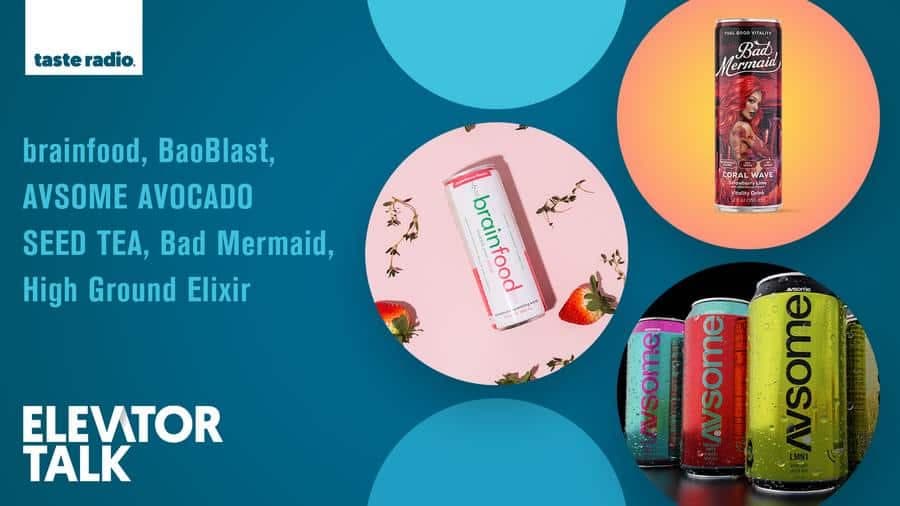
Elevator Talk Episode 118: Brainfood, BaoBlast, Avsome, Bad Mermaid, High Ground Elixir
Transcript
Note: Transcripts are automatically generated and may contain inaccuracies and spelling errors.
Ray Latif [00:05] Hey, folks, I'm Ray Latif, the editor and producer of Bevnet's Taste Radio podcast. And you're tuning to the latest episode of Elevator Talk, the series that profiles early-stage and disruptive brands from across the food and beverage industry. Today's episode will focus on 5 beverage brands whose entrepreneurs will have an opportunity to hear feedback and advice from our co-host for this episode. That's Dayton Miller, a managing partner with BFG Partners. Dayton, it's so great to see you again.
Speaker 2 [00:36] You too, Ray. Thank you so much for having me.
Ray Latif [00:38] Yeah, you're kind of an icon on this show right now. I think this is your 4th, maybe 5th appearance on Elevator Talk, and every single time gets better than the next. And so I'm assuming this is going to be the best show that you've ever participated in to this point.
Speaker 2 [00:52] Well, you're, you're too kind. Hopefully I don't disappoint.
Ray Latif [00:54] Talk a bit about your experience as an operator in the industry and also as someone who now invests in up and coming brands.
Speaker 2 [01:04] Sure, yeah, so the, the beverage company that that Iran was called Function, um, uh, we, we, uh, initially launched it in Whole Foods in the natural channel and then built it up, um, to be available much more more broadly. Um, uh, I managed it through the Great Recession, so I certainly had my fair share of ups and downs and, uh, tricky capital markets, so I think I can hopefully relate. Um, to not only folks who are just starting at the very early stages but also um navigating, uh, tricky times as well. Um, and uh yeah, the Sunsweet Growers uh ultimately bought that business, uh, which allowed me the opportunity to transition over to uh the investing side and partner up with Tom.
Ray Latif [01:46] Yeah, and BFG Partners, uh, has an incredible reputation. I'm so excited we, we have an opportunity to speak with you guys because, uh, the firm has invested in so many amazing brands, uh, just on the beverage side. You're talking about companies like Chameleon Cold Brew, Malk, Jot, uh, Mudwater, and of course, Ollipop, um, which is the crown jewel in, uh, I would say your portfolio. How do you evaluate Brands at the emerging stage. Um, and if you can talk a bit about Um, the check sizes or the size of checks that you make to brands at this point in the firm's history.
Speaker 2 [02:29] Sure, uh, so I'd say just kind of first and foremost, it starts with the product. Do we feel like the product is serving an unmet need? Is it nicely differentiated, um, in the marketplace? Obviously that's tricky given how many products are out there, but we still believe there's always room for, for innovation. Uh, we're very comfortable investing early, um, and, uh, but I'd say when we do that, we scale our check size proportional to the size of the business. So, um, our typical check size is, um, the core check size is 3 to 5 million, but we'll flex a little bit lower or higher, um, depending on where the business is in its life cycle. Um, so we try to be more opportunity driven, um, than, than anything else.
Ray Latif [03:16] Product is clearly important. How much does category and trend factor or how do category and trend factor into your investment philosophy?
Speaker 2 [03:25] Yeah, I would say broadly speaking, uh, so we do invest in businesses that are better for you, better for the planet. We believe that that is a long term tailwind and exactly how that is defined, um, we are very flexible, so we are looking for kind of better for you choices that don't necessarily compromise on taste, mouthfeel. and really customer experience and if you can deliver something that's better for you at a price point that is not necessarily the same as what's out there but not too much of a premium, and you're giving consumers a better experience, then we think that's a that's a winning formula. Obviously a lot of other things need to go right. And you know, I wish I could say like back when we made our first investment in lollipop in 2018, did we know that it was going to catch fire like it did? Absolutely not. Um, but hopefully if you put the right building blocks in place, then you're at least allowing the chance for it to work in such a big way.
Ray Latif [04:33] Yeah, well, I remember when I first encountered Ollipop, I was wondering, you know, how is this going to work? Is this really going to Catch on beyond the natural foods community, beyond the Erwan community where it was doing really well early in 2020, um, and clearly it's done in spectacularly well, and I think a lot of investors are looking for that next lollipop, but consumer education is such a huge part of this. There was a point of reference for lollipop, soda, and I remember speaking with Ben Goodwin last year on Taste Radio, and he had said if the foundation. of your ability to sell your product is educating the consumer, then you're pushing a rock uphill. And I think consumer education is such a tricky part of our business because You know there are so many innovative and interesting concepts and ingredients, but you know, as an investor, how much do you think about that consumer education as a roadblock to potential scaling and success?
Speaker 2 [05:35] Yeah, no, I think, I think Ben's right. I think, you know, one of the things we say, a little, a little bit of a cliche, but we say that it's an evolution, not a, not a revolution. So are you, uh, how much of a jump are you asking consumers to take, and if you're asking them to compromise on taste and price and you're introducing some very new novel functionality or Um form factor, then uh that that that might be kind of a bridge too far. Um, I think certainly if you can uh just give consumers an upgrade to something they're already doing, uh, you know, I'd also say, uh, in hindsight, like everything seems obvious and uh even when um when Ollipop was first launching, I mean they Themselves a tonic. They were not positioned against soda. In fact, Obi, the predecessor to lollipop, was positioned more as a soda in the glass, the glass bottle. So you know, I think you've got to kind of put it out there and see how it evolves and see how the consumers are using it maybe. And eventually they got more comfortable leaning in the soda, which I think is absolutely the right call.
Ray Latif [06:50] That's such a good point. Ollipop was originally positioned as a sparkling tonic, not a soda, and eventually it made a lot more sense, um, to consumers as to what this product was and how you could, how could you could use it. So, um, great stuff. Well, we have a great group of entrepreneurs to speak with today. Dayton, are you ready to meet our first? Yes, I'd love to. Thank you. Fantastic. That person is Megan Burton. She's the co-founder and CEO of Brainfood. Megan, it's so great to see you.
Speaker 3 [07:20] So great to meet you and see you. Well, I guess see you again, Ray, because I did see you like a week ago or so at the Fancy Food. I'm excited to be
Ray Latif [07:27] here. Yeah, thanks so much for joining us on the show. You know, I love your name. It's right to the point, Brainfood, uh, although it's a beverage, but, uh, tell us all about what you do.
Speaker 3 [07:36] Yeah, yeah, that is, that is true. Sometimes we, we get that, it's, it's a food, and we're like, no, no, it's, it's a beverage, but for your brain. Um, but yeah, um, hi everyone, my name's Megan Burton. I am the CEO and co-founder of Brainfood. At Brainfood, our mission is to make mental and brain wellness a joyful daily habit, and we do that through a unique sparkling water for brain health. Brainfood is uncaffeinated, clean, and infused with Science-backed nutrients to support focus, clarity, and stress resilience. But a little about why we created it. As a doctor and scientist turned corporate consultant, we were living like really high stress lifestyles, really busy and that ended up leading to burnout. Luckily, uh, as people with health backgrounds, we came to realize that we were missing key nutrients that tended to exacerbate our feelings of stress or mental fog. Unfortunately, because of our chaotic lifestyles, having the perfect wellness routine every single day just wasn't always realistic. So we were looking for something to fill that gap that was both craveable and easy to fit into the routine, but didn't have some of those negative consequences that come with caffeine or overly sugared drinks. So, we came up With Brainfood. Brainfood is not just a better beverage, but we want it to be a refreshing afternoon treat that can help make taking care of your brain simple and sustainable. With, like I said, uh, uncaffeinated, no added sugar, and it can just be a targeted hydration for nourishing your mind. A big reason is because at the Foundation, Brainfood, um, believes that taking care of your brain health should be as easy as taking a sip.
Ray Latif [09:15] Megan, before we get to Dayton, um, could you talk a bit about your retail and distribution footprint and the price point for Brainfood?
Speaker 3 [09:21] Yeah, yeah, so we recently launched at the end of last year and we started off very strategic, targeting a couple of campuses, especially where we build Brainfood, which was during my MBA when I was at Wharton. Um, and so, at the beginning we targeted more food service through retailers in, um, Philly, as well as Chicago, and now expanding more to D2C being inspired by some success with recess and Brez. So you can find us, um, on like physically in some Chicago, Philly stores, corporate offices. For campuses, um, but we're excited to say that to kickstart the D2C part of it, we were selected to, um, sell and demo at a lot of festivals here in Chicago. So if you're in Chicago and want to go to Ravenswood on Tap or Wicker Park Fest, we're going to be there this July.
Ray Latif [10:12] Outstanding. And price point. I'm sorry if I missed it.
Speaker 3 [10:14] Yeah, Price point is $4 a can.
Ray Latif [10:16] Outstanding. Well, you know what, Dayton, I, I would think you have a soft spot for a product like Brainfood, given that you co-founded a brand called Function.
Speaker 2 [10:25] Yeah, look, I, I actually am a believer in mental performance and kind of, uh, that, that emerging subsegment of beverage, so I do believe there is a big opportunity here.
Ray Latif [10:39] Yeah, I would say so. I think the question about or that I started with, you know, prior to talking to Megan about consumer education is an important one. Certainly when you call yourself Brainfood, it's pretty intuitive, I think. That people are going to know what this product is for. But, uh, you know, with beverage, it's all about scale, right? And so it's not just, you know, for a one-time kind of use during the day. You want people to be drinking this multiple times a day. You want lots of people to drink it. So I guess, what do you, how do you think about the broad market opportunity, Dayton, um, as opposed to sort of something that's specific to one consumer or another?
Speaker 2 [11:17] Uh, well, I, I think the way Megan was describing is something that's kind of refreshing and can kind of be enjoyed, uh, uh, really, you know, afternoon or anytime. I think there are multiple use occasions, um, uh, for, for a product like this. Um, I like the, the functional ingredients that are in there. I think, um, uh, vitamin D in particular is interesting. Uh, I feel like I'm certainly, you know, end of one, but certainly looking for more of that in, in my daily consumption as well as zinc, and I think that, you know, being sweetened presumably with a bit of chicory root in addition to the juice, I think makes a lot of sense as well.
Ray Latif [12:01] Yeah, I agree. Megan, uh, how did you think about that formulation? Cause as you note on your website, no stevia, no erythritol, no artificial flavors. Um, what are you sweetened with? Is it just chicory root?
Speaker 3 [12:12] So we're sweetened with uh some real fruit juice, that's the only like actual sugar that's in there. And then, um, it's not the chicory root we're mostly using, actually the inulin for some fiber. The only other sweetener we have there is something called RMM. It's similar to how stevia's made by fermenting the stevia plant, but they're actually fermenting sugar cane. So we have a little bit of that because we were trying to make sure we didn't also have too much of the natural sugar from the fruit juice, so it's a little bit of a blend. How we came up with that. It's actually a very interesting story. Um, we worked, uh, in the food lab at um Wharton when I was there, and I took 3 months of taking on food science, um, on my own, of course, I had some mentors to, to help me, and we did a lot of, when it comes to actual flavoring, we did a lot of focus groups with the students on campus, which was really helpful, given they were part of our target audience, in order to make sure that it not only was something people looked forward to in terms of Different types of tastes, but also combined that with um making sure it was lower calorie and that we didn't have to make the cost so high given the types of tastes people liked. As far as the actual nutrients themselves, those are based on um more of our knowledge in the health part as well as our um health network. Speaking both to nutritionists, dietitians, and, um, psychiatrists, because that's what our co-founder Juhi Gupta, she is a, uh, a psychiatrist and The reason that makes brain food so different is because of these nutrients, because these nutrients are, um, nutrients that we tend to lack, but many clinical studies have shown the importance of getting these nutrients to the levels they need to be, especially when it comes to being able to focus, being able to manage your stress or mood, as well as mental fog.
Ray Latif [14:00] I wanna get Dayton's perspective on this. How much do you think about really focusing on brain boosting or uh brain health function versus energy per se, because on your website, you note that you're caffeine-free. And we've seen a lot of energy drinks kind of play in both categories. You see energy drinks, say they have a brain function, like a certain ingredient, like a cognizant, for example, um, but how did you decide whether you want to be just, you know, focused on brain health and brain focus, uh, brain focus and just focus, or, you know, sort of energy and, and kind of play in that arena as well?
Speaker 3 [14:35] Yeah, it's, it's a great question. I think it all stems from the fact that for us, we know that brain health is the foundation of mental wellness, which also is the foundation for energy, um, being stress resilience and having that clarity. So we wanted to really build something that tugged on the root issues instead of just kind of being a band-aid on the actual problem. Obviously, you know, nutrition's only one of the many things that can aid in your brain health, but we wanted to be a part of that. And one particular thing that we didn't want to do was add caffeine, and that's because of some, as a brand that really cares about brain health. We're not like anti-caffeine, I mean, I love waking up in the morning and having my cup of joe, but There is a certain time where caffeine can really impact your sleep quality, and sleep is also an extremely important part of your overall brain health and something. That I think we as a society don't really focus on all the aspects that are impacting our energy, and instead just wanna turn to things that have that quick fix then. So, that's a long-winded saying of kind of why we chose to go away from caffeine and make sure we're targeting not just one part of energy, but our entire brain when it comes to focus and stress resilience.
Ray Latif [15:54] Yeah, what do you think about that strategy, Dayton?
Speaker 2 [15:56] Yeah, I mean, I think when you're starting out, I actually, I think Megan's right here. I think you can't be all things to all people. You've got to pick your lane. It's hard enough, as we already kind of covered, to communicate all that this beverage is doing. And if you start to have, you know, a caffeinated line and an uncaffeinated line. etc. etc. I think the entire message can get muddied, but who knows, maybe, you know, a few years down the road, there's an opportunity to launch a caffeinated SKU, but I think right now keeping the messaging super consistent and as simple as possible is the right call.
Ray Latif [16:37] Yeah, I, I mean, I think it's a pretty well thought out strategy. I guess the only question I would have as a follow up is about merchandizing, right? Because there's, there isn't really a section for uh for brain health or focus. I mean, I guess focus maybe with energy, but there is certainly a category in energy and people know where to merchandise it, so, um. You know, I, I, how do you talk to retailers, Megan, about where this product should be? How are they merchandizing it in store? And I know you're not in, you know, big retailers at this point, but how are they, where are they putting it in the store?
Speaker 3 [17:10] That is a wonderful, wonderful question because I do think it's very interesting because some people think of brain food as a product in a really crowded market with all the energy drinks, and they've got health beverages, yet some people think of it as a completely new category of cognitive hydration. I will say there's two aspects to this. One, I mean, people talk about a crowded market, but I, I do think the fact that functional beverages are becoming much more well-known is helpful for us. I mean you mentioned that educating consumers can be like pushing a rock up a hill, so the fact that that already, people already can, already are looking for sparkling waters that have something else in them, is good. Um, and then the second is part of the reason why we're being so strategic at the beginning and not just jumping into national retailers right away, is because we really want to get that messaging right, so that when we then turn to national retailers, we can tell them exactly where our target market. We'll really look for them. So, um, it's not exactly answering your question, it's more that we're working on finding the right place for brain food in a retail space.
Ray Latif [18:13] OK, well, uh, I'm sure throughout the episode I'm gonna be pinging uh Dayton about his thoughts on how to get Your product merchandise, where you want to be merchandise in-store, but we're out of time for this, uh, moment. We're always out of time. We never have enough time with our founders. But Megan, thank you so much for taking this time with us. Um, it's so amazing to see the development of your brand. I, I think there's a, it's a great runway for what you're doing at Brain food. Please stay in touch and let us know we can how we can help in any way. And also, please come out to our taste radio meetup in Chicago on August 14th. I'll send you the details after the show, but, uh, it's a live networking and podcast meetup in Chicago, uh, on the 14th. So hope to see you there. Would love to be. Thank you so much. Thank you. All right, on to our next guest for this episode of Elevator Talk, we have Hisam Sahi, who is the CEO and co-founder of Bio Blast. His job. It's great to see you.
Speaker 4 [19:09] Great to see you too, Ray, and I'm pleased to meet you, Dayton, and you know, the rest of the sort of like, uh, you know, the entrepreneur here. Everyone, thank you very much for inviting me
Ray Latif [19:18] here. Yeah, absolutely. Bob Blast. Let's talk all about what you guys do.
Speaker 4 [19:22] You know, I'm Hisham Sali. I'm the founder and CEO of Boblast, where we are a natural organic fruit juice that harm us basically the incredible power of the African baobab fruit. Uh, you know, for decades, basically, I wanted to sort of like, you know, create a beverage or crafted beverage that sort of like, you know, embraces that sort of like, uh, you know, the African heritage and culture, uh, you know, something sort of like other than basically, you know, Hakuna matata and, you know, the shikis and stuff. So, uh, fast forward, I immigrated here to the United States. I'm looking at the beverage aisles, uh, you know, I'm seeing it basically crowded with over sugary. And that sort of, you know, there's nothing sort of like the customer is looking for something more healthy, more unique, and you know, Health Week, you know, we crafted Boblast, you know, to really connect with the health conscious folks who are, you know, looking for something sort of like genuinely different. And beneficial. Now, I don't know, you know, if you're familiar with the baobab tree. It's a, you know, it's, it's basically that, you know, that famous tree where they sort of lift Simba up and they present him in the, you know, in The Lion King. So we're back to the Hakuna Matata again. But yeah, it's a sort of a symbol to all sub-Saharan Africa, you know, African countries, you know, between the tree, the leaves, and the fruit, there's like sort of like 300 basically use it for us natives, and that's why we sort of like call it, you know, the tree of life. It's like literally the, you know, nature's little sort of like secret weapon. So the fruit itself, it dries up in the branch and sort of, you know, condensing and packing all that tons of good stuff within the fruit. No, hence, it basically has vitamin C, sort of like more than orange, uh, more potassium than bananas, and sort of like more fiber than apples. And we bottled all of that up and sweeten it with monk fruit just to sort of have that, you know, that basically, you know, to give that taste for the health conscious. It's basically what we're aiming for. We're looking to be basically, you know, your natural pick me up for the day, you know, beverage, your natural refreshment, and, you know, for that, basically we just sort of gave our brand a complete new look. sort of like to really dial up on that natural goodness and, you know, unique vibe of the baobab. We also sort of like, you know, created a new vibrant label that sort of like embraces the tree, the fruit and the tree itself, and sort of in the forefront, which you can see up here behind me. And you know, we also bumped up the, you know, bumped up the volume from, you know, from 10 to 12 bands, and we've been seeing a lot of velocity sort of going right now with this new look that we have.
Ray Latif [22:05] Outstanding. Well, Hisham, I know you're based in Florida. Is that where your primary is sold, Bio Blast's primary sold at this point?
Speaker 4 [22:12] Yes, yes. Now, currently we, we are, we are, we just launched with basically the, the Healthy Ed Group, uh, through Chamberlain Natural Markets and, uh, uh, the Earth Origin Markets. Uh, we actually, actually, you know, launched beginning of July and on the 11th, we just received a reorder again from it. Uh, we're doing it, we're distributing through Pub Foods. We also do sort of a lot of distribution for cafes. Uh, we think that sort of our brands really stands, you know, our customers sort of like, you know, he's the cafe-going type, and, you know, our brand really stands with that sort of, you know, our beverage over there. Uh, and, uh, this July we actually, we also sort of like collaborated with KEE Connect. So we're going off with the Khit distribution so far.
Ray Latif [22:59] Very cool. Well, Dayton, uh, we had a brand that just led with function in, in, uh, brain food. With Boblast, we have a brand that's leading with the ingredient. Um, I, typically, I think what I've seen, um, Baobab or Baobab in, um, products, it's like in a juice shot or, um, it's, it's something that's as part of the formulation as opposed to leading the formulation, but you think there's enough, um, There's enough here to sort of get people really interested in what Bel Bloss is doing.
Speaker 2 [23:29] In my world, at least, like you really just want the consumer, you want it to be interesting enough to get the consumer to pick it up, and then when they turn it around, hopefully the benefits kind of speak for themselves and whether they're getting it from Baobab or I don't know, an orange or whatever it may be, if it's delivering on vitamin C, if it's delivering on fiber, I think that's what will pull consumers in, that plus the taste appeal. Uh, I, I think, uh, I, I wasn't able to see a nutrition facts panel online, but, um, from what it sounds like, it sounds like it's a, it's a nice, clean, uh, ingredient statement with monk fruit as the sweetener. Um, so, so no sugar, um, but still delivering, uh, some real nutritional benefits. So I think that's interesting. I think, um, you know, really what you're looking for is a hook to get people to pick it up. Um, and then, Uh, it doesn't necessarily, it could be, you know, aca acai, it could be anything. Um, uh, it doesn't necessarily have to be, um, baobabo.
Ray Latif [24:39] Hisham, I, I wonder, you know, sometimes when founders have ingredient-led brands, um, they have a great source that they either work with or a sourcing partner they work with or a direct connection to. Uh, the farmers of that ingredient. Do you, I mean, how do you, how do you source your, your baobab?
Speaker 4 [24:59] I source it here from the, from the states, from a, you know, from a company that it's actually a South African company. So yeah, so basically, you know, so that, that cuts out that, but I also sort of within my ingredients, I have acacia gum. Uh, and that unfortunately becomes sort of 95% comes from one country. Uh, but I do have also connections to sort of like the farmers in that country. Uh, I'm a native African myself, so, you know, and I've been traveled, I've done business a lot in Africa, so I'm quite well connected over there when it comes to that.
Ray Latif [25:33] Yeah, I wonder how much of this story, I mean, I, I guess this is, this is a tough question because You know, in this day and age, it seems like consumers, or at least we hear that consumers really care about where their foods, where their beverages, where their ingredients come from, and it's a part of the story. But how much of that story do you want to tell? How much of that story is going to resonate with the end consumer, because I think if I'm not mistaken, Bow Blast is, is sort of a refreshment beverage or positioned as a refreshment beverage more than it is a functional one. Is that accurate?
Speaker 4 [26:04] Exactly, yeah,
Ray Latif [26:04] yeah, I'm
Speaker 4 [26:06] sorry,
Ray Latif [26:06] go ahead.
Speaker 4 [26:07] Yeah, like, sort of, you know, uh, where, and this is the whole sort of like, you know, basically the message that we're having in, uh, you know, in, uh, you know, for our beverage. I am myself, you know, native to those lands where the bawab is, and part of our profits is actually being, you know, it's going basically to sort of like, uh, you know, dig some wells and, you know, cater for the people who are sort of in the lands of, you know, those trees. Uh, I've traveled over there. I, I'm, I'm actually sort of like doing a Bob Geldof sort of mission to it because I used to be an auditor in Africa. So, uh, I want to monitor that bit. And so far, I self-financed this whole project, uh, just to deliver that bit basically with it, including introducing this, you know, this beverage here in the States. Uh, I totally agree with, uh, Dayton and what he's saying, that sort of, it is an uphill battle because we do sort of like, uh, I mean, uh, AAberry took 15 years until it sort of got traction in the market. Uh, but I, I actually, because I stood with the, with the product and beverage, you know, and sort of like farmers' markets and, you know, doing it for myself. Uh, I found that sort of first, uh, and that's the reason why I changed my brand, uh, just the name Baobab. Uh, it's enough to attract someone to stop and say, hey, you know, uh, basically, you know, what's that or what's that all about, you know. So that's why we put it sort of like, you know, for the forefront right now in the label. Uh, and we do sort of like, you know, with discussion and sort of people, people are starting to get attraction of knowing what it is, but they definitely realize that this is something unique and something exotic.
Ray Latif [27:41] Yeah, and I wonder about the exotic heritage, um, the sourcing of the, the fruit itself, and how much of that story might matter to the consumer. Again, I think it's tough because it's more of, it's positioned more of as a refreshment beverage, but Dayton, do you think that's important? Do you think, you know, telling that story, do you think the consumer, consumer wants to hear that story about Baobab and what it's all about, where it's sourced from?
Speaker 2 [28:05] Uh, I think it's important that the more consumers kind of peel the onion, the more authentic it is. Um, uh, and I, and I feel just given, uh, Hassan's background and, um, uh, you know, where we're from originally, uh, uh, the, the, the origin story here, I think it, it holds together and it makes a lot of sense. Um, I'm not sure. Sure, necessarily consumers are looking for it kind of right off the bat. I personally think leaning into the refreshment side as you have, I think is is the right call. I think you know the product looks so much better than that version 1.0 and kind of delivering on colors. And, uh, and really taste appeal. Um, you know, I, I think to your point on like it, it being maybe a, a, a long slow build, I do think taste is paramount here because, uh, you just got to drive the repeat, even if it's, um, even if it's a slow climb, that repeat's really going to be what pulls you up. Um, so just be kind of really tracking that as closely as you can and Uh, and you know, really just not necessarily taking consumers' word for it that if they love the taste, like see if they're leaving any drops left in the bottle after they have it, that kind of thing.
Ray Latif [29:26] That's great feedback and um thank you, Isham, for sharing some samples with our offices and San Diego and here in Newton, Mass. Uh, I know our team really enjoyed drinking your product, and I agree the brand refresh looks fantastic. It's, uh, it actually feels like, um, it, it brings some of that heritage, your heritage, and that of, uh, the, the Baobabb into the label, which is really cool to see. Um, thanks so much for being, uh, being with us on Elevator Talk. Um, if there's anything we can do to help you along your journey, just please let us know. Reach out anytime.
Speaker 4 [29:59] Excellent. Thank you very much. Thanks, Ray.
Ray Latif [30:01] Good stuff. Let's keep it going with our next guest for this episode of Elevator Talk. That's Kobe Ferroh, who is the founder and CEO of Avsum. Kobe, it's great to see you again.
Speaker 5 [30:13] Hey Ray, how's it going? Good to see you again.
Ray Latif [30:15] Yeah, absolutely.
Speaker 5 [30:17] Nice, nice to meet you.
Ray Latif [30:18] Last time I saw you, you were on stage at Bevnet Live Summer 2025 participating in our new beverage showdown. Such a fantastic presentation. I really enjoyed, uh, hearing about your brand, trying your brand, but for folks who may have missed that, uh, show, please tell us all about Avsum.
Speaker 5 [30:37] Uh, so, yeah, so, uh, Ray, Dayton, nice to meet you. Uh, my name is Kobe Farrow. I'm a chef, a dad, and, and obviously the the founder of Awesome. And Awesome is the first iced, iced tea powered by upcycled avocado seeds. And what we're trying to do is reimagine what functional and refreshing really can be. It can be clean, it can be flavorful, and sustainable at the same time. And also, at the same time, having a bold standout on, on the shelf. Uh, I've spent most of my life working in kitchens and in fine dining to a private chef, and as a creative, and this brand is a natural extension of that. It's blending what I care about most, which is flavor, function, and, you know, an identity. Uh. Right now it's like there's, we've found that there's a lot of beverages that are out there that, you know, with a lot of artificial sweeteners and flavors and things that are just really vague about sort of, you know, like what real wellness is, and then Sacrifice, you know, taste for that, and that was paramount. And when we were doing our, you know, putting together our beverage, the taste was absolutely paramount, and we spent a considerable amount of time putting that together. We partnered with Harney and Son, who is a A leader in the tea tea business. We're sweetened with agave, so we're lightly sweetened. We try to keep our sugar levels very low, kind of use it almost the same way I would use, let's say, like salt in the kitchen, where it's, you know, a flavor enhancer. It's not really there to carry the beverage. It's really there to enhance the flavor of the avocado seed and the botanicals and natural fruit that we use. We're looking to launch in the Northeast in the next 6 months with plans on going into mid-Atlantic by next year, uh, and then looking for hopefully a larger kind of retail partner, so that we can expand the business, uh. And our MSRP right now is at about 325.
Ray Latif [32:54] Outstanding. All right, well, I think this is a question I don't know if I asked on stage to some of the judges or I, I think maybe the judges uh commented on this, but when it comes to your package design, tea is pretty small. The word tea is pretty small on the front of the pack. It is an amazing package design. It looks great. It is a bit more reminiscent of an energy drink than a tea, but talk a bit about your label strategy.
Speaker 5 [33:17] Right, so, uh, so, honestly, when we first met, uh, which was at one of your meetups in New York, uh, we had an opportunity to speak with, I believe it was, uh, Bev met Mike, and he kind of brought those things, he kind of brought those things. It was kind of our first sort of coming out, uh, event where it was like we were kind of keeping it really close to the chest with friends and family and things like that, and just kind of like, you know, some industry folk. And then we were like, all right, we really need to start getting this sort of out there. And after speaking to Bevnet Mike and he kind of brought some of those things up, we, you know, kind of went back in the kitchen and made a lot of adjustments. So we have a lot of updates to the callouts to avocado CT, which will be along the side of the can here, so it'll be a larger call out along with the also the flavor. There were some issues with what those flavors actually were, so we thought we were being fun and, you know, cheeky and, you know, kind of being like, oh, lemon, let's spell it differently and and things like that. So we, you know, kind of went back and we were like, you know what, let's just call it what it is. It's You know, a lemon tea, and so we changed those things so that the callouts on there are on the bottom and on the top, and actually what it is, an avocado CT is more pronounced along the side. We've also added some graphics to it. Where visually you'll be able to see what's on there. So it's uh still keeping the aesthetic of what our, you know, kind of like our brand ethos, like having sort of a can that kind of stands out on the shelf. Uh, we didn't want to step away from that, being that avocado CT is for the most part a new area, uh, and I know a lot of people said that it really looked like an energy drink, but. For, for us, the avocado seed, it's, you know, it's something that's new, and there's no reason why that something that's, you know, refreshing and uh. Can, you know, look exciting.
Ray Latif [35:29] Yeah, I've, uh, I've taken up most of the time here, and I know Dayton, it feels like you have a lot of questions, comments, feedback, so please take it away. Yeah,
Speaker 2 [35:38] no, I would just echo what Ray said. I think the packaging is super interesting and differentiated. It's got really nice kind of eye appeal, shelf appeal, and I also think that avocado seed tea is super different, and Um, and, and really cool. Uh, I think there's a lot of, um, uh, positive halo around avocados, and to the extent you can kind of tap into that in a way that tastes great and refreshing, I think is, uh, is, is really interesting. Um, I'd say maybe, uh, areas to kind of challenge you on, um, uh, to me, the benefits did not, um, manifest either in the nutrition facts panel or on the package. Um, when I went into your website, I could see some of the benefits of, of, um, avocado seeds, but I didn't see like whether it was the, the fiber side or, or Um, other, otherwise, like, I think you can lean into the reasons for drinking a, a little bit more. Um, uh, and I would also agree on the, on the taste side, which it sounds like that's, uh, feedback you've, you've already been incorporating. Um, you know, a bit mixed on like, uh, just the, um, kind of calories and, and, and sugar side, I think. Uh, 50 to 65 calories is pretty reasonable. It's like a low to mid calorie drink. Um, uh, I think there's, you know, a good precedent out there in terms of consumer acceptance and something in that range. Um, uh, that said, uh, kind of double. Digit grams of sugar, I think can be a little bit of a, of a sticking point. You'll, you'll, you'll find out. And if it is, uh, you know, maybe, maybe consider, um, some, some alternative, uh, uh, sweeteners with the, with the agave. Um, but I think it's, uh, I think it's really, really interesting. And it's non-carbonated,
Speaker 5 [37:38] right? No, it is not, it's non-carbonated. Uh, obviously we finish it off with a little bit of nitrogen, but that's, it kind of gives it a little bit of sort of fizz some people have found, but not, not, I wouldn't call it
Speaker 2 [37:53] carbonated. You might, you might want to just play that up a little bit more. I think I saw like shake or something on the, on the can, um, but, uh, which would assume non non-carbonated, but, uh, my general belief is that folks, when they crack open a can of something, they generally Uh, are biased to believe that's, um, it's carbonated, but there's, there's certainly other lemonades and other products out there, teas in particular, that are not. So, um, uh, definitely room for it.
Speaker 5 [38:24] Cool. Thanks. Uh, yeah, so what you kind of mentioned, like some of the callouts as far as, you know, the uh functionality of it, we are like in the update that's, that is some of the things that we are gonna call out more, uh, like polyphenols, antioxidants, things like that, things that are, uh, we feel that are Uh, soon to be consumer base will be looking for or interested in, uh, so those are going to be some of the things that we will be calling out onto the can be a little bit more prominent on there. So we are definitely taking a lot of the things to heart.
Speaker 2 [38:58] How did you come up with the idea of using avocado seeds?
Speaker 5 [39:02] So, so like I said, I've worked in kitchens for 25 years. I've had guys that used to come up to me and, you know, ask me, Hey, chef, can you save these avocado seeds? And And I did, I asked them, I was like, what do you want me to save them for? And they were like, oh, you know, you know, back in my country, it's really, you know, it keeps you really healthy, it's good for your hair, your skin, your nails, uh, you know, it's good for your gut. Uh, and fast forward, I was working on a restaurant that didn't happen just before COVID, and Ended up I was and it was an avocado themed restaurant, surprisingly, and so I kind of was looking to do a white label and then started doing a lot more research and found a lot of data that was supporting some of the things that these guys were saying and I was like, well, you know what, maybe There's something here, so I went out and found some friends of mine that worked in the industry, that worked in packaging, some guys who worked at Pepsi, some guys that worked at Vitamin Water. Our new COO is from Red Bull, and then we came up with.
Ray Latif [40:05] Awesome. I ended or uh uh post-presentation, I, I refer to your uh talk as awesome, and I think this was awesome as well. Kobe, thank you so much for uh joining us on Elevator Tech today. I'm so excited to see the upcoming version of, uh, of some. So, whenever you have an opportunity to send us new samples, please do.
Speaker 5 [40:28] Absolutely. You guys are always on our mailing list and we'll be sure to send you guys tons. So
Ray Latif [40:33] outstanding. Well, thanks so much again, Kobe, and we'll talk to you, talk to you soon, I'm sure. All right, let's get to our 4th guest for this episode of Elevator Talk. That's Dan Dixon, who's the founder and CEO of Bad Mermaid. Dan, great to see you. Hey, Ray, and nice to meet you, Dayton. Thank you for being here. I'm so happy you got a big smile on your face. That's the way to start a discussion about your brand, Bad Mermaid. Tell us all about what you do. So, uh, it was about 1 year and a half years ago. I was coming out of an international wine company that I had founded and spent about 5 years with, and one of the things that I, I was kind of noticing through the early parts of last summer was you had all this bad press coming from a lot of the energy drinks that were out there. And I, one of the things that I wanted to early on capitalize if I was to move into this, into this portion of the industry. I wanted to create something that was oceanic based, kind of West Coast, kind of had that unique feel. I didn't even know which direction we were going to go in, but one of the things that I noticed was a lot of the Gen Zs, millennials, athletes were utilizing certain supplements in their drinks, so as a byproduct. So whether it be marine collagen, blue spirulina, sea moss was one of the larger ones. And when I went to look through the aisles, I didn't see any of the energy drinks that had that already infused in it. So like with you, Ray, I met you on LinkedIn and I utilized LinkedIn's platform. So I started to reach out to industry professionals, and one of the resounding comments that I got back was, and Dayton, correct me if I'm wrong, but the oceanic superfoods like that are kind of hard to mask. Uh, a lot of the times, and so, uh, so, well, there's got to be a way. So I, I did some more research. Turns out that sea moss was one of the key elements and wanted to do something that was very ocean born, very, um, you know, powerful as far as hydration or, um, uh, some type of a clean energy. To compete and of course I was told that this was the one sector of the market of the beverage industry that's hard to get into. It's a little saturated. So just to give the backstory on that, um, I didn't have a name, I didn't have a logo, but I knew that at least I wanted to infuse these oceanic superfoods into this beverage. So one morning, my son, who's 8 years old, he's on the spectrum, he was playing Minecraft, I guess, on his handheld, and out of the blue he just blurted out, Bad mermaid. And I didn't, I didn't really, I didn't know where I was coming from. I looked over and here he was on these rocks swinging a stick at these sea creatures coming up at him, and I thought it can't be that easy because it did, it took me back, right? It's got to be taken. So of course you jump on USPTO, you look through network solutions, try to find if, you know, if I can use that as a play. And so it was available. It had been abandoned in Vegas a few years before. So, OK, I have this name. Let's, you know, start to lock this down. So now we have that. Now I need a, I need, I need a logo. So I know I'm kind of jumping all over the board. I've kind of given you the whole story right now. So stop me if you want to, you know, interject. So I noticed that also on a lot of the beverages that they had kind of this. You know, no disrespect, but this monotony kind of through their, their labeling, and I noticed though in the beer section, and specifically IPAs and things like that, like Voodoo Ranger, they always, they had these unique cans and these unique labels that they were utilizing in their marketing. So I reached out to a friend of mine who is a 15-year gaming graphics guy from Blizzard Games. He was a lead uh graphic artist on World of Warcraft, Final Fantasy, and I kind of gave him, you know, give me a Bad Mermaid, something that's, you know, really unique, you know, very, you know, empowering, and you came up with this. And so, now I've got, you know, I've kind of got the direction as far as the, the ingredients on what I want to use, you know, it might be a little difficult. Uh, we reached out to Darren Ezra at Power Brands, um, down in Southern California who had done Nero, and he guided us through this. We had formulation through the end of 24 and end of 25. But one of the things that we had was we had too much. There was too much ingredients in there, so they had the oceanic superfoods, but there was too many of them, so our cogs were all over the board. We had turmeric, Ginger Marine College in Blue Spirulina. And so when I've got to tell you, when Bevnet did the write up on us about 3 or 4 months ago, that was one of the key elements was, are you vitality? Are you energy, you know, where is this? You guys got to, you know, land the plane here. So we had a small production run of about 10,000. And that was going to be used for marketing, but we went back to the drawing board. We took the advice from Bevnet, and we did. We narrowed it down. We got the calorie count at 10 calories across the board, 150 mg of caffeine, so you fall kind of right in between that. And then we also got control of those oceanic superfoods, so utilizing the key elements of sea moss, sea salt in the beverage, and it's made a world of difference. So unlike some of the other professionals so far on the show today where they've already kind of gotten into the market, we have a production run down in Southern California on the 25th next month, and we're starting. Of course, across the board, but now one of the key things is going to be distribution, and that's really where, you know, I want to start to lean into, you know, Dayton's advice and, and other professionals. So anyways, that's where we are. Thanks for letting me, uh, grandstand here. No, you didn't grandstand. You gave us a great, uh, overview of what you're doing with Bad Mermaid, and I do want to hear from Dayton about, um, his perspective on the brand and callouts, ingredients, etc.
Speaker 2 [47:08] Yeah, uh, first of all, super cool story. Uh, I also have an 8 year old who loves Minecraft, so I can certainly resonates with me. Um, uh, you know, the, the, the packaging is nicely differentiated. I think CMOSS, we've candidly been surprised by how big some of the brands have been able to get, uh, and, and, you know, very, very limited distribution. So there you might be tapping into something that is an emerging subcategory slash ingredient functionality. The question I would have is how does that kind of manifest on the label. And you know, obviously there's the call out on the front, but I had thought, I'm not a sea moss consumer, but I thought like it was, it was a kind of source of potassium and magnesium. I think on your package it is not a significant source of potassium, so I don't know if there's like some consistency there, but it's great that you're including the sea moss, but I guess I'd want to know more about what it's doing for me. Uh, the, the, on the energy drink side, 150 mg, um, you know, certainly a significant amount of, of caffeine. Um, uh, I, I haven't seen kind of, you know, Caffeine plus C moss be married together. So, uh, it's different, right? Um, you know, whether it's going to work or not, I can't, can't really tell you. Um, uh, but I think it's, it's different enough to, to give it a shot. The, um, uh, you know, you mentioned kind of leaning in the distribution. I'd maybe, uh, just make sure. You feel like you have the, the product fully bright before, before leaning too far into the distribution, and really just kind of going deep in some test accounts, uh, maybe an online channel or two as well, and make sure the repeat's really strong before going more broadly than that.
Ray Latif [49:19] Perfect. Yeah, just a tagline on that along with that, one of the things that we did revamp, not only the cogs with the recipe, but the label as well. So what you're seeing right now has been completely redone. The callouts for sea moss, sea salt are prevalent on the front. And also the depiction of the benefits on the side of the can as well. Dan, we got about a minute left. I, I wanna ask about, um, online and, you know, potential for you, you talked about your son's experience, um, or the name of the brand came from your son's experience while playing video games. It seems like the gamer community, uh, there is a big opportunity within that community. Have you looked at that at, at, at all, or have you, have you tapped into that very much? We've got some contacts at Twitch that are looking into this. Um, a lot of the EDM festivals have also shown a lot of interest in, uh, 2026 for the product. And then as far as the e-commerce, we're launching the first week of, um, August. Outstanding. And what's the price point for Ken? 279. 279. OK, that seems pretty reasonable for, for what you're selling and the fact that CMOSS is in there because CMOSS ain't cheap, we know that. Yeah, Dan, it's been so great hearing about Bad Mermaid. I, I think you've got something on your hands for sure, and I think it's like, You know, the story is so beautiful, and I couldn't, you know, that's why I just wanted to hear it because you, you tell a great story and please continue to do so because I think it's a huge part of the reason why people will fall in love with what you're doing. So thank you so much for being with us on Elevator Talk today. And please stay in touch. Let us know if we can help in any way. For sure. Thank you both. On to our final guest for this episode of Elevator Talk, we have Jesse Zakowski, who is the founder and CEO of High Ground Elixir. Jesse, great to see you. Hey,
Speaker 6 [51:17] great to see you. Nice to meet you too, Dayton.
Ray Latif [51:20] High ground elixir. OK, I think people just hearing the name would have some theories about what you do, but it may not necessarily be what you do. Tell us all about high ground elixir.
Speaker 6 [51:31] Yeah, so, so, so the name really comes from, we, we wanted a way to tie to our connection to the earth and nature and an elevated experience. So, um, it's a, it's a mushroom infused sparkling beverage. So like that's kind of where the Ground comes in and like nature. Um, so we are, um, adaptogenic, not psychedelic. Um, so I always want to like say that upfront because sometimes people are like excited that they're psychedelic, but they're not. Um, but then some people are really excited that they are something that's more wellness-focused. Um, so just, um, to tell you a little bit about how we got started, so, um, I have a background in developing products in health and wellness. So like working on brands um like Garden of Life and um Sogar, things like that. Um, so, so I'm, I'm, I'm very in tune to the wellness trend and just sort of like the different benefits that consumers are looking for, as well as the new and up and coming ingredients. Um, so I, I was getting so tired of seeing like everything with Ashwagandha and like probiotics, you know, it's just kind of like everything has that, right? Um. Um, and then culturally, mushrooms have been something that have always been super, um, super ingrained in my life, both in terms of food and also from, um, from a health perspective. Um, so I was excited to, to, to see that, that mushrooms were starting to pop up more, um, and also there's a lot more science now that, that kind of backs up sort of like what I had always believed in terms of all the different benefits. Um. But then at the same time, I was also disappointed to see that the products that were coming out were things like um mushroom coffees, which I think has its place, but I think it's kind of ingrained in people that like mushrooms are gritty, they're kind of earthy, like you have to mix them in this hot water. It's kind of like asking the Consumer to do a lot of work for them to get these, these, these great benefits. Um, and, um, at that point, I had developed a couple of beverages and I just knew that there had to be a way to make something that was, um, had all those benefits, that was super delicious and also just like really, really easy. Um, so that's where my co-founder slash husband kind of came in, um, because where I loved mushrooms, I've always loved mushrooms, he hates them and he won't even be in the same room with me when I'm eating them. Um, and, and I, and I just knew that if we could make something that he would love, um, that we We had a winner on our hands. Um, so that's what we, we, that's what we did. Um, it's incredibly delicious, it's fruit forward. Um, our mushrooms are sourced from a, um, zero-waste, um, sustainable farm out in Northern California. Um, they use solar power and collected rainwater, um. Uh, the, the mushrooms themselves are certified USDA, um, certified USDA organic, even though the whole drink isn't. Um, but it was really important to us that our mushrooms were sourced in that way. Um, and then our cans themselves are also 10. 100% recyclable because they're they're um they're digitally printed. Um, I was actually surprised to find out that a lot of the pressure sensitive labels and then the shrink, you know, those, those actually render the cans like garbage. Like you can't recycle those and no consumer is going to take the work to, you know, peel everything off. Um, so to really like the, you know, the, the The, uh, the core of what we wanted to come up with was something that was great tasting, um, something that was sustainably and responsibly sourced, and a brand that was just like really, really fun. Um, Jeff, my co-founder slash husband. Um, has, um, a strong background in, um, in, uh, in design collectibles and things like that. So he really brought our, our brand together and kind of brought our, um, our, our visual identity to life. Um, and dating, just like you mentioned, I mean, like We don't want to ask consumers to do too much. So we're giving them a lot of health benefits, great taste, 25 calories, it's sweetened with apple juice, so there's no added sugar. Um, I personally like, I hate all the stevias and the erythrophols and all that. Stuff. Um, I, I don't think sugar is bad. Um, I think bad taste is bad. Um, so we have, um, 5 g of sugar that's only from the apple juice. Um, so, since we're happy to say that there's no added sugar and, um, And one of the best things that I love when I'm demoing or I'm at a trade show or at a fair is that people kind of like side-eye us and they say, oh, I don't do mushrooms, they're like, oh, this is gonna taste horrible. Um, and I love getting them in and giving them a taste because once they do get that taste, they're like, wow, like I don't taste the mushrooms. I didn't know mushrooms could taste like this. Um, and that's, that's really what we're going for. Um, we launched with a strawberry peach and a yuzu lime. Um, which, uh, were two key flavors like strawberry is a personal love, love of mine, so I wanted to have that. Um, and then lime, I think it's just one of the most popular seltzer flavors, and we're actually launching two new ones next month, a, um, orange passion fruit and a chili mango. Um, so really excited to round out our lineup in that way.
Ray Latif [56:48] Fantastic, Jesse, really good stuff. Uh, Dayton. You know, when I first heard the name High Ground, I thought it was a marijuana beverage, a cannabis beverage. Obviously, it's not, um, but there's a lot to love about what's inside the can, um, just in terms of what you've seen on the outside and the website and everything. Um, uh, uh, would you suggest any, do you have any feedback, any insights on, you know, what Jesse can do to take us to that next level?
Speaker 2 [57:14] Yeah, I, I have the same concern around, around high ground, uh, unfortunately, I think, um, you look, as you kind of start to get the product out there, I think you'll know better than anyone whether it's too polarizing. Um, I think, uh, a lot of, um, the good news is it's catchy, so you will get people to pick it up. Um, it's just a question of whether the folks who Or looking for something that's THC or other side of it is disappointed or not when they once they do ultimately pick it up and investigate it, but I do think it's more likely to get picked up than average on a very competitive shelf set to Ray's point on kind of what's on the inside, I think. Um, it, it is really, uh, admirable. I think that, you know, the real levels of mushrooms, um, which I think, uh, if it, if it does taste great, I believe you, um, uh, given, given your background, I think that is, uh, differentiating. I do think, um, you're right that, uh, consumers want convenience and they want the, the, the. The work done for them and I also think how it's balanced with 5 g of sugar is great. I think, you know, if it were if it were zero, sometimes consumers equate that with tasting bad. So there's a, there's a lot going for it as a as a product.
Ray Latif [58:49] Yeah, Dayton, I also want to ask about the, the, the word elixir. And again, you know, when we talked about lollipop being called a sparkling tonic, I think tonic and elixir are um great names, uh, great words to describe certain beverages, but not necessarily known by the broad, you know, by the broad, by broadly by Americans. So, would you suggest a change in that regard as well?
Speaker 2 [59:15] Uh, probably not to start, believe it or not. I think, look, you're trying to get a toehold. You're trying to get people to try it. I do think elixir means functional, and I, and I think that that's, that is what's being delivered here, you know, would it surprise me in 3 years if you had tons of distribution and you were calling it a sparkling functional beverage or something along those lines? No, it doesn't. Necessarily scare me, except, uh, if it, if it turns people off from a taste standpoint. Um, and, and people are scared to try it because they think it's going to be like too functional, too medicinal. Um, so just, just watch that. Uh, but, you know, where you are today and what you're doing to kind of differentiate yourself for the first couple of years is likely going to be very different than how the, the brand will, um, what the brand will evolve into.
Ray Latif [1:00:14] And just to follow up on that, you know, I love the fact that Jesse talked about how delicious this tastes because no one's gonna drink it a second time if it doesn't taste good the first time. Um, but the front of the pack, you wanna, you wanna feel like it's gonna taste great. You want to know it's gonna taste great. And yes, the call-outs of strawberry, peach, and yuzu lime, my mouth is already watering just thinking about those, but, um, how do you balance refreshment with function on front of pack? How have you seen it done well to get Dayton?
Speaker 2 [1:00:42] Yeah, I think it's a good point. It, um, the other thing with high ground, I, I think, uh, maybe it's just me, but I think people could think it's a coffee beverage as well. Um, uh, so just another, another watch out. Um, I think, uh, imagery around the fruits and, uh, you know, if you, you add, um, it looks like the second picture on your, on your website with the splashing water and Uh, just, you know, cold images that you know, like cold refreshment, uh, it's somehow bringing those more forward on the, on the label. Um, I think, I think could serve you well.
Ray Latif [1:01:26] Yeah, I would agree. And again, I, I think you've definitely got some really great stuff to start with, Jesse, and it is an evolution as Dayton pointed out, you know, you're never gonna be version 1.0 forever. This is always a process. And so, I, I'm really excited to see how the brand develops from here and also how we can help in any way. Um, I, I would love for you to stay in touch with us and just ask, uh, yeah, please ask any questions you have, whether it be about, uh, label suppliers, co-packers, ingredient suppliers. We're here to help in any way we can. I always talk about how, you know, I think that people think of, about Bevnet as just sort of reporting on the news, but we're really, really trying to help brands build and scale because brands don't do that, we have nothing to write about. So, we want to see everyone be as successful as they can be. So, uh, I know you've already been in touch with our team, but please continue to reach out anytime.
Speaker 6 [1:02:21] Yeah, definitely, and, um, and I mentioned we have our two new flavors coming next month, so I will definitely send them your way. And Dayton, um, I will send all 4 of them to you because I would love to get your feedback, especially given your rich experience, you know, both with your own company and with other brands. I'd love to stay connected.
Speaker 2 [1:02:38] Sounds great.
Ray Latif [1:02:40] Outstanding. Well, Jesse, once again, thanks so much for being with us on Elevator Talk. Thank
Speaker 2 [1:02:44] you. Thank you.
Ray Latif [1:02:46] Dayton as advertised, a really cool group, a really outstanding group of up and coming beverage brands. I always love elevator Talk, and I always talk about this show as, you know, being ground zero for the future of our industry. Um, you know, we're gonna be talking about some of these brands for sure in years to come. Um, you know, I, I know people want to pick your brain. People are gonna listen to this show and, and watch this show and say, hey, how do I get in touch with Dayton and the team at BFG? What is the best way to do so?
Speaker 2 [1:03:15] Email is probably the best initial way. So Dayton at BFG Partners or deal team at BFG Partners are two good emails. Um, so a lot of times, uh, uh, you know, it's a very, very much a flat organization, so, um, everybody does a bit of everything, but, uh, email is definitely the best way to get started with
Ray Latif [1:03:35] us. All right, Dayton at BFG Partners and deal team at BFG Partners. I love it. Uh, I, we never have enough time with you. I, I think we need like a 3 hour program with Dayton Miller. I don't know if you have the time to do that, but, uh, thank you so much for taking this time to be with us today. I'm gonna bother you again probably in the near future to see if you can co-host once again. We can we get you back on the show?
Speaker 2 [1:03:58] Of course, yeah, no, it's, it's my pleasure, Ray. I really appreciate, uh, you and all that you and everybody else at Bevnet, uh, and Nash do for the, the food and beverage community. It really is, uh, it's awesome, and Um, yeah, look, look forward to seeing you in December, if not sooner.
Ray Latif [1:04:13] App's outstanding, and you're referring to Bevnet Live and Nosh Live in December. And, uh, if you're listening, watching, we'd love to see you there as well. Well, thank you once again, Dayton. Thanks to our amazing entrepreneurs who joined us. Thanks to our incredible team at Bevnet Nosh and Taste Radio, the best in the business. Signing off for everyone, I'm Ray Latif, and we'll talk to you next time.