Search across the BevNET CPG Media network including BevNET, Nosh, Brewbound, Taste Radio, Nombase and CPG Jobs.
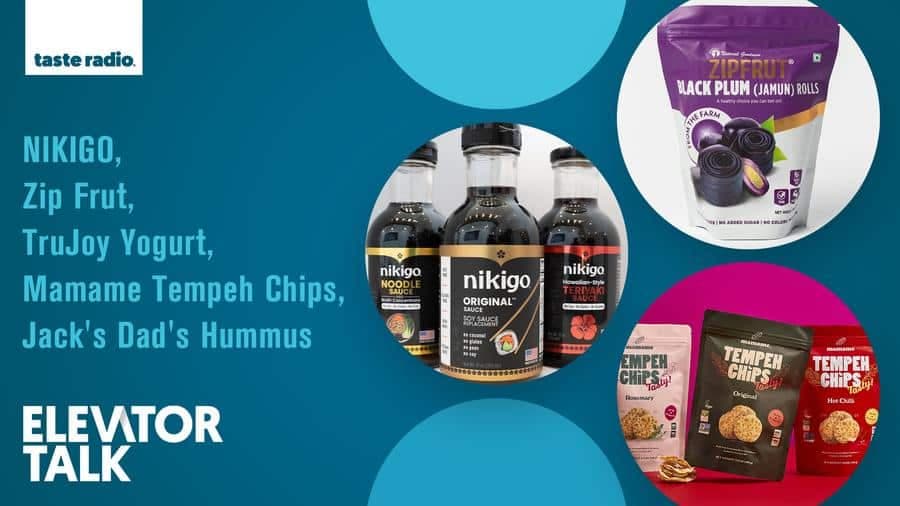
Elevator Talk Episode 117: NIKIGO, Zip Frut, TruJoy Yogurt, Mamame Tempeh Chips, Jack's Dad's Hummus
Transcript
Note: Transcripts are automatically generated and may contain inaccuracies and spelling errors.
Ray Latif [00:06] Hey folks, I'm Ray Latif, the editor and producer of Bevnet's Taste Radio podcast. And you're tuning to the latest episode of Elevator Talk, the show that profiles early-stage and disruptive brands from across the food and beverage industry. Today's episode will focus on 5 food brands whose entrepreneurs will have an opportunity to hear feedback and advice from our co-host for this episode. That's Tom Speer, who is the founder and managing partner of BFG Partners. Tom, it is so great to see you again.
Speaker 2 [00:35] Hey Ray, thanks for having me. I appreciate it. Yeah,
Ray Latif [00:38] you are a bit of a taste radio and elevator talk legend at this point. You've been on both programs, uh, a, a number of times, and in every case, it's just been so thrilling and exciting to sit down with you, and I really mean that because you have invested, BFG Partners has invested. In some of the most innovative and successful brands of the past 10 years. We're talking about brands like Ollipop, Athletic Greens, Graza, just to name a few. Um, and for folks who are not familiar with the firm, I think it'd be great to just hear a bit about what you do, your focus, uh, and what trends, categories you might be interested in at this point.
Speaker 2 [01:18] Yes, it sounds great, Ray. So, uh, yeah, we've been at this about 10 years and uh we're, we're a venture firm, uh, which means we focus pretty early, but, but we also will sometimes invest later. Uh, it really just depends on how the deal looks, uh, when we're able to, to take a, take a look at it. Um, you know, I, I would say the size of the prize in our, in our estimation and calculation is bigger than it's ever been. In most categories, uh, you know, the economy continues to grow in, in absolute dollar terms, even if some of that is inflation-based over time, and so the amount of dollars at stake continue to grow over time. And then, you know, while there's a lot of really important Things happening in the world right now, uh, you know, some of it is noise, other aspects of it are, are, is not noise, but we continue to see a lot of opportunity in a lot of categories, and while the economy may, you know, grow a little bit or even shrink a little bit. Certain categories continue to exhibit a really impressive growth, and you know we believe that if you're focused on an attractive category with products are differentiated, it's still a great time to be investing in consumers in wellness and longevity.
Ray Latif [02:38] Just for some context, uh, at what stage of development are you writing these checks and what are the size of these checks that you're writing to early-stage brands?
Speaker 2 [02:49] Yeah, no, no problem. So, uh, you know, our bull's eye is probably when a brand has really achieved, uh, you know, some performance in direct to consumer sales or in retail or both, you know, it could be, you know, a couple million in sales annually. It could be, you know, 1520 million or larger. So that's maybe a bit more of the center of the, of the bell curve, but there are examples where we have invested when companies have You know, even less revenue, uh, you know, those are pretty extraordinary cases, uh, you know, it really does take us seeing something that we really feel like, yeah, let's, let's, you know, get involved now early, uh, and when we do that, you know, the check sizes usually are, are, you know, sized accordingly. It's rare when a, you know, pre-revenue, pre-product type company is raising huge sums of money. So usually in those cases we're participating. You know, more of a seed type check, uh, maybe a million dollars or less, maybe a little more, and then, uh, for, for later stage companies, those check sizes can, can grow, you know, 4 to $8 million for a bull's eye type, type check, and we can stretch out from there if it's the right situation. And we're also excited about working with other partners. We do that, you know, in most cases these days. Uh, so if, if we're around the table, we, you know, love to work with other groups that are also value added and like to roll up their sleeves and, uh, help out founders and management teams.
Ray Latif [04:19] I'm sure a lot of this is art and science, but When you're thinking about the potential for a brand, are there one or two or three things that really stand out about the company, whether it be the entrepreneur themselves or um the formulation of their brand or their packaging or their ability to create a community, I guess what really stands out in those extraordinary cases that gives you confidence that this brand has the potential to really scale?
Speaker 2 [04:46] Yeah, I think a lot of it does come down to, to, to, to the people. I mean, that's a huge piece of it, especially at the early stages, but when you match up, you know, hardworking, hardworking, dedicated individuals with a really strong concept, uh, that's really, I think what it takes for us to, to, to get excited. And usually that concept needs to fit within a framework that creates the opportunity for scale. Certain ideas are positioned in categories or in areas that are just bigger, and then how those brands are positioned may lend themselves to being. Even bigger still with the right vision, you know, you might start in a, you know, an area where a categories may be relatively small, but if the brand has the right components and stretch, then you might find yourselves in an area where the total addressable market is actually quite huge, um, and it's just, does your brand really resonate enough with consumers to really break through all the other competition.
Ray Latif [05:45] Well, the brand I'm thinking of and was thinking of when you were speaking was Ollipop. Uh, I remember when they came out in 2020 or maybe it was 2019, but when I first met them in 2020, I was like this is a pretty small brand. I, I just don't see it scaling the way it does, and clearly I was wrong. Uh, what a remarkable brand and just some of the other, you know, companies in that space as well have just shown how big that addressable market can be, um, in the right hands and with the right products, packaging, etc.
Speaker 2 [06:15] For sure, I, you know, certainly that, that soda category and just given how large it is and the fact that, you know, it had not really been uh disrupted, uh, you know, it had been augmented by areas like energy, uh, you know, companies like Red Bull and Monster, what have you. Uh, but, you know, the soda category itself was really ripe for disruption and, and, uh, you know, Ollipop certainly has done a great job, uh, there, and, uh, and yeah, we're proud of, proud of our partnership, no doubt. Involved there 2019-ish, so it was quite early.
Ray Latif [06:50] Yeah, quite early indeed, but, uh, what a, what an incredible journey they've been on, and uh I'm seeing some categories that our brands today are based in or or playing in, and uh I see them as being ripe for disruption as well. So I'm excited to talk to all of our entrepreneurs today. Are you ready to meet our first?
Speaker 2 [07:10] I definitely am. I, I'm looking forward to it.
Ray Latif [07:12] Thanks, Ray. Outstanding. OK. That first person is Nicole Gordon, who's the founder of Nikigo. Nicole, It is great to see you again.
Speaker 3 [07:21] Hi, Ray. Lovely to see you again. And hi Tom, and thank you for having me on.
Ray Latif [07:25] Absolutely, yeah, we met at the, uh, Fancy Food show, the recently held 2025 Fancy Food Show, which was fantastic, and I was pretty blown away by what I, uh, by what I saw in your brand and your products. Uh, please tell us all about Nikkio.
Speaker 3 [07:39] Sure. So Nikkigo, we say, is trying to create a whole new food segment, allergy Friendly Asian. And it really started because I'm half Japanese, and I developed a whole bunch of food allergies in my mid-twenties, including the soy, sesame, pretty much all legumes. Um, and so it was like, well, how do I eat the food I've grown up eating when I can't eat, you know, soy sauce? And I can't eat the Um, and so that journey started about 4 years ago, and I developed the first prototype for Nihigo Original sauce, which is a soy-free soy sauce that looks and tastes like the real thing. In fact, we say your new favorite soy sauce might just happen to be soy-free. Um, and it was very important to me, you know, my mother was kind of the taste tester, so it's like it has to be an alternative that doesn't taste like an alternative. It actually has to be a preference before I'm like encouraging you to let the public try this. Um, and if you know anything about the domestic mushroom market, you would know that Southern Chester County, Pennsylvania, grows about 60% of the US domestic mushroom production. Um, and so even though I developed this product in Arizona, um, within a year and a half years, I was now living in Southern Chester County, Pennsylvania, and we formed a partnership with one of the largest mushroom farms in the country. Um, we have a dedicated production facility coming on board later this year. So Fancy Foods is actually our debut to the public, but we've sort of been in semi-stealth laying the train track mode for about the last year and a half years, um, getting ready to do our big debut. Um, and so once everything comes up, gets certified in September, by about January next year, we want to be basically producing about a million pounds of product a month, um, with about half of that being dedicated to the food service world. Um, and I think the big surprise from Fancy Foods, you know, we didn't exactly have Pre-press of our announcement, but, uh, food service providers found us, um, and you know, they kind of came to us with this is solving the problem that we're facing day in and day out from our consumers. How do we get them allergy friendly products? Um, and so that was very exciting. If you want some numbers, Tom, you know, the allergy community, they say 1 in 4 American consumers is looking for top 9 allergen-free products, because if you, if one person in your family has a food allergy, all of you have a food allergy. You know, you're all changing your lifestyle, you're all changing how you're eating, and so it impacts far more people than the people with food allergies. Um, the current Our current competitor, Coconut Aminos, um, which we beat 9 out of 10 times in taste tests, uh, they're a $400 million domestic market, and we're looking to disrupt the, um, soy sauce market, which is a $10 billion a year industry, um, by solving the solution and opening up this whole category to a group of people that are currently ignored, so.
Ray Latif [10:37] Very exciting stuff. Uh, when I tasted your product, Nicole, I was really impressed with the that umami flavor that you have at the base of your soy sauce, and, um, you know, I never really thought about those who couldn't eat soy. Um, you're, you're also, you know, no coconut, no gluten, uh, no peas, and no, and as I mentioned, no soy. Um, I, I didn't realize, I mean, maybe I'm just Just not paying attention, but it does seem like there's a pretty big market for this. Tom, is there, have you seen a real demand for products like these?
Speaker 2 [11:10] Yeah, I do. I do think so. I mean, I don't have the category size numbers right in front of me today, but certainly, you know, there's, there's a big category here in the sauces and sauces space. I'm curious how many SKUs does coconut aminos have that would comprise sales
Speaker 3 [11:28] like on average, it has about 4 to 5, almost all playing within the teriyaki realm. Um, the thing that's interesting about coconut Minos, it was an already existing sauce that was the meat marinade popular in Malaysia and Indonesia that was rebranded as a soy sauce substitute rather than being created to be one. Uh, which ikiga really was. So it has a very distinctive sweet flavor, which is why it works well in the teriyaki space, whereas for us we can make things like teriyaki, which we have, or basically a Japanese style mtsuyu, which is like a noodle sauce, which would be very difficult to make with something like coconut aminos and isn't something that they have.
Speaker 2 [12:06] Do you have a coconut amigo, amino product within your product set like a
Speaker 3 [12:12] Well, we have a teriyaki sauce, which I think is probably the closest, and we are working on a co-brand of a low carb teriyaki as well, which some people do like the aspect of the coconut meat as being towards the lower carb side of things and popular in the keto diet and whole 30 and things like that.
Speaker 2 [12:29] But you don't have a product that's specifically called, you know, Nikkigo, it's a Nikkigo brand coconut. Have you thought that?
Speaker 3 [12:39] No, so we, we would never use coconuts. So coconut used to up until January of this year, have to be listed as one of the top 9 allergens, and I'm personally allergic to coconut, so it would not be a product that I would be endorsing. Um, and so to us it's just our product is just 3 ingredients. It's fresh mushrooms, water, and salt, but a proprietary process that I developed that enables it to look and taste like premium soy sauce. So you don't have to change any of your recipes, which is something you typically do have to do with coconut aminos. Um, it's just like for like in any of your recipes. You don't have to do any tweaking.
Speaker 2 [13:13] Yeah, it's just, it's an interesting. The thing for you to think about coconut aminos, those two words have a health halo, and I think, you know, that's probably why part of the reason it's done so well is because people just think, oh, this is, you know, coconut aminos. It sounds really healthy. I'm going to dump this.
Speaker 3 [13:29] Thankfully people love mushrooms even more.
Speaker 2 [13:31] I realize there's probably some, some light bulb in there if you if you take enough.
Speaker 3 [13:38] Yes, no, and you know our very first logo used to actually be a mushroom. Um, but one of the things we've really struggled with is people don't like, don't like mushrooms, honestly. Like a lot of people are put off by the taste and the texture and all those things. And so we moved away from sort of mushroom in your face for the reason of our product doesn't taste mushroomy. So it really does look and taste like soy sauce. So we want people to be switching for that reason. Um, because they need that alternative, more so than for the mushrooms. Ultimately, the foodies will find us, you know, I think we had more than a dozen people say our products were some of their favorite things they tried at the show, so those people will find us eventually, but our sort of initial target market is just the people desperate for this kind of product. Which is the food allergy community, which we're thankfully being very actively supported by.
Ray Latif [14:30] Tom, I mentioned Nikigo to some of my colleagues, and one of the questions they had was, well, how do you market a product like this because you have to mention the name that's not in your product, right? So it's like, There's a brand called Wonder Eggs out there which I love, but they make egg-free, hard boiled eggs, right? So it's kind of a difficult, it might be a difficult thing to navigate when you're marketing, but I guess let's start with you, Nicole. How do you plan on tackling that, I guess, question that some people might have?
Speaker 3 [14:59] So I think for us it's just immediately targeting top 9 free allergens because if you are in that space, you immediately know that means no gluten, that means no wheat, that means no soy, that means no peanuts, it means no sesame. So for us that's really one of the biggest targets is if you're an active consumer within that space, you know that terminology like the back of your hand, and so you're immediately trusting that. And one of the things that's so great about the food allergy, you know, consumer being one myself, is we're the most brand loyal consumer in the world, you know, once we trust you, you know, you now save us time. So now we're just continuing to buy you again and again and again because now I don't have to research anybody else. And so that is a key sort of distinguishing factor of why we focused on the food allergy community first, and the foodie and health conscious consumer will find us later because of the taste.
Ray Latif [15:56] Yeah, Tom, I mean, do you see, again, you know, having soy being a soy-free soy sauce as being sort of a barrier or any kind of concern that you might have whether you're, you know, an investor, a retailer, food service operator? I mean, is there a question there? Do you think people will get it regardless?
Speaker 2 [16:14] Yeah, I think the consumers that are really out there hunting for products that are free from Whatever, uh, will ultimately find those types of products. It's probably a little easier to do it with direct to consumer where search results drive product placements. Obviously in the grocery store when you're, you know, amongst all the different SKUs on shelf, you know, even You know, just the little words get lost on the shelf, right? And so sometimes that's hard for consumers to find even if they are looking for it. Um, so I'm sure you're being thoughtful about your rollout and go to market strategy.
Speaker 3 [16:49] Yes, retail has always been tertiary for us, and number 2 has always been food service as our absolute number 1 after direct to consumer. And you know, there's most college campuses, for example, nowadays, and most any large campuses have top 9 allergen-free kitchens. Um, that they make only those sorts of products because of the need. And so that's our kind of initial goal is just get into those sort of large scale campuses and meet the need at their location already.
Ray Latif [17:16] Outstanding, Nicole. I remember being blown away by what I saw a week and a half ago at the fancy food show, and I'm just as excited now. By what I've heard from you today. Thank you so much for taking the time to be with us. Um, I'm really excited for the future. Please stay in touch. Let us know if we can help in any way. Let us know if you pick up any new retail wins. Um, if you can send us samples to our office, I know my colleagues would love to try it as well. Um, actually, I was gonna ask you about that too, which is, uh, when, when are sample packets coming out?
Speaker 3 [17:46] Uh, packets will be probably January next year, but the bottles I can send you now.
Ray Latif [17:52] Absolutely. Well, thank you so much for being on Elevator Talk, and let's stay in touch. All right. Next up on Elevator Talk, we have Gory Wagle, who is the co-founder of Zipfruit. Gory, great to see you.
Speaker 4 [18:04] Same here, Ray. How are you? Thank you for having me here. Yeah,
Ray Latif [18:07] I should say thank you again for joining us because, well, you joined me for a conversation at the fancy food show. Uh, and you're joining us here for Elevator Talk. I really loved what I saw and tasted from your brand, in particular, the black plum rolls, which are, I'm, I'm sure you're going to talk about this, but I really, really enjoyed that. So tell us all about Zipfruit and what you do.
Speaker 4 [18:30] So right, it started, you know, I'm a health enthusiast and I love eating, but it's been always a struggle finding something which was clean, not so processed, and delicious. So that's how I co-founded Zipfruit last year. I wanted to bring in just reimagining the traditional Indian fruits I grew up eating which were not just delicious, but at the same time they're nutrient full, like they have vitamins, minerals. We started last year. Sapota, which is chikku, also known in India, it is full of fiber. We started with sapota fruit powder and fruit slices. The fruit powder, I felt like, you know, if I'm doing a protein shake or if I'm doing coffee, I haven't, I don't consume refined sugar, which is just empty calories, but I'm not also a fan of any artificial sweetener. It leaves a very aftertaste, so there is a void in the market. It and we wanted to fill that up. So with sapoa, which tastes just like date sugar but it has the sugar of dates. The powder I use as a sugar substitute. You could put it in coffee, smoothies, protein shakes, bake with it, name it, and you have it. But not just that, it tastes delicious, like caramel tasting, butterscotch tasting, but it's fiberful. So when I'm saying fiber full, the fruit is. really makes you full quickly because of the fiber. It helps you with your gut healthization. So we came up with the saura powder and the saputa fruit slices makes a great snack. You could have a great midday snack with the slices. This year we launched a jamun, which is the Indian blackberry or we call it black plum. So jammun is really a love fruit in India. People love it. It's a purple fruit. Like it's so purple that if you The real fruit, your tongue would be purple. That's how purple it is. But you know, the taste of the fruit is tarty, sweet. It's unlike any fruit you can have. It is full of antioxidants. If you are thinking of blueberry, it's 2x times the antioxidants of blueberries. It is full of anti-inflammatory properties. It regulates your blood sugar. So with the jam roll, you can just eat it as a snack, but you could put it into your smoothies, into your. Uh, into your, um, anti-inflammatory, um, shots, you could eat it to nourish your body at the same time. We came up with mango fruit rolls as well. Who doesn't know mango, uh, Ray? But you know what bothers me is the mango that we find in the market is so much added sugar. It's a beautiful, delicious, tropical fruit, and in itself it tastes so amazing. So we use a variety of Indian mango, and we do not add any added sugar. Like any of our products, like all the 4 skews we have right now, they are just the fruit in the bag. There is no added sugar. There's no, it's gluten-free, vegan. There's no preservatives, nothing that is artificial. The idea being that whether it's a toddler, adult, senior, anybody, a health enthusiast like me, should be able to just pick up a bite and eat. At the same time, when we created this queues, one of the ideas is, I believe in having a sustainable lifestyle. What I mean by that is we have a very stressful life, and then we have to manage what we eat, which could be guilt-free, we are adding one more to do list for into our things. So with our snacks we have created the snacks that helps you to. Portion controls as well because those are fiber rich snacks so that actually helps you to eat less and be more into your, you know, quantity of what you're eating and be healthy. So it's more mindful snacks, helps you with your sustainable lifestyle and I feel like it's one less thing to do on your to do list. So
Ray Latif [22:25] I want to get to Tom because it feels like Indian. Brands are definitely having a moment, have been having a moment for the last 23 years, and when you're talking about brands like Zipfruit, it seems like there is a real audience out there. Um, but for those who are not familiar with some of the ingredients like Zapota, it seems like there might be a little bit of an uphill battle with education, but how would, how would you evaluate a brand like this, Tom?
Speaker 2 [22:54] Yeah, I was, I was gonna start with the same question about uh just, just, uh, consumers and their, you know, not being knowledgeable about the products themselves, uh, you know, so when you get on the shelf, if that's your plan, uh, how, how do you, you know, get people to, to try it and, uh, you know, if they're, if they're, you know, just looking at other products that they're super familiar with, it might be, they might be scared off. Um, so, so curious how you're thinking about combating that challenge.
Speaker 4 [23:21] So Tom, what I did was when we started, and you're absolutely right, people are, so these are how my skews looks right now. Those are the powder and the slices. It's a lot of education and I started with Farmers' Market. It's about a lot of demoing, letting them know how they could use the powder as the sugar substitute. was talking, making videos with it, working with a lot of influencers, talking to somebody like Ray where I could tell my story, tell about the fruits, grew up with. So it's more about education. It's more about networking, letting people know, reaching out to the customers, the consumers, talking to them about it, answering any. Questions they have about it. So it's, it's been a very important part of making them aware about what sport is all about, making them know that it's not just the fruit, but along with them, along with the fruit, what would the benefits be for their body and how they can use the products.
Speaker 2 [24:25] Are you making these products in India or where are the products being manufactured?
Speaker 4 [24:30] I have a manufacturing plant back in India, so I have partnered with a friend in India. And so the concept was I wanted it to be farmed to table. So we work with a lot of small farmers in India, getting the porta jammun mango from them, and then we manufacture in-house and then we get it here. Um, and then I've worked with the retailer. So right now I'm in almost 25 retail stores in the Midwest, and then I'm on Amazon.
Ray Latif [24:58] I was looking at you're in Meyer, is it pronounced Henan's or Hainan's Hainan's in the Midwest as well. I wonder where you merchandise. Where is Zipfruit merchandise in the store? Is it in the ethnic aisle? Is it with other snacks? Is it with ingredients?
Speaker 4 [25:13] So, it's right now with Hainan's. It's merchandise with wellness, so it's where the superfoods are. So it's where all the chia seeds and all the good stuff that you find in the wellness aisle with Mars. I'm in the locals right now, so where all the local Ohians are there, you can find my products there. I feel it's about, as I was telling Tom, it's about letting people know that when I'm talking about wellness, and one of the reasons I wanted it to be with wellness is with the powder or the slices when I'm saying it, it's helping people to feel better about themselves. It's, it's more mindful snacking. It's the idea. With the snack that we have created, it's not a crunchy snack. People love crunchy snacks, but the snack we have is it makes you eat slower, and when you are eating slower, your mind tells you that, hey, you ate enough, so you can actually control the portions you are eating. And that's again the part of education. So. Uh, when I'm demoing, when I'm talking to people, letting them know that it's not just a snack, it's, it's helping your wellness journey. It's an ethnic snack. It's a traditional snack that I grew up eating. It's just a piece of a fruit that would be great for your toddler or for your health just before your pre-workout. So that's where I'm pleased.
Ray Latif [26:36] Yeah, it feels like there are a couple of ways that you're going in terms of describing the product benefits to that consumer. But Tom, if you were to advise Gori, um, is there one path that you think Zipfruit should be taking and, and how it's being marketed to consumers at this point? You know, clearly you're talking to wellness consumers and that feels like the target market at this point, but Um, should there be a singular, singular message you think that'll help get the word out and get people interested in Zipfruit?
Speaker 2 [27:08] Yeah, the consumer message probably is, is one side of the equation, and then the, the selling strategy to retail is probably another. Comment I would have and just having powders and then, you know, dried fruits, uh, it does feel like two different parts of the store and if you're looking to get efficiency out of your selling network, it might be difficult to ultimately be in multiple parts of the store and you know, the snack buyer may want to put you with the other. Dried fruits and then uh the sugar buyer may want to put you with so it could be a little bit challenging there and um I would definitely challenge your thinking there uh a little bit as you think about your longer term innovation strategy and where products might have the best velocities.
Speaker 4 [27:54] Um, Tom, just to add to your, um, thank you for the, I think it's great, and you know we will think about it because with the fruit rolls and with the slices as we are launching more skews, I feel like the powder could go into a sweetener as well, where people are trying to look for more sweeteners and the other stuff could be with more dry fruits or snack aisle, but Powder. Tom, we are also working with a lot of food services right now with their smoothie programs. There was just a creamery that launched an ice cream which was vegan because one of the thing I forgot to mention was a big community that I have networked and worked with with the powder has been vegan community because they're always looking for better alternatives to sweetened. Uh, the stuff they eat and they just came up with a vegan ice cream. Uh, so I feel like, you know, that could be another potential way we, I could work with as I'm growing as an ingredient for food services.
Ray Latif [28:52] Outstanding. Cory, uh, I am so happy to see you again and, uh, I really love what you're doing. Please stay in touch. Let us know if we can help in any way. Once you get into new retailers, let us know. Um, and any chance you have an, uh, an opportunity to send us samples, we'd love to try them here in the office. Thank you again for being on the show and again, please stay in touch.
Speaker 4 [29:15] Thank you so much, Ray. Thanks. Have a great
Ray Latif [29:17] day. You too. All right, on to our next guest for Elevator Talk. We have Charlie Gentry, who is the founder of True Joy Yogurt. Charlie, great to see you again. Ray.
Speaker 2 [29:26] Likewise, great meeting you the other week in Fancy Foods. Yeah,
Ray Latif [29:29] I've been dreaming about your lemon velvet flavor since I left the show floor. Man, that's a, that's a delightful product. Uh, True Joy yogurt. Tell us all about what you do.
Speaker 2 [29:40] Yeah, so Tru Joy yogurt is a frozen Greek yogurt product I developed. We launched about a little over 2 years ago. We're based in Austin, Texas, and I, uh, the opportunity I thought I saw on the market was something for a clean ingredient ice cream alternative. You know, a lot of the ice cream, the Better for you ice creams. grew up with were filled with kind of dirtier ingredients, and there's been a big shift towards cleaner, natural, natural products. So using Greek yogurt is the base ingredient, that's our number one ingredient. I went to work developing the product. It was important to me that Um, the product had more protein than fat and had, uh, live inactive cultures, um, which that's, um, you know, at the time when I was working on it, gut health was a big thing and it still is. But, um, we're in this protein mania now and True Joy has about 2.5 times the protein of a regular ice cream, um, and 50% less sugar. Um, we sweeten with cane sugar. Um, we don't have monk fruit or stevia, which, um, you know, People feel different about, but it's, it's a super clean taste and uh it leaves a good, good texture. Um, but, so yeah, based in Austin, we're coast to coast, but, but thin. We've probably got about 450 stores that we're in, um, you know, including, we're in the Whole Foods, um, Leap on the Verge program, which is just wrapping up, um, and looking forward to growing with them. And then, you know, we're really targeting the natural channel. Um, you know, that's where customers discover better for your products and then in markets we're, we're more established and we're starting to, um, um, grow in the conventional channel as well.
Ray Latif [31:20] So, I gotta ask, Charlie, when you are interacting with consumers, are they more interested in the fact that you are a better for you type of ice cream product and the fact that, you know, the fact that you have more protein than fat, or are they more enticed by your flavors? I mean, I was, again, blown away by your lemon velvet. You also have a peanut butter chocolate chip that looks amazing, a blueberry parfait, a Madagascar, my mouth is watering. Um, so, you know, what really drives purchase at this point for your brand?
Speaker 2 [31:52] Yeah, the, the thing that really gets people's head to turn is protein, and I, I've really seen that, um, more recently. I demo 5 days a week just about, and that's, that's the big reaction. Oh, there's protein in it. And it's like, yeah, it's actually naturally protein packed. We're not adding extra protein. Um. But then this, they're always surprised by the taste. And it really, I'm obviously biased, but on flavor and texture, mouthfeel, it really competes with a premium ice cream. Um, you know, it's a 5% milk fat product. We don't use any sort of fat replacers, which, um, it just texturally, you can't get there. And, you know, vanilla is 500 calories per pint. It's about, you know, the, the caloric price is half that of an ice cream. Um, So, you know, I always lead with the protein, but, but the taste is what, what people, um, what seals the deal and what ultimately keeps them coming back. And if this brand has legs, that's ultimately going to be what carries us.
Ray Latif [32:49] Yeah, Tom, I wish you had a pint right in front of you, although you might not say a word because you'd be eating the pint the entire time it would be on the show. But, um, this
Speaker 2 [32:57] one's empty, I promise, but I did have it for breakfas.
Ray Latif [33:01] Yeah, you know, I, I, I feel like there's, there's definitely an opportunity for, for brands like True Joy. Uh, frozen can be kind of tough, but, you know, it feels like I, I can't remember seeing a Greek yogurt, a frozen Greek yogurt out, out there. Tom, have you seen a product like this?
Speaker 2 [33:16] You know, I guess uh Yaso is on the more on the novelty on the, the, the pinet side side. I can't think of one that's really broken out, so it seems like an interesting opportunity. What, what's the price point on shelf for, you know, kind of one of your larger retailers? In the Natural Channel we're 799, which is, um, I like to be cost cheaper or right at with Jenny's ice cream. That's kind of, and ultimately I want to steal the Jenny's customer and, you know, have them have a healthier product. Um, so that's kind of who I'm targeting. I like to call it, you know, an elevated indulgence, and is the size of the same size of, yeah, you have a 16 ounce pint, standard, no, no short pints, um, yeah. And so, yeah, Yasso is the big, big competitor, and Yasso is a great product, but I like ice cream and pints, and that's part of why I started this. Yeah, yeah, the novelties we have young kids in the house, and when those are in the house, it just, they, they, they go so fast that it's nice to have the binds and somehow maybe we get a little more stretch out of those, those items, uh, but the product looks great and I'm sure it's delicious. Thank you. Good to see you in Colorado today too. It's, uh, I don't know, where are you in Frisco or where? Uh no, I'm hiding out in the mountains. I'm in Telluride. Oh, you're in Telluride. Oh, that's even better. Yeah, well, we've grown into some, um, stores out here, so I'm, I'm, uh, doing demos in Telluride. It's pretty fun, you know, you cop, I assume, yeah, yep, we co-pack. It all comes together in Dallas, Texas, um, but our dairy, uh, comes from California. We have a co-manufacturer out there. It's the only person in the country who can make it to our spec, um, you know, the, the live and active cultures is part of our secret sauce. And for a number of, you know, dairy laws, there's not many people who have the equipment to do what we need. But then we flavor freeze and package in Dallas. OK. OK. That sounds good. Yeah, and just being, you know, the, the, the frozen area as Ray just mentioned, it's gonna be a bit tricky. I mean, just, you know, there's limited shelf space, uh, you know, you're, when you're behind the glass, it, you know, you, you open it up, it sort of frosts over, gets cough, you know, so there's a bunch of, you know, kind of challenges just by being in behind those doors. Any, what are the ways you're trying to break through, uh, from, from those challenges? Yeah, it's, it's tough. I, I didn't appreciate how challenging it was from behind a glass door, you know, um. So, demo, demo, demo, get the product in people's mouths. Um, we recently added a protein call out to the lid to just make it scream high protein, um, which, which gets people's attention. And, you know, once they open the freezer door and pick it up and read the back, they'll probably give it a shot. Um, and, you know, in markets where I haven't been able to get in a demo, we're selling it. Like we're still, you know, we've got accounts in Hawaii, which is insane to me, and people keep buying it out there. And I don't know who, but they are. Um, so that, and then as, as our footprint grows and I'm bootstrapped, so it's, I don't have a crazy digital marketing budget, but it's our, we're able to advertize the cost of digital marketing over more stores, be more aggressive on the social media front.
Ray Latif [36:29] Yeah, I, I think that, again, the protein certainly helps differentiate the brand, the flavors do as well. But I think your packaging really like, it's fantastic. You know, pretty clearly what it is, um, even though it doesn't say frozen yogurt, I think underneath it, it does, but the primary logo just says TruJoy Yogurt. Um, where, where'd you come up with that? I mean, how did you determine what you needed to put on front of pack? And I know again you added the protein call out later on, but talk about your, your label hierarchy.
Speaker 2 [37:02] Um, yeah, I wish I could take credit for that. I, I wanted to call it something nerdy like Atlas Yogurt and, you know, kind of resonate with strength and Greek yogurt, but my mom said, why don't you call it TruJoy Yogurt? TruJoy is yogurt spelled backwards but with a J. So I was like, man, that's pretty genius, um. So yeah, that, that's where that came from. And then I had an awesome branding group, um, do all that. I'm totally worthless on illustrator and design, um, and so they came up with
Ray Latif [37:31] that. I didn't pick up on that, um, that
Speaker 2 [37:34] once you see it, once you see it, especially if it's, you know, not stacked like that, it's, it's obvious, um. You know, hopefully, hopefully, hopefully you have a good agreement with your mom. Yeah, yeah,
Ray Latif [37:47] yeah, Charlie, uh, Tom mentioned that his kids love Yao, and, uh, I, I, I wonder how much of your consumer base or how much of your target, uh, for consumers is adults versus kids, or is it sort of a family-oriented approach.
Speaker 2 [38:04] Yeah, It's, it's tough. You can't be everything to everyone, but everyone, everyone likes, likes it. But, you know, on paper, the target is the young mom with disposable income, you know, who's not price sensitive, has young kids and wants to feed them well. But, you know, like grandparents like it too, and I've had some, some chats within the food service for like um senior living facilities because they want to get old folks as much protein as possible. Um. So it's, it's really hard to nail that down, Ray. And Tom, I'd love to get your two cents on how to pick a customer and, and really go after them. I, I think you're doing it the right way. You're going after a big segment, uh, obviously, uh, you know, there's, everyone's a shopper, but certainly it's a great grocery shopper that you're thinking about, and I, I, you can't be everything to everyone, especially at the beginning, maybe down the line, you can have some thoughtful ways to extend the brand further into other demos, you know, more kid, kid-friendly ideas or You know, partnerships with SpongeBob or what have you, I think, I think it's important. I do think one advantage you do have by being in Frozen, it does narrow your scope a bit. I mean, going, you know, direct consumer can't do it, uh, at least I don't think you should. And, uh, so at least you kind of know where to fight. Uh, Food service in general, I think, is a scary area and difficult, and it's so price sensitive, um, yeah, when you think about that, and then they go to market, usually there's multiple layers. To get to the end user and so you know price becomes a real challenge. So I think just being incredibly focused on grocery and uh knowing where your core customer is and then making sure every day that you're making a little bit of net contribution margin no matter what. Yeah. And so what do you think about, so I'm, I'm spread thin, which a lot of people would say is a bad idea, but I justify it by saying I'm going after the natural channel. Um, how do you feel about, you know, casting a, you know, coast to coast net in the natural channel or just, do I need to rein it back in and just own Texas? Yeah, I don't know if the product's turning and you're able to deliver positive net contribution after all variable expenses, then being broader is OK, you know, usually the further you go in frozen, the more expensive it is, so your price points will go up and the further, you know, in Hawaii, of course, but Yeah, I, I don't have a problem with that, um, you know, just you're going into mainstream until when, until you really know you have the right product architecture, be really careful, and you know, the closer you are to home, the more you can support it, the less risky it is. So, it depends on how much risk you're willing to take. Yes, apparently a lot in this industry. Yes, indeed. I always thought I was pretty conservative, but on paper this is not a good idea.
Ray Latif [40:57] Well, I was waiting for Tom to bring up anything related to gross margin because in past episodes he's always asking our founders about such things, but it sounds like you're off to a great start, Charlie, and I really like what you're doing, and I'm excited to see you get into the Boston area whenever you do, but Um, yeah, definitely take it one day at a time because it's, it's a tough business and yeah, frozen is a tough category, but when you have a product that's as delicious as yours, I think you've got a long runway. So thank you so much for being on this show, um, and I can't encourage you enough to just come back and talk to us and let us know how we can help in any way.
Speaker 2 [41:36] Absolutely, Ray. Thanks for having me on. Great to see you again. And Tom, nice to meet you.
Ray Latif [41:41] Up next on Elevator Talk we have Liz Kang, who is the founder and co-CEO of Mamame Tempeh Chips. Liz, great to see you.
Speaker 5 [41:50] Great to see you too. Thank you for having me.
Ray Latif [41:52] Yeah, did I pronounce Tempe correct? I, I never know how to pronounce that. Yeah, OK, I got it.
Speaker 5 [41:56] Perfect. Tempe is
Ray Latif [41:57] correct. OK, well, for folks who are not familiar with Tempe or Mamame, what do you guys do?
Speaker 5 [42:02] Yeah, absolutely. Uh, tempe is like a cousin of tofu. It's a very much slept on superfood that is um actually rooted from deep in Indonesian culture. It's been around for centuries and some say longer than tofu, uh, but it's just not been as globally proliferated. Uh, and the reason behind that is because tempe in all of its benefits and its glory is not very transportable. So, tofu is processed, you can refrigerate it and you can ship it, and it lasts like a year. Um, with tempe, actually it's in like local markets, they're sold wrapped in banana leaves and they last 3 to 5 days and at room temperature, but all of the probiotic properties of the beans, all of the protein content, all of the fiber, um, basically everything you would want in a healthy alternative plant-based protein product is packed into tempe. So what we do, we've kind of innovated outside of what typical tempe is, which is typically in like the refrigerated aisle. You can use it in stir fries, and we've shaken it up and we put it in the shelf stable aisle. Now it sits there for 15 months. People can access it in an easier way and be introduced to tempe in a snack form.
Ray Latif [43:16] Well, I really hope it's not on show for 15 months, maybe 15 minutes. That would be better for velocity's sake, you know.
Speaker 5 [43:22] I mean, yeah, I, I believe that is happening in some of the markets that we're in.
Ray Latif [43:26] Outstanding. Well, I was about to ask you about the markets that you're in because you're in some pretty interesting places. Um, if I'm reading from my notes here, you're in some awesome office pantries as well as regional grocery stores.
Speaker 5 [43:40] Yes, that's right. So we launched stateside in November last year, but we've been around for 2 months. I'm based in Singapore and our manufacturing's done in Indonesia. And so we started out in Asian countries in 2023 with South Korea, Japan, and Singapore. Since then we've made the foray into Europe and November was our launch, mostly on the west coast of the US, so the likes of Erawan and a bunch of natural banners across the west coast. Um, including the Northwest, uh, as well as food service like you just mentioned, we just did the meta snack of the month program for the East and West Coast, which was really exciting with our little 1 ounce bags, um, and we're currently serving the Netflix and TikTok offices as
Ray Latif [44:22] well. Very cool stuff. So, I'm not too familiar with Tempe. Uh, I got to think, Tom, you've had some experience with Tempe in Boulder, Colorado, no?
Speaker 2 [44:33] Yeah, you know, familiar with it, but you know there's nothing in our portfolio that's Tee-based today. I'm curious, since you have already launched in other international markets, what key learnings you're bringing into the US launch, what, you know, what's worked, what hasn't worked, you know, key questions you might have about your US launch.
Speaker 5 [44:53] Yeah, no, absolutely. I think each market is very different, and that's kind of the fun part. Um, but what has constantly surprised me is that, um, you know, Tempe is very much slept on. So, it's not very well known even in Asian countries, neighboring countries like, you know, South Korea and Japan. People are new to it and they familiarize themselves with it, um, just by a quick Google search. So I think we sometimes underestimate the consumer's ability to just look online and read up about a product. Um, and so what I found from like the comment sections of like our, you know, distribution in Europe and the UK and Korea is that people are like, kind of, you know, user generated content and commenting and talking to each other, being like, this is amazing. Did you know tempe is a superfood? It's so good for you. I want to give it to my kids. So that's been really cool. I think with the US kind of, kind of building the data set as we go, it has been a little bit of a challenge for me, especially because I'm Based like 12 hour time zone away. Um, but, you know, I think it's one step at a time and we're really carving out a good space for us in California and we want to go all in on that. Um, and then we also have a big, a big like private label deal coming out in the US which would add about like 600 doors next year. And I, I think that would be really good for just general awareness and familiarity with the product for the average US consumer. So, I'm really excited about that.
Speaker 2 [46:20] And a lot of the salty snacks are sold in larger format. Are these all small bags or
Speaker 5 [46:26] what's no, so this is a 3.5 ounce. They go for about 7.99. This one's empty, but we're doing this and then we're exploring bigger size formats for Costco and then we have the single serve for food service. Actually outside of the US we also have the 1.7 ounce, which is kind of half the size of the 3.5.
Speaker 2 [46:48] How many different languages are you having to make product in at this point? Uh,
Speaker 5 [46:52] I think currently we do 45,
Speaker 2 [46:56] 5. And is your plan to continue to go into more and more countries and more and more, you know, because there is complexity and carrying cost and all the inventory. I mean that gets to be a pretty heavy supply chain to support.
Speaker 5 [47:11] Uh, yeah, definitely. I think we're in the right markets for now. We were pretty aggressive about kind of You know, building and making our footprint and being kind of the first mover because I, we really felt that there was an advantage to that the last two years and From that, I think we've learned a lot, but we've also learned that it's not just breadth but depth, and that process has also been really rewarding because markets like Korea, which we've been around in for the longest, um, actually is the opportunity, like the opportunities continue in cycles and continue to grow, and nurturing that business has been really a core part of my day to day.
Speaker 2 [47:48] And you have local partners in each different area. That's,
Speaker 5 [47:53] yeah, we do. I mean, we have a sales team of two, so it's myself and my former boss, and so we work with partners around the world, and they're the best.
Ray Latif [48:04] Liz, did you just reveal new packaging for Mama Mae's? I thought you, you held, you held up a bag, and I, it does, and I was just gonna ask you actually about a potential label change, and
Speaker 5 [48:16] that's right. I mean, so this is what it used to look like. Um, this is an old bag and it's open. Uh, but my brother designed this packaging, and he just graduated from college. He's 22. So when he designed this, he was 20, and he had no packaging design experience. So I think he did a decent job, but You know, it's time we grow up a little bit and let the professionals take over. Um, and we really felt like this kind of speaks to our ethos more. We've got like my mom up here. My mom's the founder, by the way, she created the recipe, um, and, you know, created a BRCGS certified. Facility and a global patent in the span of two years after 27 years as a stay at home mom. So we're really proud of her and we wanted to bring her front and center, um, make the packaging pop a bit, bring the brand name out. Uh, and it's been very exciting. We revealed a little bit at Summer Fancy, but like it was a soft launch and hopefully by Expo West, we can kind of, Show everyone what we, what we have going.
Ray Latif [49:14] I, I, well, let's just say you revealed it on elevator Talk. We broke the news here just so you
Speaker 5 [49:19] you say that you were the first mover exclusive.
Ray Latif [49:22] Yes, no, I, I was literally just gonna ask you because I feel like the focus on your, uh, previous packaging was on Tee. Now it feels like the focus is really on the brand, which is great to see.
Speaker 5 [49:34] Oh, I appreciate that yeah we're trying to do,
Ray Latif [49:36] yeah, well, totally, and I think that's. You know, something that I, I, you know, I've heard investors talk about, which is you don't want to really uh marry yourself to an ingredient. It's really about the brand because, you know, let's say you want to introduce other ingredients as well. Tom, would you agree? I mean, I think the new packaging looks pretty darn good.
Speaker 2 [49:53] I agree. I have the, uh, the old packaging up on the, on your website and, uh, I was, I was surprised and nicely surprised to see the, the new look. So, uh, and yeah, a lot of mom power today on the, on the show. Uh, this is the 2nd mom. Shout out. So there you go, yeah,
Ray Latif [50:10] absolutely, and I think the other part of this is taste, right? I mean, so your packaging looks great. You have a great story. I feel like tempe is a superfood that not a lot of people know about, but I mean as soon as you talk about it, you understand why it's so good for you, but really it just comes down to taste and you have some. Some great flavors here, sea salt, hot chili, um, rosemary. How do people interact with this product on a, on a taste level?
Speaker 5 [50:38] Honestly, I, it sells itself. I sometimes say I have the easiest job at the company because I open a bag, the buyer or the retailer or the customer tries it, and there's like no chance that they're not going to take it. So it's been very easy for us to sell because it's really at the unique intersection of the X and Y axis of nutrition and also taste. Um, I think it's hard to get both, especially with the protein and fiber claims. Um, and I think we've really Kind of hit that sweet spot. And so I think the taste factor is really important and I think a big part of what drives the taste factor is the crunch. So I kind of, for those people who haven't tried it, I liken it to like a beanie tortilla chip. So it has the sturdiness of a tortilla chip, but it has like a light crunchiness of a rice chip or a potato chip. So it's like the hybrid texture of that, and then our seasoning is natural, but it tastes pretty darn good, so.
Ray Latif [51:35] Is the use case pretty similar to just like a potato chip?
Speaker 5 [51:38] Yeah, so it can go either way. I, I, it's very dippable, so it could be a dippable chip. Um, we like to put it, you know, as a side to a sandwich. You can crunch it on a salad, um, various use cases, but it's basically for any consumer at any time of the day who is craving a crunchy, salty snack.
Ray Latif [51:58] I can't recall if Tom asked you about price point. Did, did you, did you, yeah,
Speaker 5 [52:02] uh, no, this is a 7.99 bag for a 3.5 ounce, um, and on select online it's 699.
Ray Latif [52:10] All right. Well, Liz, uh, this has been exciting. We've, we've talked about, uh, Mama May's in a number of different ways. We, we got a review of the new packaging and we got a sneak peek into, uh, your retail distribution plans going forward. 600 private label stores. I'm, I'm imagining, uh, a Trader Joe's type of retailer, but we'll see. I guess if I start to see Tee chips in my local Trader Joe's, I'll know where it came from. I don't, I know you're not supposed to talk about such things, but anyway. Thank you so much for joining us on Elevator Talk today. Um, please stay in touch. Once you have some new packaging to send. Uh, please send us some samples. I know our, uh, team would love to try it.
Speaker 5 [52:52] Absolutely, definitely will. Thanks so much for being, Tom.
Ray Latif [52:56] All right, our final guest for this episode of Elevator Talk is Jack Newton. He's the founder of Jack's Dad's Hummus. Jack, great to see you again.
Speaker 2 [53:05] Ray, great to see you, bud. Tom, looking forward to you, uh, grilling me.
Ray Latif [53:10] We'll see. I, I don't know. Uh, you're, you're not in his office at this point, but, uh, maybe in the near future you will be, and then he'll definitely grill you. So
Speaker 2 [53:17] yeah, looking
Ray Latif [53:18] forward to it.
Speaker 2 [53:18] Yeah,
Ray Latif [53:19] well, we've been talking about moms. Let's talk about a dad, Jack's dad, that is. Tell us all about your hummus brand.
Speaker 2 [53:24] Yeah, so I founded Jack's dad's hummus, and it's, uh, not a marketing gimmick or anything like that. It's my dad's real recipe that he discovered by chance, and it's hummus made with miso, that's soy-free, sesame, and seed oil-free. And so the story is great. It's one of the main selling points of the brand, honestly. So around 10 years ago at this point, my dad was making homemade hummus, and he realized halfway through making the hummus that there was no tahini in our family kitchen, and my dad's an awesome chef. Like he likes spending entire Saturdays and Sundays cooking, making like lobster thermidor, Mongolian beef, you name it. So being the clever chef he was, he looked for a substitute for tahini. And so just by chance he was rummage, rummaging around our fridge and he found miso. And threw it in on a whim and didn't tell the rest of my family, my mom, my two brothers, and gave us the hummus, and we tasted it and we were like, Dad, this is the best hummus you ever made. What did you do to this? She's like, Oh, I threw some miso in it, so casually. And miso hummus actually became a staple in my family for years. We'd have it, you know, for holidays, birthdays, graduations, you name it. And yeah, eventually I realized there's nothing else like this, that the miso makes the hummus just beyond savory. There's nothing else like it, and especially with the lack of tahini, it's sesame-free, and there's not a lot of sesame-free options out there. And the other thing we did is we used a chickpea-based miso, so it's soy-free as well. Most miso is made with soy. And then finally my dad only used olive oil back in the day, so so do we. No changes to dad's recipe, and the seed oil-free aspect was very intriguing as well. So I thought, let's give this a shot. So I launched the company back in 2022, and we started in a Brooklyn farmers' market, McGoldrick Park farmers' market, and at the time I was still working in finance. I didn't know if I wanted to make the leap to becoming a professional hummus maker quite then. So I wanted to, you know, be cautious, give it, you know, try a farmer's market, let's see. And the feedback was super, super positive. We're still in the farmer's market to this day. Um, people's eyes light up when they try this hummus. The savory aspect of it is just, there's nothing else like it. And I've literally seen people jump for joy. If they have a sesame allergy, uh, and they, they discover my hummus, it's one of the best parts about being at the farmer's market. You get to see people's feedback live, um, at the farmer's market every Sunday, and I still am. Uh, this Sunday, that's where I'll be if anyone wants to come visit. Um, but yeah, so there's been lots and lots of interest. I'm part of a startup incubator and shared kitchen called Entrepreneur Space based in Queens, New York. And it's great because there's flexible hours for me to grow and scale. And so with all the interest in folks coming to the farmer's market every Sunday saying, Jack, we're, we're sick of waiting every Sunday, get into the stores, like, when are you getting into Whole Foods? Like, I'm trying. So between that and going to the summer fancy food show, there's just been tons and tons of interest. Now it's finally time for me to start making a leap into the stores. So our plan is we want to get into specialty stores around the New York metro area to begin with, um, just to gauge interest. You know, see, get real feedback on what sales look like in stores. We know that we do well in farmers' markets, but we don't want to, I don't like talking absolutes. I want to see how this does in stores. And yeah, so it's been going really well. And a fun fact for you, Tom, as an icebreaker, I'm from Darien, Connecticut. Uh, very important in the history of Bare Naked Granola, which you were heavily involved in. So it's funny talking to someone who knows the hometown heroes of Kelly and Brendan. So full full circle moment for me. Oh, that's awesome. Yeah, they did a wonderful job and it was great to be a part of the Baraked Story. So, uh, I lived there in Brendan's mom's house for, for a little while. So, I, I think I was in 9th grade when the sale of Kellogg happened and everyone was talking about it. Like my mom was talking about it, kids at school were talking about it. They really were like, this is like the biggest thing that happened for a while in Darien, so it's funny, yeah, good, good job.
Ray Latif [57:34] Yeah, Tom was talking about it too. I'm sure he was very happy when that happened. Um. So I want to be clear about one thing, you know, we've had a lot of uh brands here that participated or exhibited at the Summer fancy food show. I love them all. Um, and for all the brands that I met at the show, I offered an opportunity to join Elevator Talk. I'm just really happy that the ones who I met are here today and Jack, when I, you know, had an opportunity to meet with you, I was just, I didn't know what to expect because, you know, miso has such a specific flavor. You're wondering, is it going to go with hummus, and it does. It's so good. You get this good creaminess, that umami taste, but the umami's not overpowering. Everything about it just really, really works. I guess the question is, is there a need for a product like this? Yes, it's amazing, but Um, Tom, you know, in your estimation, are there people that are going to be looking? Is there enough of a, um, audience that's going to be looking for a product like this, just the fact that it has, uh, sesame, that it's soy sesame and soy-free, or should it just be sold on its own merit as Jack's dad's hummus?
Speaker 2 [58:42] You know, I, I think having differentiation helps a lot. Uh, you know, as one of our earlier guests suggested, you know, that it really needs to stand on its own 2 2 ft with taste, and it sounds like it does. I haven't tasted it, but, uh, I bet it's delicious. I think you're OK on, on that front. Uh, you know, it is a refrigerated product, I believe, correct? Correct, right. And what's the shelf like, uh, shelf life like on the product? Well, we've been working with Cornell University and we got approved for a 50 day shelf life, but I like to say 3 weeks or 2 weeks just to maintain the taste, but we were approved for 50 days. Yeah, I think that's, you know, it's, uh, that, that's maybe the, you know, some of the most challenging territory you're going to be in, uh, you know, when you're in those stores, you know, they tend to buy a lot of the bigger formats and just making sure you have the turn. So I do think you're onto the right track by just staying local, staying in specialty stores to start, and hopefully over time working on that shelf life because I think 50 days does get to be pretty tight when you're in distribution. And you know, product can sit in the wrong spot easily for, for, you know, a few weeks in the back of grocery stores. Yeah, completely correct, and part of our roadmap is so getting into the stores in the New York metro area. And then eventually once we have our facility locked down, whether we're staying at the entrepreneur space, startup incubator, copack or get our own facility, looking into high pressure processing, which is what a lot of other the hummus brands do to extend the shelf life. So heat-free method of clean way of, you know, extending shelf life. So that's on the radar. And you're, you're making it all today in the incubator space, is that I am. You're looking at a one-man hummus army right now. I, I, I boil the chickpeas myself right now. I lied actually. I do have one part-time worker who I hired recently who helps me scoop the hummus, and then my dad actually comes to help and it helps out a lot too. He's actually coming on Sunday to fix some machinery that broke that I bought. So yeah, like I said, he's more than, more of a marketing gimmick. He's, he's involved, but yeah, right now it's just me. Well, you've got, you've got such good energy, uh, I imagine it carries through to, to the, you know, every part of your business, and, uh, you know, you know, I do think this is a, you know, still a people business in a lot of ways, especially, you know, as you're hiring people and selling into stores and working with everyone, so, uh, I think that's gonna carry you a long way. Completely agree, and that's part of the reason why I wanted to name the company Jack's Dad's Hummus, right? Like we're, we're selling a feeling, if you will, like I, this is our family hummus. When my dad discovered this 10 years ago, like dollar signs instantly appear in my eyes. This is just delicious, different hummus, right? And so I think I, when I first came up with the company, I was like, what should I name it? And Jack's dad's hummus was like a placeholder for a day, and I was like, no, I'm definitely doing this. I went to a couple of grocery stores in Darien actually. And looked at the other hummus brands there and yeah, they're just, they don't have like that kind of story. They don't like it's I kind of thought of Liquid Death when naming the hummus brand too because you look at Liquid Death and you're like, what the heck is this Liquid Death water? That doesn't make sense. And you look at Jack's Dad's hummus and you're like, what the heck is Jack's Dad's hummus? It stands out. So rather than naming the company like something like Hu miso or, you know, I'm not clever enough to come up with a good name like that, but yeah, Jack's dad's hummus, it's a story-driven hummus. People could, you know, copy the miso idea per se, but no one can copy our story. No one can copy the branding, so that's where I wanted to focus the, uh, you know, the label and branding on. Yeah, you're spot on. You only have 23 seconds with consumers when they're walking through an aisle, and we always felt some of the earlier brands, I was a part of it, you could just grab their attention and certainly, you know, we, we think we did that back in the day, and I think we're onto something. Yeah, I made sure to clarify that Bare Naked was granola before I said you were involved with Bare Naked to make sure our viewers or listeners didn't get confused.
Ray Latif [1:02:49] Jack, you're such a great ambassador for your own brand, and I, I feel like As Tom pointed out, your energy is so fantastic. Um, how do you, how do you sell, how do you, I guess, convince others, how do you incorporate that energy into your marketing strategy? So when you're not there, you know, how are you selling? How are you resonating? How is the brand getting to people and getting them excited about what you're doing?
Speaker 2 [1:03:13] Yeah, I mean, I think the name Jack's Dad's hummus does that, and part of the next steps of getting into retail is working on our labels. I'm designing them right now myself, but Jack's Dad's hummus is that, you know, the big, most prominent feature on those labels, and I do want that to convey the same kind of fun, different energy of, you know, of who I am, who my dad is, like the hummus that he makes. It's different hummus. This is Jack's dad's hummus, so Um, I also have like a little shooting star chickpea logo that kind of stands out that I think gives energy to the brand and label as well. So yeah, I'd say all of our hummus containers currently are kind of bright colors to kind of catch folks' eyes. So yeah, I think the main differentiator to catch people's attention when I'm not there is Jack's dad's hummus in big font on the labels. Yeah,
Ray Latif [1:04:02] I, I didn't notice your t-shirt was the, was the logo there. There you go. Well done. Yeah, well, we're out of time, Jack. I, I'm so happy that we're having this opportunity to sit down and chat. It's so great. I, I was really, really impressed with your product. It tastes amazing, and, uh, I'm gonna invite myself to your house the next time your dad's making a lobster thermidor. Um, just let me know. Shoot me an email, and, uh, I'll make my way over if that's OK. But, uh, yes sir. In the meantime, thank you so much again for joining us. Uh, please stay in touch. If we can help in any way, let us know, um, and let us know about when you are potentially making that move into new retail stores, HPP, what have you, because we want to know about it.
Speaker 2 [1:04:46] Yeah, certainly. I forgot if I mentioned it or not, but I'll be in pop-upp grocer this October in Manhattan, which will be a big, hopefully a big boon given their social media presence. But yes, for now, if you want to help, Ray, come to the Goldw Park Farmers' Market every Sunday and buy a bunch of hummus in Brooklyn. That would be super helpful, but otherwise we'll keep you posted.
Ray Latif [1:05:03] OK, well, maybe one of these weekends, but I have friends in Brooklyn. I can just send them there and maybe the next time I see them I'll just pick it up from their fridges.
Speaker 2 [1:05:09] I will give you free hummus if you do that. That's OK.
Ray Latif [1:05:14] Sounds like a plan, Jack. Thank you so much again.
Speaker 2 [1:05:17] Thank you, Ray. Thank you, Tom.
Ray Latif [1:05:19] As always, Tom, uh, a fantastic episode of Elevator Talk. So much enthusiasm, excitement, innovation, uh, it, you know, as I mentioned before you hopped on the mics, these folks are changing the face of the food and beverage industry or in this case, the food industry, you know, one brand at a time. Um, just in general terms, I know we're, we're, we're pushing up against our time here, but just in general terms, if there's one or two things for all of these folks to look out for as they're building their brands over the next year or two, what should it be?
Speaker 2 [1:05:49] Yeah, I, I think just not getting overextended. Uh, this is true in any era, uh, right now in the world, I would say with capital being a bit tighter, uh, as, you know, you've probably talked about in other shows, uh, you know, I just say, you know, be careful and, uh, you know, it's tempting to grow, grow, grow, and, and extend and further expand your distribution, but, uh, you know, I think that, that if you Uh can restrain yourself until you really have the right product pack and branding, uh, you know, I think it does tend to help and, and, you know, probably going to help these founders with stress levels and all kinds of things if you can just be a little patient.
Ray Latif [1:06:32] Well, I think it also helps when you have someone to talk to. And I know, uh, you know, this show is a great opportunity for folks to engage with investors and retailers and, and other folks from our community, but, um, if folks want to get in touch with you, uh, and just introduce their brands to you and, and you and your team at BFG Partners, what's the best way to do so?
Speaker 2 [1:06:52] Yeah, thanks, Ray. Yeah, we, we certainly love it when folks reach out to us. Uh, the best way to do it is uh through an email address. It's uh deal team at BFGpartners. Uh, so yeah, our, our deal team would obviously get those emails and then, uh, you know, in a lot of cases, we love to jump on the phone and, and meet people, uh, so, you know. Please feel free to send us a note.
Ray Latif [1:07:13] There you go. Just don't send samples until you say it's OK. I know we talked about this one.
Speaker 2 [1:07:17] Yeah, I always ask folks not to because I know, you know, I really advise people to, you know, be cost contained and to have a cost containment mentality and sending samples is expensive, especially if they're refrigerated or frozen. So please let us have a chat first and then we want to, you know, be respectful of you and your capital.
Ray Latif [1:07:37] As I mentioned, Tom, this is just such a treat for us to have you on the show because you're So experienced and so awesome with your comments, feedback, and insights, uh, you know, to folks who really need all of this. So thank you so much for joining us today. I'm sure I'll be bugging you again in the near future saying, hey, can we have you back on the show because it is so amazing to, to have you join us.
Speaker 2 [1:08:03] Hey, right, Ray, right back at you. You're amazing as well. You've helped countless companies at this stage, uh, over the last. I don't know, decade or I don't, I don't know how many years it's been going, but, uh, yeah, I really appreciate it and always a true pleasure to be on the show. So thank you.
Ray Latif [1:08:18] Thank you again and thanks so much to all the entrepreneurs who joined us today. Thanks for everyone watching and thanks for our amazing team at Bevnet, Nash and Tas Radio, the best in the business. Signing off for everyone. I'm Ray Latif and we'll talk to you next time.