‘Rubik’s Cube’ Innovation Addresses Vertical Farming Scalability

A new partnership between a warehousing robotics business and a food technology company is bringing more efficiencies to vertical farming.
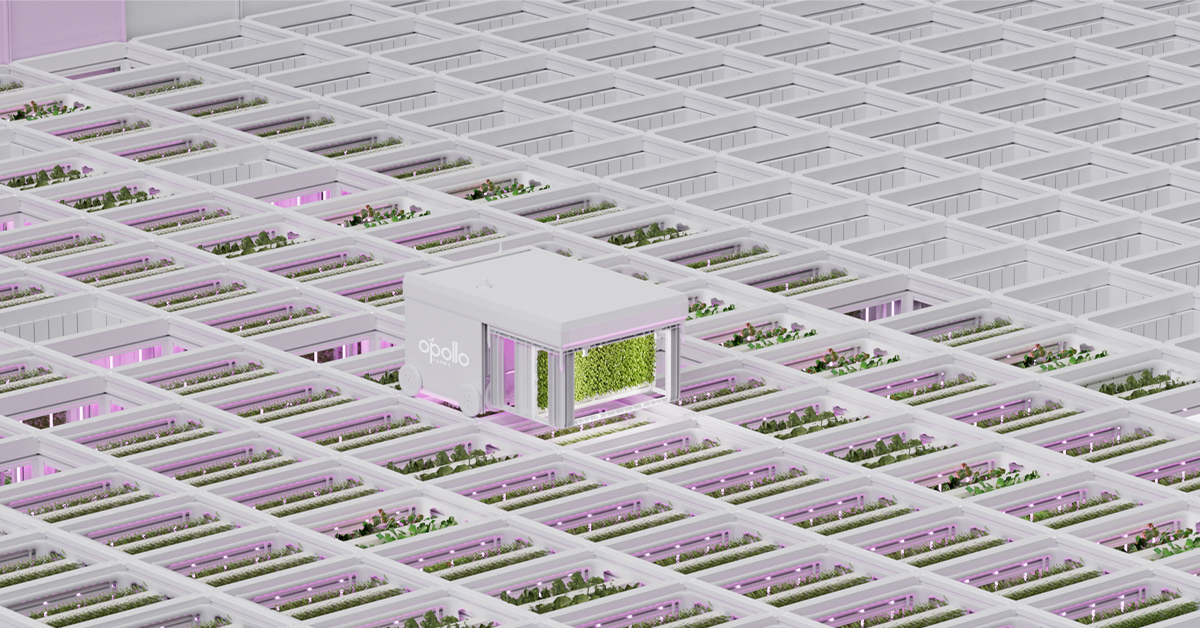
Opollo Farm is a new partnership between Arizona-based food tech outfit OnePointOne and Norwegian robotics provider AutoStore. The vertical farm grows leafy greens and herbs in a facility outside of Phoenix where Autostore’s automated cubic storage technology is used to create space, energy and labor efficiencies with movable boxes filled with vertically grown vegetables.
Founded by Australian brothers Sam and John Bertram in 2017, OnePointOne is attempting to make vertical farms as “ubiquitous and boring as a microwave,” CEO Sam Bertram told Nosh.
The company has raised about $75 million and spent nearly all of it in the first five years establishing an automated framework using Bertram’s background in robotics paired with his brother’s electrical expertise. Previously, OnePointOne partnered with California Giant Berry Farms and IMEX Organics in 2022 to scale vertical farming tech for strawberry-growing. But it is in the last three years partnering with AutoStore that the agritech business has made big gains in creating efficiencies and an innovative approach to vertical farming.
The food tech outfit was introduced to AutoStore through one of its board members. The two companies found synergy in using AutoStore’s automated robotic bins used in warehouses to reduce input costs within OnePointOne’s vertical growing technology.

“It basically looks like a Rubik’s Cube,” said AutoStore strategy manager Margherita Carrozzo. “We saw an opportunity to solve a problem when it comes to economic viability that is still a struggle with many vertical farms.”
AutoStore – which counts more than 1,600 customers and 70,000 robots deployed worldwide – provided proven competency by integrating the modular warehouse cubes into OnePointOne’s utility patent for a “robot-on-top, farm underneath” framework.
The Opollo Farm facility is in a roughly 1,000 sq. ft. space and can accommodate 1,000 of AutoStore’s bins, which grow vegetables in a hydroponic closed-loop water system. Within optimal conditions, many crops can grow to maturity in 15 days. The farm can currently grow 3,000 to 4,000 lbs of leafy greens and herbs per month (doubled if growing microgreens), reported Bertram.
OnePointOne is selling its produce to Phoenix-area Whole Foods stores under the Willo brand.
This automated framework reduces costs on labor, where one of the largest expenditures in any farming operation is employees’ footsteps.
“It’s the time it takes for people to walk from A to B and B to C around a multi-acre greenhouse or outdoor farm,” he said. “I can be sitting in a comfortable chair and the AutoStore system brings me a plant to inspect for issues or harvest.”
OnePointOne’s Opollo Farm also claims to have fewer installation costs, giving it a leg up on other vertical farming outfits in build-out as well as output.
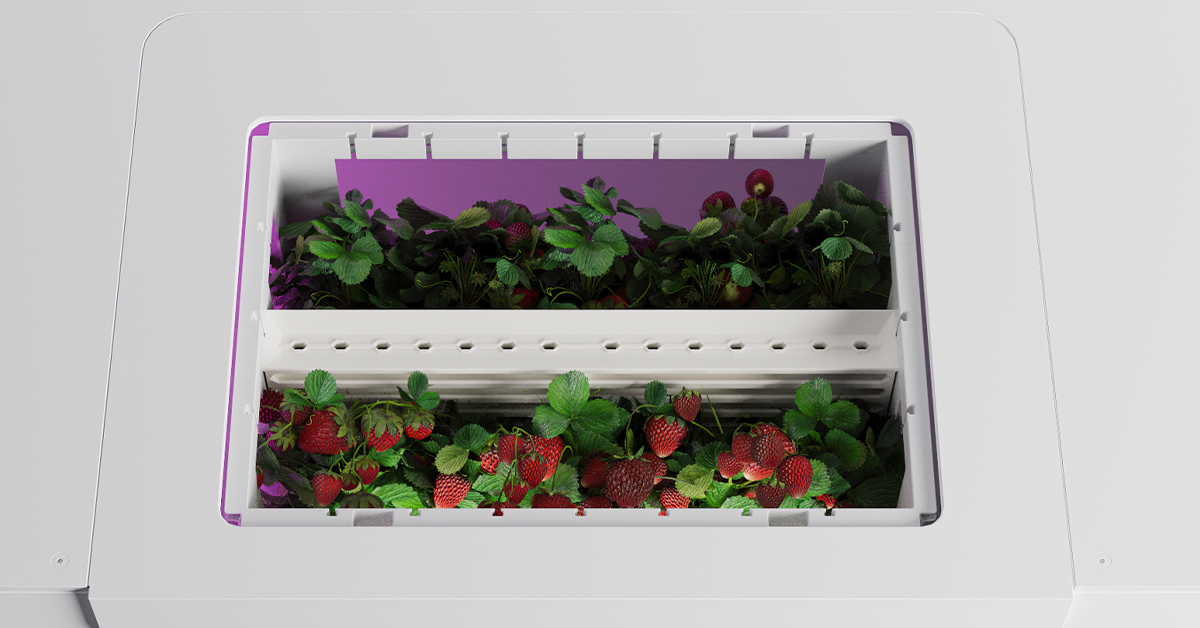
“You’re not going to beat our production density because we are producing on both sides within one bin,” Bertram said.
The partnership between the two technology companies has taken over two years of R&D and build-out. Now, OnePointOne is using the facility as a proof-of-concept to sell the innovation to grocery retailers.
“What we see is AutoStore selling systems and a network of distributors that integrate and implement those systems,” Bertram said. “Greenhouses aren’t production dense enough to co-locate efficiently. What the retailers want is very simple: A year-round supply of the same volume and same quality, at a price that makes sense.”
OnePointOne sees the value of Opollo Farm being less (but not entirely) about selling a model for vertical farming that can co-locate at grocery retailer distribution hubs, reducing the cost of shipping highly perishable produce while providing product at the same, if not better, margins.
Bertram said he has had several conversations with food retailers and distributors on how this co-locating model where AutoStore provides the robotic modules, OnePointOne builds the facilities and charges a software licensing fee to maintain operations.
At this point, OnePointOne is focused on leafy greens and herbs, but Bertram sees the opportunity for valuable commodities that are more difficult to grow.
“We put our blinders on and execute on leafy greens and herbs inside retail and distribution,” he said. “Then we can expand to strawberries, cucumbers, peppers, mushrooms and all the other fun crops.”