CPG Week: Weed, Juice & A Snack Empire
Episode 88
In this episode:
In this episode:
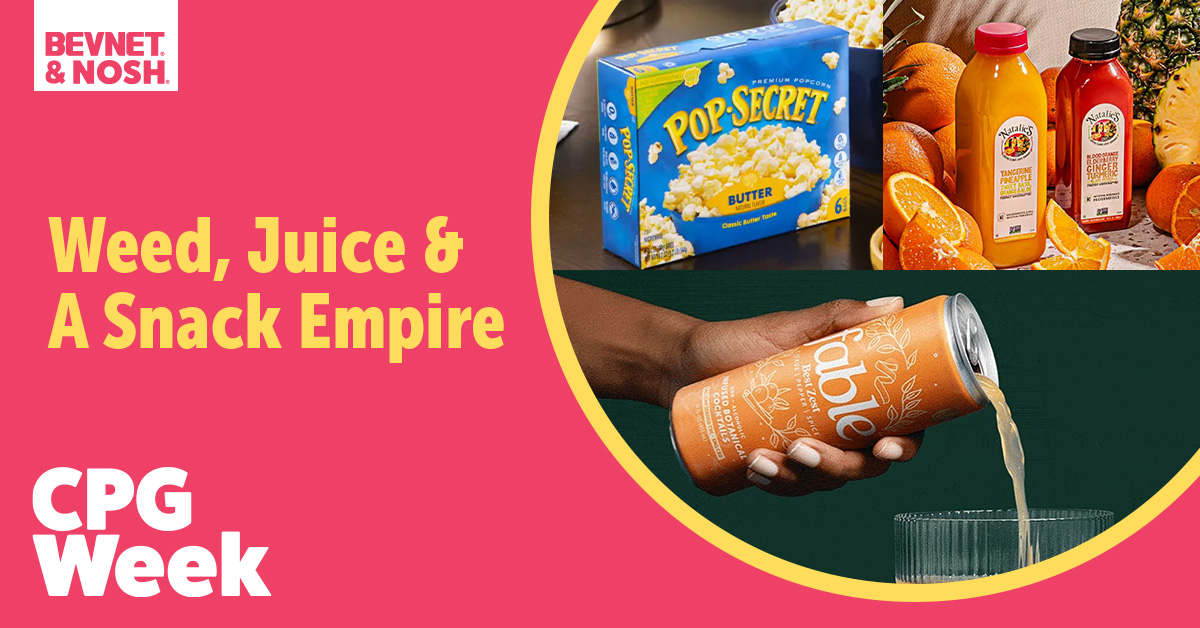
On CPG Week, the podcast team explores the uphill battle for industrial hemp food and beverage brands as individual states enact restrictions, a juice category merger and the growing snack portfolio of Our Home.
Before jumping into the week’s news, Nosh managing editor Monica Watrous gives senior reporters Lukas Southard and Brad Avery a pumpkin spiced quiz. Then, the group discusses the implications of California’s new regulations on the hemp industry. Next, Brad explains how the merger of Perricone Farms and Natalie’s Orchid Island Juice Company provides synergies for both brands to grow. Finally, the podcasters take a look at Our Home’s recent additions to its portfolio and talk about why its shift into more conventional brands could be a smart move.
Show Highlights:
0:30 – To pumpkin spice or not to spice? Monica tests Brad and Lukas’ pumpkin spice knowledge with a quiz about past and present CPG products that have taken on the harvest season’s favorite flavor.
3:30 – Last Friday, California became the latest state to rein in the hemp-derived cannabinoid industry by issuing an executive emergency action restricting the sale of hemp-derived food and beverage. Lukas explains how this move is different from other states’ approaches to regulation and what it means for the broader cannabis industry.
10:45 – In the juice category, two mid-sized companies have joined forces. Brad explains how the merger of Perricone Farms and Natalie’s Orchid Island Juice Company will bring value to both brands.
13:30 – Snack company Our Home is on a tear, acquiring Pop Secret from the Campbell Soup Company and ParmCrisps from Hain Celestial Group in about a week. The podcast team discusses how Our Home is positioning as a new snacking empire.
About the CPG Week
CPG Week is the podcast that explores the latest happenings in the consumer packaged goods industry. Join our seasoned reporting team as they dish out the week’s stories in quick, easy-to-digest episodes. Catch up on the top headlines of the week, dive into exclusive insights with the BevNET and Nosh teams, and set yourself up to make more informed business decisions. Tune in to stay up-to-date on the latest developments in the dynamic world of packaged food and beverage.
New episodes are released every week. Send us comments and suggestions anytime to cpgweek@nosh.com.
Show Highlights:
This week, the podcast team explores the uphill battle for industrial hemp food and beverage brands as individual states enact restrictions, a juice category merger and the growing snack portfolio of Our Home.
Episode Transcript
Note: Transcripts are automatically generated and may contain inaccuracies and spelling errors.
[00:00:05] Monica Watrous: Welcome to the CPG Week podcast by BevNET and Nosh, your source for the latest food and beverage industry news. I'm Monica Watrous, Managing Editor of Nosh, here with my co-hosts, Brad Avery and Lukas Southard. If you're enjoying the show, please subscribe on your listening platform of choice. On the podcast today, we're discussing weed, juice and snacks. But first it's pumpkin spice season. I just drank my first pumpkin spice latte of the season today. And I also ate some lesser evil popcorn, pumpkin spice popcorn. Did you know they had that? I did not. Yeah, of course you didn't because there's so many things that are pumpkin spiced. And that's why I prepared a little quiz for you because we love quizzes on CPG Week. And this one is called, has it been pumpkin spiced?
[00:00:56] Brad Avery: Ooh, that's a good, uh, good to spice or not to spice.
[00:01:00] Monica Watrous: Well, none of these should be spiced, but they were anyway, or were they? So I'm going to read to you the brand and you're going to tell me if it has ever had a pumpkin spice or pumpkin pie flavored version of the product in the market. At some point, maybe not every year, but at some point in its existence, not necessarily this specific season, pumpkin spices in 2024, but, but in, in within the past few years, got it.
[00:01:26] Brad Avery: I'm just gonna assume they're all yes.
[00:01:27] Monica Watrous: All right. I'm just gonna name the brand you tell me yes or no Oreo Yes, definitely spiced pop-tarts Spice no Lucas is right spiced. Yes. Oh really? Yeah. Oh, yeah Cheerios Mmm, not spice. Yes Brad is right. Cheers have been pumpkin spiced.
[00:01:48] Brad Avery: Wait, is this like honey nut Cheerios?
[00:01:50] Monica Watrous: There's a regular Cheerios pumpkin spice Cheerios. Oh
[00:01:52] Brad Avery: Really?
[00:01:53] Monica Watrous: Yeah. Did you guys go to the grocery store or no?
[00:01:56] Brad Avery: Just, you know, I just, I never been to one actually. What's a grocery store?
[00:02:03] Monica Watrous: All right. Resuming the game here. Twinkies. Now this would shock me if it hasn't been. Yeah, it's gotta be, right? Yes, they have. M&M's. Yes. No. Brad's right.
[00:02:14] Brad Avery: Yes, they have. Am I right at the top that they are all yes?
[00:02:17] Monica Watrous: Every answer is yes?
[00:02:18] Brad Avery: Let me just get through this list. Okay, okay.
[00:02:20] Monica Watrous: Pringles.
[00:02:22] Brad Avery: Let's just say yes.
[00:02:23] Monica Watrous: Yes.
[00:02:23] Lukas Southard: No. I just want to zag when he's zigging.
[00:02:28] Monica Watrous: All right. Goldfish.
[00:02:30] Lukas Southard: Yes. Sure.
[00:02:31] Monica Watrous: Yes. Spam.
[00:02:33] Brad Avery: Yes. Gross.
[00:02:36] Monica Watrous: Cup noodles.
[00:02:37] Brad Avery: Yes. Yes.
[00:02:38] Monica Watrous: Kraft mac and cheese.
[00:02:39] Brad Avery: Yes.
[00:02:40] Monica Watrous: Okay. So Brad caught on very quickly, even before the game started. All of these things have been pumpkin spiced. I knew it.
[00:02:45] Brad Avery: I knew it in my heart.
[00:02:47] Monica Watrous: And so many more other questionable, disgusting things that I just didn't have time to read to you. So. Happy fall, everybody. It's here. I want to hear about any others. We have an email. People can write into us if they want to.
[00:03:01] Lukas Southard: Yeah. Give us all your weirdest pumpkin spiced sightings in the grocery store, because obviously Brad and I just shop at like Dollar General.
[00:03:09] Brad Avery: Yeah. And if you if there's something that you know for a fact has not been pumpkin spice, it should be also tell us and we'll get the word out. Someone will seize on that instantly.
[00:03:17] Monica Watrous: Yeah. We'll deliver the message. The powers that be. That email address is CPG Week at Nosh dot com. So moving on, Lucas, what's going on in California?
[00:03:31] Lukas Southard: Well, Governor Gavin Newsom made a pretty important announcement on Friday and unveiled a proposed executive emergency action that would put pretty stringent regulations on hemp-derived THC products in the state. The emergency action was framed as a way to protect children from unknowingly consuming intoxicating hemp products. So basically, in the interest of public health, The decision comes after California State Assembly proposed a bill earlier this year which would have placed the oversight of industrial hemp under the state's Medicinal and Adult Use Cannabis Regulation and Safety Act. So the cannabis controlling body of California Yet that bill failed to come to a vote and so basically died in the state legislature, at least for the next year. So Governor Newsom put out his own executive order basically doing the same thing that that bill was going to do. So this is the latest in a series of states' efforts to tamp down on the relatively explosive growth of hemp-derived products, both beverages as well as now a lot of gummies and edibles that have entered the cannabis market, mainly through D2C and e-commerce channels. But definitely with beverages, you've seen a lot of that growth happen in unregulated adult use states like Texas and Tennessee. There's a lot of beverages, Total Wine & More being the biggest distributor that has taken it upon themselves to offer hemp-derived low-dose THC products as an adult beverage. So, Newsom framed the hemp-derived cannabinoid industry as exploiting the loophole that was opened up in the 2018 Farm Bill that we've talked about a couple times, and he called it the greed of many folks in this industry. So what is different about California's approach is not only is it an executive action, so it leaves it pretty wide open to challenges, which, according to many sources I've talked to, it will be challenged in court. A lot of them are saying that it'll be challenged on this emergency action, saying that, you know, what is the big emergency? Yes, people do consume. Children do consume low-dose THC products, but children also can get their hands on cigarettes and alcohol. We don't call that an emergency. But the other thing that is different about California's approach is that it bans any detectable quantity of THC from industrial hemp products meant for human consumption. So this includes food, food additives, beverages, and dietary supplements. And multiple sources I talked to brought up the fact that this might be going a little too far because it could potentially bar any CBD brands from operating in California, because it's really hard to pull out 100% of THC from a CBD product. And it also depends on where you're getting these products tested. So it's really putting a strong regulation on not only the hemp-derived THC market and the intoxicating cannabinoids, as Newsom called it, but also CBD products. So it's pretty big. And despite the fact that California is a huge economy and the biggest cannabis economy, at least in this country, if not in the world.
[00:06:57] Brad Avery: To some degree, I don't know if I'm necessarily surprised, because it's always been more surprising to me that we've had this whole legal market open up of Delta 9 THC products that, in effect, came through a loophole, as you alluded to. There's obviously a big regulatory issue here, and I know from talking to people in this space, in this industry, that the industry wants to be regulated, and a lot of it has been self-regulation. But we have these issues that I think Newsom's probably alluding to as well, that technically, there's no age restriction on these products. Technically, there's no laws at all about these products other than that they can be sold. There are industry groups that have been saying, please, work with us. Let's get some laws on the book that allow for the legal sale and make it clear that, OK, no one under 21 can purchase these, et cetera, et cetera. There's a lot of movement there. However, the fact that government sort of stepped in and decided instead, let's just ban it also. I mean, to me, it felt like it was probably coming. And as your article on BevNET, Lucas, you mentioned Indiana, Iowa, Oregon, Missouri and New Hampshire have done similar moves in recent months.
[00:08:10] Lukas Southard: they're not the only states. I mean, literally, this is happening across the country, state by state, different approaches. Many of them are taking more of a dosage or serving size regulatory move in terms of how many milligrams of THC can be in it or how many servings are in a 12-ounce container, for example, or even what cannabinoids can be used. So Delta 9 is kind of one of the most common, but a lot of them are restricting Delta 8 or Delta 10, and included in the California executive order, they listed 30 additional intoxicating elements. Not all of them are cannabinoids, but that are also restricted under this emergency action. So you're right in saying that this isn't really surprising. I think one of the unintended consequences that might occur as a result of this is that It might force the issue into the federal hands even more so because California is basically saying, hey, you know, along with a lot of other states in the U.S., we haven't gotten any sort of regulatory guidance from the FDA, from federal law enforcement on how to deal with hemp-derived cannabinoids. And so we've had to take it upon ourselves. And in effect, They're putting in these stringent restrictions that are really going to hurt the state in terms of like tax revenue and the business impact of of what a lot of these hemp derived companies who operate in the state are able to do there.
[00:09:44] Brad Avery: It really does underline the issue of needing federal legalization of cannabis overall. I mean, this state-by-state approach and then the farm bill opening up this loophole for hemp-derived THC has created a big headache. And it does put the imperative, as you said, Lucas, on the federal government to come down and do full legalization, as we all know is eventually coming, as has been hinted at repeatedly, it's someday. You know, everyone kind of can keep moving the goalpost for when that will be. It does feel like this type of move shows that the state-by-state approach is too difficult and there needs to be clear regulations for if this industry can continue to thrive.
[00:10:27] Monica Watrous: Insiders can read more about this developing story at BevNET and Nosh. Brad, you wrote about a recent acquisition of a pretty notable juice company this week for BevNET. Can you tell us more?
[00:10:42] Brad Avery: Yes, so last week, Paracone Farms, a California juice company, acquired Natalie's Orchid Island Juice Company, a Florida-based family-owned brand. So what we have here are two medium-sized juice brands. Paracone Farms is very focused on food service. Natalie's has been much more retail-minded and international business as well. And we have a merger here. Paracone is the acquirer, but Natalie Sexton, the namesake of the brand and the CMO of Natalie's, will be continuing as CMO at the combined company. And Bob Robczar, CEO of Paracone Farms, said that the best of both worlds is absolutely the goal here. Natalie's has a production facility in Florida that Paracone now has access to. Paracone has a great supply chain shored up that Natalie's now has access to. And largely, they're going to be continuing to go forward and grow these brands. There's an international business that Natalie's has that Paracone can sell into, and there's food service accounts that Natalie's can sell into.
[00:11:45] Monica Watrous: What does the broader category look like right now, the juice segment?
[00:11:51] Brad Avery: Well, we know that juice has slowed down a bit, and in particular, you look at orange juice, and as of July 14th, Circana showed that orange juice sales were down 4.4%. In retail, Natalie's orange juice was up 4.6%, so growing almost inverse to the category's decline. You also do have a number of recent acquisitions that this follows. Largely in 2022, we saw Bolthouse Farms acquire Evolution Fresh. We saw Suja acquire Vive Organic. We also saw a year before that in 21, PepsiCo divested its Tropicana and Naked portfolio, which is now spun off into its own business under PAI Partners. So there's been movement in the juice category, and particularly after we saw a pandemic era bump in juice purchases for immunity reasons, for people being at home and going back to old rituals of juice with their breakfast in the morning. But that's slowed down. The category is largely declining again, depending on which sector you look at, but this is a very large category with many different subcategories. What we have now are two midsize brands that are growing, that are now combining. And I don't know that they're looking at category domination, but they are definitely looking at being a more powerful player in this space.
[00:13:15] Monica Watrous: Insiders can read more on your story on BevNET called Perricone and Natalie's say post-merger synergies will strengthen both brands. And speaking of acquisitions, we also covered a couple of deals under the Our Home conglomerate. It's a growing snacking platform and within a week, The company added two more brands. First, it acquired the nearly 40-year-old PopSecret popcorn brand from the Campbell's Soup Company for an undisclosed amount. And according to Campbell's, PopSecret generated net sales of $120 million last year. Then Our Home followed up that deal with the acquisition of Parm Crisps from the Hain Celestial Group. That deal includes a production facility in Pennsylvania and adds complimentary manufacturing, innovation, and distribution to Our Home following its acquisition of Sonoma Creamery earlier this year. Both Parm Crisps and Sonoma Creamery are crunchy baked cheese snacks, so super synergistic. And as a reminder, Our Home's other brands include Real Food from the Ground Up, You Need This, Popchips, Food Should Taste Good, R.W. Garcia, and Good Health. We've seen the company steadily strengthening its position as a leader in better-for-you snacking over the past few years. And it's interesting, the addition of PopSecret kind of brings it closer to the conventional snacking space.
[00:14:44] Brad Avery: Yeah, it's a brand I remember from when I was a kid.
[00:14:48] Monica Watrous: Same. A lot of microwave popcorn consumed in the Watchers household. Our Home has certainly been one of the more prolific acquirers. We've also seen Day Day Cooks snap up a few brands this year, but it'll be interesting to watch how this company continues to build out its snacking portfolio, what other brands might join the fray or the house, as it were. Everybody's Home. Everybody's Home.
[00:15:14] Brad Avery: You know, to the mention of PopSecret, that is probably the most mainstream recognizable brand now that's in their portfolio, maybe next to PopChips. And they've been building out this big focus on Better For You, and there's no reason PopSecret can't be a Better For You brand, but it does give them a much stronger conventional brand in the portfolio. So I do think that's interesting as far as us talking about them being maybe a future powerhouse of snacking in any sense of what they're thinking of for the future.
[00:15:41] Monica Watrous: I think the real question here is, has PopSecret ever been pumpkin spiced?
[00:15:46] Brad Avery: Has it? Actually, I'm not sure. We can find this out right now on the internet.
[00:15:51] Lukas Southard: Well, it is interesting that this is happening at the same time that Kellogg's is basically getting out of the snacking business, shall we say? And maybe this upcoming snacking powerhouse in Our Home wants to kind of take on the mantle as being one of the major snack brands in grocery stores.
[00:16:10] Brad Avery: And the answer to that question, though, is yes. Has Pop Secret been pumpkin spiced?
[00:16:14] Monica Watrous: Yes.
[00:16:15] Brad Avery: Is a resounding yes.
[00:16:19] Monica Watrous: Breaking news.
[00:16:21] Lukas Southard: Well, I look forward to see Our Home do a full line across all of their brands now of the pumpkin spice. I'm sure they will.
[00:16:29] Monica Watrous: Here are some other notable bits of news from the week. Energy drink roundup. KDP and Black Rifle unite. PepsiCo slims its Celsius orders. Tasting Trees, Seedlip Founder Unveils N.A. Distillation Project, and How Big CPG Attracts a Cost-Constrained Consumer. For these stories and more, become an insider at BevNET and Nosh. That wraps up this edition of CPG Week by BevNET and Nosh. Thank you to our audio engineer, Joshua Pratt, our director is Mike Schneider, and our designer is Aaron Willette. If you enjoyed the podcast, please subscribe on your listening platform of choice, and we will see you next time.
About CPG Week
CPG Week is the podcast that explores the latest happenings in the consumer packaged goods industry. Join our seasoned reporting team as they dish out the week’s stories in quick, easy-to-digest episodes. Catch up on the top headlines of the week, dive into exclusive insights with the BevNET and Nosh teams, and set yourself up to make more informed business decisions. Tune in to stay up-to-date on the latest developments in the dynamic world of packaged food and beverage.
New episodes are released every week. Send us comments and suggestions anytime to cpgweek@nosh.com.
Stay Informed. Stay Competitive.
Become an Insider to unlock exclusive CPG insights, data, education, and industry exposure for food & beverage leaders.

Industry Analysis
Context behind the headlines

Data & Reports
Category performance & trends

On-Demand Education
Expert-led video courses