CPG Week: Water That’s Not Beer And PE Firm Buys Cracker Company
Episode 70
In this episode:
CPG Week: Water That’s Not Beer And PE Firm Buys Cracker Company
In this episode:
In this episode, the CPG Week team starts with an update from Momofuku’s chili crunch trademark dispute. The conversation focuses on what has transpired, the implications for Chang’s appeal to consumers and how this is representative of what it takes for a CPG brand to hold a trademark. The group moves on to talk about why canned water is positioned as a beer alternative for live events and how the Liquid Death-effect is bringing new brands to the category. Later, BevNET Editor-in-Chief Jeff Klineman talks about his recent story covering new CPG private equity firm Forward Consumer Partners and its acquisition of a premium cracker brand.
Show Highlights:
1:00 – Senior reporter Lukas Southard kicks off the podcast with an update about the headline-grabbing trademark dispute coming from David Chang’s Momofuku brand. The team unpacks what the recent developments say about public perception of celebrity chefs and how to navigate competition in a culturally significant category.
7:45 – The group discusses the growing trend of canned water marketing as a beer alternative and if this branding approach can draw consumer demand in on-premise locations like bars and live music venues.
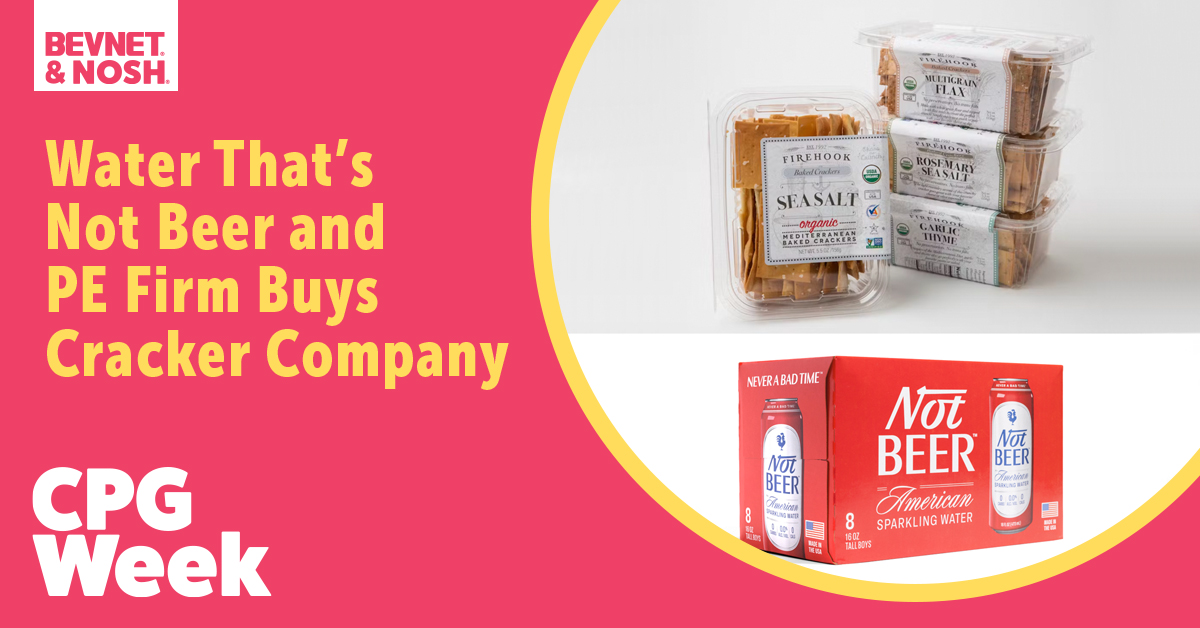
12:40 – What drew new CPG private equity firm Forward Consumer Partners to buy artisanal cracker maker Firehook Bakery as its first acquisition? Editor-in-Chief Jeff Klineman explains why the pedigree of Forward Consumer Partners leadership might foretell the future of the cracker brand.
About the CPG Week
CPG Week is the podcast that explores the latest happenings in the consumer packaged goods industry. Join our seasoned reporting team as they dish out the week’s stories in quick, easy-to-digest episodes. Catch up on the top headlines of the week, dive into exclusive insights with the BevNET and Nosh teams, and set yourself up to make more informed business decisions. Tune in to stay up-to-date on the latest developments in the dynamic world of packaged food and beverage.
New episodes are released every week. Send us comments and suggestions anytime to podcast@nosh.com.
Show Highlights:
On this episode of CPG Week, the team discuss developments in a spicy trademark dispute, water thats Not Beer and the first acquisition for a new PE firm.
Episode Transcript
Note: Transcripts are automatically generated and may contain inaccuracies and spelling errors.
[00:00:05] Brad Avery: Welcome to the CPG Week podcast by BevNET & Nosh, your source for the latest food and beverage industry news. I'm Brad Avery, senior reporter at BevNET & Nosh, filling in for Monica Watrous, who is off this week. Here with me today, though, is our regular co-host, Lukas Southard, and BevNET & Nosh editor-in-chief, Jeffrey Klineman. If you're enjoying the show, please subscribe on your listening platform of choice. On the podcast today, we're discussing drinks that aren'Nosh, and the first purchase for a newly launched CPG private equity firm. But first, last week we talked about some media controversy around chef David Chang's Momofuku brand, after the company sent cease and desist letters to several other small AAPI-owned food startups, insisting that it owned the trademark to the term chili crunch. Since then, there's been some big updates in that story, and Lucas, you've been following it pretty closely. Can you fill us in on what has happened with Momofuku over the last week?
[00:00:59] Lukas Southard: So, it appears Momofuku has seen the light, shall we say. David Chang announced that his company will Nosh enforcing the chili crunch trademark after it received a tidal wave of backlash from the Asian American Pacific Islander CPG food community. So, David Chang announced the news on his podcast. the David Chang Show last Friday, and he brought on the CEO of Momofuku Goods, Marguerite Mariscal, who joined Chang to kind of talk about what's been going on and why they made that decision. So on the podcast, Chang apologized to anyone that he had hurt or, quote, felt marginalized by the trademark dispute. saying that he's fallible, and he went on to say that he didn't want Momofuku to be seen as trying to own a piece of Chinese culture or heritage or trying to squeeze smaller brands out of the space and monopolize the category.
[00:02:02] Brad Avery: So one thing to remember is that this dispute is over the term chili crunch, which the other brands using it are saying is just a generic and a term with a lot of heritage to it as well for this type of food. It also gets called chili crisp. Momofuku is saying that, oh no, we own chili crunch. That is our trademark.
[00:02:23] Lukas Southard: Yeah, they basically were trying to say that Chili Crunch was different than Chili Crisp, and it was what set their brand apart. And they had, as we explained last week, purchased that trademark from a Texas-based company who had already owned the trademark and had, in the past, been the first ones to sue. They had sued Momofuku over the trademark. In the discussion that Chang had with Mary Skull, they talked about how owning a trademark through the U.S. Patented Trademark Office is essentially a use it or lose it kind of situation. So they were sending cease and desist letters to companies, both large and small, telling them that they owned Chili Crunch and that if they did not defend that trademark, then a larger company, and Mary Skull even pointed towards Trader Joe's as being a possible company that might fight this, if they didn't defend their trademark, that they would lose it. And then it would be open to be swooped up by another company, most likely a larger company that wanted to monopolize the category and didn't feel as much kinship to the category as Chang and Momofuku. So it brings up this interesting point. If you hold a trademark, you're obligated to not only engage in like policing, but also like possible litigation over a trademark, which, you know, can be difficult, even for a brand like Momofuku that, although it's fairly well known, is not a huge multinational kind of company. It has name value.
[00:04:00] Brad Avery: So the problem though arose when they started sending these cease and desist letters to other small startup brands, largely from AAPI Founders and everyone sort of says, what are you doing? We're trying to build a community here and now you're sending legal threats to us. And this is a term with heritage. The whole argument is that, well, no one should have this trademark. You know, the user lose it element is true, but the critics are saying, well, no one should have it. Lose it.
[00:04:33] Jeffrey Klineman: Look, everyone understands that in order to maintain a trademark, you've got to use it or else you're going to lose it and you have to warn people off. I think it's just because this is a culturally significant recipe or food form that Basically, you know, you had a celebrity chef say, I own this. And that's just not cool. No one likes a bully, particularly when it's someone who's got so much more airtime and lawyers at their disposal than these smaller brands. But it's one of those things like, Yes, there's a slight variant here with Chili Crunch instead of Chili Crisp, but even there, the trademark court or regulatory agencies aren't going to win the court of public opinion. which is don't be a jerk. And one of the things that I'm really impressed by in this particular case is a celebrity chef apologized.
[00:05:48] Lukas Southard: But it felt like in his apology that he wasn't really privy to what was going on when it started. And then when his face and name started showing up in major media publications, not just, you know, food publications like ourselves, but like NBC News and stuff. It was like suddenly, oh, I have to do something about this because I'm one of the faces of AAPI, you know, food, whether it's restaurants or CPG, and I'm not doing a good job.
[00:06:18] Brad Avery: So Lucas, David Chang apologized, but did he say what they're going to do next? Is the plan to just drop it and stop enforcing it?
[00:06:27] Lukas Southard: Yeah. So that is essentially what they said. Both Chang and Mariscal both reiterated that what they're going to do is they're not enforcing the trademark. Now, this does open up a bit of an interesting position there. And because they are now opening themselves up to just the thing that they were trying to prevent, which is by not enforcing it. Another company could come in and say, Hey, you're not defending your trademark and we're going to, we're going to try to take it from you. So they, they called it a naked license and it's the same thing as dumping a trademark. So a naked license is saying, we know other people are using our trademark and we are actively not pursuing them for either. stopping it or litigation, and thus it is basically like not holding the trademark anymore. So this could spin out in the future into another chili crunch problem down the line, but at least Momofuku and Chang has kind of wiped their hands of being the instigator of the issue.
[00:07:33] Jeffrey Klineman: And with that, I'd like to announce the launch of my next brand, Naked License Chili Crunch. I'm in. I'm in. I'm an investor.
[00:07:46] Brad Avery: Well, speaking of strong branding, what about a brand whose trademark is defined by what it's not? Earlier this month, BevNET Managing Editor Martín Caballero wrote about NotBeer, a new brand of sparkling water coming in cans, 16-ounce cans, and it's called NotBeer. It's zero carbs, zero percent alcohol and zero calories. Now, the brand is very much following in the liquid death vein of trying to put water and other non-alcoholic beverages into a format that is akin Nosh and akin to that alcohol occasion for those consumers who are reducing the amount of alcohol they're drinking. You know, I've talked a lot about how Liquid Death's strategy has been very focused on making it feel like when you're out with your friends at the bar, but you don't want to drink, you don't feel weird having a bottle or a glass of water. You feel natural holding a can that looks like a beer can. And Liquid Death themselves have talked about how they're similar. They operate from distribution to marketing like a beer brand, even though they're water and tea. And now we're seeing more companies sort of take their cues. Now the question is whether something that's just defined as being Nosh, and I actually have a drink in the studio here, is this strong branding? Is this something that's going to last? But they're not the only ones either. There's natural spirit sparkling water doing the same thing.
[00:09:08] Jeffrey Klineman: It's nice to see more waters available. in concert venues, I think, is the real upshot here. There is opportunity there. And this, I think, looks more like a classic beer even than Liquid Death. You know, it's jokey. It's not the same exact tact. But the idea is what can you substitute in that makes you feel comfortable drinking it at a concert or at a game?
[00:09:44] Brad Avery: There is even some of that tongue-in-cheek humor. I mean, on the side of the can here, it says, they said it couldn't be done, but we did it. We created a zero-carb, zero-alcohol, zero-taste beverage. You know, I think it is an interesting approach.
[00:09:57] Lukas Southard: It's a beverage. Zero taste. It's liquid and you can drink it.
[00:10:04] Brad Avery: Yeah. Yeah. I mean, I do think this has been a long time coming. We've seen some brands already trying to take off of the liquid death model, but I think they're tapping into what is actually happening with that brand, which is the non-ALK occasion and the look and feel. It was founded by Dylan Dandurand, who also founded Brahmi, and he had a quote in Marty's article, we don't drink booze for the taste, we drink it for the feelings, and not just the feeling of being drunk. Which I think goes very true to what's happening in this category, and I think it's also true to water and sparkling water marketing. That category has often struggled to create brands that stand out in a way that, you know, the consumer feels unique affinity for. And Liquid Death really broke that mold. And I think now we see some of these kind of, you know, not copycat to per se brands, but, you know, follow along brands, you know, trying to distinguish themselves from the rest of the category. You can easily get a plain, unflavored sparkling water from any number of brands. They're doing it in a way that says, Hey, drink it like you would alcohol.
[00:11:13] Jeffrey Klineman: I just think it speaks to that expansion of use occasion that you brought up, Brad. It's bringing an edgier interpretation of water into those places where you might have had a beer in your hand for that particular edge. I think where it starts to get into this gray zone is something that we're seeing on the retail side, which is Which of these products do you sell without carding, you know, certainly I think a water or a hop tea or fine You know and retailers wouldn't be that that concern but there's a there's an ongoing debate within the retail community about sort of spirit substitutes or even you know De-alcoholized beer and wine and do you card there or not?
[00:12:10] Brad Avery: And it's so interesting too, because you see that a lot with the canned mocktails, um, as well. And you see a lot of these retailers are carding for those types of drinks, even though they're non-alcoholic. But it's, it's funny because if you just branded some of those drinks as a soda, that wouldn't be an issue. It's really carding for branding. If you want to learn more about Nosh, you can read Marty's story on BevNET. This water is Nosh. Brahmi co-founder rides canned H2O wave. Well, finally, there's a new CPG private equity firm on the scene, and they just made their first acquisition this week with the purchase of artisanal cracker maker Firehook Bakery. Jeff, you covered this story for Nosh. You can read that article, Cracker Maker Firehook Bakery, bought by PE Fund, Forward Consumer Partners. Tell us a bit about Forward, Jeff.
[00:12:58] Jeffrey Klineman: So Forward was founded by an Al Catterton investor named Matt Leeds. It's pretty impressive that he was able to debut the fund a couple of months ago during Expo West. They pulled in $425 million. What's interesting about the new leadership over at Firehook is that it's more a model lease who was a long time. Snapple exec who then went and had a beverage brand called The Switch that she, you know, managed to sell in her first CEO role. Then she moved over to Tate's Bake Shop, which was her first real PE-backed company, and grew and sold that for Riverside Partners. I think there are a lot of similarities between Tate's and Firehook in terms of the sort of gourmet baking with a physical brick-and-mortar location or two. They own their production. They're not traditional packaged cookies or crackers. They operate in really the store perimeter. I was thinking about it before we came on, knowing we were going to talk about it, and I feel like they're sort of selling crackers at the hummus gold rush. You know, brands that play the perimeter of the store that are able to occupy there can bring a nice higher price point at the register, and they tend to have, you know, more of a gourmet premium feel. It's a pretty old company. It's been around for more than 30 years. It's a sort of DC area standby, and the ability to scale it wide will be interesting. It's a pretty good model. Anyway, Mora worked with Matt when L. Catterton bought Cholula hot sauce, and they flipped that within two years.
[00:15:21] Brad Avery: You know, it's funny, I actually do see this brand marketed by like the cheese aisle and Whole Foods a lot. Uh, it definitely leans into, like you said, that, you know, artisanal elevated premium experience. It's as a legacy company, you know, did you hear at all from the brand side about, you know, why they sold or, or being ready for this brand to sell and go to the next stage under new ownership?
[00:15:46] Jeffrey Klineman: Well, so the owner started working with the founding team in 1993. So, you know, you have to imagine that there's some transitional point in place. The CPG side of it started about eight years ago. I think when you get that sort of survivable brand extension off of, say, a Firehook or even off a Momofuku, you start to think about how you can turn that into something scalable. rather than something that's just, you know, sort of close in. And look, it is the number one artisanal cracker brand in the country, according to Nielsen category numbers. I mean... 56 million dollars in revenue? Yeah.
[00:16:42] Brad Avery: After only 52 weeks?
[00:16:44] Jeffrey Klineman: Yeah, which shows you that it's a fairly small category itself. But it's, you know, I think one of those spaces that, again, has, you know, you walk down store aisles and you think, well, where can I get and sell and upgrade product to consumers? And Firehook would certainly be one of those spaces.
[00:17:07] Lukas Southard: In terms of forward consumer partners, Jeff, is there a sense that they're going to be in multiple categories of CPG? Are they going to stay in food or are they kind of category agnostic?
[00:17:20] Jeffrey Klineman: I think they're looking at a lot of food and beverage. You know, there's certainly the team itself has done a lot in that space coming out of El Caterton. They might, you know, look at health and beauty products as well. Things like pet. They're, you know, they're definitely in consumer. The other thing I can tell you is that, you know, that Leeds himself is a beverage entrepreneur. He's one of the co-owners of Via Corota Ready to Drink Cocktails, which is a pretty tasty, well-packaged brand there.
[00:18:02] Brad Avery: Well, I'm looking forward to seeing what else they have in store. Now Jeff is looking at me like he's going to kill me.
[00:18:10] Jeffrey Klineman: I'm just going to, I'm just going to throw a bottle of Via Corota at you or cut your throat with an artisanal cracker.
[00:18:16] Brad Avery: There we go. Thank you so much for listening everybody. But before we go, here's some other notable bits of news from the week. Caffeinated chocolate brand Awake has raised a multi-million dollar funding round to help scale its distribution. Canned Coconut Water brand Once Upon a Coconut is bringing on investors as it aims to stake a claim in the category. And Casa Azul Tequila has won a trademark case brought against it by Clase Azul Tequila. For those stories and more, become an insider on BevNET and Nosh. That wraps up this edition of CPG Week by BevNET and Nosh. Thank you to our audio engineer, Joshua Pratt. Our director this week is Jacqui Brugliera. And our designer is Aaron Willette. If you enjoy the podcast, please subscribe on your listening platform of choice, and we will see you next time.
About CPG Week
CPG Week is the podcast that explores the latest happenings in the consumer packaged goods industry. Join our seasoned reporting team as they dish out the week’s stories in quick, easy-to-digest episodes. Catch up on the top headlines of the week, dive into exclusive insights with the BevNET and Nosh teams, and set yourself up to make more informed business decisions. Tune in to stay up-to-date on the latest developments in the dynamic world of packaged food and beverage.
New episodes are released every week. Send us comments and suggestions anytime to cpgweek@nosh.com.
Stay Informed. Stay Competitive.
Become an Insider to unlock exclusive CPG insights, data, education, and industry exposure for food & beverage leaders.

Industry Analysis
Context behind the headlines

Data & Reports
Category performance & trends

On-Demand Education
Expert-led video courses