CPG Week: Reading The Earnings Report Tea Leaves, Whole Foods’ Daily Shop
Episode 64
In this episode:
In this episode:
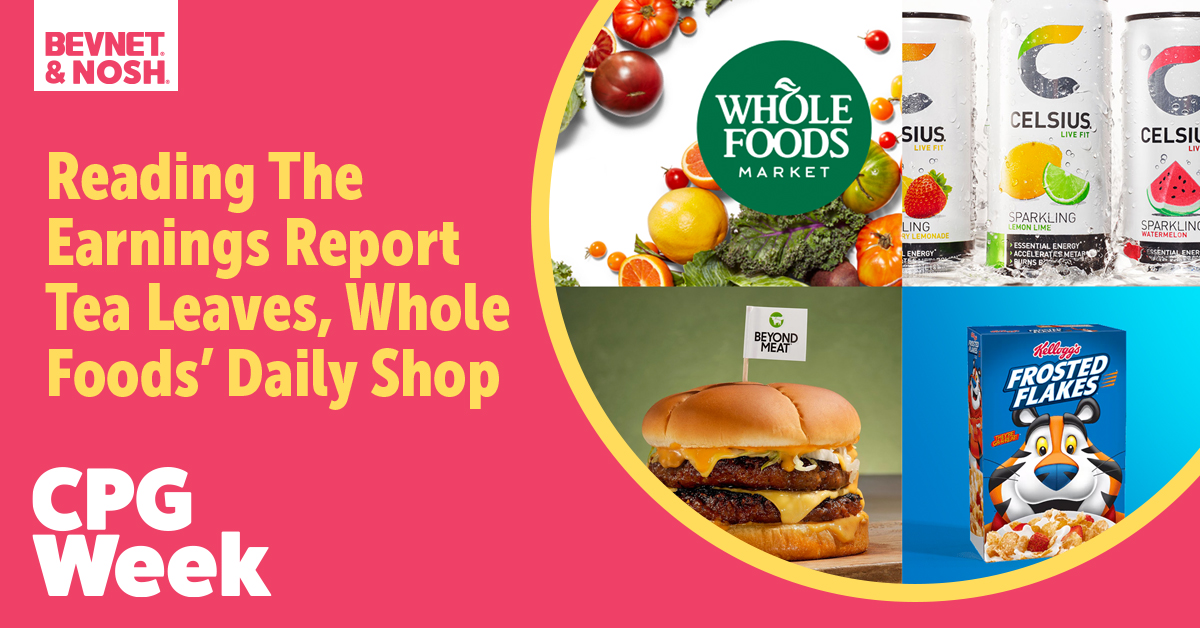
This week, the Nosh and BevNET team talks about how a marketing campaign to boost cereal sales might be imploding for Kellogg’s and what it means for the greater food maker’s empire as it moves into a new era as Kellanova and WK Kellogg Co. Senior reporter Brad Avery takes the temperature of the performance energy category through the most recent quarterly reports of Monster and Celsius. The team talks about two plant-based companies’ financial losses and finishes up discussing Whole Foods Market’s new smaller-footprint store concept.
Show Highlights:
0:30 – Is cereal a viable option for dinner? WK Kellogg’s attempt to bring the breakfast staple to other day occasions has led to some unexpected social rancor. Senior reporter Lukas Southard explains how the recent outrage on social platforms over the “cereal for dinner” campaign is related to the first standalone earnings calls for both Kellanova and WK Kellogg.
6:20 – Senior reporter Brad Avery discusses what the most recent quarterly reports from Celsius and Monster tell us about the state of energy beverages and why workout enthusiasts are driving growth in the category.
8:20 – What’s the state of plant-based? Two of the biggest plant-based meat and beverage brands posted losses in their most recent earnings. Yet, it’s not all doom and gloom, Nosh managing editor Monica Watrous pointed out, as revenues were up for one company and stock prices soared for the other.
10:35 – The team talks about the news that Whole Foods Market is launching a smaller store concept (again). Is this a reaction to other small-footprint retailers like Foxtrot or Erewhon, or a play for juicing sales of its 365 branded products?
About the CPG Week
CPG Week is the podcast that explores the latest happenings in the consumer packaged goods industry. Join our seasoned reporting team as they dish out the week’s stories in quick, easy-to-digest episodes. Catch up on the top headlines of the week, dive into exclusive insights with the BevNET and Nosh teams, and set yourself up to make more informed business decisions. Tune in to stay up-to-date on the latest developments in the dynamic world of packaged food and beverage.
New episodes are released every week. Send us comments and suggestions anytime to podcast@nosh.com.
Show Highlights:
The Nosh and BevNET team talks cereal struggles, energy drink earnings, up-and-down reports from plant-based industry leaders and Whole Foods’ newest attempt at a smaller footprint store concept.
Episode Transcript
Note: Transcripts are automatically generated and may contain inaccuracies and spelling errors.
[00:00:05] Monica Watrous: Welcome to the CPG Week Podcast by BevNET and The Nosh, your source for the latest food and beverage industry news. I'm Monica Watrous, Managing Editor of The Nosh, here with my co-hosts, Brad Avery and Lukas Southard. If you're enjoying the show, please subscribe on your listening platform of choice. On the podcast today, we're discussing earnings galore, a tale of two Kelloggs, big drink energy and plant-based face plants. Hey, Lucas, what cereal are you most likely eating for dinner?
[00:00:37] Brad Avery: Well, I like to consider myself the resident cereal enthusiast on the BevNET team. I still love a good bowl. So what I eat, usually, albeit during the breakfast period, is a cereal mix that I make. It's one part Cheerios, one part Magic Spoon frosted flavor, and one part homemade granola. But that being said, if I'm answering you honestly, my go-to, especially in dinner where I want something maybe a little sweeter I could treat, It'd probably be corn pops. That's what I ate as a kid when my health conscious parents allowed me to buy a sugar cereal.
[00:01:11] Lukas Southard: Yeah, Lucas might have a second career here as a sort of a cereal mollier, if you will. I could definitely see him doing those Instagram or TikTok videos where you just sort of cut together, here's how we're going to make the ultimate bowl of cereal.
[00:01:27] Brad Avery: It's all about having the proper bowl too. You have to have a big enough bowl to fit all the different varieties you're putting in there.
[00:01:34] Lukas Southard: You've eaten cereal during meetings before, and we've seen you have like a mixing bowl.
[00:01:39] Brad Avery: I have a special bowl. I have a cereal bowl. I have a special cereal bowl.
[00:01:42] Monica Watrous: Do you use milk, like cow's milk with that?
[00:01:45] Brad Avery: I usually use oat milk, honestly, just because it's a little too much milk for me, like dairy milk, but I've been known to when we're out of a plant-based version. Well, I did know you were going to bring this up. Serial has become kind of a big part of the first earnings call between Kellogg's split of their two companies. Kellogg's standalone serial company, W.K. Kellogg, has found itself at the center of a social media outrage, shall we say, over comments that the CEO, Gary Pilnick, said on a CNBC interview. basically in referencing inflation and the rising cost of food. He said families struggling with those high food prices should start eating breakfast for dinner, which ruffled some feathers of social media influencers and people commenting on TikTok, saying that it was kind of off base and did not really address not only nutritional aspects, but also the fact that Kellogg's, or WK Kellogg's in this case, has raised prices.
[00:02:54] Lukas Southard: It definitely came across like, what if Marie Antoinette owned the cake factory? I did kind of enjoy the Guardian's headline here, let them eat flakes.
[00:03:04] Monica Watrous: Oh, that's good.
[00:03:06] Brad Avery: That was my favorite headline too, Brad. So this echoed some sentiments that Pilnick said during the Q4 earnings call, which as I said, it was the first standalone earnings call for the WK Kellogg's company. And so Kellogg's serial business had a slightly lower net sales in Q4 with a conservative 2024 outlook of negative 1% to 1% net sales growth. On the call, Pilnik referenced how Kellogg's is positioning its marketing around cereal consumption throughout the day. So this approach comes as WK Kellogg's has buoyed their earnings through operating efficiencies across its supply chain. And as I said earlier, an aggressive pricing strategy to combat inflation. Influencers who are outraged by the cereal for dinner campaign were calling for a three-month boycott of all Kellogg's brands, so that includes Kellanova, starting on April 1st, or April Fool's Day, or as one tick doctor called it, the F.U. Fool's Day. Though cereal is the target of the kind of social media backlash as we're seeing it, it seems to have expanded to the other half of the split of Battle Creek, Michigan's first food family. Kelanovo, which operates a more lucrative global snacks, noodles, plant-based meat and international cereal business. The Q4 earnings for Kelanovo were flat with a mere 0.3% dollar sales lift compared to 2022. And the company did talk about how they had pulled back on innovation in 2023 and had plans to release some new SKUs this year. The quote was it's shifting its focus back to demand generation, which could be an issue if there is a larger three-month boycott. In the earnings report, the company also said they were undertaking an optimization project that includes closing one North American frozen food production plant and moving manufacturing to a more efficient plant. Additionally, Kelanova is also going to increase production in an underutilized UK based cereal producing facility. So in saying all this, it's hard to see how this is going to shake out in a possible boycott or how big that boycott could actually be. But there was also talk that Kellogg's might not be done with its pricing. So something to keep an eye on and how this will impact the greater Kellogg's empire, not just in their cereal category, but also in snacks and Morningstar plant-based meats and all the rest of their business.
[00:06:02] Monica Watrous: Eggo waffles.
[00:06:04] Brad Avery: Eggo waffles. Sorry, I missed the eggo. OK. You got me, Monica.
[00:06:09] Monica Watrous: I have another headline idea. Silly rabbit, tricks are for peasants.
[00:06:16] Lukas Southard: That's harsh. Well, switching gears to a CPG category that never has any controversy whatsoever, I looked at energy drinks last week for their earnings. In Celsius' earnings, they announced that for the first time ever, they passed the $1 billion mark in revenue, up 102% for the year to $1.32 billion. And if you've been following their tracking scanner data, their retail dollar sales are now averaging about $1.7 billion annually. This is huge. They are now the established number three player in this category, and there's no sign of a significant slowdown for their growth. Now, a lot of that has been because of their distribution deal with PepsiCo, which famously, if you'll remember, this could have been bang. Bang had the deal with PepsiCo. It fell apart. Pepsi waited a little bit, got out of the deal, and quickly moved to invest and sign with Celsius, which is really a huge lift when you consider that they also have Rockstar and have been building Mountain Dew up as an energy brand. Bang of course now belongs to Monster and Monster also shows some pretty good growth for their full year earnings up 13.1% to $7.14 billion. So you have Celsius now roughly a quarter or so the size of Monster and still growing and Monster continuing to keep up pace for a company of that size with double digit growth. Monster, of course, is now very serious about competing with Celsius. They have their Rainstorm brand that goes after a lot of the same consumer with a lot of the same types of product attributes. And of course, they do have Bang, which they're now working to reposition and try to keep that brand, you know, return it to growth. And it has a ton of familiarity despite all the turmoil it faced last year. And so we'll be seeing them do a lot to regain shelf space with BANG in this calendar year.
[00:08:18] Monica Watrous: We also saw earnings roll in recently from two of the biggest publicly traded plant-based companies. That would be Beyond Meat and Oatly, which both posted net losses in the latest quarter. So Beyond Meat recorded a loss for the quarter. and revenues were down nearly 8% for the quarter and 18% for the fiscal year. Volumes were down in U.S. retail and food service markets due to weak category demand, but volumes did increase in the international markets. Despite all of that, Beyond Meat shares skyrocketed by 60% to a six-month high after management discussed plans for steep cost-cutting measures and price hikes.
[00:09:01] Brad Avery: Monica beyond has been talking about this restructuring and optimization plan on the last, I want to say four or five different earnings calls. I think it is something to watch in how it allowed investors to feel more confident in the brand. And I mean, the stock price skyrocketing the way it did was kind of impressive considering that I've heard this same story from Beyond Meat's leadership on multiple earnings calls about, Oh, we're, we're trying to cut costs. We're trying to make it a more efficient company. And suddenly it seems like investors are. buying it.
[00:09:43] Monica Watrous: Well, maybe they're also excited about the newest iteration of the flagship Beyond Burger. I think it's Beyond Burger 4 now, made with avocado oil and cleaner ingredients. Maybe they feel like that might be a way to get more consumers interested in the brand. And then Oatly widened its quarterly net loss as well due to the cancellation of some new facilities that would have expanded production. The oat milk giant did enjoy top line growth. However, revenues were up 4.6% for the fourth quarter. But all of that was overshadowed by a significant net loss of almost $300 million. 2023 was a pivotal year for Oatly as it executed a recalibration of the entire organization in pursuit of a path to profitable growth. Enough about earnings. Let's switch gears and talk about Whole Foods Market, which this week it was reported that it is introducing some smaller format stores with a smaller assortment of products and a focus on its own private label brand. What's up with that, Brad?
[00:10:52] Lukas Southard: Yes, Whole Foods is now looking to open up a series of mini shops. They're calling them the Whole Foods Market Daily Shop, and the plan is to open the first one in New York this fall. And they've got about five other leases in New York City. These stores are going to be about 7,000 to 14,000 square feet in size. And if you compare the average full-size Whole Foods is about 40,000 square feet. So this hits that kind of trend that we've been seeing with some smaller grocers, say like Foxtrot. And it's interesting to see Whole Foods, which, remember, is owned by Amazon, which has its own Amazon Fresh stores in a similar format as well, trying to use the Whole Foods brand to break into this kind of quick-grab, city-based grocery model.
[00:11:41] Brad Avery: Brad, does this strike you as Whole Foods or Amazon in this case, looking over their shoulder at a brand like Foxtrot as Foxtrot has merged with Dom's Kitchen and Market in the Chicago area. Or is this more trying to adapt to a different type of grocery shopper?
[00:12:02] Lukas Southard: It's probably a little of both, if I had to guess, because I think there's an opportunity to take out some of that kind of cumbersome full grocery trip ethos, especially if you are, say, in New York City, where grocery shopping can sometimes be harder than if you're just in the suburbs. And so I think they are looking at that and seeing, that's a pretty good idea and we can now reach you know a different type of consumer or give our current Whole Foods shoppers a alternative to go to somewhere that you know I just need to grab eggs I don't need to deal with these huge aisles and the deli and all that.
[00:12:45] Monica Watrous: So here's what folks in the industry are saying about it. I saw a lot of comparisons to Trader Joe's with the focus on private label, as well as the comparisons to Foxtrot and Erewhon. One person called it a bougie bodega, and another person suggested it might be a solution for food deserts, but figured it might actually just be a hoity-toity quick trip for gentrifying neighborhoods instead. This is really a focus on the higher end shopper. and it will help Whole Foods Market penetrate deeper in large urban areas. They can use data to curate their assortment and it's a great way to pick up new customers or bring back lapsed shoppers. However, some of the brand owners pointed out that this isn't great if you're trying to build a brand and now consumers will be forced to choose between convenience and product discovery or having bigger selection. For me, I prefer as much square footage as possible when it comes to shopping because I love walking up and down the aisles of a grocery store and discovering new brands, but I'm not the average shopper.
[00:13:51] Lukas Southard: I do think it's a good point though about is this gonna be good for brands because they've said that they plan to more emphasize their private label Whole Foods 365 products in these stores. So I'm sure there will be some opportunity for brands to get in but it's gonna be more limited than your average Whole Foods it sounds like. Exactly.
[00:14:09] Brad Avery: It definitely sounds like they are prioritizing more of their private label and it's a way to, yeah, increase their footprint but also increase the amount of their specific products that they can sell. Also, this seems like a reboot of Amazon Go, which- I thought the same thing when I thought, I was like, haven't they already done this? I had to go back and look.
[00:14:32] Lukas Southard: They did literally do exactly this, the daily shop back in 2019, and that was just a 2,500 square foot store. It seems like they're trying to now go back to that model and expand it.
[00:14:46] Monica Watrous: We'll see if it works for them this time. Here are some other notable bits of news for the week. Hard kombucha and canned cocktail maker Juneshine is acquiring Beyond Beer brand Flying Embers in an all-stock transaction. Cooly Cooly is expanding its lineup with its first-ever products that do not contain its hero ingredient, Moringa. And a new report by Green Circle Capital Advisors suggests the high costs of plant protein are overstated. For these stories and more, become an insider on BevNET Anosh. That wraps up this edition of CPG Week by BevNET and The Nosh. Thank you to our audio engineer, Joshua Pratt, our director is Mike Schneider, and our designer is Aaron Willette. If you enjoyed the podcast, please subscribe on your listening platform of choice, and we will see you next time.
About CPG Week
CPG Week is the podcast that explores the latest happenings in the consumer packaged goods industry. Join our seasoned reporting team as they dish out the week’s stories in quick, easy-to-digest episodes. Catch up on the top headlines of the week, dive into exclusive insights with the BevNET and Nosh teams, and set yourself up to make more informed business decisions. Tune in to stay up-to-date on the latest developments in the dynamic world of packaged food and beverage.
New episodes are released every week. Send us comments and suggestions anytime to cpgweek@nosh.com.
Stay Informed, Stay Competitive
Unlock the articles, expert interviews, and data reports that power the food and beverage industry. Join our community and stay ahead with exclusive insights from BevNET and Nosh.