CPG Week: No Time To (Food) Dye
Episode 120
In this episode:
In this episode:
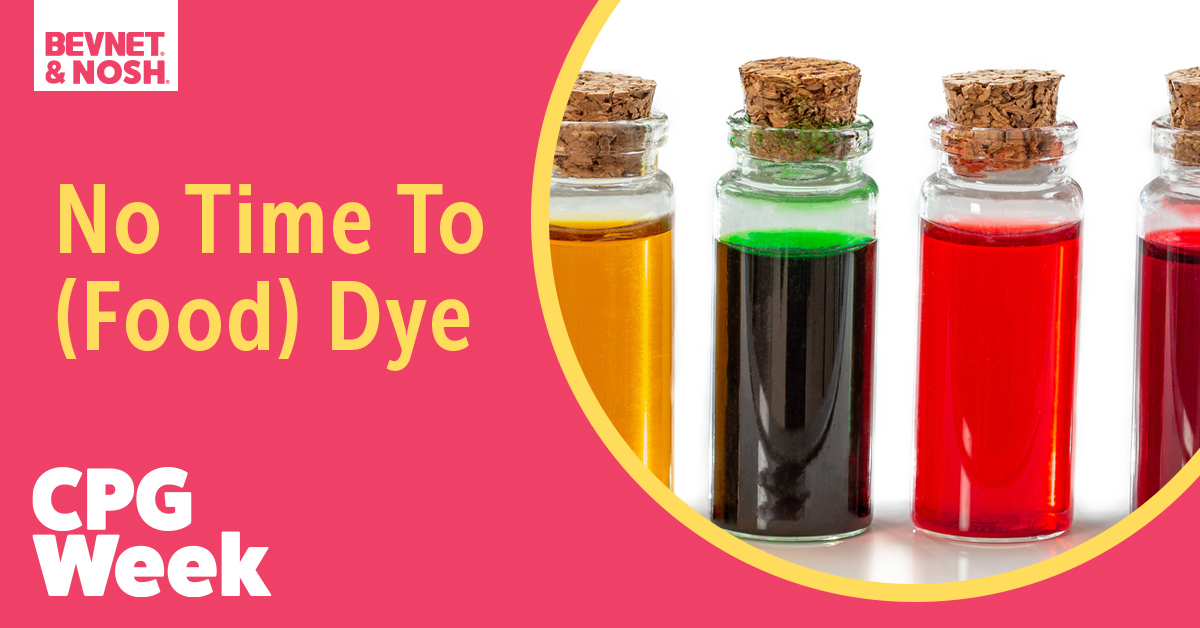
No more blue tongues or Flamin’ Hot Cheetos fingers? On this episode, the CPG Week podcast dives into the recent FDA/HHS directive to remove synthetic food dyes from food and beverages. The podcast team discusses the feasibility of the plan and how it could complicate food manufacturing.
Show Highlights:
0:30 – Monica explains the Food and Drug Administration and Health and Human Services’ new directive for manufacturers to voluntarily phase out the use of eight synthetic food dyes by the end of 2026.
2:30 – The group discusses why the proposed timeline for banning these food dyes might be too aggressive for many larger food companies.
5:30 – Pivoting to natural sources will not only force consumers to adjust to a new visual norm but will require a heavy lift for supply chain sourcing.
9:00 – Even as industry groups debate the feasibility and necessity for the directive, the podcast team talks about how many countries and states have already started the process of phasing out these synthetic dyes in the interest of public health.
About CPG Week
CPG Week is the podcast that explores the latest happenings in the consumer packaged goods industry. Join our seasoned reporting team as they dish out the week’s stories in quick, easy-to-digest episodes. Catch up on the top headlines of the week, dive into exclusive insights with the BevNET and Nosh teams, and set yourself up to make more informed business decisions. Tune in to stay up-to-date on the latest developments in the dynamic world of packaged food and beverage.
New episodes are released every week. Send us comments and suggestions anytime to cpgweek@nosh.com.
Show Highlights:
The CPG Week podcast dives into the recent FDA/HHS directive to remove synthetic food dyes from food and beverages, discussing the feasibility of the plan and how it will complicate food manufacturing.
Episode Transcript
Note: Transcripts are automatically generated and may contain inaccuracies and spelling errors.
[00:00:05] Monica Watrous: Welcome to the CPG Week podcast by BevNET and Nosh, your source for the latest food and beverage industry news. I'm Monica Watrous, Managing Editor of Nosh, here with my co-hosts, Brad Avery and Lukas Southard. If you're enjoying the show, please subscribe on your listening platform of choice. On the podcast today, we are discussing the federal government's efforts to phase out synthetic food dyes. So last week, top officials of the Food and Drug Administration and Health and Human Services announced a new directive to phase out eight synthetic food dyes by 2026. As a reminder, that's just next year. First up, the administration is targeting two little used colorants. Those are Citrus Red No. 2 and Orange B, and they are looking at phasing those out within the coming months. Now, these are colorants that are used to make orange skins look oranger.
[00:00:59] Brad Avery: Yeah, Citrus Red No. 2 is only approved for use in oranges, while Orange B is approved only for use in hot dog and sausage casings.
[00:01:09] Monica Watrous: Right, and from what I've read, these have not been used very commonly at all in the food system. But next up, the HHS is looking at green number 3, red number 40, yellow number 5 and 6, blue number 1 and blue number 2.
[00:01:23] Brad Avery: Some Dr. Seuss rhyme. One fish, red fish, blue fish. Thing 1, thing 2, mambo number 5.
[00:01:32] Monica Watrous: Mambo number 5.
[00:01:32] Brad Avery: A little bit of Erica by your side, a little bit of red dye on your slice.
[00:01:37] Monica Watrous: You know, a side note, people used to sing that song to me, you know, a little bit of Monica in my life. That was like the first time that my name became something that was like a big part of pop culture. No, that's not true. Friends really did that. And also Monica Lewinsky.
[00:01:49] Brad Avery: You've had a hard life and it was a hard 90s for you.
[00:01:52] Monica Watrous: It really was.
[00:01:53] Brad Avery: Yeah, big 90s for Monica's.
[00:01:56] Monica Watrous: It explains a lot about who I am today. But as we had been talking about previously on this show, red dye number three has been banned by the FDA. And originally, the window for removing that from the food system was between 2027 and 2028. And now the administration is working to move that deadline up also to next year. While all this is happening, HHS is also fast tracking reviews for four new natural color additives. Those are calcium phosphate, galdearia extract blue, gardenia blue, and butterfly pea flower extract.
[00:02:30] Brad Avery: So just to clarify, the government wants to phase these dyes out by the end of 2026. So that is just next year, but it is about 20 months worth of time to phase it out. That's still for a lot of the bigger companies that use these, not a lot of time at all.
[00:02:48] Monica Watrous: Now, and it's worth noting that this is a voluntary ban. So the agency said they are working with the industry to do this on a voluntary basis. But as some industry groups are saying, this is an aggressive timeline. And it's really difficult to make some of these big sweeping changes in such a short period when you consider how disruptive this is to supply chains and manufacturing infrastructure, as well as agricultural resources.
[00:03:17] Brad Avery: Well, it's certainly going to be a problem when you factor in tariffs as well and the very uncertain supply chain environment. I think everybody is just looking for a little bit of consistency and certainty, and we're not getting that. And so you have one arm of the new presidential administration saying, OK, all these tariffs are going up and your supply chain is going to be thrown up in the air because of that. And then you have another side saying, OK, but also you need to now find different ingredients for your products as well, because these are going to be banned or it's a voluntary ban and you need to get rid of them within 20 months. It's definitely a big scramble. And I think the shortened timeline shows the speed and aggression with which the administration wants to see these changes enacted. And it's definitely forcing everyone's hand to run around like a chicken with his head cut off when it comes to just managing your supply chain.
[00:04:08] Lukas Southard: Not to belabor the point, but the biggest question is, will this actually be feasible with the structure of food production that most major food makers operate in? I mean, with the ban of Red Diet No. 3, there was over 5,000 food products that would be impacted. Red Diet No. 40 is used in over 36,000 food products. So you're just talking about purely from a scale perspective, it's huge. And as you were saying, we're talking about supply chains as well. This isn't just about formulation, but this is also talking about finding those natural alternatives to make a vibrant cherry rouge for your breakfast cereals or hot dog casings. There's also, you know, the impact of remaking your packaging And in some instances, getting approvals for oversight. So despite the support of many natural food activists that this is the right move, and I would personally probably agree with a lot of removal of some of these synthetic dyes, it is a heavy lift for a lot of our food system.
[00:05:11] Monica Watrous: Well, not only is the timeline unrealistic, but it's actually going to be really challenging for companies to reformulate and maintain the vibrancy and visual appeal of these foods. If you remember, in 2016, when General Mills reformulated Trix to remove synthetic dyes, they used things like radishes and turmeric to color the cereal. And consumers complained. They thought it looked depressing, it was dull, and sales declined. Within a year, General Mills switched back to the original formula. Silly rabbit.
[00:05:40] Lukas Southard: Nobody wants a bowl of depressing Trix cereal. Personally, I like my Trix cereal to bring a smile to my face and just tell me that the world is full of rainbows and rabbits.
[00:05:50] Brad Avery: And maybe a type of thing that it takes time for consumers to get used to that these fake artificial colors probably shouldn't be there for your food in general. I understand the health argument for this and health case. And it is perhaps a thing that if the entire food system starts shifting this way, well, you know, either you have the cereal or you don't. But I think there's going to be questions about what is the supply on ingredients like butterfly pea flower extract? Is there enough available source at the moment for everybody to suddenly get in that's going to need it? And I wonder where that's going to come from and how suddenly shifting an entire food system from one dye to another in less than two years is going to work out.
[00:06:34] Monica Watrous: Well, and also, it's important to note that the ingredients that are being used, these synthetic dyes, while they sound kind of scary, and there have been some research that points to potential harmful effects in children, or maybe not harmful effects, but causes behavioral issues. These ingredients actually are proven safe by peer reviewed objective research. And a lot of the industry maintains that there's really no reason from a safety perspective to remove these ingredients. But PepsiCo recently, just in their earnings call last week, said they've been accelerating the transition to natural ingredients in some of its snack products. By the end of this year, Lay's and Tostitos will both be free of synthetic dyes. And PepsiCo CEO Ramon LaGuardia said that while these products have always been safe, they're anticipating that consumer demand for natural ingredients will increase. I just want to know what they're going to do about Flamin' Hot Cheetos, because that is a very unnatural color that is going to be really hard to replicate without, you know, Red 40.
[00:07:32] Lukas Southard: And it might be good for your fingers, you know, if they go to a less vibrant red, then you won't have your red fingers.
[00:07:38] Monica Watrous: The whole experience of eating Cheetos is the Cheeto dust fingers. That's the best part of Cheetos.
[00:07:43] Brad Avery: I've adapted to the eating Cheetos with chopsticks approach. I like it. Oh, you're fancy. It's useful. I wonder, though, what's going to happen to Blue Tongue? Are we going to still have children in the future who will be able to get one of those horrifying ice cream characters from an ice cream truck and their tongue is just blue for the next two days? What are we going to be depriving our children of if their tongues aren't blue?
[00:08:04] Monica Watrous: Yeah, I feel like the childhood experience is going to look a lot different and be a lot less colorful.
[00:08:11] Brad Avery: But Monica, you raise a good point about the peer review element that a lot of these are proven safe. While there may be some concerns, I do think we have to remember these have been in our system for a long time and whether they need to be immediately removed or not is I think it may be a bit jumping the gun as far as getting everything out immediately. And I will not be shocked if we see a pushback of the deadline, given how massive an ask this really is. I think to someone not in the industry, this is going to sound, you know, oh, well, that's just easy. You just sub out your blue number one for your gardenia blue. But we all know it's not that simple. I will not be shocked if we start seeing a extension being put for when the deadline actually needs to be met.
[00:08:58] Monica Watrous: Well, and again, I'm just going to reiterate that this is voluntary. And that was actually problematic or a point of contention for Center for Science and the Public Interest, which is a big watchdog group for the food industry. They were disappointed by the voluntary nature of the directive. But it's true, Brad. I mean, it's unreasonable to expect that this could happen so quickly if companies do agree to act upon. But the administration's also pointing to formulations that exist in other countries for these same brands. So if you could sell Trix in Europe that doesn't contain Red 40, then why can't you just replicate that for American consumers? And again, there's a lot more complexity to the supply chain and to cost structure that would make that a really difficult transition for the biggest food manufacturers.
[00:09:46] Lukas Southard: As a refresher, I'd like to remind everyone that California kind of made news at the beginning of the year when Governor Gavin Newsom issued an executive order ordering state agencies to provide recommendations on limiting the harm of ultra-processed foods, and included in that executive order was a continuation of basically a ban on a lot of these synthetic food dyes in California schools. So blue number one, blue number two, green number three, red 40, yellow five, yellow six. To carry on with this, West Virginia became the first state to ban the use of synthetic food additives in March. So in their ban, it was seven artificial dyes and two preservatives. Pretty much the same list of those synthetic dyes that were a ban in California schools. So what's happening at the FDA is kind of a broader look of what's happening in a state-by-state approach. And it's somewhat codifying, albeit in a voluntary manner, this patchwork of regulations that states are taking to try to phase out synthetic food dyes from the food
[00:10:56] Brad Avery: And we see it in other places as well. From the regulatory standpoint, we've seen the rise of sugar taxes again coming back, or even some states, including Arkansas, to remove sugary soft drinks and snacks from SNAP eligibility. It's all part of this broader MAHA movement. RFK Jr. has ushered in, where the goal is really to get rid of unnatural artificial ingredients and sugars and other unhealthy additives for food and drink. So we're talking about dyes today, but it's all part of this broader landscape, as you alluded to, Lucas, of different changes that are coming very quickly.
[00:11:37] Monica Watrous: Of course, we'll continue to cover all of these developments on BevNET and Nosh. And here are some other notable bits of news from the week. A peek into PepsiCo's latest quarterly results, inside Chobani's plans for a new $1.2 billion facility, and why RFK Jr. is seeking to overhaul the FDA GRAS process. For these stories and more, become an insider at BevNET and Nosh. That wraps up this edition of CPG Week by BevNET and Nosh. Thank you to our audio engineer, Joshua Pratt, our director is Mike Schneider, and our designer is Aaron Willette. If you enjoyed the podcast, please subscribe on your listening platform of choice, and we will see you next time.
About CPG Week
CPG Week is the podcast that explores the latest happenings in the consumer packaged goods industry. Join our seasoned reporting team as they dish out the week’s stories in quick, easy-to-digest episodes. Catch up on the top headlines of the week, dive into exclusive insights with the BevNET and Nosh teams, and set yourself up to make more informed business decisions. Tune in to stay up-to-date on the latest developments in the dynamic world of packaged food and beverage.
New episodes are released every week. Send us comments and suggestions anytime to cpgweek@nosh.com.
Stay Informed, Stay Competitive
Unlock the articles, expert interviews, and data reports that power the food and beverage industry. Join our community and stay ahead with exclusive insights from BevNET and Nosh.