CPG Week: Coke and Pepsi’s MAHA Makeovers? Plus, The Brand That Bested Better Bagel
Episode 132
In this episode:

In this episode:
On the CPG Week podcast, Nosh managing editor Monica Watrous and senior reporter Brad Avery discuss the acquisitions of Tia Lupita and Health-Ade Kombucha, new directions for the biggest beverage makers, and how Hero saved the day when Whole Foods ended its supply agreement with BetterBrand.
Show Highlights:
0:15 – Mexican food brand Tia Lupita has been acquired by Vilore Foods, distributor of Jumex beverages and other Hispanic brands. Monica unpacks terms of the transaction.
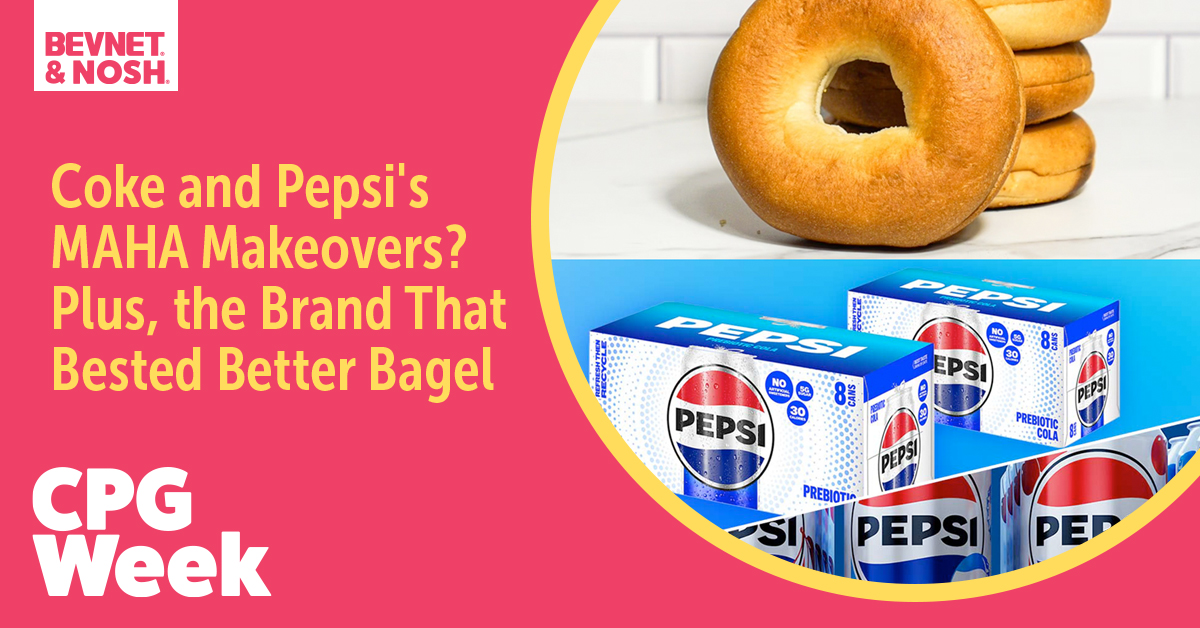
1:30 – Coca-Cola is launching a line extension of its namesake soft drinks with cane sugar, and Pepsi announced plans to debut a prebiotic cola. Brad explains what these innovations mean for the market.
4:15 – Following the meltdown of low-carb bagel maker BetterBrand, Hero rose to the occasion, filling shelves with its take on the breakfast staple. Monica shares more details on how a competitor’s collapse benefited the better-for-you baker.
7:10 – Health-Ade Kombucha has sold to Generous Brands. Brad spills the tea on the deal.
8:30 – Forget battery-flavored chips and “Spaghett-cicles.” Liquid Death is entering the energy drink segment – with what it claims is a “sane” level of caffeine.
About CPG Week
CPG Week is the podcast that explores the latest happenings in the consumer packaged goods industry. Join our seasoned reporting team as they dish out the week’s stories in quick, easy-to-digest episodes. Catch up on the top headlines of the week, dive into exclusive insights with the BevNET and Nosh teams, and set yourself up to make more informed business decisions. Tune in to stay up-to-date on the latest developments in the dynamic world of packaged food and beverage.
New episodes are released every week. Send us comments and suggestions anytime to cpgweek@nosh.com.
Show Highlights:
On the CPG Week podcast, Nosh managing editor Monica Watrous and senior reporter Brad Avery discuss the acquisitions of Tia Lupita and Health-Ade Kombucha, new directions for the biggest beverage makers, and how Hero saved the day when Whole Foods ended its supply agreement with BetterBrand.
Episode Transcript
Note: Transcripts are automatically generated and may contain inaccuracies and spelling errors.
[00:00:05] Monica Watrous: Welcome to the CPG Week podcast by BevNET and Nosh. I'm Monica Watrous, here with my co-host Brad Avery. Now, here is the latest in food and beverage industry news. Mexican food brand Tia Lupita announced on Monday that it had been acquired by Velore Foods, the San Antonio, Texas-based distributor and commercial subsidiary of heritage food brands, including La Costena, Jumex, and Totis. Founder Hector Saldivar and the rest of the Tia Lupita team will stay on board to continue leading the brand per terms of the deal. The transaction will expand market access for Tia Lupita products, which include grain-free cactus tortilla chips, hot sauce, and Mexican chili crunch. further across the U.S. and bring the brand into the Mexican market. For Velouré, which operates a variety of packaged food brands, including Jumex and Kern's juice-based beverages, Pronto's sweetened condensed milks, Milk Modifier ChocoMilk, as well as a gelatin and flan mix brand, the addition of Tia Lupita marks its official entry into the natural food space. Consumer demand is growing for healthier alternatives in the Hispanic food category, as underscored by several notable transactions in recent years, including PepsiCo's purchase of Mexican-American brand Siete Foods for $1.2 billion.
[00:01:29] Brad Avery: Well, President Trump's Coke claims may be coming true. The Coca-Cola company announced on Tuesday that it will be launching a line of branded Coke products this year featuring real cane sugar. CEO James Quincy confirmed the plans during the company's Q2 earnings call, clarifying that the new launch will be an additional product line complementing the existing high-fructose corn syrup version that they make in the US, rather than a replacement. Of course, Americans can already find a cane sugar version of Coca-Cola in the form of Mexican Coke, as it is called, the imported version of the product that's typically found in a glass bottle. Albeit, distribution of that product tends to be a lot more limited and niche than its corn syrup counterpart. Meanwhile, Pepsi is also making a more Maja-friendly product with Pepsi Prebiotic Cola. This comes after they bought Poppy earlier this year, and the company appears to be applying that better-for-you soda ethos to its flagship cola. This launch likewise uses real cane sugar in a smaller dose and will be coming out in the fall. It's curious to see both of these companies in the same week making similar product announcements. If you recall that last week Donald Trump tweeted that he had spoken with Coca-Cola and that they had agreed to begin using real cane sugar in their product. He made it sound like they were going to be replacing the corn syrup. But the company quickly issued a statement that didn't really confirm or deny just that they had new innovations coming on the horizon. Whether this is a direct response to that or something they already had in the works, we don't know. But certainly there is a version of Coke now coming to the U.S. market with real cane sugar by the end of the year.
[00:03:17] Monica Watrous: And that makes sense that it's a complementary product versus a reformulation across the portfolio, because the truth is the U.S. doesn't make enough sugar and high fructose corn syrup is a much more accessible and affordable sweetener.
[00:03:31] Brad Avery: If this does well, Coke could certainly make the transition if it does end up outselling regular Coca-Cola. But we'll need to see. They have a history of launching these types of products and quickly pulling them. If you'll remember Coca-Cola Life, which was a CVS Sweden version that came out something like 10 years ago now or in that range, and that didn't take off. This is real cane sugar and there's already an audience for it. So we know that people like it. Just will they buy it once they have it in front of them?
[00:04:05] Monica Watrous: I'll be curious to see what kind of premium these products command because again, these are more expensive ingredients and there's a limited supply. When one freezer door closes, another opens. The meltdown of Beeliegerd Bagelslinger, Better Brand, provided an opportunity for Hero Labs to replace its reduced carb rival on shelves nationwide at Whole Foods Market this past spring. Hero's take on the beloved breakfast staple is baked with resistant wheat starch, wheat protein, fava bean protein, Jerusalem artichoke fiber, olive oil, and yeast. Just a few months since its debut, the item has quickly become a top seller for the brand, which also produces high-protein, high-fiber white bread, seeded bread, tortillas, burger buns, and hot dog buns that it sells online and in thousands of retailers nationwide. This week also marked the brand's entry into the shelf-stable pasta category with the launch of a low-carb penne that will be available online exclusively this summer with potential for retail expansion next year. Now when I spoke with CEO of Hero Y.C. Chang he was telling me that the team identified a gap in the market for high protein pasta, which I thought was an interesting assessment since it seems like there's so much activity in this space. But when you look at the basis for some of these noodle products, you're seeing things like legumes and alternative grains.
[00:05:34] Brad Avery: I'm curious about the protein pasta trend in general because it feeds right into the larger macro protein boom that we've experienced and whether or not consumers are clamoring in this level for the protein. boost that they're getting. You know, I think there's certainly this drive at the moment for people who are health conscious to get as much protein in their diet as possible. But I wonder if there's, you know, an overdrive in this category and whether something like protein pasta is exemplifying that, if it's the right category for it, or whether this is something that is better served in other spaces. Do you have a sense for this, Monica?
[00:06:14] Monica Watrous: Yeah, it's a good question. And a lot of the activity that we're seeing currently in terms of the proteinification of packaged food is coming from traditionally higher carb categories. So in addition to pasta, we're also seeing higher protein bread and high protein ice cream is another trend that we're following right now. So there's a lot of competition in these categories and it'll be interesting to see what how it shakes out and who emerges as the category leaders. But as long as these products taste on parity with traditional wheat based pasta, as long as they are available at accessible price points and are as convenient to prepare and have the same texture, because a lot of people have a expectation that it's going to be al dente or chewy. then there's no reason why this segment of the marketplace can't succeed.
[00:07:10] Brad Avery: Well, this week also brought one more big acquisition to the table. Health-Ade Kombucha sold. Generous Brands, the portfolio company behind Bold House Farms and Evolution Fresh, is acquiring HealthAid in a deal that was reported by The Wall Street Journal to be valued as high as $500 million. Founded in 2012, HealthAid is the number two kombucha brand in the U.S. after GT's Living Foods and has retail dollar sales as high as $250 million a year. The acquisition is also the largest to date for a kombucha brand after spending the better part of its life building this category and helping establish it from the ground up alongside brands like GT's, Brew Doctor, Hum and others.
[00:07:49] Monica Watrous: Speaking of categories that have a lot of competition, it seems like kombucha had a big boom within the last decade. And it's surprising to see that this trend is still hanging on as tightly as it is with prebiotic soda capturing more mainstream consumer attention.
[00:08:08] Brad Avery: Well, and HealthAid also has its own prebiotic soda, SunSip, that it launched. Now, I think the point about kombucha giving way to prebiotic soda is a good point. Kombucha's held on, but I do think the category overall has struggled to maintain the level of growth that it had achieved.
[00:08:27] Monica Watrous: On a lighter note. Did you ever lick batteries as a kid? No. No? No, never did that. Maybe it's a Denmark thing? Danish corn chip brand Rewind is bringing back the nostalgia of licking a 9-volt with its new battery flavored chips. I don't really know what battery is supposed to taste like.
[00:08:49] Brad Avery: You're the one that's licked them. I haven't licked a battery.
[00:08:52] Monica Watrous: I don't know that there's a flavor as much as a sensation. And the sensation is like a little like jolt to your tongue.
[00:08:57] Brad Avery: Well, speaking of weird products, Miller High Life, the champagne of beers, has teamed up with Tipsy Scoop for a limited edition Spaghet-sicle. Mimicking what the cool kids are all into these days, the Spaghet-sicle recreates the flavors of a spaghet, which is a cocktail of High Life, Aperol, and lime juice. See, it's important to finish the sentence because I'm sure you all thought, as did I, that it was spaghetti. I know, it's the classic drink that all the kids are into these days. Nah, I mean the kids are into spaghetti. That's my sense of it all. But I definitely had a vision of just a frozen spaghetti and meatball pop that was gonna be horrific. I think this sounds much better.
[00:09:38] Monica Watrous: Not a weird product, but an interesting expansion. Liquid Death is getting into the energy drink category.
[00:09:44] Brad Avery: Yes. So the Wall Street Journal reported that Liquid Death in January 2026 will be launching Sparkling Energy, coming in their flagship cans with 100 milligrams of caffeine from green coffee and added L-theanine and vitamins. This is a better for you energy drink with a, quote, sane level of caffeine from a brand with the most insane branding. Now, I think this is really fascinating because I remember when they first launched just had still water before even sparkling. They talked a lot about how, one, that was the joke. It was a big bombastic name for something as mundane as water. But two, if it was an energy drink, which a lot of people kind of assumed it would be, then there was a risk factor there. I mean, look at what happened with Panera and the charged lemonade. If someone were to actually die from drinking 12 cans in one sitting, that would not be funny anymore. The joke would certainly lose its luster fast, and so they always avoided that. So not saying that's going to happen here, but it's an interesting direction of the brand continuing to grow that they finally have decided to embrace the energy category and put this branding into something that I think people always sort of associated it with.
[00:11:02] Monica Watrous: Well, this certainly isn't the first time we've seen a category expansion by Liquid Death, and it certainly makes sense as there's so much investment and money flowing to this category.
[00:11:13] Brad Avery: Well, I'm glad to see them embracing sanity finally.
[00:11:16] Monica Watrous: It's about time. Yeah, please. Here are some other notable bits of news from the week. After pulling off its first activation at the X Games last month, Zero Sugar Soda No Cap is putting more fuel in the tank for the second half of the year with $3 million in new investment to support supply chain optimization and marketing support. Filipino food brand Phila Manila is working to scale its growing e-commerce presence via a slate of AI applications across all areas of the business after receiving a $25,000 grant from tech company Lenovo's Evolve Small program. And finally, Awake Chocolate has raised 8 million Canadian dollars in a funding round led by Be Tomorrow Ventures, the corporate venturing arm of British American Tobacco. For these stories and more, become an insider at BevNET and Nosh. And if you're enjoying the show, please subscribe on your listening platform of choice. That wraps up this edition of CPG Week by BevNET and Nosh. Thank you to our audio engineer, Joshua Pratt, our director is Mike Schneider, and our designer is Aaron Willette. If you enjoyed the podcast, please subscribe on your listening platform of choice, and we will see you next time.
About CPG Week
CPG Week is the podcast that explores the latest happenings in the consumer packaged goods industry. Join our seasoned reporting team as they dish out the week’s stories in quick, easy-to-digest episodes. Catch up on the top headlines of the week, dive into exclusive insights with the BevNET and Nosh teams, and set yourself up to make more informed business decisions. Tune in to stay up-to-date on the latest developments in the dynamic world of packaged food and beverage.
New episodes are released every week. Send us comments and suggestions anytime to cpgweek@nosh.com.
Stay Informed, Stay Competitive
Unlock the articles, expert interviews, and data reports that power the food and beverage industry. Join our community and stay ahead with exclusive insights from BevNET and Nosh.