DoD Awards The EVERY Company $2M From $60M Pool

The EVERY Company has combatted a tough investment terrain to become the latest food tech outfit to lock in funds, totaling $2 million, from the U.S. Department of Defense, according to an announcement this week.
The cash was deployed from the DoD’s Distributed Bioindustrial Manufacturing Program (DBIMP) which was established by White House’s Executive Order 14081 to bolster the U.S.’s bioeconomic strengths and maintain the country’s “supply chain and military superiority,” according to the DoD. This latest cohort marks the last round of grants; the program has allocated over $60 million in awards to 34 companies since July.
San Francisco-based EVERY will use the new capital to begin testing the feasibility of U.S.-based manufacturing, a shift from the decade-old company’s Europe- and Asia-based production up until now.
“This award further reinforces EVERY’s leadership in the ecosystem,” Madeleine Bienvenu, chief of staff at EVERY, told Nosh. “Obtaining U.S. manufacturing would allow us to service the large multinational customers we have been working with and be one of the first companies in the space to truly enter the mass market with our highly functional ingredients.”
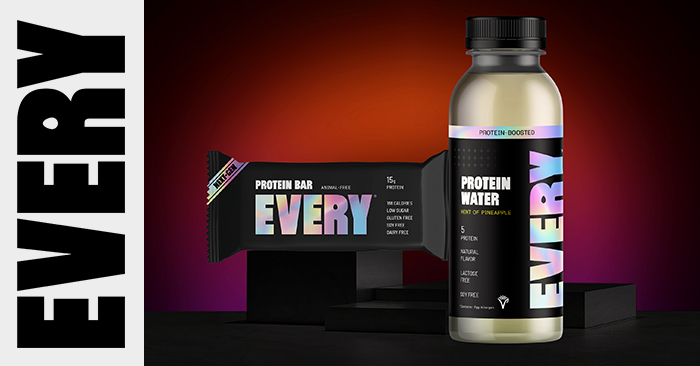
EVERY will also put the cash toward the development of military use-cases for its novel proteins. Currently, EVERY produces two proteins: OvoBoost, a soluble protein, and OvoPro, an ovalbumin ingredient designed to be an egg or egg white replacement; the latter secured a foundation patent in the past month that covers its use in a broad range of applications.
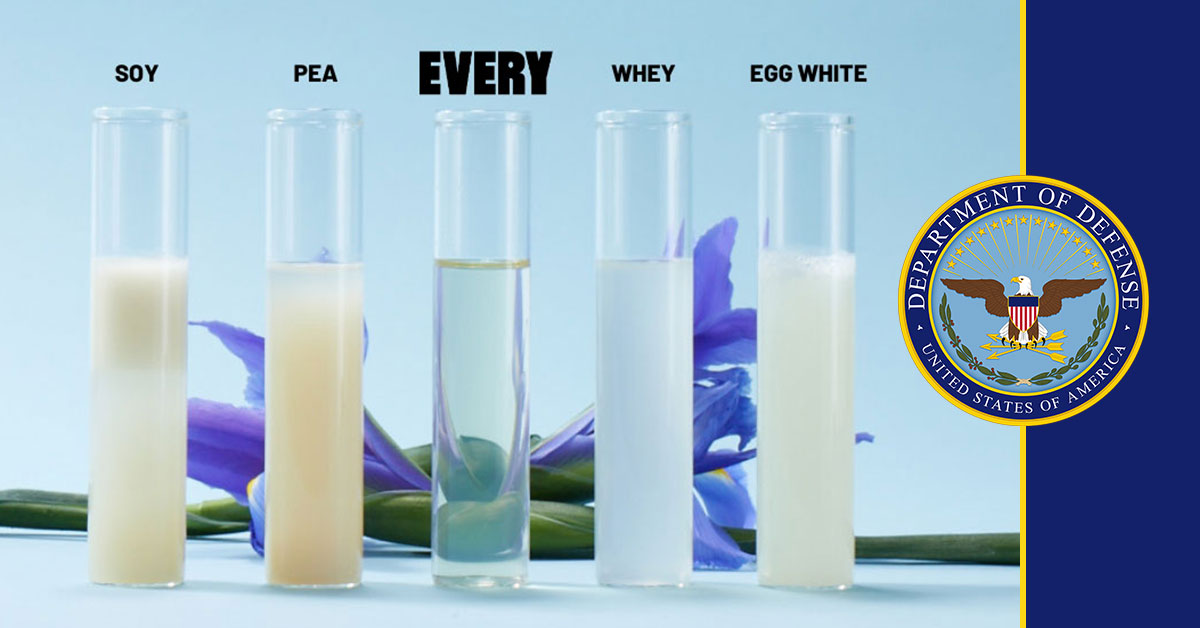
“Our technology allows us to bring novel applications to market using our soluble protein. Imagine a glass of water that looks and tastes like water, but contains 20 grams of protein. That’s what our protein can do,” said EVERY co-founder and CEO Arturo Elizondo, in a press release.
The highly soluble, clear, flavorless OvoBoost will take the lead in EVERY’s military efforts and goals to take on the mass market. Since securing FDA approval for OvoBoost in 2021, EVERY has begun applying for approvals in various other markets so that it can continue expanding its applications across food and beverage formats.
“EVERY is laser focused on preparing to enter the mass market,” Bienvenu told Nosh. “This award is directly in line with our operational priorities as we seek additional industrial-scale manufacturing capacity to supply some of the largest food companies in the world with our functional ingredients, whose demand far outstrips our current production capacity.”
According to EVERY, it has managed to consistently produce at industrial scale (more than 100,000 liters), but this deal will help it expand production capacity to meet both mass market and military demands. OvoBoost has already made its way into various products including items from Unilever-owned Vegetarian Butcher. EVERY currently has “several dozen” of active partnerships, Bienvenu emphasized, including with AB InBev and a distribution deal with Ingredion.
But the cash is also a grant of faith for the food tech sector, which has seen other CPG-focused entities struggle to find their footing and generate consumer appeal for precision-fermented, animal-free products. Of the 34 awards allocated, 10 of the recipients are developing food products or ingredients for use in food and beverage products.
Recipients include fungi-based protein producer The Fynder Group ($1.38 million), mycoprotein ingredient maker The Better Meat Company ($1.48 million), precision fermentation whey protein company Perfect Day ($1.24 million), ovalbumin producer Onego ($2 million), carbon dioxide-based flour maker Air Protein ($1.7 million), alternative palm oil producer C16 Biosciences ($1.45 million) and high-performance oil outfit Biosphere ($1.5 million), among others.
“The next industrial revolution will be a biomanufacturing revolution. DoD is keenly aware of that reality,” said Heidi Shyu, under secretary of defense for research and engineering, in a release. “DBIMP’s investment in a diverse set of companies will help transition U.S. bioindustrial manufacturing from the laboratory to a network of large-scale production facilities, able to fortify defense supply chains for critical chemicals and novel materials while positioning the U.S. bioeconomy for surging growth.”