CPG Week: WTF? N.A. Retailer Goes M.I.A.
Episode 68
In this episode:
In this episode:
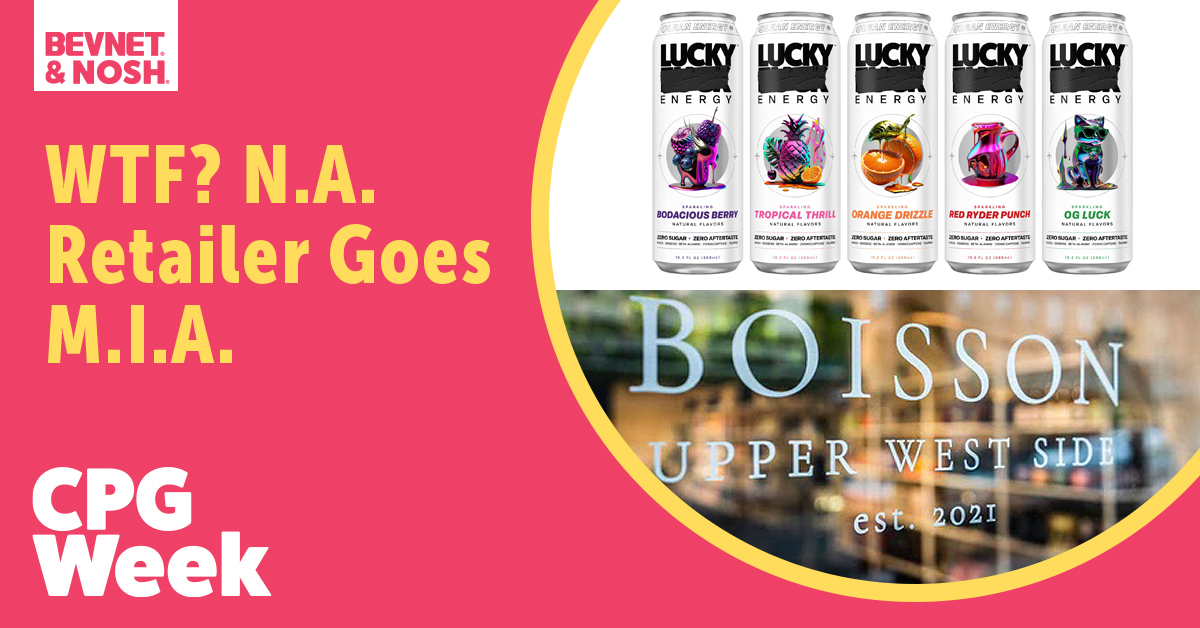
The Nosh and BevNET team bring on spirits editor Ferron Salniker to dive into why the adult non-alcoholic beverage category might be facing struggles as news broke that Boisson, one of the largest independent retailers of NA beverages, is closing its brick-and-mortar stores. The team talks about what this says about the category as a whole and what might come next as non-alc brands move into larger retail distribution.
Later, Nosh managing editor Monica Watrous and senior reporters Lukas Southard and Brad Avery discuss provocative branding in energy drinks and how finding a lane in the competitive category is forcing at least one player to rebrand itself.
Show Highlights:
2:00 – BevNET spirits editor Ferron Salniker joins the podcast to explain all that we know about the recent news that non-alcoholic adult beverage retailer Boisson has suddenly shuttered all its stores.
4:15 – The team discusses how the news reframes the non-alc category as the trend moves from niche to being carried among larger distributors and retail chains.
7:20 – Where does this leave the non-alc category and what does this foretell for the industry if one of its earliest adopters and largest independent retailers is having trouble? Ferron gives some insight into how the Boisson news is representative of how the category is growing as a whole.
11:15 – Lukas explains why Lucky F*ck Energy rebranding as just Lucky Energy is unsurprising but also speaks to how the attention economy and brands like Liquid Death have influenced other brands to increasingly push the envelope with edgy marketing campaigns.
About the CPG Week
CPG Week is the podcast that explores the latest happenings in the consumer packaged goods industry. Join our seasoned reporting team as they dish out the week’s stories in quick, easy-to-digest episodes. Catch up on the top headlines of the week, dive into exclusive insights with the BevNET and Nosh teams, and set yourself up to make more informed business decisions. Tune in to stay up-to-date on the latest developments in the dynamic world of packaged food and beverage.
New episodes are released every week. Send us comments and suggestions anytime to podcast@nosh.com.
Show Highlights:
The CPG Week team brings on BevNET spirits editor Ferron Salniker to talk about the rumors circulating around adult non-alcoholic beverage retailer Boisson and the group discusses how far is too far with edgy branding in the beverage industry.
Episode Transcript
Note: Transcripts are automatically generated and may contain inaccuracies and spelling errors.
[00:00:05] Monica Watrous: Welcome to the CPG Week podcast by BevNET and Nosh, your source for the latest food and beverage industry news. I'm Monica Watrous, Managing Editor of Nosh, here with my co-hosts, Brad Avery and Lukas Southard. If you're enjoying the show, please subscribe on your listening platform of choice. On the podcast today, we're discussing the buzz on booze-free beverages with special guest Ferron Salniker, Spirits Editor at BevNET. Plus, WTF is up with Lucky Energy's rebrand. But first, hey Brad, Lucas, do you play any musical instruments?
[00:00:40] Brad Avery: I do. I play guitar. I took vocal lessons when I was in high school.
[00:00:45] Monica Watrous: Lucas, what about you?
[00:00:46] Lukas Southard: Yeah, I am not that accomplished. I am a lover of music, but I am not musically inclined. I was a clarinet player in middle school, and that ended quickly. So no instruments for me.
[00:00:59] Monica Watrous: Well, I was going to say, if you do play musical instruments, which Brad has got us covered there, you can enter the Bush Beans Musical Fruit Contest. The canned bean brand will award $10,000 in cash and a lifetime supply of beans, plus a trip to Nashville. To the songwriter with the best update on that classic playground ditty, you know it. Beans, beans, the musical fruit, the more you eat, the more.
[00:01:23] Brad Avery: It has to be a riff on the Diddy. You can't just write an original ode to beans.
[00:01:28] Monica Watrous: You can, actually.
[00:01:29] Brad Avery: Oh, you're allowed to. I could write a seven-minute progressive rock odyssey about Bush's beans.
[00:01:37] Lukas Southard: The wheels are turning in Brad's mind right now. I can watch them just like he's like, yes, I can put that in the E scale.
[00:01:45] Monica Watrous: Yeah, I think you should do it. You have until April 18th, and we'll play the song on the podcast next week.
[00:01:52] Brad Avery: Oh boy, challenge accepted. Yeah, you're on the record now.
[00:01:56] Monica Watrous: Ferron, I'd like to bring you into the conversation. We appreciate you joining us for CPG Week. And we're talking about Boisson, the non-alcoholic beverage retailer, and some of the rumors circulating around that that popped up last week. Can you tell us what happened?
[00:02:13] Ferron Salniker: Sure. Hi. I'm happy to be here. So, on Friday of last week, news broke via an employee or a former employee who said in a private chat with someone that employees had been laid off and that stores were closing. And that was shared on social media. And so far, we don't know that much else. We haven't heard anything officially from Wasan. So what I know is basically through non-ALC brand founders that have kind of been scrambling to understand what's happening with this retail partner that's been really important to them. So we know that in one NA brand founders kind of quest to understand what's going on, she did hear from a Busan employee that the retail stores are closing or are closed and that there's some restructuring going on. Again, this is like not an official communication. It's just what she heard through an employee. Stores are listed as temporarily closed on Google. They had eight stores in New York, L.A., in Miami and they're all listed as closed on Google and they did have a big sale this weekend with sales marked as final. So that all kind of checks out that same brand founder. A member of her team did go to a store in L.A. and found it empty and closed. So We know that, at least for now, the retail stores are closed. I did speak to another NA brand founder who is owed money and is unaware of what's happening with that and with her inventory, but again, has heard nothing official from the company. And that seems the case with most of the brands that I've talked to, not necessarily being owed money, but just kind of in the dark. And that's what we know right now.
[00:04:13] Monica Watrous: Interesting. And how important is this channel for NA brands?
[00:04:19] Ferron Salniker: It's been really important for them. I mean, it was a pioneer in that sense. They started in 2021 and a lot of these brands kind of launched with them. That was the years in the pandemic were really when we started to see all these brands come to market. And so for many of them, this was a really just great platform to raise awareness. And for one of these brands that I spoke to, it was their biggest account. And so it's important in terms of what they've done for the industry, but also, you know, it's been a good sales channel for a lot of these brands.
[00:04:59] Lukas Southard: Ferron, it does seem like there's an element to this rumor that Bosson is planning for future as more of like a importer or distributor that specializes in NA products. And I know that a lot of the kind of boutique NA retailers have kind of moved into launching their own. labels of wine and products. Is it like a better long-term business strategy to be in like a distributor role as opposed to operating brick-and-mortar stores? Is that kind of the play here as you see?
[00:05:32] Ferron Salniker: I think you're right in the sense that we did see Wausan announce earlier this year that they were moving into this kind of wholesale distributor model, but also keeping their retail stores in e-commerce, according to them. But I think if we're talking about retail or if we're talking about distribution, maybe even importing, I do think the larger question is, as non-ALC goes mainstream, is there a need for these niche non-ALC kind of spaces, whether it be distribution or retail. With like a retail space, as these products get picked up in grocery and liquor stores, and are even available in places where their foolproof counterparts can't be, like yeah, how can a non-ALC retailer really compete? You know, liquor stores have, they sell high volume, they sell like, $150 fancy tequila products. I don't know, but I don't think Boisson can sell things like that. So yeah, moving into distribution makes sense. However, then you're competing with the larger distributors. So at Discus Conference and at Wine and Spirits Wholesalers of America Conference this year, there was big discussion from these event strategics, but also distributors about how non-ALC is becoming a big part of the conversation. So these businesses are getting in on non-ALC too. And so I think it is a good play for these non-ALC retailers to move into other aspects of the business. But again, they're then still competing with larger companies.
[00:07:18] Brad Avery: I think what's interesting is that there does seem to be demand for this category, though, because this week, Sashay, another non-alcoholic beverage retailer, announced that it is extending its partnership with Target to place end caps and other sets of these adult NA brands in Target stores across the country. So they originally announced that deal back in January, just in time for dry January, and they featured a set with brands like De Soi and Nope. And now it seems that it's working for them because Target is interested in keeping it going.
[00:07:54] Lukas Southard: There are struggles with being a boutique NA retailer, but there are some boutique bottle shops that are showing growth despite all the competition that's come into the market from big mainstream retailers like Target or CVS. So New Bar, a Los Angeles based NA bottle shop, they opened a second location very recently in Los Angeles. And for the second year in a row, they're also partnering with Coachella and Stagecoach Music Festivals to be the official non-ELK retail partner. So there is something to be said that there's enough demand for this that the small players can still operate in this space. I think it just really comes down to positioning. And, you know, Emily Heinz, the founder of Sashay, told me, a while ago that she likes to think of Sashay more as like a lifestyle brand and that's leaning into like alcohol flexibility as opposed to just being considered a non-alcoholic retailer.
[00:08:56] Brad Avery: Right and they have some branded products of their own that they've been putting out there which differentiates them a bit from the model that Bosson is doing.
[00:09:06] Monica Watrous: Ferron, you've been tracking this space for a while. Can you give us a sense of how mainstream this trend actually is? We see a number of players entering the space. We see retailers like Sprouts and Target creating end caps and large assortments and sets for NA brands. But beyond dry January and sober October, how many consumers are actually partaking in this trend?
[00:09:30] Ferron Salniker: So non-ALK is a fast-growing category, but it's still very small. It's 0.06% of total It hit 510 million last year. And if you look at wine, beer, and spirits that are non-ALK, it's still 1%, less than 1% of those categories. So it is a fast-growing category that's getting a lot of headlines. Dry January, Sober October is helping with that. But overall, it's still a very small category.
[00:10:06] Monica Watrous: Ferron, from your perspective, are there any clear winners in this space as far as brands or segments of the NA market?
[00:10:14] Ferron Salniker: Certainly Near Beer is the most successful of these segments so far. When it comes to Wine & Spirits, I don't think we've really seen big contender in terms of brands, that space is still figuring itself out. If we think about the back bar, I'm not sure how much room there is for multiple non-outs. direct spirit replacements, like how many non-alc whiskeys do we need? I think so far we've seen Ritual Zero Proof do a great job at kind of being that well, but otherwise it's very early to be figuring out what the non-alc back bar is looking like.
[00:10:55] Monica Watrous: Sure, makes sense. It's kind of like Oatly at cafes, right?
[00:11:00] Ferron Salniker: Yeah, we don't get offered three different oat milks, basically.
[00:11:05] Monica Watrous: Exactly. Great. Well, Ferron, thank you so much for being with us today and filling us in on the booze-free market. Thanks for having me. Moving on, Lucas, you wrote about an energy brand rebranding this week. Tell us a little bit about that.
[00:11:24] Lukas Southard: Lucky fuck energy, excuse my language. Everyone has removed the big dirty F bomb from its name and we'll going forward be named lucky energy. So this news dropped the beginning of the week. And it was also paired with the announcement that the brand lucky energy had. Raised a fresh $8 million investment from brand foundry ventures, along with sugar capital and previous investor imaginary ventures who led a $4 million round in November. So despite having to rebrand themselves, uh, less than a year into launching into the market, the, the energy drink has garnered a lot of investment attention, uh, in a short amount of time. So the story I wrote for BevNET was called WTF. Lucky fuck announces, rebrand and new investment. And obviously. Removing an expletive from the front of your can seems like a duh kind of moment for a beverage brand. It's hard to market your product in conventional retailers and grocery stores and C stores when you have the F word prominently displayed more or less on the front of your can. I understand brands are trying to mimic the success Liquid Death has had with edgy marketing, but my question for you all is, is there a limit to how far that kind of approach can go?
[00:12:59] Brad Avery: I think you have the simple problem is that you have, even though it was censored on the can originally with a little asterisk, you still have the F word prominently displayed in stores where kids are gonna go, parents are probably gonna be like, what is this? Why is my kid seeing this? In my mind, liquid death, sure, it was a gamble, but it's not a word you have to censor on a can so that people don't freak out. If you remember back to the original energy drink wave of the early 2000s when Red Bull was first coming out, we saw a lot of these types of brand names. Cocaine Energy is one that always comes to mind. There's some that I won't even say on the air. But what was interesting about Lucky is it took that with more of an aspirational message and it was trying to flip that on its head. But in the end of the day, you still have that issue that it's kind of a provocative name and that is the goal is to be provocative. And at a certain point, it seems like they crossed the line, unfortunately, as far as being able to get into stores and get sales.
[00:14:04] Monica Watrous: My question is, how do you do a Google search on a brand with a name like that?
[00:14:09] Brad Avery: I've done it, and you shouldn't do it.
[00:14:11] Lukas Southard: Well, it's funny you bring that up, Monica. So along with the rebrand, they're leaning into this with a campaign, a video campaign that's going on social platforms. With people basically Googling their old name and the explicit results that come up on Google, it's a clever kind of cheeky ad campaign, but it also kind of strikes to what the brand has struggled with in its first year on the market in that Part of it wants to have this edgy identity. And the other part of the brand is based around Richard Laver's backstory of overcoming hardship, including surviving a plane crash. And they almost want to tug at the emotional heartstrings of people. But at the same time, a lot of their advertising seems to be very liquid deathy.
[00:15:14] Brad Avery: I've talked to Richard and his story is incredible. He, like you said, he survived a plane crash. His father died in that crash. He spent time homeless and then he bounced back. He founded a brand, Kate Farms, and did very well and succeeded. But you're right, there's sort of a draw between, is this an aspirational brand or is this a cheeky, ha-ha brand? And I see that, you know, people... have wide personalities, and in a lot of ways, this is reflective of his personality, having that kind of cheeky ha-ha response to all those personal challenges. But when it comes to branding, you're pulling in two different directions here.
[00:15:52] Monica Watrous: Do you believe this brand will be successful under the name Lucky Energy? Is there anything about the liquid that makes it special and differentiated from any other energy drink on the market?
[00:16:05] Brad Avery: Well, it is a zero-sugar drink with maca, beta-alanine, 200 milligrams of caffeine. But it is going to be hard to compete in a space where there's a lot of other functional, better-for-you energy drinks on the market. And so I think, obviously, they could go forward with flavor. They could go forward with function and push that very hard. It's a question of, are consumers going to pick it up over C4 or Celsius or Monster? That's the kind of evergreen challenge that any energy drink brand is going to face.
[00:16:37] Lukas Southard: Yeah, it's a highly competitive space. And although it continues to grow, it's still really hard to break through because there is just so many different brands out there that are kind of carving out their own lanes. And I think this whole rebrand for Lucky is about trying to, you know, better define what their lane is.
[00:17:00] Brad Avery: What I would say to their advantage, though, is that they are doing this rebrand pretty early. The brand only launched last year, and a wide majority of people have never heard of it. And so there's the ability to start fresh and build the brand from the ground up and people will learn it as lucky energy and it will always be a bit of a joke that what the brand was originally called. So I think they have all this opportunity now to define the brand however they want because most people are still encountering it for the first time.
[00:17:33] Monica Watrous: Here are some other notable bits of news from the week, how Mabel is aiming to ease early stage distribution struggles, to expo or not to expo, brands share why they skipped out on Anaheim this year, and Adult Beverage Alliance forms to advocate for hemp THC regulations in New England. For these stories and more, become an insider on BevNET and Nosh. That wraps up this edition of CPG Week by BevNET and Nosh. Thank you to our audio engineer, Joshua Pratt, our director is Mike Schneider, and our designer is Aaron Willette. If you enjoyed the podcast, please subscribe on your listening platform of choice, and we will see you next time.
About CPG Week
CPG Week is the podcast that explores the latest happenings in the consumer packaged goods industry. Join our seasoned reporting team as they dish out the week’s stories in quick, easy-to-digest episodes. Catch up on the top headlines of the week, dive into exclusive insights with the BevNET and Nosh teams, and set yourself up to make more informed business decisions. Tune in to stay up-to-date on the latest developments in the dynamic world of packaged food and beverage.
New episodes are released every week. Send us comments and suggestions anytime to cpgweek@nosh.com.
Stay Informed, Stay Competitive
Unlock the articles, expert interviews, and data reports that power the food and beverage industry. Join our community and stay ahead with exclusive insights from BevNET and Nosh.