CPG Week: Unpacking ‘Unfrosted’, High Cocoa Prices & Foxtrot Update
Episode 74
In this episode:
In this episode:
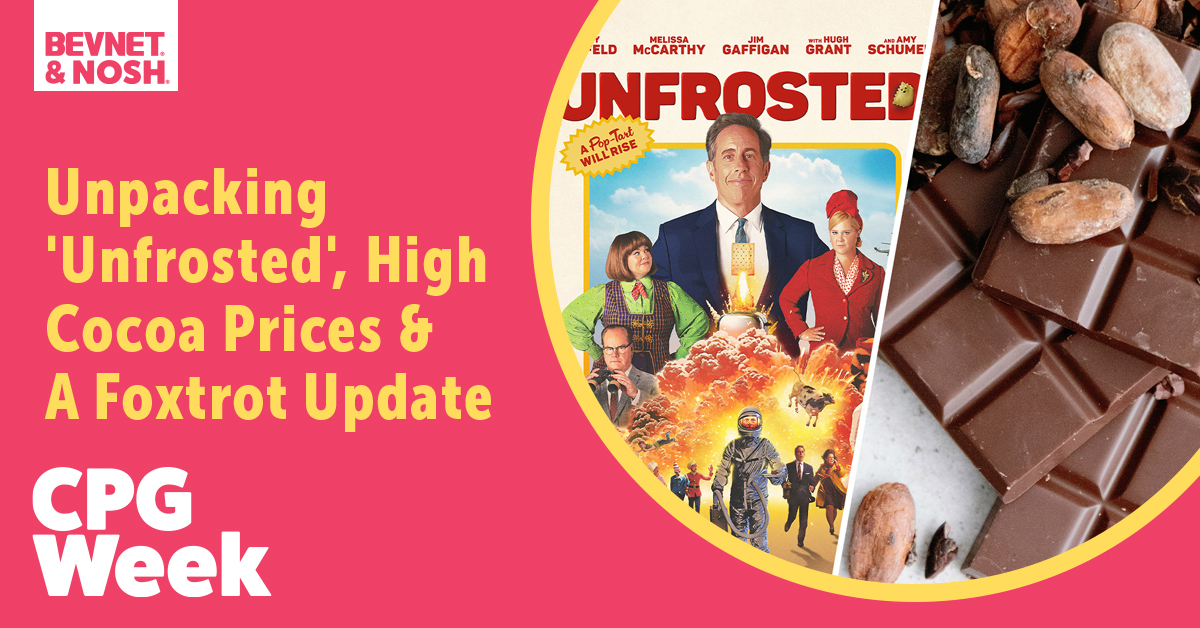
What did the CPG Week team think of Netflix’s “Unfrosted” movie? The group dives into Jerry Seinfeld’s Pop-Tarts biopic and why it is a (partially) accurate portrayal of the R&D process of creating a CPG food product. Nosh managing editor Monica Watrous shares some of the latest snack trends as related to the Sweets & Snacks Expo happening this week. Senior reporter Lukas Southard goes on to unpack the unfolding cocoa pricing crisis and what that means for chocolate producers. Finally, senior reporter Brad Avery talks about the latest update from Foxtrot’s sudden dissolution and what happened at the asset auction.
Show Highlights:
1:30 – Monica takes the temperature of Brad and Lukas’ opinions of Netflix’s “Unfrosted” movie. They discuss their personal takes on the comedy centered on Pop-Tarts and discuss how the CPG industry is interpreting its representation of the R&D process in packaged food.
7:00 – In light of the Sweets & Snacks Expo happening this week, Monica talks about the latest trends in the categories released by the National Confectioners Association in conjunction with the food show.
8:10 – What’s happening with cocoa pricing, and how that might impact chocolate producer margins as waning supply continues to push pricing up? Lukas explains what has happened in the last six months and how food tech innovation might be a growing solution to the problem.
12:05 – Brad updates the team on the latest from the abrupt closure of Foxtrot including what happened at the asset auction for both Foxtrot and Dom’s Kitchen & Market.
About the CPG Week
CPG Week is the podcast that explores the latest happenings in the consumer packaged goods industry. Join our seasoned reporting team as they dish out the week’s stories in quick, easy-to-digest episodes. Catch up on the top headlines of the week, dive into exclusive insights with the BevNET and Nosh teams, and set yourself up to make more informed business decisions. Tune in to stay up-to-date on the latest developments in the dynamic world of packaged food and beverage.
New episodes are released every week. Send us comments and suggestions anytime to podcast@nosh.com.
Show Highlights:
The CPG Week team gives their unadulterated takes on “Unfrosted” before diving into the week’s news related to snack trends, cocoa prices and an update on Foxtrot.
Episode Transcript
Note: Transcripts are automatically generated and may contain inaccuracies and spelling errors.
[00:00:05] Monica Watrous: Welcome to the CPG Week podcast by BevNET and Nosh, your source for the latest food and beverage industry news. I'm Monica Watrous, Managing Editor of Nosh, here with my co-hosts, Brad Avery and Lukas Southard. If you're enjoying the show, please subscribe on your listening platform of choice. And don't forget to register for BevNET Live happening June 12th and 13th in New York City. We're going to be there. We hope to see you there. You can register at BevNetLive.com. On the podcast today, we're discussing pop tarts, snack trends, and cocoa prices. Lucas, we all know you love your cereal, but how do you feel about Pop-Tarts?
[00:00:43] Brad Avery: Not a Pop-Tarts fan. I don't know. There's something about a Pop-Tart that it's not as satisfying as a nice bowl of cereal. I like that cereal has the milk in there. You get some of the... the quenching of your thirst while you eat. You can add fruit to your cereal or as a pop-tart. I get it. It's all-inclusive. It's a handheld breakfast. It's just not my thing.
[00:01:10] Monica Watrous: Okay, those are some strong feelings. Brad, how do you feel about Pop-Tarts?
[00:01:14] Lukas Southard: I had a Pop-Tart recently for the first time in 10 years, and it's pretty good. I think they're tasty. Probably not for breakfast. It's really more of a snack.
[00:01:27] Brad Avery: It's like a dessert now with all the frosting they put on them.
[00:01:31] Monica Watrous: Well, you can also get them unfrosted, which brings us to our first topic of conversation for this episode. Unfrosted, the movie that was directed by Jerry Seinfeld and debuted on Netflix this past week. What do we think, guys?
[00:01:48] Brad Avery: I will say that I enjoyed the movie. I grew up on Seinfeld as a TV show. So I love the TV show and, uh, have enjoyed his standup over the years. I would say unfrosted was a fun watch. I probably won't watch it again. It had some moments in there, but it was, it reminded me of the rather dumb comedies that I grew up with in the nineties. And, and so I enjoyed it for that respect, but. You know, there was a lot of misses in some of the jokes that they put in there.
[00:02:22] Monica Watrous: There were so many stars in that film. We saw a lot of Saturday Night Live alumni, a lot of comedians, and to your point, it was quite Seinfeldian. There were a lot of callbacks to the show. I actually grew up on Seinfeld and Pop-Tarts, and I loved it. I thought it was a fun watch, like you said, and I wasn't expecting a lot of substance, and it didn't deliver a lot of substance, and that's okay.
[00:02:48] Lukas Southard: I think I'm now less likely to buy pop charts, purely out of spite for this movie.
[00:02:55] Monica Watrous: Wow.
[00:02:58] Lukas Southard: Here's my hot take. I'll be the Grinch here. I also grew up on Seinfeld. I think the show is phenomenal. I think the show holds up. I do not know what the hell this thing was. Okay, there's one joke that got me laughing, which is at one point in the middle of the movie, Kenneth from 30 Rock blows up, and they have a funeral, and he gets full cereal honors, and they start just pouring milk and cornflakes into his open grave. And that was the one part that got a legitimate laugh from me. Other than that, Everything else I was just like, was that a joke? Was that supposed to be a joke?
[00:03:39] Monica Watrous: Well, the film got a terrible score on Rotten Tomatoes, but it seems like folks in the CPG industry are appreciating it for what it is. I saw some comments on LinkedIn from some folks, including a product developer, who said the film did a great job with not only the humor, but insights into the CPG landscape and the constant race for first place among corporate legacy brands, the difficult of true IP ownership in food and beverage, and using consumer feedback and insight.
[00:04:05] Lukas Southard: I think you get a lot of insight into R&D. Sometimes you just put sea monkeys into ravioli, and that's what creates the next great product. That's how it works.
[00:04:14] Monica Watrous: No spoilers, Brad.
[00:04:16] Lukas Southard: I do think it's interesting, and I wasn't quite clear on how involved Kellogg's was in the production of the film. I do know they're very involved in the marketing. I saw an end cap for Pop-Tarts at my local Star Market. They had Jerry Seinfeld on it, so they're clearly promoting around the movie. But I did think it was interesting as a example of a branded movie that we see a bit more of these days. And I think the obvious example is Barbie. And with Barbie, you have a really particular case where Mattel actually set up a production company to make the movie and was incredibly involved from start to finish in building the movie to be a marketing machine for Barbie. I think if you even look at the Barbie movie, you have the Barbies are depicted as this wonderful dream world, it's exciting, it's feminist, and then you have Mattel playing the heel in their own movie as the evil corporation, they're cold, they're soulless, and what they're doing from a marketing perspective is very deliberately divorcing Barbie, which is liberatory, fun, exciting, from the corporation you don't really feel great about supporting. And I thought that was kind of an interesting approach that they did that with the movie, I think you have to look at the Barbie movie as one big advertisement.
[00:05:35] Monica Watrous: Well, I'll be curious to see how this affects the earnings for Kellanova in the coming quarters. I do know that the company wasn't directly involved in the production of the film. In fact, Steve Callahan, the president and chief executive officer at Kellanova, posted on LinkedIn that Jerry Seinfeld made a movie about Pop-Tarts without telling us. But we also saw that some of the top executives at Kelenova attended a red carpet screening of the film. And we're very excited about the exposure. I think in all in all, it was positive. I also it reminded me of when the movie Flamin' Hot came out last year, about the creation of Flamin' Hot Cheetos and Doritos. And I'm wondering if we're going to see more films romanticizing the development of iconic food and beverage brands. That got me thinking what other food and beverage brands should get the Netflix treatment?
[00:06:33] Lukas Southard: It's got to be Bang, right? We all want to see the Bang energy movie. I think the only question is who gets cast as Jack O'Walk. That's the only thing. I'm not sure who can capture that energy.
[00:06:44] Monica Watrous: As we were discussing this in our editorial meeting yesterday, our colleague Adrianne DeLuca suggested Coca-Cola, the movie. And I would love to see that. They used to put cocaine in that stuff. How was that a thing?
[00:06:57] Brad Avery: How is it not still a thing?
[00:06:59] Monica Watrous: Good point. Well, Adrian also wrote a really great review of Unfrosted. Insiders can check that out on Nosh.com. And speaking of snacks, the Sweets and Snacks Expo is taking place this week in Indianapolis. Our colleague Shauna Golden is there on the scene reporting on some of the trends, new products that she is seeing. The National Confectioners Association, which produces the show, also released a list of trends that folks can expect to see at the show. Some of those include multi-sensory experiences, like unique textures and flavor combinations. Think freeze-dried candy, puffed snacks, things like that. There's a lot of attention on seasonal occasions and not just the traditional ones like Christmas and Halloween, but also Super Bowl, summer barbecues, s'mores season. And then also some social media attention being paid to a lot of these new products and creating buzz on TikTok and Instagram. So check out Shauna's coverage of Sweets and Snacks Expo at Nosh. I've attended the Sweets and Snacks Expo a number of times in past years. There's a lot of chocolate at that show. And the future of chocolate appears unclear given the shortages of cocoa. Lucas, you've been following this. Tell us more.
[00:08:25] Brad Avery: Yeah, to review, cocoa prices have been going cuckoo recently. The price of cocoa peaked in mid-April to over $11,000 per ton, which is markedly higher than the $2,500 to $3,500 for the average price of cocoa since the eighties. So chocolate makers have been Enjoying lower prices for this commodity for almost 30 years now. And in the last year, the prices shot up. Now, a little background on this. The high prices derive mostly upstream from cacao farmers in West Africa, where about two thirds of the world's cocoa comes from. A perfect storm of aging trees, tree disease, and not enough rain has lowered yields and pushed prices up. So once the prices started to rise on the back of this poor supply futures traders in the markets started to notice, and that's when the market went really bonkers. Prices have subsided slightly since last month. They're hovering around $7,300 per ton. Executives at large food and sweets makers like Mondely's and Hershey's have remained I'll say cautiously optimistic that their respective size and scale will help them weather the cocoa pricing storm that we've seen. But as Mondely's CEO and chairman, Dirk Vandeput said in the company's most recent earnings call, they're playing the long game. So in hopes that the late summer and fall when the harvest season comes, prices will have subsided even further and they can enjoy better margins.
[00:10:11] Monica Watrous: We're seeing some new solutions emerging that can help with this cocoa crisis. Can you tell us more about that?
[00:10:17] Brad Avery: Yeah. So food tech has been kind of working on this for years. So one solution you might say to high cocoa prices is take the cocoa out of the equation. One company we've seen making big moves is Voyage Foods. They're a food tech company based in Oakland, California. Shout out to my hometown, Oakland. Go Warriors. Voyage makes cocoa-free chocolate and has recently signed a deal with ingredient supplier Cargill. When I talked to Cargill and Voyage last month when the partnership was announced, The two companies insisted that the deal wasn't about replacing cocoa in Cargill's supply chain or in their portfolio, but more about adding options for Cargill's customers for allergen-free or more environmentally sustainable products. Yet it seems like Voyage is preparing for a future where commodity prices for agricultural products like cocoa remain volatile. Voyage announced last week it had secured $52 million in a series A-plus round led by Level One Fund and Horizon Ventures. The company had originally reported a $22 million raise in December, and this extra $30 million is an add-on to that. Voyage also makes a coffee-less coffee alternative and nut-free spreads that use sunflower seeds instead of peanuts.
[00:11:45] Monica Watrous: We're also seeing another food tech startup, Win Win. They're working on bringing a cocoa-free alternative to Big Chocolate after refining its approach during the Mondelēz CoLab program earlier this year. So we'll be keeping an eye out and seeing how these companies are going to help keep the chocolate industry flowing. Another development we reported on this past week revolves around the ongoing Foxtrot saga. Brad, what happened there?
[00:12:13] Lukas Southard: So it just keeps getting weirder. So about three weeks ago, Foxtrot abruptly closed all stores and announced they were going bankrupt. Everyone was pretty shocked by that. Now, this week, there was an asset auction hosted by JPMorgan Chase via Microsoft Teams to auction off Foxtrot and Doms. And it very quickly opened and closed with a $2.2 million bid from FurtherPoint Enterprises, which is an investor in Foxtrot, and then They very quickly offered a lot on DOMS for about $200,000. There was no details given. And then after 30 seconds or less, they said, OK, never mind, and concluded the auction. It was a very stranger deal, according to the people who were present. Some people on the call thought that this was just a compliance issue, and they only hosted an auction for the show of it so that the preselected buyer could acquire it. This is all speculation because we haven't heard much after this. It was a rather strange ordeal and it was a very low bid for the assets as well. Now there's talks that Foxtrot may be coming back, perhaps in a smaller capacity under this new ownership. But overall, I think there's more questions than answers here.
[00:13:36] Monica Watrous: And a lot of those questions involve how former employees and suppliers are going to be paid. Will those outstanding invoices be paid? Will anyone want to go work at Foxtrot again after this happened?
[00:13:51] Lukas Southard: There's now lawsuits for back pay happening because it turns out if you lay everybody off without any notice, it runs into some financial issues. So there's a lot of learnings to be had here. what exactly those learnings are are still developing, but we certainly haven't heard the end of this story yet, and who knows what is on the horizon.
[00:14:15] Monica Watrous: Right. To sum it up from a former employee of Foxtrot who posted on LinkedIn, she said, as a laid off Foxtrot employee, how dare they?
[00:14:28] Brad Avery: Well put, I would say. Yeah.
[00:14:30] Lukas Southard: It's messy.
[00:14:32] Brad Avery: From the brand perspective, like you were saying, Monica, I don't know who would want to work with Foxtrot at this point from some of these emerging brands, because along with the employees, they also really lost out on how quickly this all unfolded and the lack of transparency from before they closed through now, through the auction. And so like, why would anyone want to want to sell to, to a Foxtrot if it did come back?
[00:14:59] Monica Watrous: A lot of the chatter I saw on LinkedIn was pretty mixed, and there was a kombucha brand that said, hey, I would do it. Shelf space is shelf space.
[00:15:07] Brad Avery: There you go. I guess that's what it all comes down to.
[00:15:10] Lukas Southard: And from the consumer side, they probably just see, oh, hey, that store that I like to close is back.
[00:15:15] Monica Watrous: It's true.
[00:15:18] Brad Avery: You're reminding us that we follow this way closer than a lot of other people. Yeah.
[00:15:23] Monica Watrous: Here are some other notable bits of news from the week. Laird Superfood Q1 earnings marks return to growth story. Not another keto product. Ketones RTDs seek place within emerging functional set. And Meaty raises $100 million and locks in Kroger deal as path to profitability accelerates. For these stories and more, become an insider on BevNET and Nosh. That wraps up this edition of CPG Week by BevNET and Nosh. Thank you to our audio engineer, Joshua Pratt, our director is Mike Schneider, and our designer is Aaron Willette. If you enjoyed the podcast, please subscribe on your listening platform of choice, and we will see you next time. I really want a Pop-Tart now.
[00:16:15] Brad Avery: I'm gonna have a bowl of cereal.
[00:16:18] Monica Watrous: You would.
[00:16:19] Brad Avery: Fuck Pop-Tart.
About CPG Week
CPG Week is the podcast that explores the latest happenings in the consumer packaged goods industry. Join our seasoned reporting team as they dish out the week’s stories in quick, easy-to-digest episodes. Catch up on the top headlines of the week, dive into exclusive insights with the BevNET and Nosh teams, and set yourself up to make more informed business decisions. Tune in to stay up-to-date on the latest developments in the dynamic world of packaged food and beverage.
New episodes are released every week. Send us comments and suggestions anytime to cpgweek@nosh.com.
Stay Informed, Stay Competitive
Unlock the articles, expert interviews, and data reports that power the food and beverage industry. Join our community and stay ahead with exclusive insights from BevNET and Nosh.