CPG Week: UNFI’s Cyber Crisis Aftermath & The Celebrity Podcaster To Bev Biz Pipeline
Episode 129
In this episode:
In this episode:
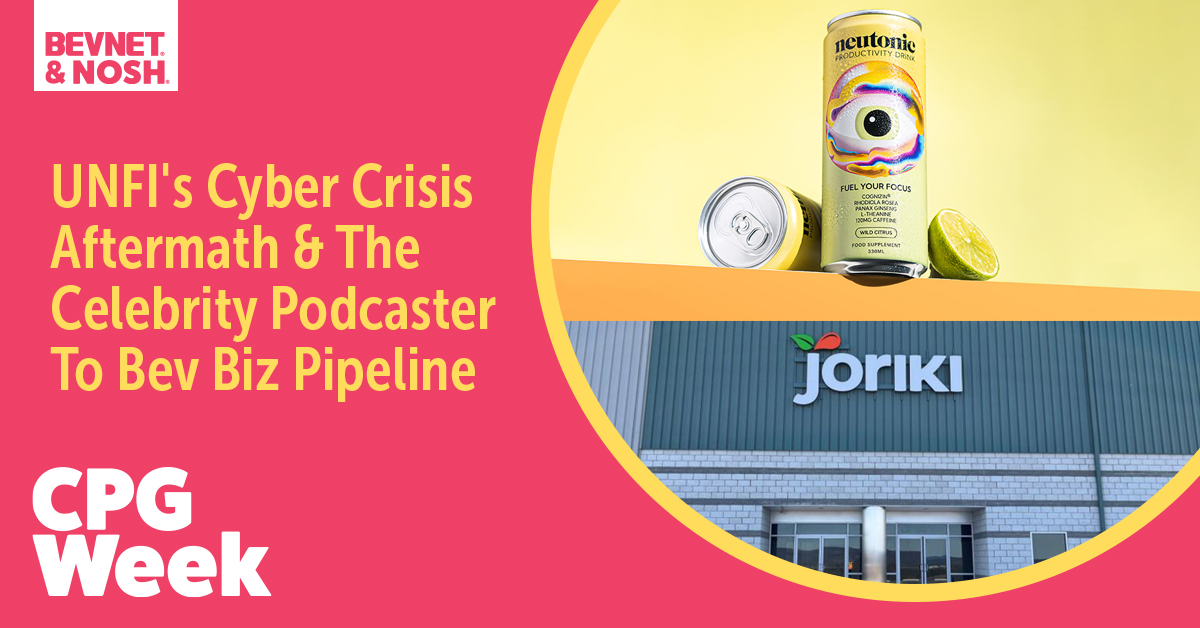
On this episode of the CPG Week podcast, BevNET managing editor Martín Caballero joins senior reporter Brad Avery to talk about the ongoing impact of the UNFI cyberattack, investment in podcast-backed beverage brands, the rebirth of co-packer Joriki Beverages and what’s next for beer distributors after the Alani Nu acquisition.
Show Highlights:
0:15 – CPG brands are starting to prepare for the implications of UNFI’s cyberattack a few weeks ago. Brad discusses what Nosh has learned so far in talking with founders, stakeholders and experts.
1:30 – Marty describes the recent raise by influencer-backed cognitive beverage brand Neutonic. The hosts discuss why there appears to be a synergy between celebrity podcasters and the beverage business.
4:30 – Co-manufacturer Joriki Beverages is readying to reopen after the founder of Reed’s Ginger Beer, Chris Reed, acquired the recently-shuttered aseptic beverage production facility in Pittston, Pa.
6:30 – How are beer distributors approaching the potential loss of Alani Nu from their portfolios? The team discusses what they are hearing.
10:00 – On the lighter side, Brad and Marty talk about Star Wars-themed Coke cans and Taco Bell’s bet on beverages.
About CPG Week
CPG Week is the podcast that explores the latest happenings in the consumer packaged goods industry. Join our seasoned reporting team as they dish out the week’s stories in quick, easy-to-digest episodes. Catch up on the top headlines of the week, dive into exclusive insights with the BevNET and Nosh teams, and set yourself up to make more informed business decisions. Tune in to stay up-to-date on the latest developments in the dynamic world of packaged food and beverage.
New episodes are released every week. Send us comments and suggestions anytime to cpgweek@nosh.com.
Show Highlights:
On the CPG Week podcast, the team discusses the UNFI cyberattack, podcast-backed beverage brands, the rebirth of Joriki Beverages and beer distributors’ next move after Alani Nu.
Episode Transcript
Note: Transcripts are automatically generated and may contain inaccuracies and spelling errors.
[00:00:05] Brad Avery: Welcome to the CPG Week podcast by BevNET and Nosh. I'm Brad Avery, and I'm here with my co-host this week, BevNET Managing Editor Martín Caballero, stepping in as Monica and Lucas are out in the field at Monica Watrous Monica Watrous. Now, for the latest in food and beverage industry news. UNIFI says it has contained the cyber attack that hobbled its operations last month and appears ready to move on as its systems return to normal. But brands are still waiting for the other shoe to drop as many food and drink producers say they feel like they've been left in the dark around the situation. Several suppliers told Nosh that they were unaware where out-of-stocks may have occurred and have no sense of how new product launches or promotions may have been impacted. One founder, who asked to remain anonymous, said their team had received conflicting information from UNFI and from Whole Foods, and that they didn't know whether the brand's stock was sitting in a warehouse, stuck in transit, or if it had been discarded. Even those who feel like they weren't hit too hard by the outage still expect it to take months before the true effects are felt. Dino Stamoulis, co-founder of grain-free granola brand Pellionola, described the incident as, quote, not massive, but not small, and said that communications with UNFI have resumed, praising the distributor for its speed in getting back up and running. UNIFI officially reported the cyber attack, in which an unauthorized user was identified within its computer systems, to the SEC on June 9th. Whether or not any data was compromised is still unknown, and the case promises to resonate for some time, particularly as a warning about serious vulnerabilities within the food industry.
[00:01:35] Monica Watrous: There's a new Nootropic drink headed to U.S. shelves later this year, as New Tonic, the supplement brand fronted by Chris Williamson, the podcaster and health and fitness YouTuber James Smith, this week announced it has raised $3.7 million at a $20 million valuation to help fuel the expansion of its RTD Productivity drinks. These drinks have been on the market for around 18 months in the U.K. and in the U.S. exclusively online, direct through their website and on Amazon, where the company claims to have sold over 3 million cans and generated over $10 million in revenue across the U.K. and U.S. The race consisted of $2 million from venture capital group JDI Investments, with further participation from individual investors, including Cody Sanchez, founder of Contrarian Thinking, fitness entrepreneur Mike Thurston, as well as Alan Barrett, a founder of sports nutrition company Grenade, which was acquired by Mondelez in 2021 for 200 million British pounds.
[00:02:35] Brad Avery: Now Marty, you wrote the story for this on BevNET and in there you made a point about the connection between podcasters and beverage is increasing. You mentioned Dr. Andrew Huberman and Emma Chamberlain and Alex Cooper with their Unwell brand. It's obviously they have a built in loyal audience that they can immediately sell into, but for you, what questions do you have about the potential of these products to break out beyond their audience?
[00:03:03] Monica Watrous: Well, I think some of the brands that you mentioned have done really well in bringing in some experienced beverage operators to be part of a team. So I think how much they're able to sort of incorporate some of the knowledge and talent will be a big question for that as well. And I think it's just interesting because, you know, if you were a brand launching today in a disruptive category that requires some consumer education. It might not be a bad idea to start a podcast, right? So what do these guys have? These guys have a podcast that's already mature and millions of listeners. And now they're going the other way where they're introducing a brand rather than reverse engineering it. They have a great platform to educate about, you know, this kind of cutting edge functional product, which is going to require some education with some of these ingredients and some of the specific kind of use occasions that they're going for. A podcast is certainly a great platform to do that.
[00:03:55] Brad Avery: And it makes a lot of sense when the focus of the show and their brand is health and wellness or function or supplements. So them making the leap isn't that far. Whereas I'm curious how something like Alex Cooper doing a hydration drink, she speaks more generally to issues affecting women in a broader way, not just food or health.
[00:04:16] Monica Watrous: Absolutely. Some have been really impressive. Others have sort of fizzled. So we'll have to wait and see.
[00:04:22] Brad Avery: Well, moving on. After its abrupt closure on New Year's Eve, the Joriki Beverages Co-Packing Facility in Pittston, Pennsylvania has a new owner and Reed's Ginger Beer founder, Chris Reed. Reed, working with an unidentified Chinese business partner, acquired the aseptic production plant out of bankruptcy earlier this year, putting $30 million into the project, with the site already preparing to resume full operations as soon as possible under the new name, Pittston Co-Backing Corp. It's a happy ending for some of the plant's former employees, who are first in line for jobs at the reopened site. All 229 Jiriki team members were told via email on December 31st not to return to work on January 2nd, after the New Year's holiday, as the plant was shutting down immediately following an acquisition deal that fell through. Employees said at the time that they were blindsided by the closure, and on January 3rd, Jiriki, which is a Canadian company with three more plants above the border, filed for creditor protection. Reid called the acquisition of the plant opportunistic, crediting his business partner with being the one to push for picking up manufacturing facilities in the U.S. while they work to develop another beverage project involving functional nutraceutical ingredients. The plant is also bringing back some old customers. The site is equipped to produce juices and plant-based milks, and its past customers under Jiriki's management included the Coca-Cola Company and Welch's.
[00:05:42] Monica Watrous: Yeah, certainly an opportunistic purchase, as you mentioned, but I think that's something that Chris Reed has a great ability to recognize. I think we've seen that in the past and we'll certainly be watching this as they expand and take on new clients.
[00:05:56] Brad Avery: Yeah, and I think it's a really interesting follow-up to something I wrote about back in January, which was the closure of the plant. It was a strange incident. I even spoke to some of the employees who had been laid off abruptly and there was questions of whether there might be lawsuits or not. This went to court, the company filed for bankruptcy, and this has now turned into this chance for Chris, an experienced beverage business builder, to help rejuvenate a local co-packing facility that's pretty significant to the community there.
[00:06:30] Monica Watrous: You know, I also wanted to call attention to a story, Brad, that you wrote last week, which was sort of pulling from a Nielsen report that came out in late May, kind of focused on a survey of beer distributors. And it was really interesting to see just sort of the attitudes towards Elaninu. Of course, we know Elaninu was acquired by Celsius earlier this year. A lot of the speculation has been as to where Alani Nu is going to end up in terms of distribution. Celsius, of course, has its deal with Pepsi, but also moves Alani through independent beer distributors at the moment. But really, the interesting thing about this report was that 93 percent of respondents said that Alani Nu is going to remain a strong focus of their non-ALC portfolios, and they're not de-emphasizing sales. Even if over half around 64% said they expect to lose the brand sometime in their near future. And, you know, I think that's really interesting for, for several reasons, but the biggest one to me is it just reflects the importance of Alani Nu and within these beer distributors portfolios. We're talking about one of the biggest brands outside of those billion dollar plus club that includes Celsius, Monster and Red Bull. Of course, you know, there's folded into Celsius with Alani's acquisition. But really, it just reflects that the energy category and high performing brands within the energy category have become super, super important to beer distributors. And they're hoping that there's no change in the current setup with Alani Nu. Around 36% of respondents believe that it's unlikely Celsius will move Alani Nu out of the existing DSC network. Of course, outside of that network, there's a lot of traffic, as many of the big strategics are already spoken for. So it will be something to watch. Interesting to see distributors attitudes and really, again, reflecting the importance of Alani Nu their current portfolios.
[00:08:20] Brad Avery: These distributors are used to having to constantly flip brands that have something that's big, growing, a big money driver for them, and then it gets acquired, or it moves to a wholesale model or some other system, and they have to find something new and start all over again. But it does feel like this has really happened repeatedly to them in a short succession of time because of the nature of the modern energy drink set, and all these new next-gen brands that came in, grew really fast, So, we had Bang first. Bang moved to Pepsi back in 2020. All these distributors that were reliant on Bang had to find something else. Then Celsius signs with Pepsi. Ghost gets acquired. C4 signs a deal with KDP. keeps happening again and again. And Elani is the last of the really big growers that they have had. So I can see why, even if you have a sense that maybe this is gonna be off our trucks by the end of the year or by this time next year, you still wanna put all your weight behind it. And it's not to say that there aren't some options still in the wings. There's Redcon1, there's Lucky Energy, there's Bucked Up, there's a lot of brands out there that they could jump to next.
[00:09:34] Monica Watrous: Well, yeah, I mean, just to your point, Brad Avery $3 billion in the 52 week period ending May 31st, a dollar sales up 20% volume sales growing 15.5% according to Nielsen data. So would you say no to that?
[00:09:50] Brad Avery: I could not turn that offer down. I would put everything I have behind it for as long as I possibly can.
[00:09:57] Monica Watrous: I think you could be a beer distributor.
[00:09:59] Brad Avery: There we go. All right. I can always fall back on that someday. Well, on the lighter side, Coca-Cola is going to a galaxy far, far away for its next marketing campaign. They are partnering with Star Wars for a limited edition campaign called Refresh Your Galaxy with 27 cans and bottles featuring characters from the Star Wars universe. Marty, you wrote that story and you're a pretty big Star Wars fan too.
[00:10:25] Monica Watrous: Love the OG trilogy. Yeah, and that you can probably guess my age from that comment. But yeah, interesting to see, you know, really, I think this is about the partnership between Coke and Disney, which has been around for over half a century. But yeah, they're leaning into Star Wars for this one. Interesting that it does recall a previous Star Wars promotion, but actually with Pepsi, if you remember back in 1999 when the prequels were coming out, there was a collect them all sort of gig going on with the Pepsi cans featuring all different characters. So this is kind of like that, a little bit different in terms of what's being offered. Um, this isn't 1999, this is 2025. So of course we get something like, um, you know, uh, augmented reality as part of the cans and, and you can do a cool little hologram message, Star Wars style. So yeah, that'll be in stores or is in stores right now.
[00:11:16] Brad Avery: You've also got about 100 hours of new Star Wars movies and TV shows to pluck new characters from, so definitely drawing from The Mandalorian and Grogu and all those other new characters that they've added since. But when you wrote this story, the first thing I thought of was that old Pepsi campaign.
[00:11:34] Monica Watrous: Those cans are still on eBay for, you know, more than you would expect.
[00:11:40] Brad Avery: Let's put it that way. Maybe less than I expect, honestly. Well, in more fun news, Taco Bell is mighty thirsty. The fast food chain is going all in on its new line of refrescas drinks after a limited test run in select stores with six flavors rolling out nationwide this Monica Watrous it's opening up 30 new locations of its Live Mas Cafe beverage concept restaurants. This is particularly interesting because it comes not too long after McDonald's announced that its Cosmix restaurant concept came crashing down to Earth and was shutting down immediately.
[00:12:10] Monica Watrous: The Cosmix closure I think was maybe not entirely unexpected in the sense that I think that it was always sort of meant to really Gather evidence and information to make decisions later on. I don't think necessarily they were planning on opening a You know million locations of that of that concept and then for live moss I mean, I think it's you know, we'll see what happens with With this, you know 30 locations. That seems pretty ambitious, but certainly the idea of fast beverage focused concept restaurants is Definitely a thing. It's definitely a thing when we think about dirty soda, when we think about coffee, various different categories. Taco Bell, maybe looking to get ahead of the curve on that.
[00:12:57] Brad Avery: And here's some other notable bits of news from the week. Bar producer Bearded Brothers has acquired competing brand Sans Meal Bar, adding another functional product to its platform, which also features energy bars, protein bars, and the indulgent Yumster Yo brand. Japanese investment company Marabeni Corporation acquired Phoenix-based ice cream startup Bubbies, marking its entrance into the U.S. ice cream market with plans to keep the brand operating out of Arizona. And Casamigos Tequila has embraced the RTD cocktail trend with a new line of canned margaritas, boasting four flavors and 10% ABV in a 200-milliliter can. For these stories and more, become an insider at BevNET and Nosh. And if you're enjoying the show, please subscribe on your listening platform of choice.
[00:13:42] Monica Watrous: That wraps up this edition of CPG Week by BevNET and Nosh. Thank you to our audio engineer, Joshua Pratt, our director is Mike Schneider, and our designer is Aaron Willette. If you enjoyed the podcast, please subscribe on your listening platform of choice, and we will see you next time.
About CPG Week
CPG Week is the podcast that explores the latest happenings in the consumer packaged goods industry. Join our seasoned reporting team as they dish out the week’s stories in quick, easy-to-digest episodes. Catch up on the top headlines of the week, dive into exclusive insights with the BevNET and Nosh teams, and set yourself up to make more informed business decisions. Tune in to stay up-to-date on the latest developments in the dynamic world of packaged food and beverage.
New episodes are released every week. Send us comments and suggestions anytime to cpgweek@nosh.com.
Stay Informed, Stay Competitive
Unlock the articles, expert interviews, and data reports that power the food and beverage industry. Join our community and stay ahead with exclusive insights from BevNET and Nosh.