CPG Week: The Insurgent Brands Playbook
Episode 115
In this episode:
In this episode:
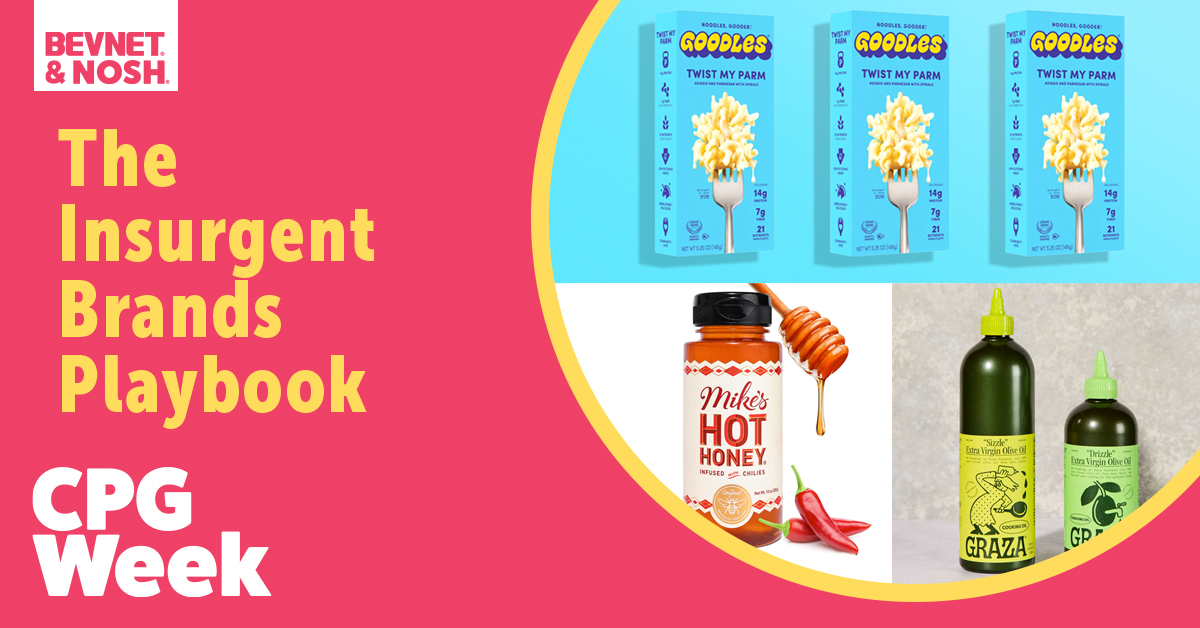
On this episode, the CPG Week team discusses Bain & Company’s Insurgent Brands class of 2025. The group goes through similarities among new insurgent brands and how operators can derive successful growth strategies from Bain’s yearly list.
Show Highlights:
0:30 – It’s March Madness, so the podcasters chat about college hoops and Kellogg’s bracket challenge where a lucky contestant could win a year’s supply of one of the company’s cereal brands.
3:30 – Nosh managing editor Monica Watrous introduces how Bain classifies its Insurgent Brands list and what a scaling insurgent brand means.
7:15 – In many ways, the Insurgent Brands list is a temperature gauge of certain CPG categories and can be a bellwether of successful growth strategies.
8:45 – Eighteen of the brands in this year’s class of insurgent brands were also part of Bain’s emerging brands category. In total, there were 103 emerging brands this year.
11:00 – Monica and senior reporter Brad Avery point out that this list has grown over the years, showing not only trendsetting but also the pace of growth in many categories.
About CPG Week
CPG Week is the podcast that explores the latest happenings in the consumer packaged goods industry. Join our seasoned reporting team as they dish out the week’s stories in quick, easy-to-digest episodes. Catch up on the top headlines of the week, dive into exclusive insights with the BevNET and Nosh teams, and set yourself up to make more informed business decisions. Tune in to stay up-to-date on the latest developments in the dynamic world of packaged food and beverage.
New episodes are released every week. Send us comments and suggestions anytime to cpgweek@nosh.com. Subscribe on Apple Podcasts
Show Highlights:
The CPG Week podcast team discusses Bain & Company’s Insurgent Brands class of 2025, the similarities among new insurgent brands and how operators can derive successful growth strategies from the yearly list.
Episode Transcript
Note: Transcripts are automatically generated and may contain inaccuracies and spelling errors.
[00:00:05] Monica Watrous: Welcome to the CPG Week podcast by BevNET and Nosh, your source for the latest food and beverage industry news. I'm Monica Watrous, Managing Editor of Nosh, here with my co-hosts, Brad Avery and Lukas Southard. If you're enjoying the show, please subscribe on your listening platform of choice. On the podcast today, we're discussing Insurgent Brands. Who are they and what are they doing differently? But first, how are your March Madness brackets faring, Lucas and Brad?
[00:00:34] Brad Avery: Well, let's just say I decided to take part in the BevNET communities, um, bracket or tournament, and I am second to last. Uh, so not very well, I guess would be the short answer to that. I chose UCLA to win it all who, uh, not because I really care that much. It was just there at California UC, I'm a UC grad. I'd go with them and I think they got knocked out in like the second or third round.
[00:01:05] Lukas Southard: So you never Just go with your home team. Like you can't do that.
[00:01:09] Brad Avery: You got to be objective step back Yeah, well I considering I don't follow college basketball at all. I'm a as most listeners probably know I'm a big NBA fan I'm very tuned into what's going on in professional basketball, but when it comes to the collegiate level I It's just, it's hard to keep up. There's too many teams. There's too much, too many games to watch.
[00:01:29] Lukas Southard: I just think everyone should remember that if you do not call every game correctly, that is a personal failing on you. It is a moral failing. You should feel bad. You should have been able to correctly call every single match. That is a thing that is reasonable to be expected of a person. Yeah, of course.
[00:01:47] Monica Watrous: Well, my alma mater, Mizzou Tigers, lost in the first round. So I feel your pain. You can't just go with the team that you like the most.
[00:01:56] Brad Avery: I mean, let's say if the Fighting Banana Slugs from UC Santa Cruz, my alma mater, were in, I would pick them every time, even even though there's not a chance in hell that they will ever even be in the tournament, let alone win.
[00:02:11] Lukas Southard: Is it Warren Buffett who has a thing that if you turn in a perfect NCAA bracket, he'll pay you a million dollars or something like that? It's statistically impossible for the most part, almost impossible. I bet AI could figure it out. No, it's just too many variables. It could probably generate every single possible bracket, in which case, well, of course, then you're right.
[00:02:37] Monica Watrous: All I know is that Kellogg is launching a bracket challenge with two of its serial mascots, Tony the Tiger and Toucan Sam. And if a bird makes it to the finals, five winners will get a year's worth of Froot Loops. If a cat makes it to the finals, then five winners get a year's worth of Kellogg's Frosted Flakes.
[00:02:57] Brad Avery: They couldn't give him something better than just like the cereal. Like, really? Like, it's Kellogg's. Like, you guys got some money. Like, just give him some money, too. I'd be like, I'm doing great. I've got a lot of, like, Frosted Flakes to feed me. But, you know, a $1,000 check would probably be better.
[00:03:12] Monica Watrous: Per the rules, if there's no cat or bird in the finals, we all lose. I don't know what that means, but it sounds ominous. They discontinue the cereals, they take them off the market, you'll never have them again. Well, you know, if these food additive bans continue to pass across various states, then we probably won't be seeing Froot Loops on the shelves for a while. Moving on, Bain and company released its ninth annual list of Insurgent Brands, featuring 120 CPG companies that combined drove 39% of incremental category growth while holding less than 2% of market share in their respective categories. The criteria for being an Insurgent Brands, according to Bain, is generating more than $25 million in tracked channels and annual sales. growing more than 10 times the category average over the past five years, and maintaining positive growth over the past two years as an independent company or recently acquired company. Brad, you were looking at the beverage brands on the list and found some commonalities. Can you tell us more?
[00:04:18] Lukas Southard: Yes, one thing I thought was interesting about this year's list is a lot of these brands we've seen start making moves and start getting acquired. Poppy was on the list, Alani knew, Ghost, three brands that have been picked up by major larger companies including PepsiCo and KDP just in the past six months. We also see brands that have aligned closely like Black Rifle has aligned with KDP. And we see these insurgents starting to win in the market. Some of these brands are really establishing themselves as leaders now. At what point do they stop being insurgents?
[00:04:57] Monica Watrous: That's a great question and certainly the broader food and beverage industry is seeing all kinds of challenges right now from consumer confidence waning and stagnating volumes as well as all of this discourse around ultra-processed foods and the rise of GLP-1 weight loss drugs. These brands are obviously overcoming some of the big headwinds that are stymieing the bigger players in the industry.
[00:05:26] Lukas Southard: One thing I thought was interesting in the Bain report is they call out certain scale insurgents, which are companies that now make more than a billion dollars in sales. So brands that were on the list ordinarily last year, Celsius, Chobani, Rouse, are now considered these $1 billion plus scale insurgents. They're sort of graduating into this place of being, you know, Again, leaders in their categories, in their space, and you know, Celsius just threw around 1.8 billion dollars to pick up Alani, another Insurgent Brands on the list. So the insurgents are acquiring the insurgents.
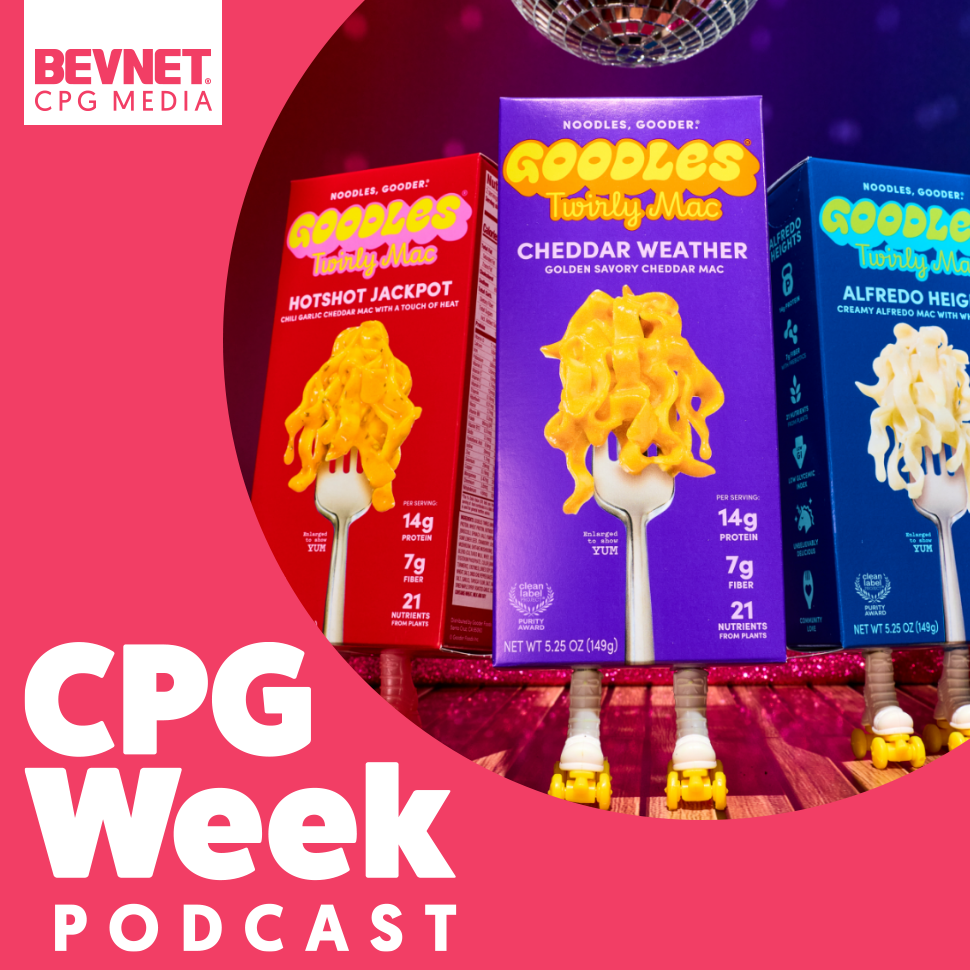
[00:06:07] Monica Watrous: And on the food side, we saw new insurgents, including Aloha, Goodall's, Graza, Mike's Hot Honey, So Good, a lot others. And what's interesting about these brands or what they have in common is that they're all establishing strong retail partnerships. They have created consumer-centric innovation and really fostered brand loyalty among their core consumers. They're executing innovative collaborations with other on-trend brands. Just look at Mike's Hot Honey. Every day I feel like I see a new product in the market with Mike's Hot Honey and some other brand. We're also seeing these Insurgent Brands expanding into high-impact segments. So Good, for example, had a timely pivot into freeze-dried candy once that company saw this picking up on social media. We also saw Goodall's expanding into the deluxe segment of mac and cheese. So these brands are very thoughtful about their innovation pipelines. They're not proliferating innovation, but really focusing on their core assortments and their hero SKUs. And they also have founder-led mentalities that they're embedding throughout the organization. And consumers are really gravitating towards these things.
[00:07:23] Lukas Southard: Some of these are also brands that are simply outpacing their category. Among the new insurgents, we see Busy Cold Brew and Counterculture Coffee. As coffee has slowed down a bit in recent years, these are brands that are getting recognized because they are continuing to grow at a pretty rapid pace, while the rest of their set is struggling or slowing down.
[00:07:47] Brad Avery: Yeah. And to go along with that, I mean, you look at some of the new insurgents this year, like you pointed out in the food side, Monica and Graza or Coco June, even Mike's hot honey, as you pointed out as well, all kind of fit into this reinventing categories or, or products that have been in the market for a long time. Olive oil, honey, you know, the kids pouches and, and yogurt, like bringing a new spin to it. That is really catering to a new generation. and a new type of consumer, and that's really resonating. These are brands that are really starting to make a name for themselves, not just in natural channel, but all over the country and in conventional retailers as well.
[00:08:31] Monica Watrous: And we're also seeing existing insurgents that have made the list yet again, including Impossible Foods, Kevin's Natural Foods, Catalina Crunch, Chomps, Van Leeuwen. Again, premium position brands with better for you attributes reinventing stagnant categories and really trampling the incumbents.
[00:08:49] Brad Avery: One thing that I did think was a little interesting and I wish they had to provide a little bit more clarity is they talk about these emerging Insurgent Brands. So as you stated, Goodall's, Coco June and Mike's Hot Honey were part of 18 different brands that, uh, were, were emerging Insurgent Brands last year. And now they are part of the new insurgent class of 2025. They didn't actually name the other 15 brands that were. part of this emerging insurgent class that had graduated up to becoming full-on insurgent status. But they did highlight that brands like Cleveland Kitchen, Soli, and Belgian Boys were part of the 2025 emerging insurgent class, which I think is interesting because those are all great brands that we know very well. I'm a big fan of Soli, actually. I have a bunch in my pantry because I love their take on just the dried fruit and the fruit belts or fruit wraps, whatever you call them.
[00:09:47] Brad Avery: Fruit belts.
[00:09:49] Brad Avery: Fruit belts, what do you call them?
[00:09:50] Brad Avery: I know what they're called, they're a fruit belt.
[00:09:52] Brad Avery: Fruit leather, I guess is the proper, fruit leather.
[00:09:54] Brad Avery: I like fruit belts.
[00:09:55] Brad Avery: I like it because it's like a belt, you know, you put it on your wrist and then you eat it.
[00:09:59] Monica Watrous: Oh, that's how you consume them?
[00:10:01] Lukas Southard: You wear belts on your wrist? That's true.
[00:10:04] Brad Avery: Actually, I don't wear belts on my wrist.
[00:10:06] Lukas Southard: I think if you call something a fruit belt, you should be able to wear it around your waist. It should be long enough.
[00:10:10] Brad Avery: If you strap a bunch of the solely fruit belts together, you could make a whole belt to go around your body.
[00:10:16] Monica Watrous: Are fruit belts like the new candy necklaces? Are we edible accessories? Is that back in in 2025?
[00:10:22] Brad Avery: I'm all about it. Should be. At least with the dried fruit ones, it might be sticky though. You can't wear them for too long.
[00:10:29] Monica Watrous: the emerging insurgents, those are brands with between 10 million and 25 million in annual revenue in tracked channels. So graduating up, like you mentioned, Goodall's and a few others that had come from the emerging side of things last year, obviously they're sustaining strong distribution expansion, velocity growth, and having a strong omni-channel presence is also a big factor here.
[00:10:56] Lukas Southard: So one of the key takeaways from this report, in my mind, is that while these brands combined account for less than 2% of the market share, Monica, you mentioned earlier they drove 39% of incremental category growth. Compare that to 2023 when the Insurgent Brands list that year accounted for just 17% of incremental category growth. 17% to 39% last year is huge. These brands are not just setting the trends, they're setting the pace of the industry.
[00:11:32] Monica Watrous: You're talking about how much more incremental growth this class is driving versus the class a year ago, but there are actually more insurgents this year than there were in previous years. Last year, Bain tracked 97 brands, and this year, like we mentioned, there were 120. I think that says a lot about not only how powerful these brands are, but how many more of them are rising to this level and achieving this sustainable growth.
[00:12:03] Lukas Southard: It's exciting because it feels a bit like a tale of two cities sometimes in the industry where we can look at all these next-gen brands that are really changing the game, changing the landscape, changing the culture in a large way. Compared to, we've also been experiencing a lot of shakeout in the industry, a lot of other brands that came up around the same time that haven't been able to make it or have been distressed or just struggling to find money. And we see companies that have similar ideas or similar prospects and winners. And I don't want to say losers because sometimes it's just a matter of getting the right luck or getting the right play executed. That is something that I think is interesting. We talk so much on the show about how difficult the industry is right now. But we can also look at this class and we see not just the big names like Poppy or your Liquid Deaths, but we see companies have just been plugging along and growing steadily. Remedy Organics, Solti. These are companies that have been around for years now that maybe haven't set the world on fire yet, but they've played it smart and they've kept it going and they've kept it growing.
[00:13:12] Monica Watrous: And on the food side, purely Elizabeth, Bobo's, Kodiak. These are brands that continue to plug away and keep growing.
[00:13:21] Brad Avery: It is something that I'm sure we will all be returning to look at this list because as you see some of these existing insurgents. are part of the class of brands that were acquired this year. Siete being one of the biggest ones, but as you said at the top, Brad, Alani New, and Ghost, like Poppy, these are all brands that we've been talking about this whole year that have been acquired, and that is just a sign of where the bigger strategics and the bigger food and beverage companies are looking to grow their portfolios and where they're going to invest significant amount of capital.
[00:14:00] Lukas Southard: One last thought on this is that I think you can look at this class of brands here, and maybe not every company is doing everything perfectly. Maybe there's stuff we don't know about behind the scenes, but you can look at every brand and you can take lessons away of what they've been doing right, whether it's their product, whether it's their branding, whether it is their strategy and their execution and their merchandising. There's lessons in every single one of these brands And I think they all stand out in a very distinctive way that when I look at these logos here all combined I think ah yes them they they feel so different and stand out on the shelf so much from the next brand Right next to them
[00:14:40] Monica Watrous: And we write about all these brands and how they're operating differently and some of these case studies that they're showing the rest of the industry. So it's great to see them celebrated in this way. And we'll continue to be distilling lessons from these insurgents going forward. And here are some other notable bits of news from the week. Why blended meat brands are struggling to gain ground in retail. highball energy, returns to brick and mortar, and a conversation with Yum Earth's CEO on trends in the candy category. For these stories and more, become an insider at BevNET and Nosh. That wraps up this edition of CPG Week by BevNET and Nosh. Thank you to our audio engineer, Joshua Pratt, our director is Mike Schneider, and our designer is Aaron Willette. If you enjoyed the podcast, please subscribe on your listening platform of choice, and we will see you next time.
About CPG Week
CPG Week is the podcast that explores the latest happenings in the consumer packaged goods industry. Join our seasoned reporting team as they dish out the week’s stories in quick, easy-to-digest episodes. Catch up on the top headlines of the week, dive into exclusive insights with the BevNET and Nosh teams, and set yourself up to make more informed business decisions. Tune in to stay up-to-date on the latest developments in the dynamic world of packaged food and beverage.
New episodes are released every week. Send us comments and suggestions anytime to cpgweek@nosh.com.
Stay Informed, Stay Competitive
Unlock the articles, expert interviews, and data reports that power the food and beverage industry. Join our community and stay ahead with exclusive insights from BevNET and Nosh.