CPG Week: Tariff Turmoil For Small Brands
Episode 117
In this episode:
In this episode:
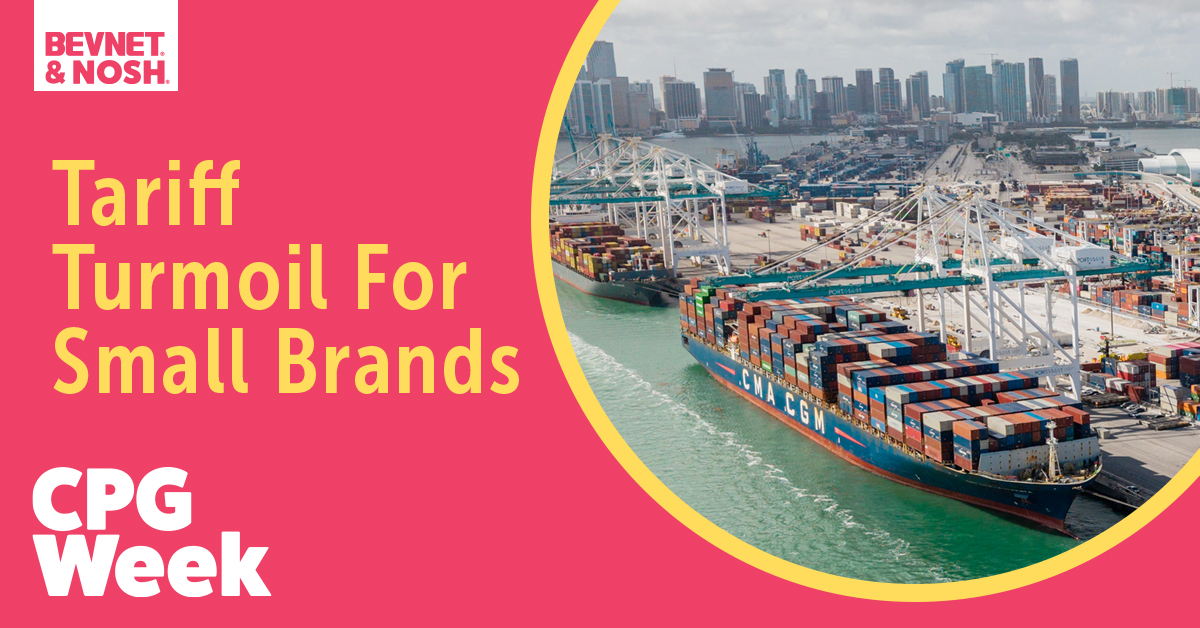
This week, the podcast team is turning its attention to how small brands are navigating tariff turmoil. The CPG Week podcast hosts talked with several food and beverage founders about the issues most pressing for their respective businesses amid the rapidly changing environment. From pulling back on trade spend to changing packaging solutions and tariff-related spring sales, emerging brands are getting creative in how they plan to survive a potentially protracted period of import taxes.
Show Highlights:
0:30 – Is Pirate’s Booty on its way back to its founder Rob Ehrlich? At the moment, the brand appears to be staying under Hershey ownership, but Ehrlich continues his nearly two-year campaign hinting that it will be back in the Vegan Rob’s portfolio.
4:15 – Tariffs are all the rage right now, but how are small food and beverage brands dealing with added costs? Senior reporter Brad Avery explained what Just Ice Tea founder Seth Goldman said about his company’s moves to ease the burden of new import taxes.
7:00 – The dynamic nature that tariffs have been announced to the public has caused not only uncertainty but also a fear that demand shock will cause prices to rise steeply.
10:30 – Packaging is a major concern for CPG entrepreneurs because much of it comes from China, which is facing over 100% tariffs currently. For many brands, pivoting to a domestic supplier is not available, leaving limited options to counter elevated costs.
14:00 – There are only so many ways to squeeze cost-savings out of a startup’s supply chain, especially when many of these costs are being felt weeks or months after orders were made.
About CPG Week
CPG Week is the podcast that explores the latest happenings in the consumer packaged goods industry. Join our seasoned reporting team as they dish out the week’s stories in quick, easy-to-digest episodes. Catch up on the top headlines of the week, dive into exclusive insights with the BevNET and Nosh teams, and set yourself up to make more informed business decisions. Tune in to stay up-to-date on the latest developments in the dynamic world of packaged food and beverage.
New episodes are released every week. Send us comments and suggestions anytime to cpgweek@nosh.com.
Show Highlights:
On this episode of the CPG Week podcast, the team turns its attention to how small brands are navigating tariff turmoil.
Episode Transcript
Note: Transcripts are automatically generated and may contain inaccuracies and spelling errors.
[00:00:05] Monica Watrous: Welcome to the CBG Week podcast by BevNET and Nosh, your source for the latest food and beverage industry news. I'm Monica Watrous, Managing Editor of Nosh, here with my co-hosts, Brad Avery and Lukas Southard. If you're enjoying the show, please subscribe on your listening platform of choice. On the podcast today, we are discussing how tariffs are affecting food and beverage founders. But first, what's going on with Pirate's Booty? Have you guys been following this bizarre series of events?
[00:00:40] Brad Avery: Well, it seems like Pirate's Booty is just going along as normal. It's the founder that is doing some interesting things.
[00:00:47] Monica Watrous: Yes. So let's recap. Rob Ehrlich, the founder of Pirate's Booty, posted on LinkedIn last week that he had bought back the Puft snack brand from Hershey in a $25 million transaction that was expected to close immediately, according to his quote there. And lots of people were congratulating him, very exciting to see a founder buy back his brand.
[00:01:18] Brad Avery: Expected to close immediately should have been the red flag.
[00:01:21] Lukas Southard: Yeah. I mean, I will point out, I think I reported on this almost like two years ago now when he first started on this tirade of like, I'm bringing Pirate's Booty back to its roots. And he's been posting about this. for over two years, it's been a mess. But every time we've checked up on it, as you did last week, Monica, Hershey said the same thing. We're not selling it back to him.
[00:01:44] Monica Watrous: Yes. So we did reach out to Hershey and they acknowledged that they had seen the post and that there was no truth to it. Here's a little history on the brand. Ehrlich founded it in 1986 and sold it to B&G Foods. in 2013 for $195 million. VMG Partners was one of the early investors in the brand. And then Hershey bought the brand from B&G Foods five years later for $420 million. So this idea that Ehrlich bought it back for $25 seems
[00:02:16] Brad Avery: Well, there's been some big losses in trades. I mean, look at Tumblr, sold for a billion and then resold for three million. In the history of business, that's not necessarily unrealistic, but I'm not sure off the top of my head how Pirate's Booty's been doing.
[00:02:33] Monica Watrous: Hershey is, as we saw last week, continuing to build out its snack portfolio. It made a deal to acquire Lesser Evil for around $750 million. It also acquired Dots Pretzels a couple years ago, and Skinny Pop is one of its biggest salty snacks brands. So we're not seeing this company retreating from salty snacks by any means. In fact, it's doubling down as it looks to reduce its reliance on cocoa. So we're not sure what is going on with that fictitious LinkedIn post. We did reach out to Ehrlich, and I haven't heard back yet, but we wish him the best. Side note, of course, all this happened after Ehrlich recently declared himself mayor of Seacliff, New York, the small coastal village in Long Island where he lives. citing a little-known New York state law, and then losing in a landslide in the subsequent election.
[00:03:34] Brad Avery: I've never talked to Ehrlich. I don't know him. I don't really know anything, but I think it's pretty clear that he has a tendency to declare premature victory, at least in his recent proclaiments. Just to put a serious note on it before we transition, it is a real sort of red flag moment of be careful what you read on LinkedIn and taking everything at face value. Just because it's LinkedIn, clearly wrong information gets out there.
[00:04:04] Monica Watrous: So what I'm hearing there is don't get your news from LinkedIn or other social media sites. Go to BevNET.com and Nosh.com to get the truth.
[00:04:14] Brad Avery: Good plug.
[00:04:16] Monica Watrous: Great plug. Well, let's get to the meat of this episode, the overpriced, overtaxed meat tariffs. We've talked about it on the show before, but it's really becoming a bigger topic as the trade war that Trump has kicked off in the last couple months, continues to escalate. Every day there is a new development. But today we are focusing on what food and beverage entrepreneurs and operators are doing to prepare for higher costs of goods as a result of these tariffs. Brad, you spoke with a very seasoned beverage industry veteran, Seth Goldman, just this morning before we started recording. Can you tell us what he is saying about how his brand, Just Iced Tea, is responding to tariffs?
[00:05:02] Brad Avery: Yeah, so the first issue is that the uncertainty and confusion is enough of a problem on its own and starting to plan and prepare is pretty hard when you don't know whether more tariffs are coming, whether tariffs will be pulled back, whether negotiations are happening or aren't happening. That's one thing that's been a real problem top down from the White House about where is this all leading to. So it's already hard for brands to start prepping properly when they don't know what's actually going to happen next. Now, going ahead immediately, you still have to be doing business. And Seth's take on how Just Iced Tea will respond is that they're hoping to not have to increase costs and they're going to hold off on increasing costs and prices as long as they can. But this is a brand that sources its tea internationally. It's key ingredient is organic fair trade tea, and you just really can't find much of that at all in the United States. So it's not as though they can just switch to domestic sourcing. They have to pull from, I believe you said China is a big one on the list. They source from India. They source from Mozambique. There's a flat 10% tariff on all of these countries now, China in particular has higher tariffs. And yes, the company is going to be looking at reformulation and what it can do to try and reduce some of the input costs. But there's not much they can do as far as changing sourcing, other than looking for some other countries that have lower tariffs than other countries. Again, you cannot find this ingredient in the United States. Thankfully, they source their glass bottles domestically, which not every brand can do, so that's one of their higher costs that are lower, but the first thing that's going to be lost as a result of this is trade spend. They're going to pull back on trade spend and promos when they can, and that will be sort of the first price increase that consumers might end up feeling.
[00:06:57] Monica Watrous: We know that entrepreneurs are being a little reticent about making these big sweeping changes across their supply chain because we don't really know how long this is going to last. And it's really expensive to change your packaging and to change your recipes in order to source cheaper ingredients. So from what I've seen, a lot of founders are talking about holding back and seeing what kinds of pricing updates they receive from their suppliers before moving forward in any drastic way.
[00:07:28] Lukas Southard: And it's that uncertainty that is really one of the biggest problems, especially for smaller brands. So I recently had a conversation with a California-based granola brand called Nana Joe's. The founder, Michelle Pusateri told me that she was really worried about demand shock. Similar to what we saw during the pandemic with people and companies out there buying a glut of product in anticipation of During the pandemic, those products not being available in the case that we're faced with now with tariffs prices going up. So even today, in my local newspaper, they were reporting on grocery shoppers were already stocking up before prices rose for staple goods. In the case of Nana Jo's, Pusateri was worried about prices going up from her suppliers. So she's a granola brand. They buy a lot of oats. She's like, I can't buy truckloads of oats at a lower price than what I'm going to have to pay in a couple of months because I don't have the capital runway to do that, nor do I have the storage in my manufacturing to hold those oats. Whereas, you know, a General Mills or some of the larger food companies can do that and, and get a little bit of those price breaks. But for the smaller brands, they're going to be hurt by this demand shock pretty significantly. And even if the tariffs and the trade war goes away next week, which is. possible the way things have been going, they can swing back and forth every day. It seems like she called it like a waterfall effect rather than a trickle down effect in terms of how tariffs are impacting supply chain forecasting, especially for the smaller brands.
[00:09:05] Brad Avery: I had another interesting conversation with a founder, Stelios Stavrianos of Korbev, a Connecticut-based spirit startup. They have a number of brands in their portfolio and he's a bit of a younger entrepreneur and he had a bit of a glass half-full. full approach to this. Now, I wanted to see what his take was because I know that they produce a Greek island rum brand called Cavo that they produce and import from Greece. And he said, yeah, the costs there are going to go up. They intend to eat the cost in order to not have to raise their prices. They also have to source their glass internationally for their bottles, so that's another rising cost. But he said most of their products are produced domestically. They have a vodka brand, and his hope is that this could help drive a Buy American approach. Their vodka brand, Cylinder, he said, has trouble competing on price point. They have to charge $24 a bottle, and most competing vodkas that are produced... in other countries can sell for much lower. That's been one of the biggest hurdles. So he was a little optimistic that this could be good for a small company looking to fight back against big conglomerates that use international production. Now, how that plays out when you consider the macro economic environment, consumer confidence, that's all to be seen.
[00:10:29] Lukas Southard: So it's interesting you bring up this take about packaging, Brad, and you were talking about with Just Iced Tea as well. What initially piqued my interest with Nana Jo's, besides the fact that they're a Bay Area brand, so shout out to my San Francisco Bay Area people, but was a post that Pusateri put in on LinkedIn a couple of weeks ago that was centered around how tariffs are impacting packaging, most especially for her. So unsurprisingly, a good portion of packaging solutions from bags to aluminum comes from abroad. A lot of it coming from China. And Pusateri's post talked about a conversation she had with a non-CPG industry friend who had expressed enthusiasm that the tariffs would return manufacturing to the US. But what Pusateri said was that she can't get the same packaging materials that she uses for from a domestic supplier. They just don't really exist. And when she has, when she first launched the brand, you know, almost 20 years ago. She sourced domestically the bags that she uses for granola. They cost 68 cents per bag, but were a poor quality and like the seal would break all the time. And she was forced to source new bags from Taiwan and China that cost 50 cents less per bag. So she was getting bags that were 18 cents a bag and they, you know, aren't effective. They are better made. And she's like, I just can't get that here. And there isn't a supplier that's going to be launching my kind of bags anytime soon, because manufacturing takes a long time to build out. And it's something that I've seen reported a lot recently is just this idea that we're just going to bring manufacturing back, but that doesn't happen right away. And for small brands, their timelines are much tighter. And, you know, the really the only levers that she has left to pull, if she's going to have to eat the cost of tariffs on her packaging material is raising her prices. And she's like, I'm already at the top of what I can charge for my consumers before they just go somewhere else. And if that happens, then it doesn't take long for small brands like hers to realize that they just can't maintain and they have to shutter.
[00:12:42] Brad Avery: Also, who manufactures the manufacturing materials and the equipment and the production? Exactly. Are we making that all domestically right now? So when we build these new factories, allegedly?
[00:12:52] Lukas Southard: Yeah. Lumber and nails don't just come from America all the time.
[00:12:57] Monica Watrous: Right. Yeah, no, and I've been hearing a lot about brands who are trying to navigate this and figure out whether to pass the cost to their consumers. And several have said, this is not something that we are going to do. Burlap and Barrel, which is a premium spice company and imports a lot of ingredients internationally, the brand just ran a spring cleaning tariff sale, a 20% off site-wide discount. in order to finance another year of purchasing from the smallholder farmers that it works with in a number of different countries from Afghanistan to Zanzibar. And this is a brand that can't source domestically. They're talking about Vietnamese cinnamon and ingredients that just simply can't be uprooted and moved to the U.S.
[00:13:53] Brad Avery: Going back again, we also have to consider all the individual components. Like you said, sometimes you look at this and you think coffee, coconuts, you know, big ingredients that make up entire products. And you're wondering, oh, how are those going to be affected? But it's those little inputs from the packaging. One thing that Stelios brought up to me is he was unsure about their labels, you know, whether some of the inks are produced internationally. He didn't know, but that's a possibility. Little tiny costs and they can add up. everywhere, I mean from the light bulbs in your factories even. So you see costs going up everywhere, it all piles up and it creates a challenging economic environment. We're in a way, this industry, CPG, is not nearly as challenged by this as sectors like tech are. auto manufacturing, industries that have to ship a product across multiple countries before it's finished, paying the tariffs multiple times. So in some ways, CPG does not have it the worst, but it's still going to be a hard challenge going forward if this doesn't change.
[00:15:04] Monica Watrous: Well, the difference with CPG, though, is that margins are razor thin to begin with. So to try to squeeze cost savings out of every inch of the supply chain is going to be a very tall task.
[00:15:17] Brad Avery: I mean, with just iced tea, Seth was telling me how it on average costs about five cents worth of tea per bottle. And you think, oh, well, five cents, you know, 20 percent is one cent. Think about how many bottles you're producing and how much that adds up over time. It's a much bigger challenge than it may sound like, even if it's a relatively small issue. And that's only if it stays at a 10% tariff.
[00:15:44] Lukas Southard: One thing to think about also that's happening across industries, not just CPG, is that these tariffs are affecting orders that were made sometimes months ago. And so a lot of people I talked to at Expo, they weren't having to think about if those tariffs would impact their supply chain because they weren't sourcing from Canada or Mexico. But now they are faced with that with this 10% tax tariffs on products from pretty much everywhere, as well as elevated tariffs from places like China, where we get a lot of those packaging supplies and a lot of different ingredients and things that they ordered months ago, that they weren't planning to have tariffs. Lopped onto them when they entered the U S at the ports are now being tariffed. And they're going to have to account for that, even though they weren't putting that into their long-term forecasting.
[00:16:36] Monica Watrous: Well, of course, we'll continue to report on this and share stories from across the industry. And here are some other notable bits of news from the week. AI-driven food company Starday has raised an $11 million Series A round. Monty's Fine Foods pulled in $2 million in funding led by consumer venture studio Knight. And how Spirits industry founders are getting creative amid a mergers and acquisitions slowdown. For these stories and more, become an insider at BevNET and Nosh. That wraps up this edition of CPG Week by BevNET and Nosh. Thank you to our audio engineer, Joshua Pratt, our director is Mike Schneider, and our designer is Aaron Willette. If you enjoyed the podcast, please subscribe on your listening platform of choice, and we will see you next time.
About CPG Week
CPG Week is the podcast that explores the latest happenings in the consumer packaged goods industry. Join our seasoned reporting team as they dish out the week’s stories in quick, easy-to-digest episodes. Catch up on the top headlines of the week, dive into exclusive insights with the BevNET and Nosh teams, and set yourself up to make more informed business decisions. Tune in to stay up-to-date on the latest developments in the dynamic world of packaged food and beverage.
New episodes are released every week. Send us comments and suggestions anytime to cpgweek@nosh.com.
Stay Informed, Stay Competitive
Unlock the articles, expert interviews, and data reports that power the food and beverage industry. Join our community and stay ahead with exclusive insights from BevNET and Nosh.