CPG Week: Storm Damage And Shutdowns
Episode 97
In this episode:
In this episode:
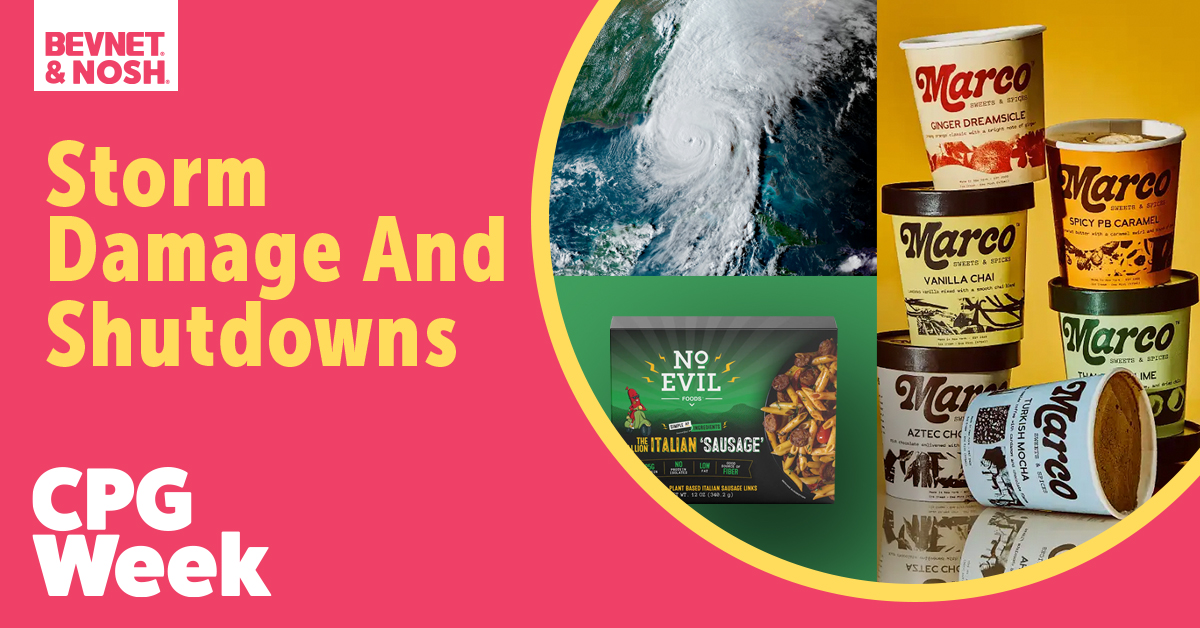
On CPG Week, the podcast team talks about the impact of Hurricane Helene on North Carolina CPG businesses and a slate of small brands shutting down.
Nosh managing editor Monica Watrous and senior reporter Lukas Southard are joined by reporter Adrianne DeLuca this week in a conversation that begins with a look at how businesses are picking up the pieces after hurricane season. Then, the group walks through the most recent CPG business closures before a brief discussion about how inclusive hiring practices can build stronger workforces.
Show Highlights:
0:30 – The team talks about what they are excited for as they prepare for BevNET and Nosh Live in less than a month.
2:00 – It’s been about a month and half since Hurricane Helene devastated the southern Appalachia region. Learn how some CPG companies have tried to restart operations and rebuild their businesses after flooding, lack of utilities and downed trees impacted the local economy.
8:45 – Adrianne explains what happened at plant-based meat company No Evil and vertical farming operation Bowery Farms, which both announced they were closing recently.
10:30 – The closures also come as frozen treat maker Marco has shut down operations after a recall at its co-manufacturing facility created too many challenges to overcome. Monica goes on to compare these shutdowns to a recent report from SciFi Foods former founders called Graceful Exit.
13:00 – On a more positive side, Adrianne discusses her story about inclusive hiring practices implemented by some CPG companies.
About the CPG Week
CPG Week is the podcast that explores the latest happenings in the consumer packaged goods industry. Join our seasoned reporting team as they dish out the week’s stories in quick, easy-to-digest episodes. Catch up on the top headlines of the week, dive into exclusive insights with the BevNET and Nosh teams, and set yourself up to make more informed business decisions. Tune in to stay up-to-date on the latest developments in the dynamic world of packaged food and beverage.
New episodes are released every week. Send us comments and suggestions anytime to cpgweek@nosh.com.
Show Highlights:
In this episode: On CPG Week, the podcast team talks about the impact of Hurricane Helene on North Carolina CPG businesses and a slate of small brands shutting down. Nosh managing editor Monica Watrous and senior reporter Lukas Southard are joined by reporter Adrianne DeLuca this week in a conversation that begins with a look… Read more »
Episode Transcript
Note: Transcripts are automatically generated and may contain inaccuracies and spelling errors.
[00:00:05] Monica Watrous: Welcome to the CPG Week podcast by BevNET and Nosh, your source for the latest food and beverage industry news. I'm Monica Watrous, Managing Editor of Nosh, here with my co-hosts, Lukas Southard and Adrianne DeLuca, who is filling in this week for Brad Avery. If you're enjoying the show, please subscribe on your listening platform of choice. On the podcast today, we're discussing storm damage and shutdowns. But first, Nosh Live is right around the corner, just a few weeks away. Are you guys excited?
[00:00:36] Lukas Southard: Of course. I think, you know, being a virtual resident of our editorial team, I can't wait to see all of your shining faces in person, as well as the rest of the food and beverage industry.
[00:00:48] Brad Avery: Yeah. I mean, it's always a lot of fun to be out in LA, especially in December, uh, for those of us coming from the Northeast where it's getting quite cold, but you know, I'm looking forward to, obviously the pitch slam is always a lot of fun. It's always great to see some of the brands that. We've either talked to, or we've been reading about or seeing in stores and kind of hear their whole story. Taste some of the products, obviously I'm going to be doing a panel of, uh, focused on manufacturing. So looking forward to talking to a couple stakeholders in the manufacturing end of CPG food industry. And, um, you know, trying to, trying to learn a couple of things while I'm on stage as well.
[00:01:30] Lukas Southard: I'm doing the same with TikTok Shop this time. So we will see exactly what that platform entails and how brands can use it best.
[00:01:39] Monica Watrous: Well, of course, it's not too late to register. Insiders get a discount and you can find out more and see the full agenda and speaker lineup at Nosh.com. And now for some less happy news. Lukas, this week you wrote about the impact of Hurricane Helene on food and beverage business operations. Can you tell us more?
[00:01:59] Brad Avery: Of course. Yeah. So it's been almost a month and a half since Hurricane Helene kind of ravaged the Southern Appalachian region of the United States. Most especially as most people are probably familiar, the Asheville region of Western North Carolina was kind of the most devastated in terms of how the hurricane hit, although parts of Tennessee and Georgia and Florida also definitely had some damage. But I guess what was unique about Asheville was that it really wasn't. Set up to handle a huge storm like this and they weren't really expecting it. So they weren't prepared for the, the, the sheer volume of flooding that, that happened in the region and not just in Asheville itself, but really all the surrounding areas of Asheville. So a lot of the smaller mountain towns around there. So I wanted to kind of talk to some of the brands in the area. We'd know of many craft breweries that are in the area. Obviously Asheville is known for its craft beer industry. Its nickname is Beer City. So I talked to New Belgium Brewery, who has a huge brewery right in the middle of Asheville. They wouldn't give me details on how much damage was done to the actual brewery, but they definitely had to close it for some amount of time. They've closed their tap room and have been doing repairs, although it didn't seem like it was enough damage to close it completely. They do plan to be reopening. But I was also interested in talking to some of the non-alcoholic beverages as well as some of the CPG food companies that are based in the area to hear how they've been impacted. Asheville Tea Company would be one of the biggest examples and their whole facility literally washed away in the flooding. There's videos online of their neighbors in the condominium next to them, filming their facility literally floating down a river, which was incredibly devastating and sad to watch. I wasn't able to actually talk to Asheville Tea Company, but they did post a lot of updates on their socials and talks about how they are trying to rebuild. Like many businesses in the area, they're relying on donations and crowdfunding operations to help get back on their feet. And Asheville Tea did have plans to resume operations using co-manufacturers, hopefully by the end of the year. I did talk to a vegan cheese company called Daree, that's spelled D-A-R-E with an umlau over the E. So I'm assuming that means dairy instead of dare. they operate a facility that is outside of Asheville but in the the general area and their facility was actually on high ground and wasn't flooded but like many in the area All the power was lost and water was also lost for days and weeks at a time. And the cheese company was not able to actually even reach their facility due to downed trees blocking the roads for about a week. And by the time they got there, they realized that most of their inventory had gone bad as a result of there being no power at the facility. So they had to basically restart operations from scratch. Talking to the founder, they are back to producing they had to start their cashew based cultures from scratch which takes a couple days and they've had to start you know replenishing their inventory luckily they seem to have enough ingredients to get back to somewhat normal production, but they lost a lot of time. They lost a lot of product. And most importantly, they're now having to also deal with insurance claims, which aren't necessarily going to cover all the losses that they estimate they've had as a result of the flood. So according to Dairy's estimates, they calculate about $35,000 was lost in inventory, as well as if you account in the ingredients and the revenue loss from October, that the total economic impact for them talks about $100,000. Now for a small company, that's a lot of lost revenue. And according to the founder, the insurance so far has only claimed, is only gonna honor about $9,000 of the claim, although they are continuing to negotiate. So it's another aspect of this whole story that sometimes we don't think about is that even after everything, the floodwaters have receded, after everything is kind of starting to maybe get back to a little bit of normal, you also have to go through the bureaucracy of getting insurance to cover some of what you've lost, if not all of what you lost, hopefully. And that's not always an easy task, especially when the scale of devastation like there was in Asheville, there's a lot of insurance claims going around.
[00:07:04] Monica Watrous: Well, what we've seen is that these storms and severe weather patterns only are accelerating. So what's the takeaway for businesses that may be affected by catastrophic storm damage in the future?
[00:07:18] Brad Avery: Well, when I talked to Derry and asked that same question, the founder said basically, you know, trying to prepare for something like that in terms of having even your warehouses in different places, having backup generators in place and just preparing for the worst, I think is the most important thing. The biggest thing I heard when talking to the various brands in the Asheville area was that they just were unprepared for how bad it got. And no one could have really expected some places to be completely flooded out. Like the town of Marshall reports were that there was 27 feet of water flowing through. the downtown area of this small town. That's the same town that FedUp Foods, who's the largest fermented beverage co-manufacturer, is located. Luckily, their facility is not located in downtown, but the town that they're located was completely washed out. And so it's all kind of about preparation, and even these places like Asheville that are considered kind of like climate, or were once considered climate-safe areas, are not safe. And so you kind of just have to prepare for the worst, I guess.
[00:08:30] Monica Watrous: Insiders can read more. The story is called Weathering the Storm, Hurricane Helene's impact on CPG on BevNET and Nosh. Moving on to some also sad news. In the past few weeks, we have written about businesses that have ceased operations due to the numerous challenges plaguing our industry. Adrienne, what happened at No Evil and Bowery Farms?
[00:08:57] Lukas Southard: No Evil's one that, you know, it's a plant-based food company, was growing, you know, alongside that boom that we've seen over the past few years. They've navigated some ups and downs, basically, since they were founded. They began as a manufacturing operation, had to switch to co-manufacturers, ended up laying off a lot of their team. They've had numerous leadership changes. It just seemed that they struggled to really make the business work and find a path to scaling it up to become profitable. They had raised some money at some point, but it seemed a lot of those early investments kind of hindered their balance sheet as they did work to grow and as the space became more competitive. If I had to guess, it was a similar situation over at Bowery Farms. They were a heavily funded vertical farming operation. They invested heavily in their technology to get those farms up to scale. They had three different farms operating in the US, but given the extreme investment that took to get that operation off the ground, it doesn't seem that demand across the vertical farming space, Bowery is not the only one that's gone under recently, has just not kept pace with exactly what needed to keep them alive. There's been others like Smallhold and Arrow Farms, both of which have emerged in different forms from bankruptcy. have really had to work to retool their business model as they've scaled up.
[00:10:23] Monica Watrous: With both of those examples, vertical farming and alternative meat, these are category-wide issues and weaken consumer demand. With frozen desserts and ice cream, that's not the case. But Marco's Sweets and Spices is another company that had to halt operations in the last few weeks. And the issue that stopped them from continuing is a recall. Their sole co-manufacturer had recalled 60 different products over the summer. The manufacturer is totally cool. They produced a number of different brands, including Jenny's, and Hershey ice cream, as well as Carvel ice cream cakes, there was listeria detected in that plant on the ice cream production line. And although Marco products, which are pints and novelties, weren't produced on that line, their products were recalled. According to Avery Henderson, the co-founder of Marco, the brand just simply couldn't financially recover from the effects of that recall. And that's why they went out of business. Of course, these examples aren't the only ones we've seen this year. And we anticipate this trend will continue as a number of these challenges and more persist. But to help founders figure out what to do and how to navigate the issue of dwindling runway and the question of continuing operations when things look bleak. The founders of failed startup Sci-Fi Foods penned a guide to exiting gracefully. Sci-Fi Foods was a venture backed cultivated meat company that wound down its operations earlier this year. The report is entitled Graceful Exit, Navigating the Complexities of Winding Down a Deep Tech Venture. And it was funded by the Estera Institute. The report includes checklists and strategies for preserving runway, including buying time with layoffs or delaying paying your vendors. The guide also features an overview of possible exits, such as asset sale, bankruptcy, or a simple wind down. We've seen a number of these outcomes play out over the past few months and several founders who have exited their businesses through licensing deals or by selling for a much smaller valuation than they probably hoped for when they launched the business. We will link to that guide in the show notes. And Adrian, because this has been such a bummer of an episode, let's end on a positive note.
[00:13:01] Brad Avery: Perk us up here, Adrian.
[00:13:03] Monica Watrous: You wrote about several food businesses that have adopted inclusive hiring practices. Can you tell us a little bit more about that?
[00:13:10] Lukas Southard: I'd be happy to bring some optimism to this discussion. So I talked to several food businesses that have taken what they call an open approach to hiring where they're not putting their workforce through that typical like application, job interview, background check style of hiring. Instead, it's simply like a no questions asked format. If you can show up and do the job reliably, it is yours. This has largely benefited those who have faced barriers to employment, whether they have a criminal record, immigrants, have language barriers, a disability. It really spans a whole host of reasons why someone would not benefit from that traditional hiring process. A lot of these companies have taken extra steps to support their workforce. One of my favorite anecdotes, which I was unable to sneak into the feature, so I'll push to it now, was Everybody Eat, their Chicago-based cracker company, and a lot of their workforce, I believe, Nicole Wilson, the founder, said it was around 85% originally was food insecure. The vast majority was also homeless. They recognized that was a large barrier within their team, so she began hosting Friday lunches just to ensure that everyone could have some good food before the weekend and intentionally ordering a little extra and potentially having some takeout containers also on the side. So, you know, as months progressed, those weekly lunches turned to bi-weekly lunches and now the team often hosts potlucks where they are actually the ones bringing the food in themselves. Everybody Eat has really seen the benefit of nurturing their workforce and supporting them to a point where they can show up and be reliable and now a very well-tenured manufacturing team. So you can read more about exactly how these businesses are approaching inclusive and open hiring in the full story on Nosh titled Just Good Business, Why Food Businesses Have Adopted Open Hiring, and also tune in to the companion community call which dives in a little bit further with the founders of Shires Natural, a plant-based cheese company, as well as the general manager of Greyston Bakery.
[00:15:27] Monica Watrous: And of course, folks can find the Community Call podcast wherever you get your pods, just like this one. Here are some other notable bits of news from the week. Hershey acquires Sour Strips to relentlessly accelerate growth in sweets. One Trick Pony secures seed round from Collaborative Fund. And Molson Coors takes majority stake in ZOA Energy. For these stories and more, become an insider at BevNET and Nosh. That wraps up this edition of CPG Week by BevNET and Nosh. Thank you to our audio engineer, Joshua Pratt, our director is Mike Schneider, and our designer is Aaron Willette. If you enjoyed the podcast, please subscribe on your listening platform of choice, and we will see you next time.
About CPG Week
CPG Week is the podcast that explores the latest happenings in the consumer packaged goods industry. Join our seasoned reporting team as they dish out the week’s stories in quick, easy-to-digest episodes. Catch up on the top headlines of the week, dive into exclusive insights with the BevNET and Nosh teams, and set yourself up to make more informed business decisions. Tune in to stay up-to-date on the latest developments in the dynamic world of packaged food and beverage.
New episodes are released every week. Send us comments and suggestions anytime to cpgweek@nosh.com.
Stay Informed, Stay Competitive
Unlock the articles, expert interviews, and data reports that power the food and beverage industry. Join our community and stay ahead with exclusive insights from BevNET and Nosh.