CPG Week Podcast: High Hopes For Hemp Beverages. Plus, TreeHouse Foods’ Lofty Exit
Episode 148
In this episode:
In this episode:
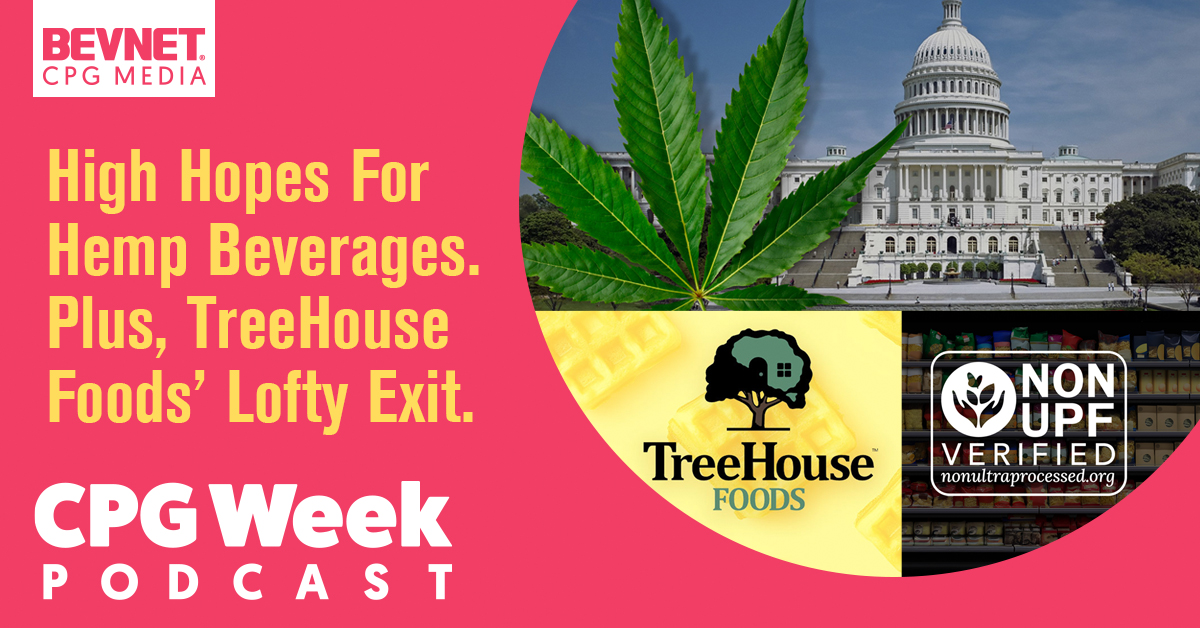
This week on the podcast, Nosh managing editor Monica Watrous and senior reporter Lukas Southard chat about the acquisition of TreeHouse Foods, the regulatory outlook for hemp beverages, a new verification standard for non-ultraprocessed foods, and Lucky Energy’s latest funding round.
Show Highlights:
0:15 – TreeHouse Foods is going private in a deal valued at $2.9 billion. Monica explains what’s next for the private label food and beverage manufacturer.
1:45 – Hemp beverages could be sacrificed in a deal to reopen the federal government, as spending legislation moves through Congress that includes language effectively prohibiting such products. Lukas shares details and insight.
4:20 – A new verification program for non-ultraprocessed foods has debuted. Monica breaks down which ingredients are unacceptable under the Non-UPF Verified standards.
7:45 – Lucky Energy has landed $25 million in a Series B round led by Paine Schwartz Partners, with former leaders from Suja Juice joining its board.
9:15 – The podcasters weigh in on pickle-scented candles and female-coded energy beverages.
About CPG Week
CPG Week is the podcast that explores the latest happenings in the consumer packaged goods industry. Join our seasoned reporting team as they dish out the week’s stories in quick, easy-to-digest episodes. Catch up on the top headlines of the week, dive into exclusive insights with the BevNET and Nosh teams, and set yourself up to make more informed business decisions. Tune in to stay up-to-date on the latest developments in the dynamic world of packaged food and beverage.
New episodes are released every week. Send us comments and suggestions anytime to cpgweek@nosh.com.
Show Highlights:
This week on the podcast, Nosh managing editor Monica Watrous and senior reporter Lukas Southard chat about the acquisition of TreeHouse Foods, the regulatory outlook for hemp beverages, a new verification standard for non-ultraprocessed foods, and Lucky Energy’s latest funding round.
Episode Transcript
Note: Transcripts are automatically generated and may contain inaccuracies and spelling errors.
[00:00:05] Monica Watrous: Welcome to the CPG Week podcast by BevNET and Nosh. I'm Monica Watrous, here with my co-host, Lukas Southard. Now here is the latest in food and beverage industry news. One of North America's largest private label food and beverage manufacturers is becoming a private company. Treehouse Foods will be acquired in an all cash transaction for a total enterprise value of $2.9 billion by a subsidiary of Invest Industrial, a European group of investment holding and advisory companies with 17 billion euros of raised fund capital. Once the sale is completed, Treehouse Foods' common stock will no longer be listed on the New York Stock Exchange. Treehouse Foods produces crackers, non-dairy creamer, pickles, refrigerated dough, broths and stocks, hot cereal, pretzels, in-store bakery items, griddle, cookies, cheese and pudding, powdered beverages, and other blends, coffee, tea, and unique candy products. It has a total of more than 85 manufacturing facilities and employs a workforce of more than 16,000. The company will operate independently within Invest Industrial's portfolio. Invest Industrial previously acquired Treehouse Foods' meal preparation business for $950 million. Treehouse Foods has been pruning its portfolio for years as softer consumption trends and supply chain disruptions have impacted operational results. This transaction is expected to close early next year. Insiders can read more about this deal on Nosh.com.
[00:01:42] Lukas Southard: From treehouse foods to cannabis or trees, as my generation called it, the Senate advanced an appropriations bill on Sunday to fund the government and end the government shutdown. Now, while this is good news for SNAP funding and holiday travelers, stakeholders in the hemp-derived THC category are in an uproar. over a little provision that would prohibit intoxicating hemp products. Language in the bill would cap all finished products at 0.4 milligrams of total THC per container, a change that would effectively eliminate the hemp beverage market in its current state. This potentially industry-ending provision carves out an exception for non-intoxicating CBD and industrial hemp products, but full or broad spectrum CBD products that contain some trace amounts of naturally occurring THC would also be outlawed under this provision. The news comes after beverage alcohol industry stakeholders began to weigh in on the category last week. While a coalition of 54 beer, wine, and spirits distributors asked congressional leaders to regulate and tax intoxicating hemp products similar to alcoholic beverages, a separate grouping of alcohol industry lobbyists, including the Beer Institute, American Distilled Spirits Alliance, Distilled Spirits Council of the US, Wine America, and the Wine Institute, asked lawmakers to ban intoxicating hemp.
[00:03:17] Monica Watrous: Lucas, what are brands in the THC beverage space doing in response to all of this?
[00:03:22] Lukas Southard: Well, to be honest, Monica, there's not really a lot they can do. At this point, it's on congressional leaders to get this spending bill passed. And whether the provision in there that bans intoxicating hemp or intoxicating hemp-derived cannabinoids remains in the bill, it remains to be seen. It is important to note that Kentucky Senator Rand Paul, who's been a longtime advocate of the hemp industry, has introduced an amendment removing the section from the funding bill, but a lot can change in just a couple of days. For now, most of the industry and hemp-derived THC beverage brands are sending out newsletters and calls to action for their consumers and their constituents to reach out to their congressional leaders and ask them to remove this part of the spending bill.
[00:04:17] Monica Watrous: Well, of course, we'll continue to follow this and report on it at BevNET.com. This week, we got details on a new certification program for non-ultra processed foods. The Food Integrity Collective unveiled the first iteration of its non-UPF verified standards, detailing the permitted processes and ingredients it believes are essential to reprioritizing naturalness and less processing in the food supply. The standard addresses product manufacturing from two angles. First, by assessing the processing of ingredients and the end product as a whole, as well as setting requirements around ingredient integrity and formulation. The initial version of the standards encompasses ingredient classes including sugar, gums, thickeners and emulsifiers, natural flavors, and refined oil and sodium. As a baseline, 70% of non-UPF verified products must be considered minimally or moderately processed. That remaining 30% allows for conditionally processed ingredient inclusions like starches, protein powder, and other processed inputs that may have a structural function in improving the healthfulness of a product. Added sugar limits have been determined per food category. Desserts cannot feature added sugars that exceed 20% of the weight of the product, while breakfast foods are restricted to 15% and beverages to 5%. Non-nutritive sweeteners and sugar alcohols are banned with one exception for whole leaf or minimally processed stevia products. The standards allow for minimally processed sweeteners like honey and coconut sugar to be added without limitation to verified products. Additionally, the program places an outright ban on most traditional gums, gelling agents, and emulsifiers such as carrageenan and polysorbates. Natural flavors are considered an optional category for obtaining verification and is one aspect of the program that is likely to evolve in future iterations. Hydrogenated and industrial processed oils are banned entirely, while refined, bleached, and deodorized oils, as well as others, are restricted to conditional use and cannot exceed more than 30% of the product formulation. Industrially processed sodium sources, like MSG, are not allowed in any amount, while naturally occurring sodium from whole or minimally processed foods are permitted, and the amount of inclusion is unrestricted. The aim of the food integrity collective is to restore integrity to processed food instead of rejecting it outright.
[00:06:54] Lukas Southard: Now, Monica, I understand that this is similar to the non GMO project in that it is a verification that a brand can opt into if they see it as a way to build a bigger consumer base. But is there any response from the industry about if there's an interest for this or where this might take packaged food?
[00:07:14] Monica Watrous: And that's a good question. We know that 16 brands have been involved in the pilot program and helped the Food Integrity Collective shape the standards for the certification. Amy's Kitchen, Simple Mills, and Spindrift were among the brands that helped the Food Integrity Collective understand how processing methods are applied, acceptable use cases for specific ingredients, and what constitutes a responsible amount of documentation to audit and certify a product.
[00:07:45] Lukas Southard: In another bit of news from this week, Lucky Energy, or the brand formerly known as Lucky Lucky Energy, has landed $25 million in a Series B round led by Payne Schwartz Partners. It brings the former leaders of Suja Juice, James Brennan, and Bob Debord to Lucky's board of directors. It is also following on a $14.2 million Series A1 round that Lucky Energy closed in March. In its first two years, Lucky has accumulated $63 million in investment and is already planning a follow-on series B1 round in early 2026, driven by the quote $50 million demand for the new fundraising opportunity it just closed this week. In talking to Lucky Energy's founder and CEO, Richard Laver earlier this week, He said that lucky has filled a void in within independent distributor portfolios as emerging brands like C4 and ghost have moved into strategic distribution, most especially with KDP. Lucky is in over 15,000 retail locations, including Albertson's circle K and quick trip, and is now preparing to go national with Walmart sheets and Cumberland farms next month.
[00:09:11] Monica Watrous: On a lighter note, and speaking of energy beverages, Monster Beverage is releasing a slate of new innovations that includes a female-oriented brand called Flirt, or F-L-R-T, early next year. Flirt is positioned as a zero-sugar, female-focused brand, debuting in four flavors, Strawberry Fling, Guava Lava, Berry Tempting, and Sunset Squeeze. I can't even read those with a straight face. As a female, I'm a little offended.
[00:09:41] Lukas Southard: I imagine you would be. And to be honest, when I first read this, I read it as flart. So I don't know, maybe it's just weird branding on, on a lot of different levels.
[00:09:52] Monica Watrous: Hmm. Well, we'll see how it tastes, I guess, and whether females want to be pandered to in this way.
[00:09:58] Lukas Southard: I will say that there is one bit of brand pandering that I appreciated that we saw in the news. PF candle company and gorillas pickles have partnered to launch a classic dill pickle candle, which features the scent of crisp cucumber garden herbs, zesty lemon, and dewy florals. And I will say, I would definitely light that candle in my house, especially because one of my sons is obsessed with gorillas pickles. So I would just light one up and I bet he would just eat pickles all day, which, you know, for me, it's getting some vegetables in that boy's body.
[00:10:32] Monica Watrous: Do you think people really enjoy the smell of pickles? Is that part of the appeal? I mean, I love eating a pickle, but I don't really know if I want my house to smell like them.
[00:10:40] Lukas Southard: I do, I think. But it's hard to say.
[00:10:43] Monica Watrous: There's only one way to find out.
[00:10:45] Lukas Southard: Yeah. I mean, a candle is a little different than just opening a jar of pickles. So I guess you're right. I would have to try it first to really see how much I love the smell of pickles in my house. But on the surface, I'm all for it.
[00:11:02] Monica Watrous: Well, I don't know if we'll have any pickle scented candles at Nosh Live, but we do have a full agenda up on our website and it is jam packed with insights, inspiration, and innovation from top thought leaders, decision makers, and entrepreneurs across the packaged food industry. We have the leaders of Cloud, Jenny's, Splendid Ice Creams, Actual Veggies, Archer, Daily Crunch. We also have a number of investors from venture capital and growth equity firms and a retail presence that includes buyers from Walmart and CVS. We're super excited to see you there. By the time this episode drops, it will be three weeks away. So definitely register, book your hotel, get that flight, and we'll see you in L.A. Here are some other notable bits of news from the week. Diageo has tapped Sir Dave Lewis to lead the world's largest spirits maker into its next chapter, ending a months-long search following former CEO Deborah Crew's departure in July. Relaxation drink maker Trip has secured another $40 million in growth capital earmarked to fund U.S. expansion. And finally, Miyoko Schinner is attempting to buy back Miyoko's Creamery, the vegan food business she founded in 2014 and led until she was ousted by the brand three years ago. For these stories and more, become an insider at BevNET and Nosh. And if you're enjoying the show, please subscribe on your listening platform of choice. That wraps up this edition of CPG Week by Bevhna and Nosh. Thank you to our audio engineer, Joshua Pratt, our director is Mike Schneider, and our designer is Aaron Willette. If you enjoyed the podcast, please subscribe on your listening platform of choice, and we will see you next time.
About CPG Week
CPG Week is the podcast that explores the latest happenings in the consumer packaged goods industry. Join our seasoned reporting team as they dish out the week’s stories in quick, easy-to-digest episodes. Catch up on the top headlines of the week, dive into exclusive insights with the BevNET and Nosh teams, and set yourself up to make more informed business decisions. Tune in to stay up-to-date on the latest developments in the dynamic world of packaged food and beverage.
New episodes are released every week. Send us comments and suggestions anytime to cpgweek@nosh.com.
Stay Informed. Stay Competitive.
Become an Insider to unlock exclusive CPG insights, data, education, and industry exposure for food & beverage leaders.
Industry Analysis
Context behind the headlines
Data & Reports
Category performance & trends
On-Demand Education
Expert-led video courses