CPG Week Podcast: Hemp’s Ticking Clock, The Supplements-To-Energy Pipeline
Episode 149
In this episode:
In this episode:
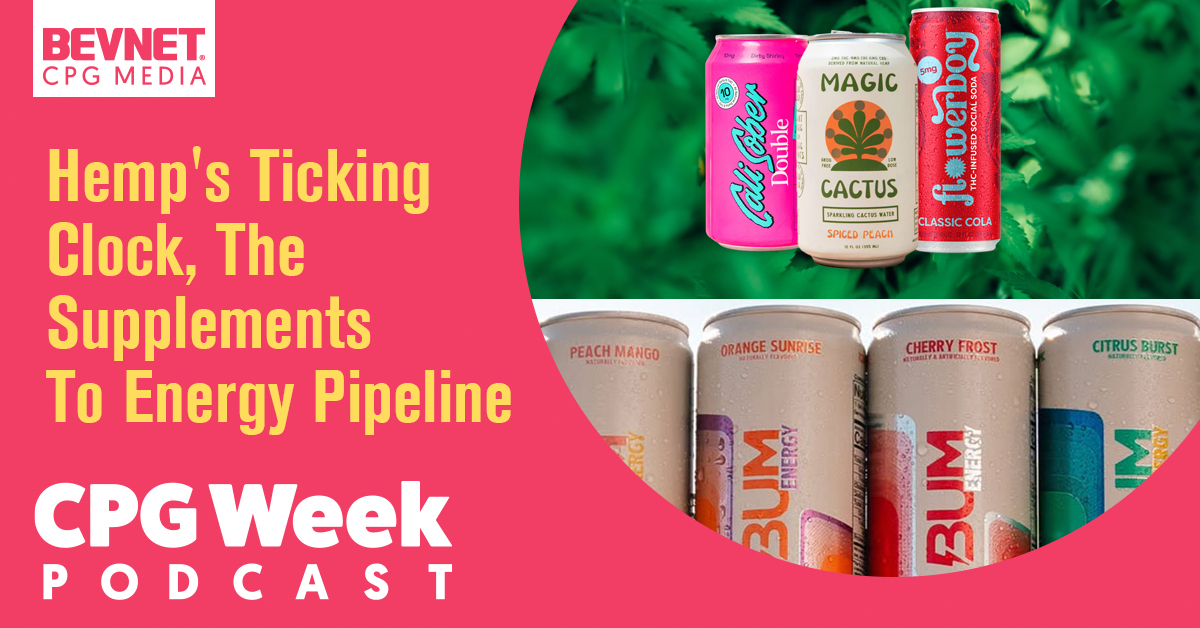
This week, the podcast explores the implications of the Congressional spending bill on the hemp beverage industry and why there is a silver lining to the defined timeline for product sales. Senior reporters Brad Avery and Lukas Southard also discuss Gopuff’s big investment round and why there is so much synergy between energy drinks and fitness supplements. The podcasters conclude the episode with a taste test of new beverages and snacks.
Show Highlights:
0:20 – Hemp is facing an existential crisis after Congress passed its newest spending bill, putting a 365-day timeline in place for hemp-derived beverage sales to continue. Brad and Lukas discuss what stakeholders have been saying in the last week, what we might see moving forward with lobbying efforts and what could happen in the broader cannabis industry.
8:00 – Gopuff has secured a $250 million investment as it puts more resources behind its artificial intelligence technology that will make the online grocery delivery platform more efficient.
9:00 – Another fitness supplement brand, RAW Nutrition, is aiming to go deeper in energy drinks with its BUM Energy brand by adding significant industry experience to its team. Brad and Lukas discuss the trend of gym supplement brands finding a broad consumer base with energy drinks.
12:45 – For the first time in a long time, Brad and Lukas are in the same room recording so the two reporters decided to try new food and drink together and discuss how these samples represent some trends in their respective categories.
About CPG Week
CPG Week is the podcast that explores the latest happenings in the consumer packaged goods industry. Join our seasoned reporting team as they dish out the week’s stories in quick, easy-to-digest episodes. Catch up on the top headlines of the week, dive into exclusive insights with the BevNET and Nosh teams, and set yourself up to make more informed business decisions. Tune in to stay up-to-date on the latest developments in the dynamic world of packaged food and beverage.
New episodes are released every week. Send us comments and suggestions anytime to cpgweek@nosh.com.
Show Highlights:
On the CPG Week Podcast, the team discusses the impending hemp ban, Gopuff’s $250 million and supplement makers launching energy drinks.
Episode Transcript
Note: Transcripts are automatically generated and may contain inaccuracies and spelling errors.
[00:00:05] Brad Avery: Welcome to the CPG Week Podcast by BevNET and Nosh. I'm Brad Avery, here with my co-host, Lukas Southard. Your regular host, Monica Watrous, is traveling and will be back behind the mic next week. Now, here is the latest in food and beverage industry news. Hemp is on the chopping block. Last week, Congress set a one-year deadline for an all-out ban on hemp-derived THC products as part of the funding bill to reopen the government. Its passage means that the government has until November 13, 2026 to create a proper legal framework for these products. What was until now a hypothetical threat looming over the hemp space is now a ticking clock, and many in the industry are keeping their focus on what can and needs to be done rather than fretting. Theo Terras, CEO of Uncle Arnie's, put a positive spin on the law, stating, Douglas Fisher, general counsel for vape tech company Active, said that this should be the driving force behind renewed push for legalization and sensible regulation of cannabinoids. Many entrepreneurs in the hemp food and beverage category have already been active in the regulatory and lobbying space behind the scenes. As they've worked to build their brands, they simultaneously are going to be taking up more of their time in this activist role in order to help establish a legal framework before the deadline. Of course, the government moves at a snail's pace. The White House has been continuously exploring if, when, and how to reschedule marijuana since the last administration. And who knows at this juncture whether Congress will be able to meet this deadline, though much like the TikTok ban that was supposed to take effect back in January, it's possible we may be kicking this can down the road for the foreseeable future.
[00:01:54] Lukas Southard: When looking deeper at what happened last week and how brands within this space are operating as a result, it does lead to some very interesting questions about where they will go next. Now, as you said, Brad, they have a whole year to continue to sell and advocate for getting a regulatory framework, which is something that this industry has been asking for for many years now. And in some ways, you can see how that positive spin of, hey, now we have a deadline, now we have something to work towards, and this has become a big issue that mainstream media is now reporting on. But at the same time, it does provide a lot of hurdles for brands to have to overcome. One thing to note is that it's not just hemp-derived THC, but it's really any hemp-derived product that has more than 0.4 milligrams of THC per container, which in effect would ban a lot of CBD products as well. And so the industry as a whole, it's not just intoxicating hemp beverages that are going to be pushing for, you know, a regulatory framework that makes sense, but it's really anyone that's operating in hemp consumables, which again be seen as both a good or bad thing. It's opening the tent up to a broader list of brands and companies in the space, but it's also providing a lot of differing opinions on how this industry should be regulated from a federal framework.
[00:03:34] Brad Avery: I do think a lot of the optimism we're seeing is by necessity because, yeah, you need to get this done. It's go time for this legal framework to get passed. The thing that is shocking is I feel that a lot of people figured there's so much money behind this industry now that it couldn't come to this when clearly this is a show that that sort of Damocles that was dangling over this space this entire time has finally started to come down and I'm hopeful for sure that this space will continue to grow. I think we've seen so much innovative entrepreneurship. We've seen so much innovation that has been pushing the overall food and beverage industry forward. I do wonder, the leaders here in this space, the entrepreneurs who've positioned themselves as activists now, how much more of their time this takes up and the difficulty of trying to build a category from scratch and also trying to be a lobbyist in a way.
[00:04:40] Lukas Southard: It's not going to just fall on the brands and the stakeholders in the cannabis industry. There's going to need to be advocacy from beverage alcohol, which has been one of those soft points in this whole conversation for years, because although there are many beverage alcohol retailers who when states allow, have brought these products into their stores, there hasn't been a vocal voice from the beverage alcohol industry supporting hemp-derived THC or intoxicating hemp products. And I think that is something that will be necessary. As we just saw a couple weeks ago, Target started bringing these products into their stores in Minnesota. You have Circle K bringing these products into stores in various states. There is support for it from the retailer side, but you haven't seen that support really make the next step into advocating for regulation and lobbying of lawmakers and legislators to get a framework set in place that will provide transparency for these brands to operate in a more cohesive way.
[00:05:52] Brad Avery: You just took the words out of my mouth when it comes to the mainstream retailers. I was going to bring up Target and Circle K, and the timing of this is significant that we were just seeing this breach into the mainstream. And I do wonder if this has a chilling effect, if this stops more mainstream retailers from getting involved because they know a ban might be coming in the future, and because it reintroduces a taboo element that was beginning to break down in the market. Obviously, these retailers could very well still go forward and just play a wait-and-see approach. I know that in the Jones Soda earnings this week, they talked about continuing to go forward with their Mary Jones line. That is an established brand that decided to get into this space and take a risk in getting into hemp. They acknowledge that they may have to cut it entirely or at least pivot drastically if this does not get solved. But for now it's very much go ahead as planned. Keep building. You can't stop now because we don't know what next year is going to hold.
[00:07:01] Lukas Southard: There's a lot of questions that remain to be unanswered at this point. Again, we are early stages of this. We are a week into the news of this ban going forward, a year from now. But what I will be tracking is what the larger cannabis industry is saying. A lot of the hemp-derived THC beverage and food brands had a contentious relationship with what they call the other side of the plant. So operators in the recreational marijuana and medicinal marijuana industry. And I'm wondering if there will be a coming together of cannabis to push this into rescheduling cannabis, or if this will provide opportunity to further split the cannabis industry between the hemp side and the marijuana side.
[00:07:56] Brad Avery: Well, our colleagues Martín Caballero and Jeffrey Klineman collaborated on an article for BevNET last week, Where Did Hemp THC Drinks Go From Here? We'll be continuing to cover the category as we always do, and we'll be paying close attention to what happens next.
[00:08:12] Lukas Southard: Last week, GoPuff secured a $250 million investment in a round led by Eldridge Industries and Valor Equity Partners. The round also included participation from Bailey Gifford, Robinhood, and Aqualis Capital, among others. The new funding puts the company in its quote, strongest financial position to date. The new capital will go towards supporting GoPuff's infrastructure as well as improving its AI integration. The AI tech has been used to improve delivery speeds and streamline the customer experience on the platform.
[00:08:48] Brad Avery: And Bum Energy, an upstart energy drink brand created by supplements maker Raw Nutrition, is getting a big expansion next year with rollout into Walmart and Target. To prepare for the national rollout, the business has been expanding its team with seasoned sales executives as they aim to crack the ever-competitive energy drink space. Lucas, you covered the story for BevNET this week. What did you learn talking to the brand?
[00:09:12] Lukas Southard: Well, I wasn't aware of Chris Bumstead until I started reporting on the brand, but apparently he's quite a big name in professional bodybuilding, and he built Bum Energy out of his powdered supplement brand, Raw Nutrition. In April, Raw Nutrition was acquired by a European sports fitness business called The Quality Group, and since then, Bum has really been putting a lot of emphasis on hiring some liquid beverage industry veterans to help it scale the business into a real competitor in energy drinks.
[00:09:50] Brad Avery: Yeah, I see here that they've got Tao Branwell as new director of sales and distribution. He came from Redcon1, has been at Rise Fuel and Clean Cause. Bum also added Mark Shearer in October. He's serving as chief strategy officer and he ran distribution at Congo Brands, Liquid Death, again, Clean Cause, and also Bang.
[00:10:11] Lukas Southard: It's quite a group. There was a couple others that they added in as well. They're really leaning into people that have a lot of experience working in energy drinks, but also this synergy that we've seen with supplement brands and fitness oriented energy drinks. So Alani New, Rise Fuel, Ghost have all done a really good job. kind of blurring the lines between powdered supplements and RTD energy drinks. And there seems to be something working there. Obviously, Ghost and Alani Nu have been acquired in the last year, and they all are doing very well and continue to show that there is a lot of momentum behind energy drinks that are also in the same portfolio as fitness-oriented supplements.
[00:11:02] Brad Avery: Like you, I don't follow professional bodybuilding, so this is also my introduction to Chris Bumstead. But I do think that's a great point about the way that this trend has formed of supplements brands turning into RTD energy brands where they can flourish more in the mainstream with a wider audience. FirstForm is another that comes to mind that is beginning to do this with a partnership via Anheuser-Busch InBev. And it's become a consistent strategy in this space when we talk about better for you and fitness, performance, energy. That's the MO of a lot of these companies. So while I hadn't heard of Bum Energy before, it's been around for a couple of years, but working things out, I'm certainly familiar with the play.
[00:11:50] Lukas Southard: Although I didn't talk to Chris Bumstead, he was in the gym, I'm sure, I talked to one of the other co-founders, Matt Thompson. He said he's been operating in the powdered segment for about 10 years, but what they found in these first two years of running Bum Energy is that the energy drink category is a lot different in terms of it's all built on relationships. The DSD network that you have to have to be a successful big brand in energy drinks is very, very different than your distribution model for powdered supplements. And that's why they brought on all these seasoned energy drink veterans, because these are the guys that have relationships with DSDs. They have the ear of retail buyers and convenience and mass and conventional. And that's just not really where a lot of the supplement category operates. And on a lighter note, we're in the same place, Lucas. It doesn't happen often that I make the trek out to the office, but I figured I was recording with you, so why not come, and we could maybe toast some beverages together, taste some of the samples that we get here at the office. Just, you know, be IRL, as the kids say.
[00:13:12] Brad Avery: Yeah, we're here in the studio in Newton, and we have in front of us a few different samples from upstairs to try, give our takes on. Now, I've been sipping on throughout this Blue Durango iced tea, their long-arm citrus flavor. 16-ounce canned iced tea with lemon, pomegranate, and prickly pear. I saw they do have an unsweetened flavor as well, but this one has 19 grams of sugar, kind of going for that mid-range sugar that I feel like we've seen more brands doing lately. Well, this is a Georgia-based brand, and I do feel like the liquid has that real sweet tea element to it, although not as sweet as I'm sure like a purist would want but it definitely hits that sweet spot if you're looking for again that more mid calorie you know mid sweetness.
[00:14:04] Lukas Southard: I like having a little bit of sweetness but I can always taste the sugar alternatives in there, whether it's stevia or it's monk fruit or some sort of allulose, sucralose, you know, it always leaves a kind of film in my mouth, whereas I want some of the sweetness. Yes, I don't want the full, full sugar you might get in a soft drink, but I like when it's just cane sugar and you can get sweetness, but it doesn't have that tacky aftertaste.
[00:14:33] Brad Avery: Yes. Well, what did you pick out of the cooler? What jumped out to you?
[00:14:37] Lukas Southard: Well, I've heard a lot about this brand, but I've actually never talked to them. So in keeping with our discussion about hemp beverages, I picked up Dadgrass Leisure Drink. So this is a 3mg THC, 6mg CBD, hemp-infused, canned, intoxicating beverage.
[00:14:56] Brad Avery: This is just Lucas's excuse for trying to drink weed at work.
[00:15:00] Lukas Southard: I'm only going to have a small cup, but it does have lion's mane, L-theanine, and electrolytes, so it does some good stuff in there too. Here, hand me some glasses. I'm going to crack this open here. A little one for you, a little one for me.
[00:15:19] Brad Avery: All right, I'm really just gonna have like a small sip.
[00:15:21] Lukas Southard: This is jalapeno lime. I mean, it's three milligrams, so a little sip you're not gonna have.
[00:15:25] Brad Avery: Oh, it's a good nose, though.
[00:15:26] Lukas Southard: Yeah, you definitely smell the jalapeno and the lime.
[00:15:29] Brad Avery: The jalapeno definitely hits that mocktail note that I think we've seen a lot of the cannabis and hemp drinks go for. It makes sense as an alternative, you know, that drinking occasion and Dadgrass exhibited there, a lot of other brands exhibited there. And it speaks to the evolving use occasion of the category as it has become established and found its audience of people who in large part, aren't the typical stoner.
[00:16:00] Lukas Southard: I like that they're doing the jalapeno and they went jalapeno forward with it because it does have a little bit more of an elevated, almost kind of like margarita, spicy margarita feel to it without trying to be a margarita. And it rolls off the tongue, dad grass, you know? And they call it a leisure drink, which I like that use as well, a leisure drink. It's not an adult beverage. It's not a weed drink. It's a leisure drink. So you drink it leisurely. To go along with that, I have a bag of B-Sides upcycled puffs. This is also a jalapeno flavored. I wrote about this brand in the last year and they are Definitely an upcycled brain, but they're not leaning too heavily on their upcycling positioning, so I haven't been able to try it until now, so I'm happy that I found this in the stash of snacks. I think it's quite good. I like it. Yeah. You get the jalapeno, it's got a nice little bite at the end.
[00:17:00] Brad Avery: Just a little bit of a tingle, not too powerful, although I have a strong heat tolerance, so I don't know if someone with a lower heat tolerance might find it too spicy. For me, it's very mild. How long has this brand been around? Where are they coming from?
[00:17:16] Lukas Southard: It's a New York based brand. And again, like I said, they're using upcycled ingredients, but they are relatively new to the scene the last couple of years and kind of slow building out of the New York City market. And really just trying to be one of the many brands that are solving for food waste in their own way while also producing a, you know, fiber rich, better for you snack.
[00:17:45] Brad Avery: a I've been really enjoying these as a kind of Fig Newton-esque product. A competitor there with lower sugar, made with real fruit, high in fiber, organic, non-GMO. We've had these samples in the office for a little while. I've been having them a bit as a breakfast supplement.
[00:18:23] Lukas Southard: No, they're great. I actually had a different flavor this morning, so I'm glad I got to try the blueberry as well. I love them. I've been following this brand. They do kind of breakfast biscuits, and this new soft-baked bite product is a great addition to the portfolio. I think these are great, and they come in a little two-pack, so they're perfect for kids' lunches or stick in your purse or in your bag.
[00:18:45] Brad Avery: Absolutely. Well, I'm glad you were able to make it into the office for once, Lucas. And I guess we'll see each other next out in California for BevNET Live and Nosh Live coming up. Nosh Live is December 4th and 5th in Marina Del Rey. BevNET Live is December 7th, 8th, and 9th. Hoping to see you out there. Here are some other notable bits of news from the week. Chocolate manufacturer Barry Calabat has partnered with NotCo to explore using artificial intelligence to develop new chocolate recipes. Nonprofit food business incubator Hope & Main has broken ground on a new commercial kitchen in Providence, Rhode Island, slated for a grand opening in spring 2026. and fresh zero sugar innovations and distribution gains paid off for Jones Soda Company in its Q3 earnings report, with the company announcing nearly 15% revenue growth. For these stories and more, become an insider at BevNET and Nosh. If you're enjoying the show, please subscribe on your listening platform of choice.
[00:19:45] Monica Watrous: That wraps up this edition of CPG Week by Bevhna and Nosh. Thank you to our audio engineer, Joshua Pratt, our director is Mike Schneider, and our designer is Aaron Willette. If you enjoyed Week Podcast, please subscribe on your listening platform of choice, and we will see you next time.
About CPG Week
CPG Week is the podcast that explores the latest happenings in the consumer packaged goods industry. Join our seasoned reporting team as they dish out the week’s stories in quick, easy-to-digest episodes. Catch up on the top headlines of the week, dive into exclusive insights with the BevNET and Nosh teams, and set yourself up to make more informed business decisions. Tune in to stay up-to-date on the latest developments in the dynamic world of packaged food and beverage.
New episodes are released every week. Send us comments and suggestions anytime to cpgweek@nosh.com.
Stay Informed, Stay Competitive
Unlock the articles, expert interviews, and data reports that power the food and beverage industry. Join our community and stay ahead with exclusive insights from BevNET and Nosh.