CPG Week: Pepsi Buys Poppi. Your Move, Coke.
Episode 114
In this episode:
In this episode:
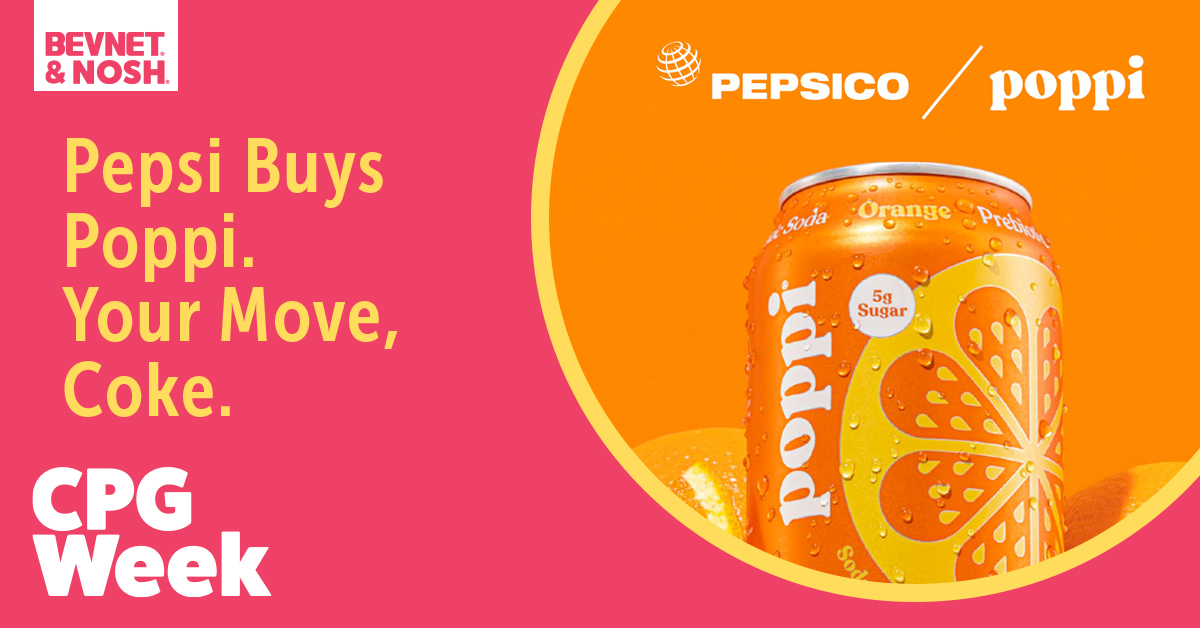
On this episode of CPG Week, the team unpacks PepsiCo’s unsurprising acquisition of better-for-you soda brand Poppi. The podcasters break down what is known so far and what might be on the horizon for the gut-health soda set due to the deal.
Show Highlights:
1:00 – Diving right in, the CPG Week team launches into PepsiCo’s acquisition of Poppi. What does the “Popsi” deal, as Nosh managing editor Monica Watrous calls it, mean for the category moving forward?
4:00 – The group discusses how this changes the trajectory of other soda strategics like Coca-Cola in the category.
7:30 – Senior reporter Lukas Southard flags how the deal could shift the category deeper into foodservice where competitor Olipop has been investing heavily.
10:15 – Can Poppi continue to be cool within a large beverage conglomerate’s system? The podcast team discusses why Poppi has succeeded in making itself one of the most recognizable brands in the better-for-you soda set and whether it can maintain that image.
About CPG Week
CPG Week is the podcast that explores the latest happenings in the consumer packaged goods industry. Join our seasoned reporting team as they dish out the week’s stories in quick, easy-to-digest episodes. Catch up on the top headlines of the week, dive into exclusive insights with the BevNET and Nosh teams, and set yourself up to make more informed business decisions. Tune in to stay up-to-date on the latest developments in the dynamic world of packaged food and beverage.
New episodes are released every week. Send us comments and suggestions anytime to cpgweek@nosh.com.
Show Highlights:
On this episode of CPG Week, the team unpacks PepsiCo’s unsurprising acquisition of better-for-you soda brand Poppi.
Episode Transcript
Note: Transcripts are automatically generated and may contain inaccuracies and spelling errors.
[00:00:05] Monica Watrous: Welcome to the CPG Week podcast by BevNET and Nosh, your source for the latest food and beverage industry news. I'm Monica Watrous, managing editor of Nosh, here with my co-hosts, Brad Avery and Lukas Southard. If you're enjoying the show, please subscribe on your listening platform of choice. On the podcast today, we are discussing Ollipop? Culture Pop?
[00:00:28] Brad Avery: The third most important of the prebiotic sodas.
[00:00:38] Lukas Southard: Why? What happened with Poppy?
[00:00:40] Monica Watrous: Oh, they had that vending machine thing. Or no, that was a few weeks ago. Oh, right, yeah.
[00:00:45] Brad Avery: With the Super Bowl ad or something?
[00:00:46] Monica Watrous: Something like that, yeah.
[00:00:47] Brad Avery: A couple Super Bowl ads?
[00:00:48] Monica Watrous: Right. Or, I guess, probably more recently, PepsiCo has announced it is acquiring Poppy for a pretty big transaction valued at almost $2 billion.
[00:01:01] Brad Avery: Yeah, that one just snuck under the headlines. No one really saw that one coming, really.
[00:01:05] Monica Watrous: Well, a good thing that the eagle eyes at BevNET were paying attention. All right, well, Brad, you wrote about the deal. Can you tell us a little bit about what to expect from PepsiCo's acquisition of Poppy?
[00:01:18] Lukas Southard: Sure. It's been a long time coming. There's been rumors that Poppy, as well as Olipop, have been in discussions with conglomerates about potential acquisitions for quite a while. And I will say, not naming names, but we heard some rumblings around the time of Expo West that Poppy and Pepsi might be closing in on something final. A few days before this news became official, Bloomberg reported that they were in talks for a deal that could be as much as $1.5 billion. Now, the official announcement says $1.95 billion, of which $300 million is anticipated cash tax benefits. But this officially leapfrogs PepsiCo to the front of the functional, next-gen, better-for-you soda game.
[00:02:05] Monica Watrous: I'm going to start calling it Popsy, this new tie up here between PepsiCo and Poppy. So with Popsy... Has that been done before?
[00:02:14] Brad Avery: I don't know.
[00:02:15] Monica Watrous: I think I just coined that.
[00:02:16] Lukas Southard: Yeah. Phonetically, it makes sense that they would acquire Poppy. Like it really, I think aesthetically, they had to do it.
[00:02:23] Monica Watrous: What does this mean for Poppy though, under the PepsiCo banner? I mean, this is expanded distribution, potentially more innovation.
[00:02:32] Lukas Southard: Well, We don't exactly know what's going to happen yet. We don't know how much of the team is going to be carried over. We don't know exactly how they're going to want to change things if at all. But we can say look at how they've expanded Celsius for one example of how Pepsi has been able to integrate brands into its system and rapidly scale them. Obviously, there's a lot of strategic reason for this. Last year, it was rumored that Pepsi might be trying to get into this category by relaunching its Soul Boost brand. Now, that's been pulled in order to focus on a brand that's already well established in the space. It's got mainstream attention. It's widely known. It's been marketed at the Super Bowl, as we mentioned. So, I think we see the next step. We see it start showing up in even more places where it hasn't already been. From there, innovation, sure. Whether they want to expand the line, whether they want to just focus on the core, that's going to be up to the team that is now going to lead this.
[00:03:34] Monica Watrous: So I feel like a couple of questions are now popping up as a result of this deal. One, what is Ollipop going to do? And two, what is Coca-Cola going to do? Because we know that Coke has been dabbling in this modern soda functional gut health space with the launch of Simply Pop early this year. But is that enough? Should Coca-Cola acquire Olipop as a response to this deal or stay the course? And how does Coca-Cola's acquisition track record measure up to Pepsi's?
[00:04:13] Lukas Southard: I think Ollipop would love for Coke to acquire them. That seems fair to say, but I don't know if Coke is as interested in Ollipop or not. I will say the launch of Simply Pop does seem a little bit of a odd play. It's a brand that doesn't have the same kind of excitement around it, simply. It may be them testing the waters, trying to see how far they can build the category on their own. But we saw Pepsi was going to do the same, and then they backtracked in order to pay out and make an acquisition. So we can't really say exactly what Coke's thinking. They've been cutting SKUs for a long time, cutting brands, and we've seen a lot of their past acquisitions get thrown away, like Zico and Honest Tea and, you know, even Odwalla, which was a long time ago. They have shown a willingness to acquire brands and then not end up building them out. Pepsi's done that on occasion. You can look at Sobe as a brand that didn't quite pan out after an acquisition. But on the other flip side, there's Gatorade.
[00:05:17] Monica Watrous: Also just looking at PepsiCo's recent activity in the M&A front, it just paid $1.5 billion for Siete Foods. It spent $244 million to take over its part in the joint venture of Sabra Hummus. So it's buying its way to better for you. And this deal with Poppy just seems consistent with CEO Ramon LaGuardia's strategy.
[00:05:43] Lukas Southard: Don't forget back in 2020 they paid a billion dollars for Rockstar and that was more of a strategic deal so they could get rid of an exclusivity contract clause and initially work with Bang and then has now led to them being able to invest over half a billion dollars into Celsius. So we don't know if they might want to acquire Celsius at some point but they've got that brand in their fold as well.
[00:06:07] Brad Avery: Getting back to your point about Alipop and what they're going to do next, one interesting thing to note is that Alipop recently just announced a $50 million Series C round at a $1.85 billion valuation. So when you start thinking about these really high dollar amounts, For Coca-Cola to potentially acquire them, they're looking at probably a higher price than what Pepsi just paid for poppy. It probably would be upwards of $2 billion. Now, I'm not to say that Coca-Cola doesn't have the appetite for that kind of a big buy, but it seems like PepsiCo has shown, as you guys were just talking about, more of an appetite for these bigger price tags for brands that are pretty well established, whereas Coca-Cola, that might just be a little too steep for them to try and go after Olipop.
[00:07:00] Lukas Southard: What it does say is there is significant confidence in this category, at least on the part of PepsiCo. We've been talking about this as the future of soda for a long time. The brands have been talking about it as the future of soda, and we've seen consumers take to it. The lower sugar content is appealing to consumers. The flavor is appealing to consumers. The pitch as a soda is appealing to consumers. So PepsiCo clearly sees this as an avenue that they need to win in.
[00:07:30] Brad Avery: I mean, one thing I will be tracking is how poppy is integrated into the Pepsi system, not just in terms of. the kind of traditional channels that you would expect to see soda, whether it's convenience or grocery stores. But I'm thinking, are we going to see poppy in fountain sodas more often? Are we going to see them in food service? One thing that I wrote about last year was about Olipop's push to be in more sports arenas and stadiums and performance places. that kind of on-premise opportunity has become pretty big for some of these emerging brands.
[00:08:11] Monica Watrous: Poppy has already started making inroads in food service. They sell at Chipotle now, which anytime I get a burrito bowl, which is quite frequently lately, I always pick up a can of orange poppy alongside it. I don't care that it's four bucks or something stupid like that, but there are aligned food service opportunities and poppy can only benefit from its relationship with PepsiCo now.
[00:08:32] Lukas Southard: Well, Olipop's at Starbucks now. I was at Starbucks the other day and saw Olipop there. And they're definitely a bigger one, but we should also remember, pull out the category. This is a very crowded set. They're not the only potential acquisition target. We could potentially see a company decide to go for Culture Pop if they could maybe get a lower price point for it, since it's the third in the category. Or does any myriad of other brands that are playing in this functional soda set whether a strategic buyer or someone else could want to scoop up and see if they could build it more. That's not to say that Olipop might not be an attractive acquisition target. It's about neck and neck, roughly, give or take, with sales as poppy. So it's the next largest or potentially the largest in the category. But maybe Coke doesn't want to pay $2 billion or more for an acquisition at the moment. We don't know. We'll have to wait and see. But I think it definitely just says, balls in your court, Coca-Cola.
[00:09:28] Monica Watrous: And also maybe even a potential IPO opportunity for Olipop. I feel like that could also be on the table.
[00:09:36] Brad Avery: But in saying that, because this category has become so crowded and I mean, we saw at Expo and we talked about it last week, there was, you know, a number of new brands, both established beverage brands getting into the category as well as new brands launching into the category. Do you think that PepsiCo acquiring Poppy and being kind of the big, the first big strategic to go all in and invest heavily in this category will push out some of these smaller names or will it just drive the momentum even further for a brand like Culture Pop or Cove that are kind of been nipping at the heels of Poppy and Olipop but don't have quite the cachet as those two do?
[00:10:22] Monica Watrous: I wouldn't be surprised to see if this drives some of the smaller players out of the category. But I think what's important to note is that Poppy isn't even really a gut health soda brand anymore. It's a lifestyle brand. And if you think about that partnership that they've recently had with Target, if you think about all the TikTok reels and Instagram
[00:10:47] Brad Avery: content that just shows the liberation of vending machines out there in the world now.
[00:10:51] Monica Watrous: Yes, but also, and I learned this from talking to one of my friends who's not in the industry, but there's something that particularly women, really like about matching their can of poppy with their outfit or posting about it as sort of a status symbol. I mean, it's a real thing. Alison Ellsworth has done a fantastic job of making that sort of a, I mean, a real point of differentiation, but also a competitive moat around poppy, where Ollipop really doesn't have that kind of following or effect on consumers.
[00:11:27] Lukas Southard: That's going to be one of the big challenges going forward as it gets integrated into the Pepsi system, is can you maintain that? And I will say Pepsi's generally been pretty good at building lifestyle brands. I mean, you can look at how they built Mountain Dew out and appealed to a certain subset of consumers with the gamer focus. Can they keep poppy cool is the big challenge that's ahead of them. I think that's always a thing with an acquisition and we've talked about it why certain brands say like liquid death might struggle in a strategic system. Can what makes liquid death appealing to its consumer base remain under new ownership. So with poppy. I think in a way their branding is actually kind of perfectly suited for something like a PepsiCo system, and so long as they are able to keep that je ne sais quoi about it, then certainly, I don't see why not, but that will be one of the big hurdles going forward.
[00:12:21] Monica Watrous: The big factor here to consider is the fact that Poppy has transcended the better for you and natural space and has become a mainstream brand. When PepsiCo acquired Siete, I feel like there was a lot of backlash and people saying that the brand was going to be compromised or it wasn't going to be made with the same quality of ingredients. I don't expect to see that kind of reaction to the poppy deal because even though it is considered a better for you product, it has made such a splash in conventional channels already.
[00:12:59] Lukas Southard: All you have to do is look at their Super Bowl ads. Look at the campaign that they put out there and the messaging of it's just soda. It's soda for the future. It's a very neutral kind of message that can be broadly appealing. It has a bit of that I want to buy the world a Coke. type of message to it that, you know, it sounds bad when you say it, but like chameleon-esque, that it can allow the consumer to project what they want onto the brand in a way that makes it familiar to them and welcoming to them. I say that all as a positive. I say that all as, you know, generally a testament to what they've done here, that they've made a brand that is both distinctive and yet neutral enough that you can sort of put yourself into it as well.
[00:13:41] Brad Avery: You look back at when poppy launched and it was called mother and it was in a glass bottle and it looked like a kombucha and they've come a long way. Now it is a nice looking can. I'm not going to say I'm going to be matching my poppies to my outfit, but I don't match anything with anything. So that's not saying much, but they did kind of, as you said, bridge that gap from being a better for you drink like a kombucha that has really struggled to get mainstream appeal. and turned itself into a soft drink that people are willing to pick up, not just because they might think that it's better for them, but also just because it tastes good and it looks cool and people know it. That's almost more important.
[00:14:23] Monica Watrous: And as a testament to its broad appeal, my nine and 12-year-old nieces are kind of obsessed with poppy. They love drinking it when they're at my house or when we're out. They always ask for me to get cans for them. So even a couple of little girls in Kansas are big fans of the movement. And I'll be curious to see what this deal forebodes for the general industry in terms of M&A or funding. Insiders can read more about the Popsie deal at BevNET.com. Here are some other notable bits of news from the week. How spirit companies are preparing for uncertainty in trade disputes, the industry's approach to the ultra-processed foods debate, and even more Expo West coverage. For these stories and more, become an insider at BevNET and Nosh. That wraps up this edition of CPG Week by BevNET and Nosh. Thank you to our audio engineer, Joshua Pratt, our director is Mike Schneider, and our designer is Aaron Willette. If you enjoyed the podcast, please subscribe on your listening platform of choice, and we will see you next time.
About CPG Week
CPG Week is the podcast that explores the latest happenings in the consumer packaged goods industry. Join our seasoned reporting team as they dish out the week’s stories in quick, easy-to-digest episodes. Catch up on the top headlines of the week, dive into exclusive insights with the BevNET and Nosh teams, and set yourself up to make more informed business decisions. Tune in to stay up-to-date on the latest developments in the dynamic world of packaged food and beverage.
New episodes are released every week. Send us comments and suggestions anytime to cpgweek@nosh.com.
Stay Informed. Stay Competitive.
Become an Insider to unlock exclusive CPG insights, data, education, and industry exposure for food & beverage leaders.
Industry Analysis
Context behind the headlines
Data & Reports
Category performance & trends
On-Demand Education
Expert-led video courses